Heinrich von Kleist: The Duel – Der Zweikampf (1811)

Today is the bicentennial of Kleist’s death. I had a few different ideas for this post but finally, after having read The Duel – Der Zweikampf, one of the very few of his novellas I hadn’t read before, I decided on focusing on that. The initial idea was to write about his death. Since his death and the novella The Duel have elements in common, it’s only fair, to at least mention it.

Kleist shot himself on November 21 1811, near the Kleiner Wannsee, after having shot his friend Henriette Vogel. This suicide was premeditated and even announced. He wrote letters to different people mentioning it and so did Henriette. It has been argued that one of the reasons why his grave is hard to find and almost hidden isn’t that he was a suicide but that he was also a murderer. I don’t think we can call him that, what he did was assisted suicide. Henriette wanted to die with him and, as was found out later, had reasons. The autopsy showed that she suffered from terminal cancer. In any case, what is striking, is the violence of their deaths which leads me back to The Duel. One of the most striking features of Kleist’s prose, apart from being very unique, and at times challenging to read, is the omnipresence of violence. Rape, abuse, murder, fights, duels, you name, it’s there. The novella The Duel is no exception. The story that is set in the 14th century starts with a murder. From the beginning there is a suspect only he seems to have an alibi. He indicates to have spent the night with a noble woman, a widow. In order to save himself, he reveals her name which has severe consequences. Upon hearing what their sister has done, her brothers beat her up and chase her from their home. She seeks refuge at the castle of another noble man, one who had asked her to marry him before. Convinced of her innocence he wants to duel with the man who has brought shame upon her and in doing so prove that she is not guilty. Since he is convinced she is innoncent, he is convinced the other one will die.

For those who will still read this novella I’m not going to reveal the outcome of the fight. What struck me is that it is believed that a duel equals a judgment of God and that the outcome isn’t only a means to get satisfaction but will show the irrevocable truth. The duel should help clarify who is lying. It’s aim is not a payback for an inflicted injustice or a libel but it will, through God, reveal the truth.

The story felt very archaic, and as I already said, I was, as always with Kleist, amazed how violent the story is. I’m far less familiar with his plays. I think some of them are even comedies. Kleist is a fascinating writer because there is something mysterious in what he writes. His characters react in a very intense way and one of the predominant themes is always sexuality which is linked to violence. The aggression between men is intense but it’s far more intense between men and women.

The Duel is one of Kleist’s shorter novellas and not a bad starting point if you have never read him. My favourite is The Marquise of O. An incredible story of a woman who doesn’t know how she got pregnant and is looking for the father of her child.

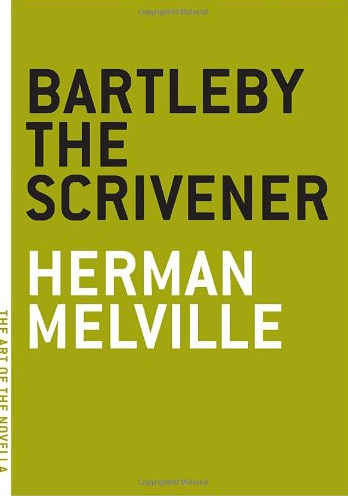
The Duel is part of The Art of the Novella series by Melvillehouse Publishing and in this series part of The Duel set of five novellas with the same title from different authors.

Have you read any of them and which one did you like? How do you think Kleist’s book compares to other duel stories?

For those who read German, I attached this link where you can find his letters. Alle Briefe

The review is part of German Literature Month – Week 4 Kleist and other Classics

Tao Lin: Shoplifting From American Apparel (2009)

Sometimes I forget  something very important that I want from literature. I read books, I like them but at the end of the day, they are often far from our lives and certainly nothing new. And then I come upon a book like Shoplifting From American Apparel and all of a sudden I know what I was looking for. Books that look at contemporary life in a revealing way and are written in a very distinct voice.

Tao Lin was first only well-known in underground circles but starts to get more and more appreciation from everywhere. He is also known as the writer of a blog called Reader of Depressing Books. The title has changed meanwhile but the blog still exists as you can see here: Tao Lin’s Blog.

Lin has published poems, short stories, two novels and this novella.

The book tells about two years in the life of a young writer. It’s mostly set in Manhattan but some of the chapters take place in other cities.

If it was only a writer’s story it wouldn’t be that special but it’s also an exploration of relationships, alternative lifestyles and the meaning of happiness. The characters question what our society takes as a given. Forms of living, culture and social conventions are explored and this with a total absence of sarcasm or cynicism which is refreshing.

Sam is a young writer. To make a living he works in a vegan restaurant but he has hardly enough money to buy things he likes. Shoplifting has become a habit for him. Getting caught seems to be part of it. Everything in  his life seems to be changing constantly. He goes through phases. At the beginning of the book he sees a girl called Sheila and his best friend is Luis, who is a writer as well. Their friendship takes place in cyberspace, on Gmail chat. They both blog as well. They met once but did not have all that much to say to each other although they can chat for hours.

“Do you think in five years the national media will create a stupid term like blogniks to describe us?”

A year later he is seeing Hester but they drift apart very soon. His best friend is Robert, with whom he goes to parties.

This book is rooted so deeply in contemporary life that it’s almost eerie. Sam meets the DJ Moby, he drinks smoothies, eats organic and vegan food, chats online and writes a blog. He sees friends and wonders if they are happier than he is. Some of his relationships take place in real life others are limited to cyberspace.

The dialogue is one of the best elements in the novel. It sounds very authentic with its frequent use of “like” and “or something”.

“I played video games,” said Luis. “Perfect Dark. I killed people for two hours then I got bored. I know what you mean by impossible.”

“This is fucked,” said Sam.

“You know those people that get up every day and do things,” said Luis.

“I’m going to eat cereal even though I’m not hungry, “said Sam.

“And are real proactive, ” said Luis. And like are getting things done, and never quit their jobs. Those people suck.”

“We get shit done too, ” said Sam. “Look at our books.”

“I know but that brings in no money, ” said Luis. “Are we, like, that word ‘bohemians’. Or something. Our bios: ‘They lived in poverty writing their masterpieces.'”

But more than dialogue, many of these exchanges are intimate conversations in which people listen to each other and take each other seriously.

I liked this book so much because it’s fresh, irreverent and looking at other ways to live, far from the mainstream but the characters are not self-destructive nor cynical or sarcastic, like they are in so many other books about young writers. Apart from the shoplifting, Sam is quite tame. And the shoplifting is not so much delinquency as silliness. The characters are insecure and floating but very close to their feelings. They can talk about their emotions and dreams and wishes. And even when a relationship has come to an end and they have nothing much to say anymore, they can put this into words. This doesn’t mean they are happy all the time, on the very contrary, they feel often sad and lonely but they express it, they don’t just act it out.

I also liked that there are references to so-called high culture standing next to the references to pop culture. Sam tests what works for him, in music or literature but doesn’t feel tied down by something being called “classic”. I read somewhere that Tao Lin also uses his books as a means to raise awareness for alternative lifestyles. It’s interesting to see how many times food is mentioned and what type of food. The way he writes about it makes it sound playful, not preachy at all. This made me think that there was once a time when writers felt they had a responsibility, that they should contribute to making this world a better place. I think Tao Lin can bee seen in that tradition.

I want to read more of Tao Lin and am very curious where he will go from here as a writer.

Have you read him?

Steven Millhauser: Enchanted Night (1999)

“This is the night of revelation. This is the night the dolls wake. This is the night of the dreamer in the attic. This is the night of the piper in the woods.”

Hot summer nights have a special magic. In the middle of the night, when everyone is sleeping and only night creatures are awake, the hot still air is heavy, time seems to stand still and the world is indeed enchanted. This is the magic captured by Steven Millhauser in his beautiful and poetical novella Enchanted Night. I have never read this book before but the images, the atmosphere felt so familiar. It was a bit like looking into my own imagination.

Thanks to Carl who reviewed the book not long ago (here is his review), I waited for a hot summer night to read it. I’m glad I did. It felt so right to read this novella during one of the very few hot nights we had this summer.

Here is the beginning of this wonderful book.

A hot summer night in southern Connecticut, tide going out and the moon still rising. Laura Engstrom, fourteen years old, sits up in bed and throws the covers off. Her forehead is damp. her hair feels wet. Through the screen of the two half-open windows she can hear a rasp of the crickets and a dim rush of traffic in the distant thruway. Five past twelve. Do you know where your children are? The room is so hot that the heat is a hand gripping her throat. Got to move, got to do something. Moonlight is streaming in past the edges of the closed and slightly raised venetian blinds. She can’t breathe in this room, in this house.

Laura isn’t the only restless being on this hot and sultry night whose quiet darkness is illuminated by moonlight. All over the little town people feel their yearnings and desires, think of their dreams and wishes. Many of them feel lonely and driven by a secret longing. There is the writer who has turned the nights into days. He writes until midnight, then goes out to visit an elderly woman, roams the streets and sleeps until after noon. He is 39 years old, lives with his mother and has been trying for years to write the definite historical novel. Mrs Kasco, the widow he visits in the middle of the night, still regrets that she didn’t seduce him, when he was still a teenager and she a fairly young woman. On the other side of the city a mannequin in a shop window feels a secret stirring and comes to life. A young man who has never made love to a girl is visited by the moon Goddess while he lies in a backyard dreaming. A mysterious piper plays a flute and attracts stray children. Black cats haunt the streets, four girls wearing masks break into houses. A lonely woman walks the street in a pink bathrobe. A sleezy man spies on a young girl who takes a moon bath.

The story of this hot enchanted summer night, in which abandoned dolls come to life in the attics of the houses, is told in small tableaux, little atmospherical sketches that seem to originate in our childhood imagination. I remember how, when I was a child, I used to check in the morning  whether my toys had moved. Like many children I secretly thought and hoped they were alive at night. My biggest wish was to catch a glimpse of their doings.

Millhauser doesn’t only capture childhood dreams and wishes but also those of teenagers, grown-ups and the elderly and interweaves them in this haunting tale which is written in beautiful, melodious prose that seems inspired by lyrics.

He’d like to wipe it all out, start things over again, give the land back to the Indians. Or better yet, give it to him, to Haverstraw, King of the New World: trapper, hunter, fisher, farmer, sower of appleseed, stargazer, trailblazer, pathfinder, deerslayer, barefoot boy with cheek of tan, Huck Finn on the Housatonic, crackerbarrel philosopher, wily old coot in a coonskin cap, shrew-eyed Yankee, inventor of the cotton gin, the printing press, the typewriter, founder of libraries, distributor of American jeans to the Indians, self-made tycoon in a thirty room mansion, a hometown boy, worked his way up, one in a million, lone ranger, a wayfaring stranger, a born loser, a man down on his luck.

I don’t know anything about Millhauser, only that he won the Pulitzer Prize for Martin Dressler, but his style is so accomplished that I’m curious about his other books.  Does anybody know them?

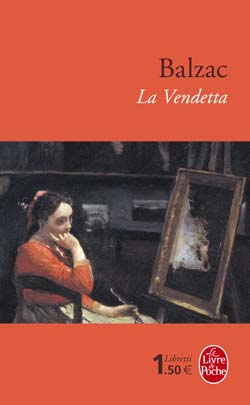
Balzac: La Vendetta (1830)

I read La Vendetta as part of a mini-readalong together with Danielle and Emma. It was Danielle’s idea to read it for  Book Bath‘s and Thyme for Tea‘s event Paris in July.

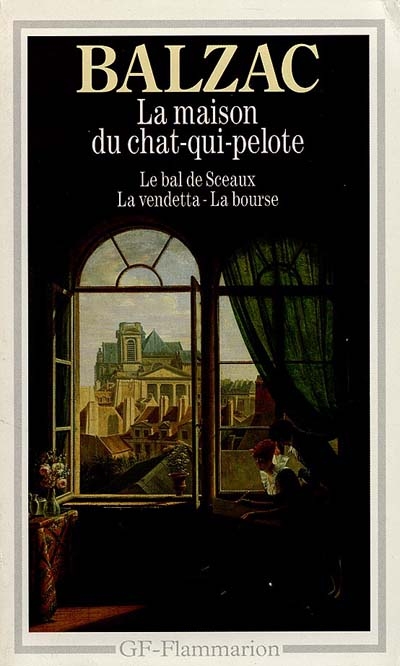
You can find different English versions of the novella or, if you read in French, you will find it in the collection La Maison du chat-qui-pelote or as a stand alone.

La Vendetta is one of Balzac’s earlier stories and part of the so-called Scènes de la vie privée. It is an interesting story for various reasons. On the one hand because it reflects some of the themes that were fashionable in the literature of the time but also because we can already see some of Balzac’s key themes emerge. I would say this novella is still rooted in romanticism with only a touch of realism.

The central story is the story of two families, the Piombos and the Portas,  who are connected by their mutual hatred. We learn at the beginning that after the Portas killed almost the whole family of the Piombos, the old Piombo killed the whole Porta family with the exception of a son, Luigi.

As Balzac tells us, the Corsicans are a fierce people and take revenge, or vendetta, as they call it, seriously. It is almost a religion for them. There will be no mercy or forgiveness ever. It’s a blood feud that can cost each and every member of a family his or her life.

After seeing their family so drastically decimated, Bartholoméo Piombo decides to leave Corsica and look for assistance by Bonaparte in Paris.  He has to learn an important lesson before being accepted in Paris. He must acknowledge that there will be no more vendetta. In Paris justice is not a personal matter but part of an official legal system.

After the first scene in which Bartholoméo is introduced the book fast forwards some ten years and focuses on the daughter of the family, Ginevra. The young woman is taking painting classes with a famous painter. She is quite skilled and produces many a good copy of existing pieces of art. The girls taking these calsses are a composite group. Some are of aristocratic background, some are nouveaux riches. There are many petty rivalries that are influenced by their families political orientation

Ginevra is a beautiful and cherished young woman. She is already 25 years old but has never fallen in love. She thinks that she will never leave her family and go on living a peaceful life at the side of her elderly parents. Destiny has other plans and one afternoon, while painting, she discovers a young soldier, who has been hidden by the painter. The young man is no other than Luigi Porta. It is a time of great turmoil, Napoléon has been overthrown for the second time and all those who followed him are in grave danger. Luigi has endured a lot, he was part of the Berezina campaign, he fought at Waterloo.

The two young people fall in love and Ginevra wants to get married but her father doesn’t want to accept this. His reasons go far beyond the fact that the young man is a Porta. He doesn’t want to lose his daughter. He doesn’t even care that this refusal might lead to a tragedy. When he finally realizes that he has made a mistake, it is too late.

I can’t really say I liked La Vendetta. Should you know Merimée’s Mateo Falcone, a novella on a similar theme, written just one year prior to La Vendetta, you will know why. Mérimée’s novella is accomplished and renders life and customs of Corsica without falling into the trap of stereotypes. Unfortunately this isn’t the case here. Balzac doesn’t do the Corsican people justice. He probably chose the theme because it was fashionable and I think what he really wanted to write about is the jealous possessiveness of a father. Bartholoméo Piombo isn’t the only selfish father in Balzac’s books. There are many others. This is why I could at least appreciate parts of the story. Another typical Balzac theme is the artist. Balzac was fascinated by painters and regularly evokes them in his stories. I found it sad that Ginevra who seems to have been very talented wasn’t encouraged to paint anything else but copies and in the end this speeded up the economical downfall of the young couple. This element is certainly realistic. There weren’t many accepted female painters in the early 19th century. Still it saddened me to see that young girls with talent had to paint mediocre works.

La Vendetta isn’t a bad novella but it isn’t Balzac at his most original. We see a few glimpses of the future master, but he isn’t there yet.

I’m curious to read what Emma and Danielle think.

Here are the links:

Danielle (A Work in Progress)

Emma (Book Around the Corner)

Cees Nooteboom: Mokusei! (1982)

Cees Nooteboom’s novella Mokusei! Een liefdesverhaal – Mokusei! a Love story is my second contribution to Iris’ Dutch Literature Month. It is currently out of print in English but there are German and French translations available.

Cees Nooteboom is one of those writers who simply never disappoint me. While reading this short book (70 pages) I was once more wondering how he does it. How can he write such stories that are feathery and light and still so full of meaning. His writing is inventive and informative, playful and deep, beautiful and melancholic. Apart from Nooteboom I know only the Italian writer Antonio Tabucchi with a similar style.

Arnold Presser comes to Japan to shoot pictures of a woman in a Kimono standing in front of Mount Fuji. He has a image of Japan in his mind that is very idealized. He thinks, he knows what the real Japan is like. It is the Japan of Kimono’s, Basho’s Haikus, Hokusai’s paintings, the Japan of the many views of Mount Fuji, the Japan of rigid traditions and beautiful gestures. The modern Japan which adopts Western traditions, buys into consumerism, the big cities, the traffic and pollution are not Japan for him. Same as he has fixed ideas about the country he knows what a beautiful Japanese woman has to look like. It takes a while until he finds the perfect model but then he discovers Satoko.

He photographs her and falls in love with her. Their story will last five years. Five years in which they are more separate than together, five years of secret love-making and intense moments in which she will never tell him about her life, never introduce him to his parents. Presser has three names for her, her real name Satoko, the one he calls her to himself, Snow Mask, that implies that he cannot read her expressions and the term of endearment he uses when he calls her, Mokusei. Mokusei is one of the rare Japanese flowers with a scent and seems to perfectly fit his mysteriously withdrawn lover.

Mokusei! is masterful for many reasons. It’s a short, intense and tragic love story, and a meditation on Japan and the images and ideas we can have of a foreign country. What is so amazing is that Nooteboom writes at the same time about an idealized Japan, the real Japan and manages to adopt the Japanese writing style. The concept of wabi sabi pervades this novella on every page. There is a scene in which Presser goes for a walk in a garden and sees a dead leaf hanging not on a branch but on a torn spider web. This image captures beauty, fragility and perishability.

Mokusei! is a beautiful and profound piece of writing and I am glad I finally read it thanks to Iris’ event.

Louise Welsh: Tamburlaine Must Die (2004)

It’s 1593 and London is a city on edge. Under threat from plague and war, it’s a desperate place where strangers are unwelcome and severed heads grin from spikes on Tower Bridge. Playwright, poet, spy, Christopher Marlowe has three days to live. Three days in which he confronts dangerous government factions, double agents, necromancy, betrayal and revenge in his search for the murderous Tamburlaine, a killer who has escaped from between the pages of Marlowe’s most violent play. The Final Testament of Christopher Marlowe is a swashbuckling adventure story of a man who dares to defy God and state and who discovers that there are worse fates than damnation.

I really enjoyed Tamburlaine Must Die. I liked Louise Welsh’s latest novel Naming the Bones (here’s the review) and wanted to read another one and I wasn’t disappointed. However I know the book got very mixed reviews and this mainly because of the language. Clearly Welsh tried to write 16th century English and might not have been 100% successful. I didn’t care or – because I’m not a native speaker – didn’t notice. I thought the language was beautiful.

In her novella Louise Welsh lets Christopher Marlowe, the famous playwright, tell his final ten days. Someone has written a libel in his name, imitating his writing, signing with the name of the main-protagonist of one of his plays, Tamburlaine. Welsh imgines how and why he must have been killed, how he spent his last days, sleeping with men and women, drinking too much, picking fights, putting himself in danger through his blasphemies.

I think Christopher Marlowe is one of the most fascinating figures of literature. An immensely gifted writer, a rake, a debauchee, a spy, a rough neck, a ruffian, an innovator and subversive man  and many other things. The book is atmospheric and evocative, you see the streets of London, the intrigue, the danger of a city afflicted by the plague, the violence of the times. Any sign of not following the Church, not being loyal to the Queen, being a homosexual were highly dangerous.

We know Marlowe escaped the dungeon but only to face death through an unknown enemy. His murder has never been solved and to this day there are many speculations.

I think I start to realize what type of historical novels I like. I like it when a writer manages to give a voice to historical figures, makes them come alive, imagines how they thought and felt.

One thing that has been criticized is that she didn’t depict a fear-ridden Marlowe although he knew he was going to be killed. I think from what I know of the man, he wasn’t too anxious, he threw himself into life until his last moment. He would have gladly gone on living, writing more plays but if this wasn’t to be, then it wasn’t. As simple as that.

The best about the book is that it sparked my imagination. I’m in the mood to read Marlowe’s Tamburlaine, The Great and Doctor Faustus which influenced Goethe and Thomas Mann and I would also be interested in reading about him.

Louise Welsh based her book to a large part on Charles Nicholl’s The Reckoning: The Murder of Christopher Marlowe but David Rigg’s The World of Christopher Marlowe sounds equally interesting.

Has anyone read any of these or other books about Tudor England?

Herman Melville: Bartleby the Scrivener. A Story of Wall Street (1853)

bartleby

Academics hail it as the beginning of modernism, but to readers around the world—even those daunted by Moby-Dick—BARTLEBY THE SCRIVENER is simply one of the most absorbing and moving novellas ever. Set in the mid-19th century on New York City’s Wall Street, it was also, perhaps, Herman Melville’s most prescient story: what if a young man caught up in the rat race of commerce finally just said, “I would prefer not to”?

There is a specific reason, why I read Melville’s novella Bartleby. I have just read and reviewed Delerm’s novel Quelque chose en lui de Bartleby and since it was obviously inspired by Melville’s story, I had to read it.

I was never tempted to read Moby Dick although my parents had a copy with beautiful etchings. I can’t tell you why but some books just do not sound like you would like them.

Reading Bartleby I was very surprised how humorous it is. The characters are very eccentric and so is the story. It is basically the story of a young man called Bartleby who just doesn’t want to comply. Like the raven, in Poe’s eponymous poem, he has his stereotypical sentence which is “I would prefer not to.” Whatever it is he is asked to do, Bartleby invariably refuses it uttering the sentence I just quoted.

Bartleby is told in the first person peripheral, by a lawyer who has his office on the Wall Street. He once hired Bartleby as a copyist or scrivener. He already had three different copyists, each one of them with his own eccentricities, that’s why at first he didn’t pay too much attention when Bartleby declares that “he would prefer not to” read the copies together with anyone else.

The lawyer thinks at first that this is just a whim but soon enough it is obvious that there is more to it. While in the beginning he doesn’t want to read with the others, never goes out or seems to eat, after a certain time Bartleby stops working altogether. On a Sunday morning the lawyer makes another discovery which leaves him quite fazed. Bartleby never leaves the office. He stays there over night and during the weekends.

As much as he threatens him, offers him money, tries to negotiate, Bartleby doesn’t work anymore and he doesn’t leave either. If he wants to get rid of him, the lawyer has to take extreme measures. After some time and many frustrations, he decides to change the office and move away from Wall Street.

Not long after he has moved, he hears complaints by the new lawyer about Bartleby. The man is still there and haunts the building.

I’m not going to tell you the end in all its details, it should just suffice to say that the narrator tells the reader, that he thinks he might have found out what drove Bartleby to this extreme behavior. Bartleby used to work for another lawyer handling “Dead Letters”. I must admit I had no idea what “dead letters” are. It reminded me vaguely of Gogol’s Dead Souls and it proved that the association wasn’t totally wrong. “Dead letters” are letters that never reach their recipient because he has died or disappeared or left without leaving an address.

While reading this novella I was reminded of many other books. Not only Poe’s The Raven came to mind but some of Poe’s other writings. He didn’t only write Tales of Mystery and Imagination but a fair amount of absurd tales like we find them again in Kafka’s work. The already mentioned Gogol came to mind as well. I was also reminded of the first scene in Balzac’s Le Colonel Chabert (see my review in which the clerks bicker and quarrel.

Bartleby is the tale of someone who gives up on life, who stops participating and contributing. He is tired of it all. I often wonder when I see beggars in the streets how many chose to live like that. I met Clochards in Paris who told me that the hassle of a job, an apartment, a wife and children was just too much for them and they found it easier to live on the street. At first this may seem absurd but thinking of it for a while, it may make sense.

If it hadn’t been for Delerm, I wouldn’t have read this novella but I’m glad I did. It’s surprisingly modern. It is interesting to discover its intertextuality and a  more thorough analysis would be fascinating. I’m sure Kafka read it, as sure as I am that Melville was influenced by Poe, Gogol and maybe Balzac. However, I must say, I don’t think that Delerm’s Spitzweg and Bartleby have much in common.