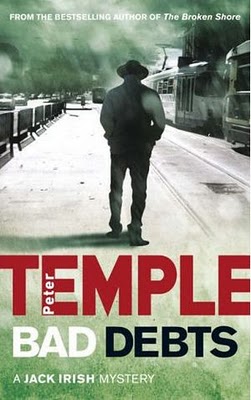
Peter Temple: Bad Debts (1996) A Jack Irish Mystery

Meet Jack Irish: some-time lawyer, part-time private eye, spare-time cabinet maker and full-time lover of strong coffee, swift horses and spirited women.

Bad Debts is the first in Australian crime writer Peter Temple’s Jack Irish series. Temple has won a lot of Australian prizes for his crime and thriller writing. I think it is the first time I read an Australian crime writer. I was very curious and looking forward to the novel and for a total of 50 pages I really enjoyed it.

It’s starts off well enough, quite sarcastic and humorous. Jack Irish seems a typical hardboiled private eye and debt collector. He used to be a lawyer but when his wife is killed he starts drinking and spends a year in total limbo. Sometime during that year he has to defend Danny McKillop, a drunk-driver, who killed a woman. The woman he killed, Anne Jeppeson, was an activist and pain in the neck for many people. The driver had no memory of either driving a car or hitting someone.

Ten years have gone by and all of a sudden Danny McKillop leaves messages on Jack’s answering machine. By the time Jack hears them McKillop has been shot by the police. Jack feels guilty. It seems to him as if he had let down McKillop a second time and he starts to investigate not only his death but also Anne Jeppeson’s death.

After interviewing a few people he finds out that there were and are a lot of strange things going on. People in high places are doing things they don’t want anyone to find out about. His investigation leads Jack deep into corruption and conspiracy and the farther he gets into these things, the more he endangers himself. The last third of the novel is very action-packed.

The beginning of the novel was humorous and I thought it might be one of the series I would like to explore further but after 20-50 pages, there were far too many things I didn’t like. Jack isn’t a lawyer anymore, he tries to make a living collecting debts, betting on horses and doing cabinets. All these different occupations take up time and pages which is very disruptive. On top of that I hate horse-racing stories. Not only do I despise horse-racing I also find it outrageously boring to read about it.

Another problem I had was the language. A large part of the novel consists of dialogue. Australian spoken language seems much closer to British English than to American English. I certainly didn’t mind that. But I did mind that most of the dialogue was composed of swearing and foul language. It was somewhat tiring after a while. And there is the love story. Maybe Jack has been mourning for ten years, but for us, who just got to know him, it’s odd to see him mourn on one page and jump at full speed into a love affair on the next one. And how do I have to picture a woman who is not good-looking but handsome?

I realized that I have a few first and occasionally second books in series at hand and decided to start to read my way through them. Peter Temple’s book was one of them. I’m sure the Jack Irish series has its merits, only I couldn’t find them.

Does anyone know the series? Or any other Australian crime novels/series?
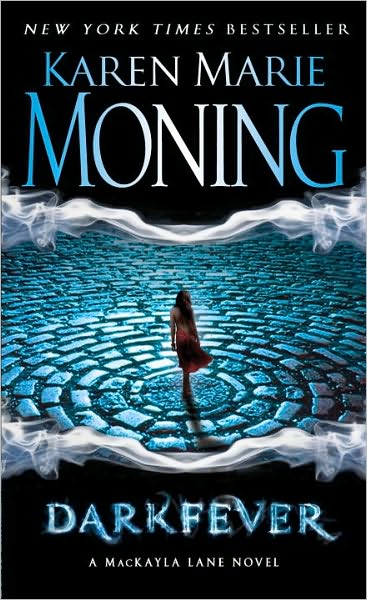
Karen Marie Moning: Darkfever ( 2006) Fever Series I

My philosophy is pretty simple: any day nobody’s trying to kill me is a good day in my book. I haven’t had many good days lately.’ When her sister is murdered, leaving a single clue to her death – a cryptic message on Mac’s cell phone – Mac journeys to Ireland in search of answers. 

What a romp. This was so much fun. If anyone has been looking for a Dark Fantasy version of Janet Evanovich’s Stephanie Plum series, there is good news, Darkfever is exactly what you have been looking for. This is the first in the series of this urban fantasy goes crime of Karen Marie Moning who is better known as a romance writer. Don’t get alarmed, this is not a romance novel although there is a certain undercurrent in it, no, this is a real whodunit, spiced up by some nasty supernatural happenings. There are also some explicit sex scenes and judging from Book Rain’s review, the series is getting steamier from book to book. I’m grateful I read her review because now I know that not only the series ends, but that it is rather like a whole novel in five parts. Although part one has some sort of denouement, the end is a cliffhanger.

Mac (short for Mackayla) is a very naive character. She is also clumsy which is a common cliché in paranormal crime. And she was definitely into the Disney Princesses as a child and still loves pink more than anything else. But having a character like that encounter dark and malevolent beings makes for slapsticky fun.

Trying to overcome the grief over her sister’s murder and in attempt to urge the police to solve the crime, Mac decides to take things into her own hands and flies from the US to Dublin where her sister studied. Before her sister died she left a cryptic message on Mac’s cell phone saying that she had been wrong about someone and something needed to be found. All this is very strange and as soon as Mac arrives in Dublin things get even more mysterious. Despite an intense aversion she befriends Barrons, the handsome but moody owner of a book shop.He agrees to help her find the murderer of her sister but only because Mac can help him find an old and very dangerous book.

Mac, as she soon finds out, is what is called a Sidhe-Seer, someone who can see faeries and other supernatural creatures. This helps her to avoid that some encounters end deadly but it also exposes her. The moment faeries know she can see them she is a threat to them and they hunt her. Additionally she can spot magic objects and since absolutely everyone in this novel seems to hunt for the same magical book Barrons is after, they are all threats to her.

This is a fast-paced novel in which a lot of the action takes place in unlit streets roamed by dark creatures. It’s a decent crime story too and there are a lot of other riddles to be solved and characters who have a hidden side which makes it well worth reading.

In any case, this was a true guilty pleasure and I will definitely read the next in the series.

Atiq Rahimi: Earth and Ashes – Chakestar o Chak (2000)

Novel, short story, fable? – who cares. Here is a text with a sadness that tears at your heart, a visual beauty shot through with the horror of war, where every tear shed, every move made, every word counts.

Set during the Russian occupation of Afghanistan Earth and Ashes tells the story of an old man who has survived the bombing of his village. All the other members of the family are dead with the exception of Yassin, his little grandson and Murad, Yassin’s father, who works at the coal mines.

The old man has undertaken the exhausting journey to go and tell his son about the death of all of their loved ones  and that the little boy has lost his hearing in the bombing.

At the beginning of the slim novel the old man is sitting on the road with his grandson. It’s hot and dusty. They are hungry and thirsty and waiting for a truck to get a ride to the mines. These are dreadful moments in which the old man is torn by memories and fears. The memory of the bombing and the fear of the reaction of his son. How much should he tell him? Should he tell him how he saw his wife die?

With your back to the autumn sun, you are squatting against the iron railings of the bridge that links the two banks of the dry riverbed north of Pul-i-Khumri. The road connecting Northern Afghanistan to Kabul passes over this very bridge. If you turn left on the far side of the bridge, on to the dirt track that winds between the scrub-covered hills, you arrive at the Karkar coal mine.

This is the first book of Rahimi, an Afghani writer, that I have read but it will not be the last. This is beautiful prose, a second person narrative which is very appealing and something you don’t find very often in Western literature.

An army truck, a red star on its doors, passes the bridge. It disturbs the stony sleep of the dry earth. The dust rises. It engulfs the bridge thensettles. Silently it covers everything, dusting the apples, your turban, your eyelids. You put your hand over Yassin’s apple to shield it.

The dryness and harsh beauty of this country is rendered very well and what we read about the interactions with other men the grandfather meets, before arriving at the mines, is touching. The old man, as well as Mirsa Qadir, a shop owner, are moving characters. Qadir is a reader and a writer who had to flee Kabul and found refuge in this forlorn backcountry. In Kabul he used to assemble people and told them stories all night long.

One of the biggest achievements however is that with a few sentences and sparse but eloquent prose, Rahimi tells us a lot about his country. The old man learns that his son is found to be very promising when his superior tells him, that his son, although a grown up man, will be sent to school and learn to read and write. Allusions like these and the portrait of the storyteller Qadir show us a world in which literacy isn’t the norm.

Atiq Rahimi’s book is one of the most important discoveries of my reading this year. Not only is it well-written, it brought back memories of a trip to Morocco and the amazing encounters with kindness I had in that country. But far beyond reminding me of personal experiences it is also a plea to consider what horrors war means for civilians, what tragedies bombs trigger.

Earth and Ashes is a heartbreaking story of a war-torn country that reads as if we were looking into the soul of a man broken by tragedy.

The Patience Stone is the next of Rahimi’s novels I am planning on reading. Have you read any of his books or any other Afghan writers?

Vanessa Diffenbaugh: The Language of Flowers (2011)

The Victorian language of flowers was used to express emotions: honeysuckle for devotion, azaleas for passion, and red roses for love. But for Victoria Jones, it has been more useful in communicating feelings like grief, mistrust and solitude. After a childhood spent in the foster care system, she is unable to get close to anybody, and her only connection to the world is through flowers and their meanings.

I saw The Language of Flowers at a bookshop, spontaneously bought and read it right away. After all the books I read during the last weeks (Sebald, Josipovici and Morante – all upcoming reviews) I felt like reading something “heartbreaking and redemptive” as the book cover states.

Victoria is 18 years old and finally relieved from the foster-care system she has been living in since she was born. Her only chance at adoption went by when she was 10 years old, after that she spent most of her life in homes. She is aggressive and shy, wounded and mistrusting. With nowhere to go she decides to sleep in a public park in San Francisco. Flowers are her only passion, growing them, taking care of them as well as their meaning. She learned all about flowers from Elizabeth.

In chapters that alternate between then and now, we find out who this mysterious Elizabeth was. Elizabeth was the owner of a vineyard. She knew everything about the language of flowers as it was used by the Victorians. I don’t want to spoil this novel, and will only tell you that Elizabeth was Victoria’s only hope to be adopted but a tragic event prevented it.

The Victoria of today soon discovers that even though she can live in the open, she still needs money for food. She is lucky and can convince the local florist of her talent with flowers. Renata hires her, amazed that this wild-looking, unkempt girl has such a talent. While buying flowers at the flower market they meet Grant. Victoria has never been in love and doesn’t want anyone to come close. He is clearly interested but she fights off his advances at first. His knowledge about flowers and, surprisingly, also about their language, helps Victoria to open up. It is a coincidence, but not a too far-fetched one, that Grant turns out to be Elizabeth’s nephew.

As I said, this book has a redemptive ending but the road that leads there is more than bumpy. It’s not a romance but love plays an important role. It’s more the story of a young woman who has been too deeply wounded to trust, a novel about mothers and motherhood and of course about flowers. There was one part in it, involving birth and nursing that is very powerful, to say the least.

Victoria’s gift is so considerable that she will start her own business. Not only does she know about the meaning of flowers, she is capable of arranging them in a way that they affect someone’s life. A person looking for a relationship will find a partner thanks to Victoria’s flowers.

Vanessa Diffenbaugh created a flower dictionary and included it at the end of the book. She went trough many Victorian books, comparing the meanings. Often there was more than one meaning for a flower, occasionally they were even contradicting. She decided what she thought works best. She also added flowers that are more common nowadays and left out those that cannot be found anymore.

The Language of Flowers reminded me a bit of The Mistress of Spices but it is far better. It has been compared to White Oleander which I loved but I didn’t think they had anything in common.

I must admit I wasn’t exactly the right reader for this. It’s hard to describe what problem I had with it. There were moments when I really liked it and others where I was thinking it felt artificial.

One thing  is for sure, the right reader will absolutely adore this book. The combination of the meaning of flowers, a wounded woman who struggles to find happiness and extremely graphic descriptions of giving birth and nursing is quite different.

Literature and War Readalong August 26 2011: La Storia – History by Elsa Morante

The readalong book for August, La Storia or History,  is one of the most important books of Italian literature. It is also quite a substantial book, depending on the edition, it is over 800 pages long which is why I decided to post the introduction already today to give anyone who would like to read along the opportunity to do so.

I’m already on page 150 and fascinated by her writing that reminds me of Latin American literature in its exuberance. Before the individual chapters there are detailed accounts of the history of Italy. La Storia is pretty much the story of a woman, the schoolteacher Ida Ramundo, and the history of a country. Given all the atrocities Germany committed we tend to forget that there were allies like Italy. The history of Italy during WWII is  story of megalomania, bad choices and bad planning and borders quite often on the ridiculous. But there are also stories of resistance and heroism. This, however, is not the topic of this novel.

I did a bit of research and found out that a lot of this novel is based on Morante’s own life. Her mother was half Jewish and a teacher, like Morante herself.

Elsa Morante was married for quite a long time to Alberto Moravia, author of  La Noia (Boredom) and many other outstanding books.

History isn’t Morante’s only novel, she is also the writer of Aracoeli and L’isola di Arturo (Arturo’s Island).

La Storia has been made into a mini-series starring Claudia Cardinale as Ida Ramundo.

Frank Herbert: Dune (1965) Book II Muad’Dib

It’s time for the second Dune readalong post. The readalong is hosted by Carl V from Stainless Steel Droppings,  The Little Red Reviewer and (slight change of the initial three) Grace from Books without any Pictures. This weeks questions have been sent by Redhead (The Little Red Reviewer). Check out the other links here.

I’m happy to report that I liked part II much better. There is far less dialogue and if there is, it is an exchange between two people and not purely an instruction of the reader.

Was Liet’s identity a surprise?  Who do you think he really works for?

I’m not totally sure about this question. I thought he died? I thought since he was a Fremen he also secretly worked for them.

What do you think of the Fremen culture?  Is this a culture you think you’d enjoy spending some time with?

They sound like a very proud and interesting people and reminded me a bit of the Tuareg or any other desert dwelling nomads. A lot of Dune is inspired by North African culture. But since I like rain and plants more than anything else in the world and as appealing as I think some of it sounds, thanks but no thanks, I wouldn’t want to live with them. Furthermore I’m not into duelling. A fierce fighting people isn’t the kind I would want to spend time with. One aspect that I liked is their patient attempt to re-green the desert. Their elaborate plans sounded very convincing.

What do you think of Count Fenring’s unusual verbal mannerisms?  

I found it quite annoying and was trying to imagine how it would sound. I’m not sure what Herbert wants to tell us with this?

This is a far future empire with very little in the way of computerization. Information is often passed down orally, and schools (such as the Mentats and the Bene Gesserit) have formed to train young people in memorization and information processing.  What are you thoughts on a scifi story that is very “low-tech”?  Does that sound like a feasible future? A ridiculous one?

This is precisely the reason why I thought from the beginning that it really is a bit of a sci-fi/fantasy blend. Considering the fact that resources are limited on earth, and very likely on other planets as well, low-tech seems a more viable way to go. These people are advanced in other ways. The mental faculties are far more developed and this would be something to wish for. Unfortunately, humans stay humans, and will, even with low-tech support only , try to exploit others. At least that’s how it is on Dune.

If you found the beginning of the book tough to get into, do you find that you’re having an easier time with the middle portion, now that all the “set-up” is complete?

Yes, it is far easier, as I said in the intro, there is much less dialogue in this part and finally people seem to talk to each other. At least to a certain extent. In part I the dialogue was meant for the reader to understand life on Dune, which is a highly artificial way of getting information across. Since a lot is “set-up” now, he did let go of this. The reading was more fluent and there was quite a bit of action. I liked the part when Paul and his mother are on their own. That part was quite gripping.

The center portion of the book is still pretty dialog heavy, but what I’ve noticed is the subtlety of the dialog. Things left unsaid are often more important than things that are said.  What do you think of that as a stylistic choice? does it make the dialog more interesting? less interesting? 

Any change in the dialogue form was a welcome change for me. I appreciate it much more the way it is handled here but it is still far from realistic. And whenever the parts are centered on the Baron, the dialogue is still heavy (meaning too much and artificial).

Dune was written in the 60’s. Does it feel dated to you? How does it compare, writing style-wise, to more contemporary science fiction you’ve read?

I don’t know any new science fiction. It doesn’t feel dated, no. Maybe the strong Arabic element is dated. I have a feeling a contemporary writer wouldn’t use a word like jihad and would try to be more inventive in terms of cultural elements and not just pick from existing cultures.

If you’ve never read this book before, where do you think the storyline is headed?

I’m really not sure. I start to have a feeling that we will be left with a lot of open questions at the end of Part III. It’s epic, so that seems logical. I wonder if we will even get introduced to the Princess Irulan. I would like to read something about her. But – should anyone wonder – I will not go on reading this series. The moment I close part III, that’s it for me.

Colette: La Chatte – The Cat (1933)

I’m so pleased that I actually found a picture of the old 60s paperback of La Chatte that I bought second-hand a few years ago. These old Le Livre de Poche editions have such an incredible charm.

The book is available in English as Gigi and The Cat which is very misleading as Gigi is an independent story in its own right as much as The Cat and pairing them like this sounds as if that was the book’s title. I realised this when reading the review of the two books on Literary Relish’s blog.

Reading tastes change, at least mine do, but some authors will always remain favourites. One of those authors who is special to me and has always been is Colette. She is such an accomplished writer, a masterful stylist, a great storyteller and a psychologist of superior order. She can take a story that looks simple and nondescript and turn it into a complex piece of writing, revealing the numerous layers of motives and motivations behind actions. Her descriptions of people and settings are some of the best I have read. Her vocabulary is selected and she tried to find the exact and appropriate expression at any moment. Still there is no superfluous word or unnecessary adornment in her writing.

La Chatte is no exception. It has a subject to which I relate but it is far more than the story of a relationship between a man and his cat. It is a subtle analysis of love versus passion, of marriage versus celibacy, of childhood and growing up, of change and permanence. The story also captures the dynamics of disenchantment following the recognition that one’s object of desire is flawed.

The story is simple and can be told in a few words. Childhood friends Alain and Camille are going to be married. The lively and insensitive Camille is looking forward to her new life but Alain, who has to leave behind his beloved cat and the home of a happy childhood, is not as joyful as the bride. The relationship he has with the Chartreux cat Saha is very intense and emotional. They share rituals and habits and are deeply attached to each other. The cat doesn’t like Camille and the young woman thinks her future husband is slightly silly when it comes to the animal.

The newlyweds are meant to live at the old house with its splendid garden but at first they move to a friend’s apartment while Paul’s old rooms and the family home are being transformed into a bigger apartment for them.

Paul cannot adjust to his new life and sneaks off to his parents’ house frequently. Whenever he returns the cats looks thinner and thinner. She misses him and doesn’t eat anymore. Finally he takes her with him to his new home. To make things easier for the cat and his wife, Alain tries to teach her the cat’s ways but Camille couldn’t care less.

What unfolds is a story of jealousy and hatred between Camille and Saha. It is an uneven fight, shocking at times. Most of it happens behind Alain’s back but in the end, after something horrible has occurred, he notices what is going on. Camille’s reactions to the cat and the way she treats her opens an escape route for Alain and tells him a lot about his wife that he hadn’t seen before.

I really liked Alain who is a dreamer and so unprepared  for married life. He is an only child of very rich parents and the beautiful family home is stately and imposing and so is the old garden. One of Alain’s and the cat’s biggest joys is sitting quietly on a chair, watching birds, smelling the flowers and do nothing else but contemplate their surroundings.

One wonders what motivated Alain to get married in the first place. He was so content before, enjoying a life of leisure.  He shares everything with the cat apart from a sexual relationship which seems the only reason why he let Camille sweep him away into marriage. He realizes that he doesn’t need to be married to get what he needs. He can always have girl-friends.

The deep affection he and the cat have for each other is very touching. Colette loved cats but I think the cat could be replaced by a friend or a brother, a sister, anyone with whom one wouldn’t have a sexual relationship. I think Colette also shows that love in its purest form can come from many sources.

La Chatte is a novel full of beautiful descriptions and the tension that slowly builds up between the two rivals makes this a very engrossing read.

I read Colette’s novel as a contribution to Book Bath‘s and Thyme for Tea‘s event Paris In July.