World Cinema Series and Foreign Film Festival

I realize this is awkward and a bit funny. I did already kick off my series last week but I never wrote a proper introduction because I didn’t think anyone would join. Meanwhile there have been two introductory posts, one by Novroz (Polychrome Interest) here and one by TBM (5o Year Project) here and quite a few people who said they would like to join us as well as you can see on the World Cinema Series Pages.

As a result, the World Cinema Series is now officially an event and you can sign up on the page which I will amend slightly, adding parts of this post.

Coincidentally Richard (Caravana de recuerdos) has started a Foreign Film Festival on his blog which is open to interested participants as well.

Just a few words on the “rules”, similarities and differences of our events.

I will, as I stated already, review up to two movies per month and add the review links to my page. The aim is to take a trip around the world in movies. This means I’m personally interested in movies that open a door to another culture. I wouldn’t review a Turkish crime movie that is set in the US. Not sure that exists but you get the idea. However I will review a German movie whose topic is Cambodia and I also plan on reviewing documentaries. But this is my interpretation. If you like fantasy movies and want to explore how different countries handle this in different ways, that’s a neat interpretation as well. All a participant has to do is link to my page and add a comment with the link to their review so I can add it. I will try to do an occasional wrap up post but nothing scheduled.

I’m glad if anyone has suggestions. I’m not very familiar with African filmmaking for example.

Richard’s Foreign Film Festival, in which I will participate as well, works a bit differently. Foreign is interpreted depending on your country of origin. No French movies for the French. You can sign up with Richard here and post links to your reviews on his blog. While I will just collect links, Richard will do a monthly wrap-up. The two projects are really two faces of the same medal. Movies can be entered on both sites.

What we decided off-line is that we will maybe organize the one or the other watchalong. The movies will be announced early on and we will post our reviews and discuss the movies on a set date. Suggestions are welcome.

At the end of the year  I will give away a DVD to the person who has managed to cover the most countries. Old reviews are not considered as an entry.

Other introductions

Dhitz

Here are the links to all the reviews


Caramel – Sukkar banat (2007) World Cinema Series – Lebanon

I’m starting the World Cinema Series today with a movie that I watched during the Christmas break. It’s a Franco-Lebanese film directed by Nadine Labaki who also plays one of the five main characters.

Caramel tells the story of five friends living in the city of Beirut, in Lebanon. It’s an homage to friendship and the city of Beirut which was once called “Paris of the Middle-East” before it was bombed constantly and almost completely destroyed. The movie interweaves these five friends’ stories, shows their sorrows and pains, their joys and happiness. It manages to paint a picture of an extremely diverse Muslim society. Through the stories of these five women we see five different ways of life.

The biggest part of the story takes place in a beauty parlour where three of the five women are working. Layale is in love with a married man, and frequently rushes off from work, to meet him somewhere in a parking lot. Rima is attracted by women and one of her clients seems to feel the same. Nasrine is about to get married. She has a huge problem, that she shares with her girl friends. She isn’t “intact” anymore. Jamale is one of their clients and best friends. A fortysomething divorced part-time model who is terrified by getting older. Rose is an aging seamstress who takes care of Lilli, a very old demented woman.

There are some men as well, an aging man who falls in love with the gentle Rose, a policeman who pines for Layale.

I liked Caramel a lot. It’s a very warm movie, that captures a world that is at the same time foreign and familiar. I was captivated by the music, the pictures and the stories alike. These women fight the same fights we fight, they look for love and happiness, friendship and meaning. They are worried about their looks, their family, their love life. What is however completely different from our society is the human warmth and the friendship that extends over different generations.

The story of Rose and Lilli was one I liked best. All of the women take care of Lilli and she is treated with such a lot of love and respect although she does really crazy things and is getting on everyone’s nerves.

Caramel is a highly entertaining movie, moving and funny and with the right amount of melancholy to prevent it from becoming either silly or sugar-coated. Like the title, a bit like burnt sugar… Btw caramel isn’t only eaten in the movie, it is used for depilation, instead of wax. It’s such an apt symbol, something that can be sweet and delicious but causes a lot of pain as well. Just like life.

The trailer below takes a few seconds before it starts. It gives a good impression of the movie and its wonderful score.

A Few Plans for 2012

Happy New Year to all of you, my readers, commenters, subscribers and friends.

I wish that 2012 will be a wonderful year for all of us!

*******

This is the year in which I will

– Buy fewer books

– Read at least three books from countries I’ve never read a book from (most likely: Nigeria, Vietnam, Portugal)

– Read fewer novels

– Read plays and poetry

2012 Fearless Poetry

I will participate in Serena’s Fearless Poetry Exploration Challenge. It’s not a very demanding challenge, all you have to do is, read two poetry collections or participate in her Virtual Poetry Circles.

– Translate poetry

– Read more fantasy and YA

– Read more life writing including diaries, memoir and letters

– Pursue some of my reading projects that I had abandoned like

  • Native American reading project. I have a huge pile and have already read one book during the last week of last year.
  • African American reading project and as part of this the
  • Zora Neale Hurston reading project

– Start the new movie series World Cinema. The idea is to take a trip around the world in movies.

– Work on my About page. This page is actually clicked a lot and I was mortified to find out that since the day I started this blog, I hadn’t changed it which means it’s still a draft version. And it almost reads like a job application. It’s embarrassing.

– Write far less reviews and drastically shorten the summary sections

– Write in different ways

– Finally learn how to upload photos. I know you are dying to see my cats, my messy apartment, the view from my windows and oh the book piles. No worries, that’s not what you will get (or let’s say, the cats, yes, but not the mess and the shamefully high piles). I’d like to explore the medium photography and here is the moment to mention one of my very favourite blogs Mrs Pearl’s aka Carole’s Pearls and Prose. All of her posts are like gifts. Not only does she share her beautiful photography, she also shares a lot of tips and tricks.

– Read less, write more. No, not blogposts. Don’t get alarmed.

– 6/12 cities project. I want to travel quite a bit this year and, if possible pair this with some reading. The planned destinations so far are

  • Stockholm
  • London
  • Paris
  • Milano
  • Istanbul
  • ?

As I’m notorious for overthrowing my vacation (and other) plans it’s possible the final list will look very different. Milano and Paris are the most likely as they are close (4 respectively 3 hours by train). Why these 5 cities? I haven’t been in Paris for over a year and ususally went there at least a few times per year. Milano – The famous cemetery and I need clothes. Or rather a style change is overdue and how to best achieve that than with Italian fashion, right? Stockholm – I’ve never been there. Istanbul – I’m sure I will love it.

These are my blogging related plans. I spare you the others, the list is three times as long.

How about you? Are you making plans or just go with the flow (which I will eventually do as well but I love plans)?

http://www.youtube.com/watch?v=gFv7ipZh9-Q

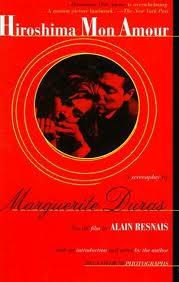
Marguerite Duras and Alain Resnais: Hiroshima mon Amour – Book and Movie (1959/60) Literature and War Readalong July 2011

How do you talk about war? How to put it into words, into pictures? How to tell and show the unspeakable, the horror, the atrocity? How much can you know about something that you have not experienced? These are but a few questions Marguerite Duras and Alain Resnais explore in the book and the movie.

Hiroshima Mon Amour is maybe the most difficult book of this readalong to write about. A summary wouldn’t do it justice. I was amazed once more how good it is, how profound and how the book and the movie seem like two different ways of exploring, with two different languages, the atrocity that we call war. What is fascinating is how they seem to converse with each other.

In 1959 a Japanese man and a French woman meet in Hiroshima. They are both a bit over thirty and happily married. They spend a night together. It is shortly before the woman’s return to France. She is an actress who has come to Hiroshima to play a nurse in a movie on peace. They make love and talk. First about Hiroshima, then about the past of the woman. They part for the day but he follows her and they spend another night together, stay awake, spend  time in a tea house. During the second night, the woman tells the man the whole story of her past in Nevers and her tragic first love. She hasn’t told anyone this story before because there was never anyone like her first lover after that until this day.

I’m glad I read the book again before watching the movie. It was interesting to see how different it is when we first imagine something and when we then see it as well.

During the initial part of the movie we hear a voice-over. The woman tells the man everything that she has seen in Hiroshima. In the news at the time, in the museum during her stay. When you read it, you see in your imagination what you have seen before in documentaries or on photos but the movie shows you how it really was and on the other hand you have the man’s voice telling you, that you have seen nothing, know nothing. There is no replacing the actual experience.

The first pictures show bodies, parts of bodies, first covered in what looks like fall out, then in sweat. This reminded me of Resnais’ documentary Night and Fog. It is the same visual language that tries to show us what violence does to the body, that tries to capture the devastation. Hiroshima Mon Amour seems also to say that war and love can be equally destructive. There is violence in aggression and in passion.

What struck me is that we do not know their names. At the end they give each other the name of the places in which their mutual tragedies happened. She calls him Hiroshima, he calls her Nevers.

One of the themes of the book and the movie is how the collective and the personal tragedies are linked. While Hiroshima and WWII stand for a collective tragedy, Nevers stands for a personal tragedy. This is one of the achievements of  Hiroshima Mon Amour. One approach in war stories or war movies is to pick one exemplary person and tell his/her story. We understand the individual far better, can identify far better with one person’s story but the large-scale of the collective should not be forgotten. Hiroshima Mon Amour is one of the rare movies/books who manages to show both and make clear that they are interdependent.

For those who have not read the book, I would say that it is a valuable addition and it is fascinating to see how they complement each other. First there is the script, including proposals by Marguerite Duras, then she adds information on what scenes Resnais finally chose, plus there is an annex in which Duras goes deeper, explores the woman’s story, gives it more density. I liked the appendix, that was mostly dedicated to the woman’s story, a lot.

There are many things that are worth discussing and I am looking forward to hear your thoughts. One question that has been on my mind since I re-watched the movie is the choice of the Japanese actor. He struck me as looking quite European. I had kept the appendix for last and was glad that Duras mentioned this choice, saying they had wanted to make a more universal statement with this. They didn’t want people to think “That’s an attractive Japanese” but “That’s an attractive man”. I was not completely happy about this. It’s a sad fact that whenever a person from another continent is casted in a European movie, the film directors think of the European taste and choose someone less typical. This is unfortunately exactly how exotism works. I think Resnais and Duras were honest in their attempt but I’m not sure it was ok.

Other reviews:

Emily (Evening All Afternoon)

Litlove (Tales from the Reading Room)

Richard (Caravana de recuerdos)

*****

Hiroshima mon Amour was the seventh book in the Literature and War Readalong. The next one will be Elsa Morante’s History. Discussion starts on Friday August 26, 2011.

Paris – A Movie by Cédric Klapisch (2008)

I watched this movie as part of Book Bath‘s and Thyme for Tea‘s event Paris in July.

Paris is an absolutely charming movie and I’m sure it will appeal to many people because it combines a good story with interesting character portraits, wonderful pictures of Paris and a great cast (Juliette Binoche, Mélanie Laurent, Fabrice Luchini, Albert Dupontel and Romain Duris). I feel really homesick now.  All the places to which I used to go while I lived in Paris can be seen: La Place de La Sorbonne, the Jardin du Palais Royal, the Bibliothèque Nationale. But we also see Ménilmontant where I used to live briefly after I had finished school.

Paris tells one main story, different smaller side stories branch out from it. The people of the main and the side story are only connected because they live in the same town and their paths cross but they don’t get to know each other. Parallel storylines don’t always work well but in this movie they complete each other and the outcome is nicely rounded. The movie has really only one flaw, a brief “All-you-need-is-love”-moment towards the end of the film. Watching this short part was like biting on a lump of sugar in an otherwise tasty cake.

The central characters are Pierre (Romain Duris) and Élise (Juliette Binoche). Pierre is a professional dancer whose best friend is his older sister Élise, a fortysomething divorcée with two kids. At the beginning of the movie Pierre is diagnosed with a serious heart disease that means his career as a dancer has come to an end. He is condemned to stay in his apartment and watch life go by. This offers a great opportunity to have him observe people, one of them is the beautiful Laetitia (Mélanie Laurent). Whenever Pierre is alone, walking the streets of Paris, mourning his career, contemplating his possible death, his reflections are accompanied by the music of Erik Satie. I liked that touch a lot.

Élise doesn’t belive in love anymore. She has been disappointed, doesn’t want to risk falling in love. When she goes shopping for her brother to the street market, near where he lives, she meets one of the vendors (Albert Dupontel) and there seems, from the beginning, a possibility for something between them.

Roland Verneuil (Fabrice Luchini) is an elderly professor of history. His story was for me the most touching. We learn about it because he falls in love with one of his students, Laetitia who lives in an apartment vis-à-vis of Pierre’s flat and he watches her. Verneuil is insecure but at the same time there is a lot of passion in him that has been stored away for a long time. Falling in love with a student reawakens him and brings out a very different person. There is nothing sleazy in this older man falling in love with a young woman. Unfortunately the beautiful Laetitia is one of those good-looking women who enjoys not only to play with men but who also likes to inflict pain. A nasty piece of work.

I loved the melancholy end of the movie. We  know from the start that there isn’t a lot of hope for Pierre. He needs a transplant and he may or may not survive the surgery. The last scene shows him travel through Paris in a taxi, on his way to the hospital.

Paris is a beautiful and touching movie and a homage to a city. I liked it even better than Paris, Je t’aime which isn’t bad at all either.

Zabou Breitman’s Je l’aimais – Someone I Loved (2009) The Movie Based on Anna Gavalda’s Novel

I wasn’t aware of this movie until I read about it on Guy Savage’s second blog Phoenix Cinema. I liked Anna Gavalda’s short story collection I Wish Someone Were Waiting For Me Somewhere (Je voudrais que quelqu’un m’attende quelque part) and her subsequent novel Someone I Loved (Je l’aimais) a great deal and was looking forward to watch the movie.

Zabou Breitman’s Je l’aimais or Someone I Loved is a very subtle, touching movie and the main actors are amazing, all three of them.

At the beginning we don’t really know what happened. Pierre (Daniel Auteuil), Chloë’s father-in-law, drives her and her two kids to their holiday house, near Annecy. It’s quite cold, the mountains look bleak, there is a constant drizzle and the young woman is crying during the whole trip. At the same time she emanates a fierceness. She seems desperate, wounded and angry at the same time. Florence Loiret Caille plays the wounded woman with such intensity, it’s painful to watch, we forget that it is a movie and think that we are really watching someone in distress and pain.

Once arrived in the little house, the girls start watching TV non-stop, Chloë cries and Pierre tries to take care of them. For a while, it works more or less, they hardly talk, keep politely distant but then Chloë has a break out and shouts and screams and tells Pierre she can’t take it any longer, these polite silences, the way how in their family they always remain silent, never talk and that this silence is precisely the reason why she never saw it coming. She never even expected that her husband had a mistress, she wasn’t prepared to be left like this, without forewarning.

This outburst, the honesty and directness move Pierre and he starts to talk. First he tells Chloë about his brother who died very young after having served in Indochina and later he tells her that he also had an affair.

We see the story of the love of his life in flashbacks, we watch how he meets Mathilde (an excellent Marie-Josée Croze) in Hong Kong on a business trip, how he falls in love head over heels, how they continue seeing each other for years in different places, Hong Kong, Paris, anywhere in the world. He tells Chloë of his extreme happiness, how well they felt together until the day Mathilde asked him what would become of them. From that moment on things got complicated.

Despite a loveless marriage Pierre cannot break free. There is his wife, the children, his reputation, the house, the holiday house, his habits, his way of life. He would have liked to go on like they did forever, meeting Mathilde whenever possible, but not changing his routine. For a while Mathilde accepts this but one day she cannot take it any longer and Pierre must make a decision.

It is easy to judge Pierre and I guess everyone who watches this movie at a certain moment will judge him. But after a while one starts to understand and one also understands why he told Chloë his story. He doesn’t want her to keep back his son. He doesn’t want his son to be a coward and to destroy two lives.

Je l’aimais is a great example of what French cinema has to offer. Actors who are so excellent, they let you experience what the characters they portray go through. The three people come across as so vulnerable and naked, it’s quite amazing. The camera seems glued to their faces and they fill the screen at any moment, every gesture, every facial expression is meaningful.

I couldn’t find an English trailer and had to attach the French one but there are subtitled versions of the movie available.

Je l’aimais is my first contribution to Book Bath‘s and Thyme for Tea‘s event Paris In July.

I decided to do a weekly French cinema post on Sunday starting today until the end of the month.

Dashiell Hammett: The Glass Key (1931) and Heisler’s The Glass Key (1942)

Ned Beaumont is a tall, thin, moustache-wearing, TB-ridden, drinking, gambling, hanger-on to the political boss of a corrupt Eastern city. Nevertheless, like every Hammett hero (and like Hammett himself), he has an unbreakable, if idiosyncratic moral code. Ned’s boss wants to better himself with a thoroughbred senator’s daughter; but does he want it badly enough to commit murder? If he’s innocent, who wants him in the frame? Beaumont must find out.

I have read everything Raymond Chandler has written. He used to be one my favourite authors. This might be the reason why I neglected Hammett for so long. Maybe I thought he would be too similar and that this would influence my reading.

The Glass Key was my introduction to Dashiell Hammett and although it did remind me a bit of Chandler, they are still quite different. Hammett is at the same time sparser and coarser.

At the heart of The Glass Key lies the question “Who has killed Taylor Henry?”. Taylor Henry is the son of the influential politician Ralph Henry. In an attempt to appear cleaner than he is, the corrupt politician Paul Madvig tries to associate himself with Henry. And he is in love with Henry’s daughter Janet. When Taylor is found dead, rumors start to circulate that he might have been killed by Paul. None of these people are really main characters, the central figure and exemplary tough-guy, is Ned Beaumont. He is a sort of assistant to Paul Madvig and tries, like a PI, to investigate the murder. He visits bars and clubs and people. Gets beaten up and is held captive. Women literally throw themselves at him. This all leaves him quite unfazed. No matter how much you beat that guy up, how often you threaten him, how many times you flatter him or try to seduce him, you will not get much of a reaction but a very short reply. This is as tough as tough-guys go.

The interest, at least for me, did not lie in the solving of the murder. I couldn’t care less. The appeal of this book, is the character of Ned Beaumont, this monosyllabic guy who doesn’t even flinch when he is beaten to a pulp. The other appeal is the world and the atmosphere this novel depicts.

The world of The Glass Key is a world of corruption, prohibition, easy women, hard men, bars and secret joints, bribery and violence.

And of course one has to mention the dialogue. You couldn’t find any more sparse and caustic dialogue in any novel.

Ned Beaumont advanced into the room where Lee and the Kid were.

The Kid asked: “How’s the belly?”

Ned Beaumont did not say anything.

Bernie Despain exclaimed: “Jesus! For a guy that says he came up here to talk you’ve done less of it than anybody I’ve ever heard of.”

“I want to talk to you,” Ned Beaumont said. “Do we have to have all these people around?”

“I do,” Despain replied. “You don’t. You can get away from them just by walking out and going about your own business.”

“I’ve got business here. “

After having finished the book I realized that I had the movie. It is part of a collection of Film noir movies that I had ordered before Christmas. I immediately watched it and liked it a lot.

The story is told differently. More chronological and Janet Henry’s (Veronica Lake) role is much more important. A few names have been changed. There is a club owner who is Irish in the book. He is Italian in the movie which was probably more in line with the depiction of wise guys as they populated the film noir. What I truly liked about the movie is Veronica Lake. Since I have seen L.A. Confidential (one of my favourite movies) in which Kim Basinger is compared to Veronica Lake I always wanted to see the real one. I think she is really special.

Don’t ask me whether I prefer the novel or the movie. I enjoyed reading and watching at the almost same time. It was as if the characters had stepped out of the pages at the end of the book and come alive.

I am really pleased I found the trailer which is not usual for every old movie.