Welcome to Angela Carter Week

ACW badge 2-2

Today marks the beginning of Angela Carter Week.  We have over twenty people who would like to participate. I saw quite a few intro posts, links and announcements. Thanks everyone for that. I’m really thrilled to see so much enthusiasm.

Delia has made a list of the participants and I’ve added everyone to my bloglovin account – still, it’s possible we might not see every contribution, therefore we’d be glad if you could use the Linky below.

It’s not as sophisticated as a blogspot Linky but it does work. You just have to click on the widget to see all the entries.

I’ll be visiting and posting all through the week. Next Sunday we’ll wrap up and hopefully we’ll be able to share a list with all the links.

I wish all the participants a great Angela Carter Week!

Some Plans: Spanish Literature – Japanese Literature and Mary Hocking

Japanese Literature Challenge

I’m not good at sticking to plans and projects these days. Especially not when I add reading lists to my intro posts. That jinxes it every time. Therefore, I’m not going to make the same mistake again and just let you know that I will take part in three events. Maybe these announcements will inspire the one or the other to join as well.

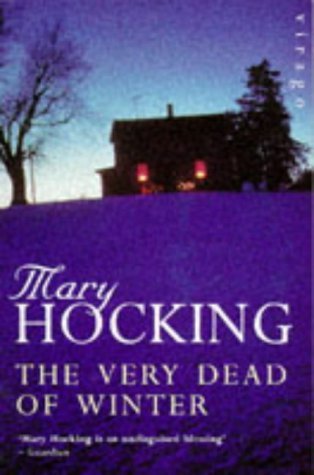
First up is Heavenali’s Mary Hocking Reading Month. I’d never heard of the author, nor was I familiar withHeavenali’s blog before I saw an announcement on Kaggy’s Bookish Ramblings. Browsing told me that Mary Hocking is right up my street and I decided, if I can get one of her many novels (many are out of print), I’ll join. So this is the only plan I’m sharing. I’ll be reading Mary Hocking’s The Very Dead of Winter.

The Very Dead of Winter

Here’s the blurb

This is a portrait of a family forced to confront the grievances of their shared past. In the very dead of winter they assemble at a remote country cottage enveloped in snow. Mary Hocking has also written “Good Daughters, Indifferent Heroes”, “Welcome Strangers” and “An Irrelevant Women”.

Should you want to join, there are quite a lot of used copies available. She’s written a lot of books, many of which have been published by Virago and are still in print. You can find a list on Heavenali’s blog.

spanish_speaking_countries_flags

July is Spanish Literature Month hosted by Richard (Caravana de Recuerdos) and Stu (Winstonsdad’s Blog). Two years ago, when they hosted the first Spanish Literature Month I had some wonderful plans and failed miserably. This year it should be different. I’ve been collecting books for the event, the general direction might be crime, but I’ll decide what I’ll read spontaneously.

Japanese Literature Challenge

Bellezza’s Japanese Literature Month 8 has started on the first of June and runs until the end of January 2015. On Bellezza’s blog you’ll find reading suggestions and links to the review site. This year I will read whatever I like, without taking into consideration whether or not the book has been translated into English. Hopefully I’ll be in the mood for something that has been widely transalated.

Will you participate in any of these events?

Susan Minot: Evening (1998)

Evening

With two novels and one short story collection published to overwhelming critical acclaim, Susan Minot has emerged as one of the most gifted writers in America, praised for her ability to strike at powerful emotional truths in language that is sensual and commanding, mesmerizing in its vitality and intelligence. Now, with Evening, she gives us her most ambitious novel, a work of surpassing beauty. During a summer weekend on the coast of Maine, at the wedding of her best friend, Ann Grant fell in love. She was twenty-five. Forty years later–after three marriages and five children–Ann Lord finds herself in the dim claustrophobia of illness, careening between lucidity and delirium and only vaguely conscious of the friends and family parading by her bedside, when the memory of that weekend returns to her with the clarity and intensity of a fever-dream. 

It’s not easy to capture the beauty of Susan Minot’s gorgeous and ambitious novel Evening. If Virginia Woolf or Proust had written page-turners, that’s what it could look like.

In beautiful prose which explores how memory and consciousness work Evening captures the story of Ann Grant’s life. It is 1994 and Ann is terminally ill; she’s lying in her bed, drifting in and out of consciousness. Scent transports her back in time. The morphine induces hallucinations, which are rendered in brilliant stream of consciousness paragraphs. These chapters and paragraphs, are very short, fragments only; the main story however simply moves back and forth between 1994 and 1954, the summer in which she met Harris Arden.

She smelled the cushion and smelled the balsam and what happened to her then was a kind of wild tumult. The air seemed to fracture into screens which all fell crashing in on one another in a sort of timed ballet with spears of light shooting through and something erupted in her chest with a gush and in her mind’s eye she saw her hands forty years younger and heard the clink of rocks on a beach and the sound of a motorboat and rising behind that came a black night and a band playing in the trees and the smell of water in the pipes of a summer cottage and she raised her hand to keep the cushion there and breathed in and heard an old suitcase snap open.

While Ann is remembering four days in 1954, when she met Harris, her grown-up children, her friends and nurses flutter like moths in the periphery of her bed. Ann is given morphine and more often than not, she’s not lucid but hallucinating. One moment she remembers something that happened in 1954 and the next moment a noise in her bedroom changes everything, makes her imagine something; another moment later, she’s back with her visitors.

Her children hear her talk to an invisible stranger, Harris, but when they ask her about him, Ann denies knowing a person with that name.

The story is divided into several recurring elements. There is the story of the four days in summer 1954, the stream of consciousness elements in which Ann sees her whole life pass, the passages in which we hear her children talk, and very short passages in which Ann seems to be talking to Harris who has come to visit her. His visits take place in her imagination but for her this seems more real than anything else.

Evening questions what is left of a life when it comes to its end. Memories, dreams, illusions, are all the same, when you look back. Ann has been married three times. Some marriages were good, others were bad, but now that she is dying, Harris, the unlived possibility, is the strongest memory she has.

Evening explores the way memory works

First she was Ann Grant, then Phil Katz’s wife then Mrs Ted Stackpole then Ann Lord. Bits of things swam up to her, but what made them come. Why for instance did she remember the terrace at Versailles where she’d visited only once, or a pair of green and checkered gloves,  photograph of city trees in the rain?It only demonstrated to her all she would forget. And if she did not remember these things who would? After she was gone there would be no one who knew the whole of her life. She did not even know the whole of it.

Although the narrative is fragmented and modernist in places, the book has the qualities of a page-turner. At the beginning we only know that Ann Grant met Harris in 1954 and that they both fell in love. It will take the whole book to reveal what has happened and why, after all these years, she still remembers him as if it had been yesterday but never told anybody about him.

Underlying this remembrance of things past, lies a very crucial topic: pain medication in palliative care. It’s briefly mentioned in the book that Ann Lord decided to be medicated although she knew she would probably spend her final weeks, days and hours not being lucid. Some cancer patients prefer lucidity and live their final moments with as much pain as they can possibly endure. Not Ann.

It’s a beautiful book and strangely uplifting. Possibly because it testifies how intense an interior life can be and that nothing is really lost. Everything we’ve ever experienced, imagined or dreamed is still somewhere. In its best moments Evening reminded me of Virgina Woolf’s The Voyage Out, in which we often see people or houses from outside. They are motionless or sleeping, but we catch a glimpse of their inner lives, which are rich and deep and passionate.

Evening has been made into a movie with Claire Danes, Vanessa Redgrave, Glen Close, Toni Colette, Natasha Richardson and Meryl Streep. It doesn’t capture what made the book so wonderful but it’s still a beautiful movie.

Chris Beckett: Dark Eden (2012)

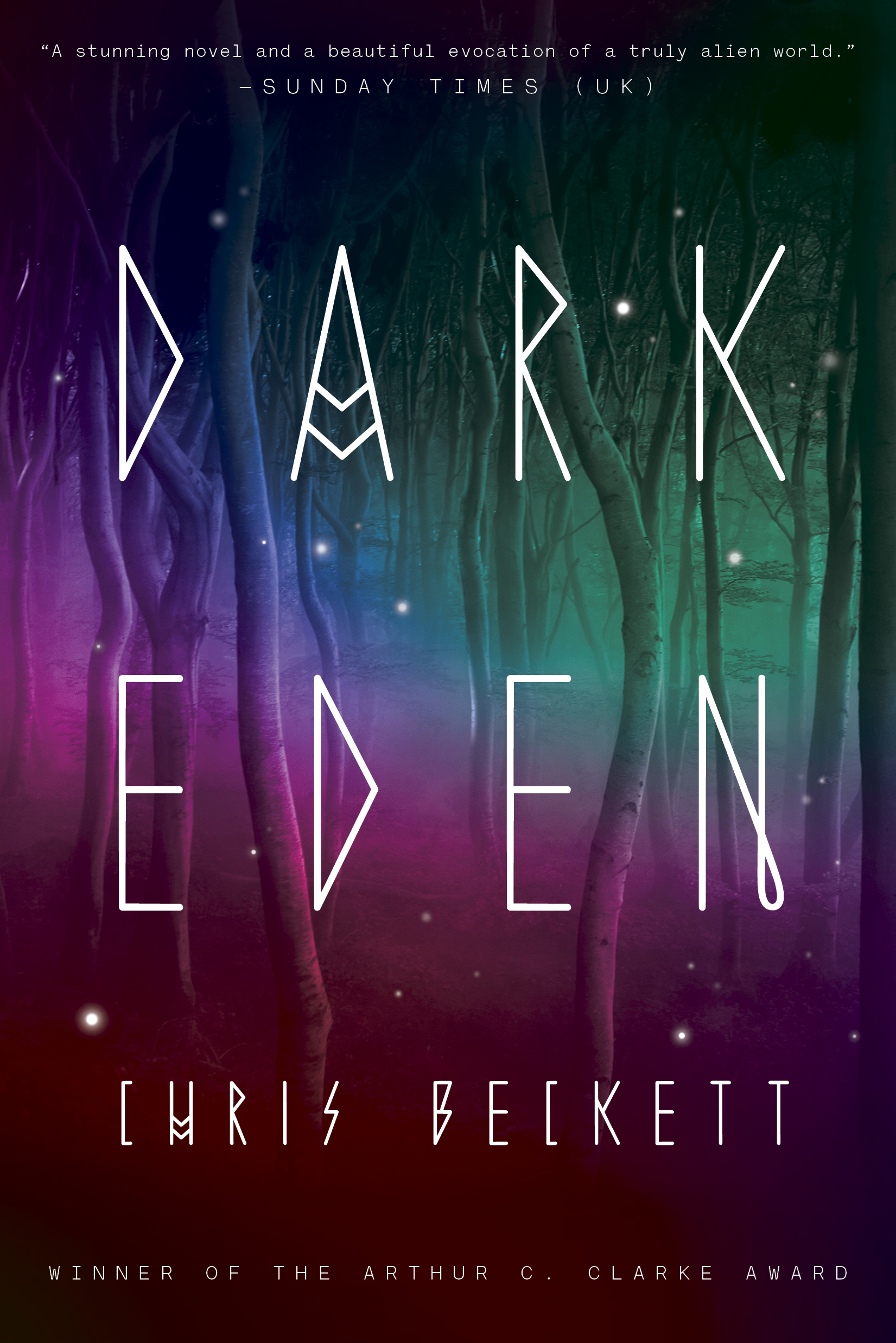
DARK_EDEN

Chris Beckett’s novel Dark Eden was last year’s Arthur C. Clarke Award winner, which usually guarantees that a book is at the more literary end of the Sci-Fi spectrum. For once I can understand why a novel received an award. Dark Eden is nothing if not a tour de force. It’s as original as it is philosophical; in its themes as much as in its execution. Reading it wasn’t only a brainy experience, it was quite visceral as well. Beckett’s world felt so realistic, the everyday life of the people is described in all its strangeness and boring repetition, that I felt sucked in.

As a linguist and cultural anthropologist, I found the civilisation Beckett created extremely fascinating and thought-provoking. What would happen if a part of our high culture, a tiny fragment of our civilisation – two people to be precise – were abandoned on an alien planet, with nothing but their clothes, some paraphernalia and nothing else? This is what happens to Thommy and Angela, the ancestor’s of the people we meet in Dark Eden. The world they encounter is strange and dark. Light and warmth come from the lantern trees. Food abounds at first. The two humans can eat fruit and hunt the strange six-limbed animals of Dark Eden. Angela and Thommy procreate and once the story begins, the population of Dark Eden has risen to 532 people. Food is scarce by now. The perpetual darkness is hard on them. They have not ventured further because their creation myth traps them. After 160 years, or wombtimes as they call it, they are still waiting for a “veekle” from Earth to return and bring them back to their planet of origin. A planet that sounds like paradise to them. A planet where there is “lecky trickity” and daylight coming from a giant star.

Cultural anthropology studies – among other things – the development of civilisations from hunter-gatherers to (nomadic) herders to agriculturalists and more advanced civilisation. In Dark Eden this evolution is reversed at first and then starts to move through the aforementioned stages. The descendants of Angela and Thommy are hunter-gatherers, on the verge of becoming herders. And they have an oral tradition again; writing and schools have been abandoned a long time ago. Many of the words are written phonetically to illustrate that. “Rayed Yo”, “Veekle”, “Secret Ree”, “Wind Oh”. The sentence structure is simple and words like “very” don’t exist but instead of them, the narrators repeat words. “Very sad” becomes “sad sad” or even “sad sad sad”. I thought this was ingenious but – in all honesty – it got a bit on my nerves as well.

As we all know, a story needs conflict and the conflict arises in the form of a “newhair”. John Redlantern is only 20, but he questions the traditions who keep them trapped in this one place, waiting forever for an air ship that never comes. He dares the unspeakable. He challenges the elders and is finally cast out. What the elders didn’t expect – he’s struck a chord with many. Staying in one place means that food is getting scarcer and people are afraid of starving. When he leaves, a group of newhairs joins him.

John’s frustration has a lot to do with survival but is about something else als well. John’s suggestion to leave their dwelling place has something to do with leaving behind the past. Everything they do or think revolves around a distant time and place. They hope to be saved and brought back one day. They re-enact the story of Thommy and Angela again and again and, while waiting to be saved, they don’t really enjoy life or live freely.

What false hope can do to people is only one thought-provoking element, which is part of a profound analysis of meangless rituals and religion.

The structure of the novel is interesting as well. It has two main first person narrators and at least six minor narrators. That breaks up the monotony and gives Beckett the opportunity to show more than one view of the same story. The multiplicity of stories is another important theme in the book:

There are lots of different stories branching away all the time from every single thing that happens. As soon as a moment has gone, different versions of it start to be remembered and told about. And some of them carry on, and some die out, and you can’t know in advance which version will last and which won’t.

Dark Eden  describes a world in which sexuality is lived freely, in which nobody has ever murdered anyone and in which even the crippled and disfigured are treated like everyone else. But it’s not a peaceful society. Hatred and aggression simmer under the surface and can only be contained as long as absolutely nothing in the daily or yearly routine is changed. Once John questions tradition and sets in motion change, violence erupts.

The end is well done and logical. Pretty much what I had expected but that wasn’t disappointing. However, closing the book was a relief. The world Dark Eden describes is a wondrous place, filled with abundant vegetation and a strange and haunting fauna, but it’s bathed in perpetual darkness, and very suffocating.

Dark Eden is a novel that touches on many different topics – religion, family, tradition, overpopulation, hope, creation myths, languages etc. –  it’s philosophical and anthropological in scope and certainly testifies that Sci-Fi can still contribute a fresh and thought-provoking exploration of the human condition and our culture.

Thanks to Broadway Books for the review copy.

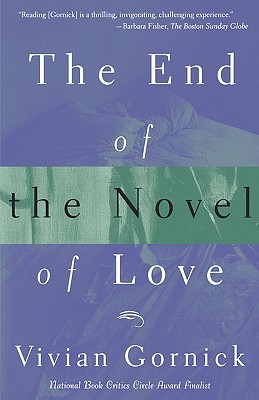
Vivian Gornick: The End of the Novel of Love (1997) Essays on Literature

The End of the Novel of Love

In these essays Vivian Gornick examines a century of novels in which authors have portrayed women who challenge the desire to be swept away by passion. She concludes that love as a metaphor for the making of literature is no longer apt for today’s writers, such has the nature of love and romance and marriage changed. Taking the works of authors such as Willa Cather, Jean Rhys, Christina Stead, Grace Paley and Hannah Arendt, Gornick sets out to show how novels have increasingly questioned the inevitability of love and marriage as the path to self-knowledge and fulfilment.

Vivian Gornick is an essayist and memoirist. Her collection The End of the Novel of Love contains a wide range of essays on different authors and topics. The title is the title of one of the essays. Almost all the essays circle to some extent around the topic of love. Some of the essays are more biographical, others focus more on a theme and compare and analyse different authors and works.

There are biographical essays on Kate Chopin, Jean Rhys, Willa Cather, Christina Stead and Grace Paley. I liked the one on Willa Cather and Grace Paley best, as Gornick is less judgmental in them than in some of the others. In the essay on Paley she says that despite the fact that her range isn’t all that wide, that Paley often writes about the same things again and again, her stories are still excellent because in her stories the voice is the story. What is unique in her stories is that people don’t fall in love with each other but with the desire to be alive.

There have been three story collections in thirty-five years. They have made Paley famous. All over the world, in languages you never heard of, she is read as a master storyteller in the great tradition: people love life more because of her writing.

The book contains two essays on people who are not fiction writers: Hannah Arendt and Clover Adams. While I’m familiar with Arendt and her work, I didn’t know the tragic story of Clover Adams, the wife of Henry Adams, who took her own life in 1885. The suicide struck Henry Adams particularly hard as he thought of Clover and himself as two parts of a whole, while, very clearly, Clover had an inner life of her own and didn’t share most of her distress. Clover was, according to Gornick, extremely intelligent and witty, which fascinated Adams. He fell in love with her mind right away, but didn’t show much kindness when he wrote about her as being anything but handsome. And even his praise of her intelligence doesn’t really read as a praise because he feels obliged to add – implicitly and explicitly – that she’s witty and intelligent “for a woman”.

The most interesting essays in the collection are those on themes, in which Gornick analyses and compares several works.

In Diana of the Crossways Gornick compares George Eliot’s Daniel Deronda, Edith Wharton’s The House of Mirth, George Meredith’s Diana of the Crossways and Virginia Woolf’s Mrs Dalloway. Gornick tells us that while the three books written by women are brilliant, they aren’t a success, unlike Diana of the Crossways, which is a stunning novel, because it goes one step further.

Each of these three novels was written by a brilliant woman with the taste of iron in her mouth. Each of them gives us a sobering portrait of what it feels like to be a creature trapped, caught stopped in place. Yet no one of these novels penetrates any deeper than the others into the character’s desire to be free: all that is achieved here is the look and feel of resistance. (…)

George Meredith, in his late fifties, had the experience and the distance. Meredith knew better than Woolf, Eliot, and Wharton what a woman and a man equally matched in brains, will, and hungriness of spirit might actually say and do, both to themselves and to one another. (…)

Diana Warwick is one of the first women in an English novel both beautiful and intellectually gifted who needn’t be dismissed as vain, shrewd, and ambitious before we can get on with it.

Ruthless Intimacies analyses the relationship between mother and son in D.H.Lawrence’s Sons and Lovers, and the relationship between mothers and daughters in Radclyffe Hall’s The Unlit Lamp, May Sinclair’s Mary Oliver, Virginia Woolf’s To the Lighthouse and Edna O’Brien’s short story A Rose in the Heart of New York. The relationships in these novels are symbiotic and swallow up the daughters completely. They struggle their whole lives to free themselves. I can relate to that all too well and would really love to read The Unlit Lamp and Edna O’Brien’s short story. Both sound pertinent and excellent.

Tenderhearted Men focusses on author’s who write in the vein of Hemingway about men and women. Raymond Carver, Richard Ford and André Dubus. Gornick dismisses them as too sentimental. They cling to a dated idea of men being saved by women, without trying to understand them.

The End of the Novel of Love is interesting. It states the obvious but the obvious was still worth stating. Most of the tragic (love) stories of the past like Madame Bovary and Anna Karenina, but also books like The House of Mirth are unthinkable in our day and age. Marriage and society have changed so much. Adultery doesn’t have the social consequences it had. I thought this part of the essay interesting, but I didn’t like that she chose to illustrate her concept in picking apart Jane Smiley’s novella The Age of Grief and calling it not only unmoving, but a failure. Harsh words. Maybe it’s true. I haven’t read it but I don’t like this type of unkind criticism.

Gornick’s writing is very accessible, a lot of her insights are fascinating and made me think, but, as I mentioned before, she’s very judgmental, which made me cringe occasionally. It made Gornick come across as very unkind. See for example this passage taken from the essay on Kate Chopin.

One of her biographers makes  the point that Chopin never revised, Chopin herself, announced, in interview after interview throughout her professional life, that the writing either came all at once, or not at all. I think it the single most important piece of writing we have about her. She seems to have considered this startling practice a proof of giftedness, rather than of the amateurishness that it really was.

Although I didn’t care for some of her harsh judgments, I thought many of her observations were pertinent and fascinating and I’d certainly read another of her books. I’m interested in her memoir Fierce Attachments and her book on creative non-fiction The Situation and the Story: the Art of Personal Narrative.

If you’re interested here’s the first chapter on Diana of the Crossways.

Elke Schmitter: Mrs Sartoris – Frau Sartoris (2000)

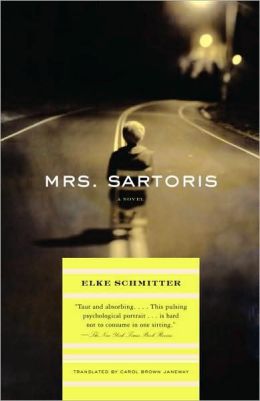
Mrs Sartoris

Part confessional, part thriller, Elke Schmitter’s explosive first novel is the story of Margaret. Jilted by a rich boyfriend when only eighteen, she finds herself many years later married, with a daughter, to Ernst, a war veteran with a penchant for routine and order. Living out her days in a small German village she is emotionally frozen, until one day she embarks on passionate affair with a married man. Planning to run away with him, she seems unaware that her plan is a fantasy that can never come true, and similarly unaware of the shocking repercussions that could result from chasing such a dream.

Why does someone commit a crime? Especially someone who isn’t really a criminal, but an ordinary person. Mrs Sartoris is an ordinary person, still, she kills someone. How that happened and who she killed is at the heart of this captivating and masterful novel.

Mrs Sartoris is a troubled woman. She drinks too much, is unhappy and once upon a time she spent a few months in a psychiatric hospital. She lives with her mother-in-law, her husband and her daughter in a small house. The only person in her life she’s truly attached to is her mother-in-law. She makes life bearable. There is no warmth between her and her husband and, as we will learn later, there are reasons for that.

The book opens with a cryptic short paragraph in which Mrs Sartoris, who tells the whole story, writes about an incident. What it is will be revealed very slowly. Small chapters on that incident change with chapters on her life. Her childhood and unhappy love story, her dreadfully boring and conventional married life, her affair with Michael.

Mrs Sartoris isn’t an entirely unreliable narrator but she’s highly deranged and depressed which clouds her judgement.

The story as such is interesting and suspenseful. And there is a twist at the end, which is very well done. But what makes this book truly masterful is the way it’s told. There are passages in the narration that I would call “litanies” in which Mrs Sartoris enumerates things. In one instance she talks about all the meaningless sentences she doesn’t want to say anymore. Reading them in rapid succession is eerie to say the least and makes the reader think how often one uses empty phrases just like that. How many meaningful conversations do we have day in and out? Another litany enumerates all the things Mrs Sartoris has never had in her life and this reveals so much bleak emptiness, it’s  chilling.

Mrs Sartoris has been compared to Mme Bovary. I don’t think I would have made the comparison if the blurb hadn’t told me to make it. Sure, there is an adultery, but other than that? Mrs Sartoris’ husband is as conventionally boring as Charles Bovary, Mrs Sartoris is lost in a dream world and her lover resembles Mme Bovary’s lover a tiny bit but that’s that. I would, if I had to, much rather compare it to Tim Parks’ Loving Roger.

Mrs Sartoris is the tightly woven story of a life, an analysis of a crime written in a chilling, and revealing style that will haunt readers for quite a while.

For another take on the novel here is Stu’s review.

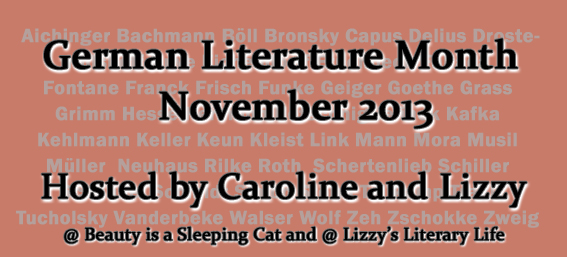
Announcing German Literature Month III – November 2013

image

Lizzy and I are delighted to be making this announcement and we hope you’re happy to hear it.  The tweets of others as early as January of this year looking forward to German Literature Month convinced us it just had to happen.  And so your wishes have come true. This time, however, we are issuing a challenge.

GLM I and II were resounding successes and we want GLM III to follow suit.  One thing has concerned us though.   Why were the lady writers so grossly under-represented?  Only 22% of the authors read in GLM I, reducing to 19% in GLM II, were female. We want to redress that balance.  Now we’re not going all Orange prize on you.  We don’t want to exclude the great male authors in German(-language) literature.  But we are structuring the month so that there are times to focus in on the ladies.

We would, therefore, like the structure of German Literature Month III to look like this.

Week 1:  1-7.11 Ladies Week

Week 2:  8-14.11 Gents Week

Week 3: 15-21.11 Ladies Week

Week 4: 22-28.11 Gents Week

Weekend 29-30.11 Read as you please

Read anything you want: any format, any genre. As long as the works were originally written in German and are reviewed during November, they count for GLM III.  The ideal female:male author ratio at the end of the month would be 50:50.

We will also have two readalongs:

7.11 Lizzy will lead a discussion of a title to be determined by public vote. A post will follow shortly with voting options. In the meantime if there’s a title you wish to suggest, written by a female (it will be ladies’ week after all), please leave a comment.

29.11 Caroline will lead a War and Literature discussion of Hans Keilson’s Death of the Adversary.

With just 5 weeks and 3 days to go it’s time to start planning.  Check out those TBR’s and library catalogues.  Find some female authors to read.  Most of all get excited.  This is the German Lit blogging event of the year.  What’s not to get excited about?