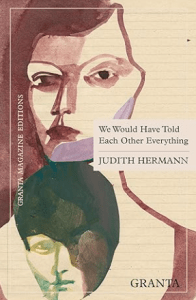
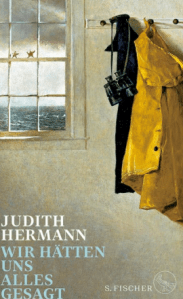
Judith Hermann – We Would Have Told Each Other Everything (Wir hätten uns alles gesagt)

We all have authors whose every book we read. For me, Judith Hermann is one of those authors. She’s best known for her short stories but has also written novels and now, finally, her long awaited first memoir. Or rather a series of lectures on life and writing that reads like a memoir. We Would Have Told Each Other Everything will be published in English next April. Two of her short story collections, Summer House, Later and Nothing but Ghosts are available in English. Her third short story collection Lettipark, a book of five connected stories, Alice, and her two novels Aller Liebe Anfang (Tony just let me know this and Letti Park were translated) and Daheim don’t seem to have been published in English.

Hermann is a bit of a phenomenon. Her first short story collection, Summer House, Later, which came out in 1998, was published to high acclaim. Critics and readers adored it. Nobody had written quite like her before. She seemed to capture the lifestyle and mood of a whole generation – the generation of those who were in their twenties in the late 90s. She wrote about things other people didn’t write about. Young people hanging out, travelling, doing nothing, just living their life. Most of the stories are set in Berlin, Judith Hermann’s hometown. I loved that book so much, found myself in so many of the stories and have been a loyal reader ever since. Sadly, even though I liked almost everything she has written, I found, like many of her critics and readers, that she was never able to achieve again what she had achieved in her first book. Some critics were already harsh when the first book came out. Over the years the criticism got worse. I never really understood why the reviews were at times so harsh, even cruel. When her first novel came out, one critic wrote she couldn’t write and had nothing to tell. In the memoir Judith Hermann addresses this review and what she has to say is very interesting. In many ways, her response to this reproach lies at the heart of these lectures.

Judith Hermann has never spoken much about her life, her childhood, or where her inspiration came from. Her answers to certain questions were always evasive. The book explores in detail why this was the case and it also investigates what is autobiographical and how she transforms what she has experienced and turns it into literature. At the beginning of the book, she describes how she ran into her psychoanalyst, late one night in Berlin. She discovered this psychoanalyst through a friend who went to see him and then spontaneously decided to go to see him as well. It seems the friend’s therapy was already over when she began to see the therapist, nonetheless, she never told her friend, Ada, that she went to see him too. We learn that this was rather typical of her. She hardly ever spoke to people or told them anything about herself or her childhood. The more we read about her past, the better we understand why she was silent. The trauma of two world wars, mental illness, emotional abuse, were all part of her difficult childhood.

All her stories are inspired by her life, but nothing is recognizable as such. That is because of her writing technique. She writes draft, after draft, after draft, erasing every time what is closest to what happened to get to a deeper meaning and truth. Very similarly, her psychoanalyst taught her to write down a dream and then write it down again the next day and once more on day three. The thing that would be missing, would be the most essential element of the dream, the element because of which the dream was dreamt, so to speak. Talking about her writing she says that in the end she sometimes no longer knows what really happened and what didn’t.

When she read the criticism I mentioned before, she agreed with the critic. Yes, she really didn’t have anything to tell because she couldn’t really tell what was important.

A large part of the book is dedicated to her friendship with Ada and the group of friends that surrounded Ada. Many of these scenes reminded me of some of her stories. She spent a lot of time with these friends. They spent whole summers together in the house near the sea that belongs to Judith Hermann’s family. These scenes are so wonderfully evocative. The friendships she has with these people, particularly with Ada, are very intense. They experience so much together yet they don’t really talk. This chosen family, she says, showed a very familiar lack of words and speechlessness to her own.

The last part of the book is set during Corona and the early lockdowns. During that time, she moved to the countryside and made a new friend, Jon. They spent a lot of time together but this time, her silences aren’t easily accepted, almost cost her this new friendship. And that’s where the title comes from. There’s a moment during which she would have told Jon everything about her life. It doesn’t happen but she will tell him later why she is so evasive.

Many of the things she describes in this book are relatable to anyone who has suffered (childhood) trauma. So often, one can’t find a way out of silence. It’s often the whole purpose of a therapy to be able to finally tell someone everything.

I’m not entirely sure I managed to capture how much I loved this book. But I did. It will make my end of year best of. It was one of those books I didn’t want to end. She achieves something quite magical – she lets us know a lot about herself and her writing process, but she also allows us to discover ourselves more deeply. Just like she does in her best stories.

The German title of this book is interesting. During these lectures she mostly uses the word “erzählen” – “to tell a story”. For the title, however, she uses “sagen” – “to tell”. This shows, in my opinion, that she’s come full circle. She used to tell stories but left out most of what really happened in her life. Through the new friendship with Jon, and in writing these lectures, she breaks the silence and speaks about the things behind the stories. I wonder if there will be another novel or book of stories from her. In some ways it would make sense if this was her last book. I hope not though.

For those who don’t want to wait for the publication of the English book there is either a part or even the whole translation by Katy Derbyshire on the Granta website here.
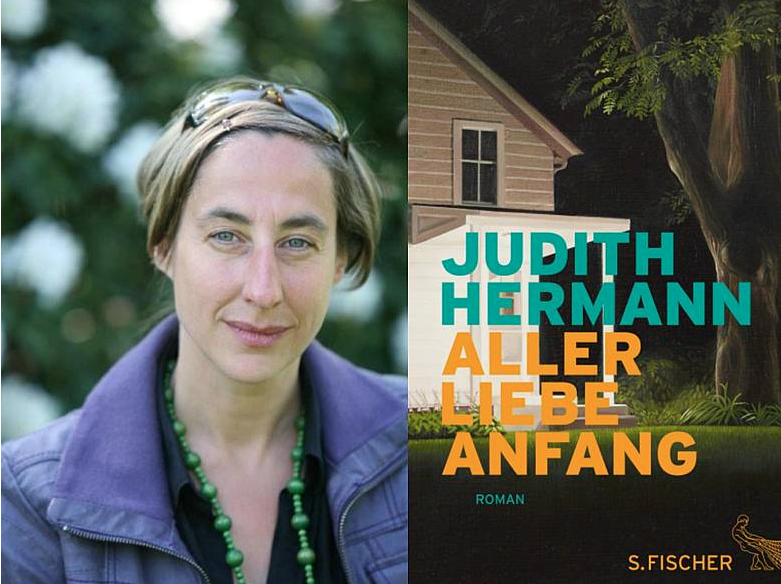
Bad Literature Doesn’t Equal Genre – On Judith Hermann’s Aller Liebe Anfang (2014)

Aller Liebe Anfang

Edo Reents, the critic of the FAZ – Frankfurter Allgemeine Zeitung – wrote about Judith Hermann’s long-awaited first novel:  “Judith Hermann has two problems. She cannot write and she has nothing to say.” – “Judith Hermann hat zwei Probleme: Sie kann nicht schreiben, und sie hat nichts zu sagen”. I wouldn’t go as far as that, but I too felt that the muses were absent while she wrote this. It’s particularly disappointing because she took a long time to write this novel. Her last book came out in 2009. You’d expect a masterpiece after five years of silence.

Edo Reents’ review wasn’t the only one I read and most critics share his opinion; they just don’t word it as a personal attack. I’m not keen on this type of exposure of an author, but there were other elements – in the reviews and the book – that were incredibly annoying.

Aller Liebe Anfang is a stalker novel. Yes, another one. It’s the choice of theme that led the critics to the most stupid analysis I’ve read in a long time. Because this is a topic often used in genre literature and because the book isn’t great, they deduce that it must be genre. Some critics even mentioned Stephen King. Now, you may like Stephen King or not, but the guy knows how to write great genre and, funny enough, if you read Aller Liebe Anfang as genre – it’s even worse. Clearly those critics just know about Stephen King, they haven’t read him or any other genre writer or they would know that plausibility and logic are key in most crime novels. Unfortunately you don’t find a lot of that in Hermann’s book. Nor do you find compelling and precise descriptions, but blurred settings and faulty imagery. The characters too are blurred and their occupations seem vague. I’ve never heard of a nurse doing people’s shopping or of a carpenter designing houses.

What’s the novel about? Stella and Jason have been married for five years. They live with their small daughter in the suburbs. Where? We don’t know. That’s another annoying trait of this book: Everything is vague. Jason is mostly gone for weeks and Stella is alone. She loves to sit in the living room, in front of a huge window, reading. She doesn’t realize that she’s probably watched all the time until one day a guy rings the door bell demanding to talk to her. She refuses and, Mister Pfister (yes, that’s his name, not Herr Pfister), insists. He returns daily, leaves messages, photos, small things in her letter box. Stella is passive at first and when she finally reacts it’s too late. Things go very wrong.

Why does she not react? Because she’s unsettled by Mister Pfister and starts to look at her own life from outside. Is this really the life she wanted? Has she ever decided what kind of life she wants or has she just been drifting?

The reflections circling around Stella’s life were well done. I also liked her prose in these sections because some of the descriptions stood out like scarecrows on an empty field. She does more telling than showing but it’s often interesting telling. She takes risks.

In spite of some good elements, this isn’t a book I would recommend. I seriously wonder what went wrong here. I have a suspicion. Judith Herman is one of a few German authors who has been highly praised and translated into English – and many other languages. This book feels as if it had been written with an international market in mind. Knowing that the US and UK market is much more interested in plot, she added a stalker element to an otherwise quiet and introspective novel. The names she chose are very telling too. Stella, Jason, Ava, Mister Pfister  – really? I haven’t come across these names in Germany very often. And then there’s the  setting. It’s deliberately vague – with a bit of imagination it could be set anywhere in the world.

I once thought that Judith Hermann was one of the most important younger writers. I still think her shot story collections are wonderful. But she isn’t a novelist and she shouldn’t add a dodgy plot to her story just because she has an international market in mind. Considering how very few German books are translated into English, I would wish, this one wouldn’t make it and leave room for something that’s really good. Sadly, without the stalker element – and maybe 100 pages shorter – this could have been another of her memorable short stories.


Initiating German Literature Month or 14 German Women Writers You Shouldn’t Miss

Welcome to German Literature Month or Herzlich Willkommen zum Monat der deutschsprachigen Literatur 

I thought it might be a good idea to start German Literature Month with a post that I had promised to write on some of the most important women writers of German language. German literature is often perceived as being dominated by men.

As you know the first week of German Literature Month is dedicated to German literature. The second will be focussing on crime novels, the third on Austrian and Swiss writers, week number four is Kleist and/or classics week and during the last days of the event you can do as you please. Maybe those who don’t know what to read yet, will find something in the list below.

I’m reading an excellent anthology right now which is called Wenn die Worte fliegen  (When words take flight). The book is out of print but cheap used copies can be ordered. It’s a compilation of 30 German women writers and poets. Some of them have written books I like a lot. I was quite excited and thought it would be great to pick 20 of them and introduce their writing but when I started looking them up, I saw that it was pointless. Not even 50% of them have been translated. Maybe some of you would have been interested anyway, especially those who read German, but for the others it’s a bit pointless. The book focuses mainly on writers of the 20th century and that is no coincidence. There are not a lot of women writers before that.

Finally I decided to introduce 11 writers who have been translated into English – with the exception of Lena Christ and Brigitte Reimann – and to add three earlier authors.

When I was reading the compilation I found it interesting to see how the topic’s change. I think you can find four main currents. Before WWII – war literature – post-war and finally post-wall literature. We shouldn’t forget that until 1989, there were not three countries producing literature written in German, but four. The literature and authors of the Former Democratic Republic of Germany (ex DDR) are quite unique. Their choice of themes is different from the West, they are often far more political and they didn’t have the same freedom of expression. Their books circle around topics that are important for them, like living in a communist state. Their characters question their country and it’s politics, many books describe people who are tempted to leave or who leave.

Sophie von La Roche’s (Germany 1730 – 1807) Geschichte des Fräuleins von Sternheim. Von einer Freundin derselben aus Original-Papieren und andern zuverläßigen Quellen gezogen (1771)  aka The History of Lady Sophia Sternheim: Extracted by a Woman Friend of the Same is the first German novel by a woman and as such foundational. It was very successful and widely read, although, it seems, very often misunderstood. Von La Roche, who was the grandmother of Bettina and Clemens Brentano, always had an educational aim when she wrote. He writing belongs to the Enlightenment and Sentimentalist (Empfindsamkeit) movement, a precursor of romanticism.

Annette von Droste-Hülshoff ‘s (Germany 1797 – 1848) Die Judenbuche  – The Jew’s Beech (1842) is very mysterious, eerie and highly readable. It is an early crime story and has also a very Gothic feel. Droste-Hülshoff however marks the transition between romanticism and realism. When I read this book I was surprised how well-written and truly suspenseful it is. Here is an online version The Jew’s Beech.

Johanna Spyri (Switzerland 1827 – 1901). Her most famous work Heidi (1880) is also one of the most famous Swiss novels and one of the most famous children’s books. It’s the tale of the little orphan girl Heidi who has to live with her cold and distant grandfather, high in the Swiss mountains. This is a tear-jerker that has also been made into movies and TV series. It’s still widely read to children in Switzerland and Germany. I might not have included it, if it hadn’t been so difficult to find another Swiss author who has been translated. For those who read German I would like to recommend the novels of Eveline Hasler. In each one of them she explores the life of a famous woman. Her style is noteworthy and the stories are thought-provoking. Here are links to German books. Anna Göldin. Letzte Hexe, Die Wachsflügelfrau. Geschichte der Emily Kempin-Spyri.

Lena Christ (Germany 1981-1920). Lena Christ was a successful writer but is best known for her autobiographical novel Erinnerungen einer Überflüssigen (Memoir of a superfluous woman). Her books have not been translated but I found this interesting analysis of her work and the works  of authors like Asta Scheib that are based on her life: The Passion of Lena Christ. Lena Christ’s story is famous because it is so tragic. It’s the story of a toxic mother-daughter relationship that ultimately seems to have killed the daughter. Lena Christ committed suicide in 1920. Reading her book is very painful. It’s the story of a sensitive and emotional girl who was crushed by a mean domineering mother.

Anna Seghers (Germany – German Democratic Republic 1900- 1983) This is one of Germany’s most accomplished writers. Her writing during and after the war circles around Nazi Germany and the Holocaust. Seghers was Jewish and fled from Germany. She lived in the Caribbean for a while. Later she settled in the DDR and wrote novels with a distinct socialist theme. Her most famous book Das siebte Kreuz aka The Seventh Cross is a must-read. One of the best books on Nazi Germany. Her short-stories are outstanding as well.

Irmgard Keun (Germany 1905 – 1982). Irmgard Keun’s novels are as interesting as her life. She entered the literary scene early with The Artificial Silk Girl that was a huge success (not her first novel but her biggest success). When the Nazi’s came to power her books were banned and she fled from Germany. After Midnight captures the mood of pre-war Germany like no other. Prone to drinking and self-delusion she often spent long stretches in psychiatric hospitals. The last twenty years of her life she didn’t write anymore and just vegetated in a home. I love the voices of her heroines who capture the pre-war atmosphere and uncover the most terrible things with utter naiveté.

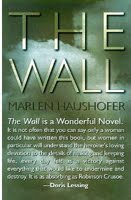
Marlen Haushofer (Austria 1920-1970) has written a few novels but the one that really stands out is The Wall. I have read this book a long time ago but it is still haunting me. This is such a powerful story and I would like to recommend it to all of you who haven’t read it yet. It’s been called dystopian or feminist ecological and whatever not. All wrong. This is an absolutely uncanny look into the frailty of human existence. The protagonist wakes up one morning to find herself totally isolated from any other human being and separated from the rest of the world by an invisible wall. She struggles hard to survive. She isn’t completely alone, she has her animals, one of them a dog. It’s fascinating to see how resourceful she is and after a while her life seems almost normal until the day she senses someone else’s presence…

Ingeborg Bachmann (Austria 1926 – 1973). Bachmann is one of the most interesting German writers. There is nothing she couldn’t write marvellously well. Poems, short stories, a novel. They all contain a rare and savage beauty, something raw and refined at the same time. Her only novel Malina aka Malina (German), which is part of the Todeasartenzyklus (The Cycle of Manners of Death), contains a very uncanny element. I’m not going to reveal it but if you read it and read her biography you will see what I mean. Her books circle around death and different ways of dying. It’s eerie to know that she died a particularly strange death. She was smoking in her bed in Rome and because of the high amount of pain killers she took, she burned alive without realizing it.

Brigitte Reimann (German Democratic Republic 1933 – 1973). If I had studied German literature and had to choose a research topic it would have been her. If I had studied psychology, I would have chosen her as well. Reimann was an amazing woman. She wrote a few novels that are highly engaging, although flawed. I know of no ex DDR writer who was so much in favour of her country and still managed to analyze it in-depth, to show the difficulties, the contradictions. On the other hand she was an excessive woman and an addict like no other. She had probably more lovers than any other writer ever, was married at least four times. She drank excessively and smoked too much. She was only 40 when she died of cancer. What makes her so fascinating is that she kept a diary and reading it is mind-boggling. This was such an intelligent and intellectual woman, yet she didn’t get how unfree she was, unfree through the state she lived in and through her way of life. Her life has been made into an interesting TV movie starring beautiful Martina Gedeck Hunger auf Leben (not sub-titled).

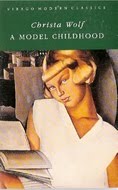
Christa Wolf (German Democratic Republic – Germany 1929 –  ). She doesn’t need a lot of introducing as she is probably one of the best know German women writers. Her oeuvre is interesting and captivating. Some of the early books are easily readable and so are her short stories. Some are complex and almost experimental. I couldn’t recommend one single book as she has written so many and in so many different styles that I would need to know someone to know which one to pick. I personally like No Place on Earth aka Kein Ort. Nirgends that explores the tragic lives of Karoline von Günderrode and Heinrich von Kleist but I would also recommend her Cassandra aka Kassandra which stunned me and her more famous ones A Model Childhood aka Kindheitsmuster and The Quest for Christa T. aka Nachdenken über Christa T.

Monika Maron (German Democratic Republic – Germany 1941 – ) Like Christa Wolf, Monika Maron was born in the former German Democratic Republic and many of the novels she wrote circle around themes related to her home country. Flugasche aka Flight of Ashes is one of the most famous ones and tells the story of a journalist uncovering the environmental pollution stemming from a coal-fired power pant. I like Maron’s later novels a lot. They all explore the inner lives of women and are very subtle and engaging. However they are not translated with the exception of Pavel’s Letters that I haven’t read yet.

Elfriede Jelinek (Austria 1946 – ) Nobel Prize winner.  The Piano Teacher aka Die Klavierspielerin is an unpleasant book. It’s fantastic but I didn’t like it. The story of the piano teacher whose dominant and dysfunctional mother crushes her and turns her into a being torn between masochism and sadism and who tries frantically to repress her own sexuality, is hard to take.

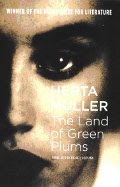
Herta Müller (Romanian born German 1953 – ) Nobel Prize winner. Being awarded the Nobel Prize seems to help you getting published. Most of Herta Müller’s books are available in English. I’m puzzled about the English titles.  The Land of Green Plums  aka Herztier (Heartanimal) The Appointment – Heute wär ich mir lieber nicht begegnet (I would have preferred not to meet myself today), The Passport aka Der Mensch ist ein grosser Fasan auf der Welt (Man is a large pheasant in the world). Herta Müller was born in Romania and her novels all explore life under a communist regime. She wrote novels, poems and essays that all deal with the aftermath of terror, violence and cruelty.

Judith Herrmann (Germany 1970 – ). If you would like to read a contemporary author who has so far refrained from writing about WWII or history in general but prefers to explore her characters interior lives and how they are rooted in our contemporary society, then you should read Judith Hermann. I’ve hardly been as impressed by a collection of short stories as by her Summerhouse, later. She has since written another collection Nothing but Ghosts and a novel Alice. This is contemporary German writing at its best. Poignant and poetical.

I could add a lot of other names. Especially in the last few years there have been a lot of new voices, some of them great. Lizzy will focus more on newer books and will also review the one or the other younger author, like Alina Bronsky.

Please, don’t forget to leave a comment with a link, should you have written a post and also hop over to Lizzy who starts German Literature Month with The Magic Mountain of German Literature.

All the posts will be compiled in the German Literature Month November 2011 Participants – Links – Giveaways Page