Some Plans: Spanish Literature – Japanese Literature and Mary Hocking

Japanese Literature Challenge

I’m not good at sticking to plans and projects these days. Especially not when I add reading lists to my intro posts. That jinxes it every time. Therefore, I’m not going to make the same mistake again and just let you know that I will take part in three events. Maybe these announcements will inspire the one or the other to join as well.

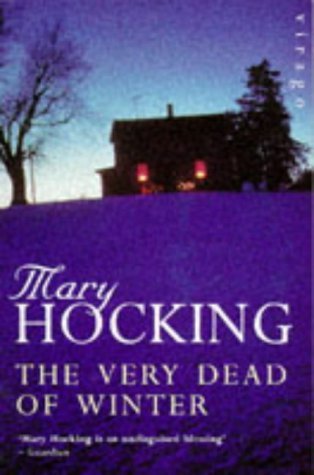
First up is Heavenali’s Mary Hocking Reading Month. I’d never heard of the author, nor was I familiar withHeavenali’s blog before I saw an announcement on Kaggy’s Bookish Ramblings. Browsing told me that Mary Hocking is right up my street and I decided, if I can get one of her many novels (many are out of print), I’ll join. So this is the only plan I’m sharing. I’ll be reading Mary Hocking’s The Very Dead of Winter.

The Very Dead of Winter

Here’s the blurb

This is a portrait of a family forced to confront the grievances of their shared past. In the very dead of winter they assemble at a remote country cottage enveloped in snow. Mary Hocking has also written “Good Daughters, Indifferent Heroes”, “Welcome Strangers” and “An Irrelevant Women”.

Should you want to join, there are quite a lot of used copies available. She’s written a lot of books, many of which have been published by Virago and are still in print. You can find a list on Heavenali’s blog.

spanish_speaking_countries_flags

July is Spanish Literature Month hosted by Richard (Caravana de Recuerdos) and Stu (Winstonsdad’s Blog). Two years ago, when they hosted the first Spanish Literature Month I had some wonderful plans and failed miserably. This year it should be different. I’ve been collecting books for the event, the general direction might be crime, but I’ll decide what I’ll read spontaneously.

Japanese Literature Challenge

Bellezza’s Japanese Literature Month 8 has started on the first of June and runs until the end of January 2015. On Bellezza’s blog you’ll find reading suggestions and links to the review site. This year I will read whatever I like, without taking into consideration whether or not the book has been translated into English. Hopefully I’ll be in the mood for something that has been widely transalated.

Will you participate in any of these events?

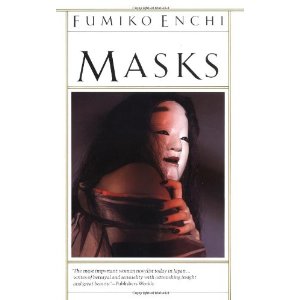
Fumiko Enchi: Masks – Onnamen inaudita (1958)

Masks

Mieko Togano, a highly cultivated, seemingly serene, but frustrated and bitter woman in her fifties, manipulates for her own bizarre purposes the relationship between her widowed daughter-in-law and that woman’s two suitors.

I just finished Fumiko Enchi’s Masks. Enchi was one of the most important Japanese women writers of the so-called Shōwa period (reign of Emperor Hirohito). The role of Japanese women was an important aspect of her work. Most of her figures are still old-fashioned, very obedient, even subservient figures. Nevertheless they try to fight their oppressors, sometimes, like in Masks, using rather unusual methods.

Masks is a mysterious novel. Looking at Masks superficially you could call it the tale of a vengeance. It’s a dark, mean, unfathomable story. The German edition I’ve read even calls it a crime story. A very unconventional crime story. Although nobody commits a murder, I was reminded of the work of Boileau-Narcejac, notably The Fiends – Diaboliques.

Mieko is a widow and a famous poet. She lives together with her equally widowed daughter-in-law, the beautiful, young Yasuko. Ibuki, one of Yasuko’s suitors, suspects the relationship to be sexual. The two women are very close. Yasuko pretends, she wants to break free but doesn’t make any attempts to change her situation.

Yasuko continues her late husbands studies of possession and necromancy. The two women, together with Ibuki and Mikame, form a literary and spiritualistic circle. Ibuki, a professor of literature, and Mikame, a doctor who dedicates his free time to anthropological research, are both specialized in the belief in ghosts and possessions.

Both men are attracted to Yasuko and feel as if they were under a spell. The mysterious thing however is that it’s not Yasuko who cast the spell but her mother-in-law Mieko.

Later in the book we learn a lot about Mieko’s tragic life and how badly she had been treated by her late husband. Her role as dependent wife who was at the mercy of a cruel man, turned her into a vindictive woman. The only man she really loved was her son Aiko, Yasuko’s late husband but he died on mount Fuji.

The story of her vengeance is pretty uncanny and the end is more than a little surprising. Both men are used like puppets and one of them pays a considerable prize for getting too close.

The novel bears great similarity with a black and white painting on which just a few, small details are highlighted in colour. The story and the people are black and white, with some shades of grey, while the descriptions of nature stand out in a most descriptive and colorful way.

What I loved about this book was the combination of many different aspects. It combines dark erotic elements, beautiful small descriptions of nature, a fascinating story and a complex symbolism. Many aspects of traditional Japanese culture like the No-Masks, the Tale of Prince Genji, the firefly festival and many more, build an interesting backdrop.

Masks is a haunting book, full of mystery, darkness, beauty and with an ending worthy of a psychological thriller. I’d recommend it to anyone who likes Boileau-Narcejac, as well as to the fans of Yoko Ogawa.

Hiromi Kawakami: The Briefcase – Sensei no kaban (2004)

Hiromi Kawakami is one of my favourite writers. Three of her books have been translated into German two of which are available in English as well. I loved both books I’ve read so far (Manazuru and Mr Nakano and the Women) and was looking forward to this third one which has been published last year in English.

I often hear people say they don’t know any Japanese literature or don’t know where to begin. I usually recommend Banana Yoshimoto as a first author but now I think Kawakami’s The Briefcase may be even a better starting point.

The Briefcase is a love story between a retired college professor and his former student Tsukiko. When you read “love story”, you may have some expectations but you will have to throw them overboard as nothing will quite match this story which is as far from a Western love story or romance as can be.

The professor or sensei and his former student  meet accidentally one evening in a bar. Tsukiko is 38 years old, a loner who doesn’t believe she will ever find true love. She isn’t too sad about this though, she is unconventional and likes to live on her own.

The professor is somewhat startled to meet a woman in such a bar and drinking a lot of sake at that but soon they are both delighted to find out that they like the same food and drinks and that they enjoy hanging out together. The relationship is very formal at first, nothing hints at a possible love story at all. Tsukiko is quite quirky and in the beginning the professor tells her constantly that she isn’t acting very ladylike, only she couldn’t care less. It becomes soon obvious that he isn’t less quirky. They never  make appointments, they just meet at the same bars week after week until one day pick when they a fight over something really silly. It’s only when they do not see each other any more for a long time that Tsukiko realizes she has fallen in love.

The way they slowly and carefully approach each other, and get to know each other is so lovely. They really take their time and only decide to be real lovers when they have spent a long time together and have seen each other at their worst. But they are also both very shy and not very experienced and have been on their own for a long time. Why the professor has been alone will only be revealed in the end.

The way this relationship is described is very Japanese. It’s filled with respect and an almost ritualized slow approach of another human being. None of them would ask the other any direct questions, the way they get to know each other is far more subtle. Through shared moments and mutual attention and observation.

There are many wonderful and typically Japanese elements which could have turned the book into a cliché if a lesser writer had attempted to write about them. Food is extremely important and we read about an incredible amount of different meals. Vegetables, mushrooms, fish we’ve never heard of are mentioned.

Japanese poetry, Haikus, the cherry blossom festival, calligraphy and many other things are very important as well and reading the book is a bit like a trip to Japan. Or at least like I would imagine it.

What I liked is how the book reads as if it had been painted with one of those very precise and fine calligraphy brushes. Kawakami can evoke an atmosphere and emotions in a few lines, and artfully captures how they are changing constantly. The story takes up almost a year and the change of seasons is captured as well as the change of emotions.

The end was a real killer, beautiful but quite sad. I highly recommend this wonderful and lovely book. It is a great introduction to Japanese literature, its sensibilities and esthetics.

I’ve read the book as a contribution to Tony’s January in Japan and Bellezza’s Japanese Reading Challenge.

January_in_Japan

Japanese Literature Challenge

Taichi Yamada: In Search of a Distant Voice – Toku no koe wo sagashite (1986)

Last year I read Taichi Yamada’s Strangers and it was one of the best books I’ve read that year. It haunted me for weeks. The mood, the atmosphere, it was beautiful and sad at the same time. I knew that it wasn’t his first book but the first to be translated into English. There are two other of his novels available in English one of which is In Search of a Distant Voice.

Just like Strangers, Yamada’s older novel In Search of a Distant Voice is a ghost story. But what a peculiar ghost story. Tsuneo works as an immigration officer in Tokyo. This means he chases illegal immigrants, takes part in raids, arrests people and sends them back to their country. Early on in the novel we learn that he has complex emotions which he fights and tries to repress. Some of them are linked to his professional life, some to his personal, very lonely life and another part has something to do with an incident which lies back ten years and took place in Portland, Oregon.

At the opening of the novel, Tsuneo has to get up in the middle of the night and take part in a raid to arrest Bangladeshi immigrants on the outskirts of Tokyo near a cemetery.

First he was overcome by a sense of foreboding. A second self would realize this back-and-forth was just part of the program. And the he would notice that even this realization itself was part of a ritual he had performed many hundreds of times. He was used to holding back moods. Keeping his feelings suppressed. Today, too, everything was happening as it always did.

When he runs after one of the immigrants and wants to arrest the man in the cemetery he is suddenly overwhelmed by an intense feeling which he cannot define at first but seems to be of an intense sexual nature. Tsuneo is delighted and shocked at the same time about the intensity of this experience. Something, a ghost, he thinks has flooded him with his or her emotions. When he returns home that day, he starts to hear the voice of a woman who speaks to him. At first he thinks he is going mad but then he is sure the voice is outside and not inside of his head. And although nobody else hears her, she seems real. It’s like having a phone conversation, only with a ghost.

Tsuneo’s has a lot on his mind these days. He feels pity for those people he arrests and he is wary of the arranged marriage he has agreed to. He is not in love with the woman but she isn’t a bad choice. But the more the book progresses, the more Tsuneo talks to the invisible woman, the more absurd the arranged marriage seems to be. He has a hard time to suppress his feelings and during the engagement ceremony when everyone is performing meaningless gestures and speaking empty words he starts to laugh uncontrollably and in the end breaks down and cries.

There is too much, Tsuneo has never told anyone. What happened in Portland for example or why he even went there. He cannot talk to his fiancée about that nor about the voice but he opens up to that invisible woman and tells her everything, the whole tragic episode that happened in Portland.

More than a ghost story, this is the portrait of a man who, at only 29, has given up on his hopes and dreams, who has repressed all of his feelings but cannot cope anymore. It’s the story of a breakdown, an analysis of guilt, suppressed sexuality, loneliness and search for meaning. There is a moving scene in which Tsuneo tells his friend that his life is completely meaningless. The friend is quite affected and answers that if this was the case, then his life would be meaningless as well.

It’s a flawed book as the end of the ghost story is not as satisfying as in Strangers – and the book is certainly pale in comparison to Strangers – but it’s still a very interesting book.  There are many beautiful scenes and reflections and I don’t think I’ve read a lot of novels which dealt as powerfully with the two complementary themes “strangers” and “immigrants” as this book. I didn’t love it as much as Strangers but I liked it too.

There is a third book available in English I Haven’t Dreamt of Flying for a While which I’d like to read as well.

The review is a contribution to Bellezza’s Japanese Literature Challenge 6 and Carl’s R.I.P. VII.

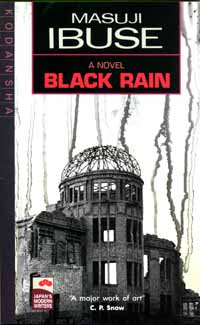
Masuji Ibuse: Black Rain – Kuroi Ame (1969) Literature and War Readalong July 2012

Reading Masuji Ibuse’s Black Rain was an intense experience. Beautiful and horrifying. In all honesty though I have to say the horror prevailed and I have to contradict those who say it’s not depressing. For sure, Ibuse isn’t a manipulative writer, he doesn’t strive for emotional reactions in his readers, but still, I couldn’t help being affected by what I read as no amount of toning down – something Ibuse has been accused of – can minimize the atrocity of what people had to endure on August 6 1945, in Hiroshima and the days and months that followed the bombing.

I think one hast to call Black Rain a documentary style novel. In order to write the book Ibuse has used real diaries and notes of victims and incorporated them in his book. Additionally the descriptions are so detailed and often matter-of-fact that the book reads in parts like a non-fiction account.

The main story is the story of Shigematsu Shizuma’s niece Yasuko. She would like to get married but a marriage is endangered as there are rumours that she got in the Black Rain after the bombing of Hiroshima and suffers of radiation sickness. Shigematsu himself is afflicted by a mild form of radiation sickness which he tries to fight by eating as healthily as possible and with mild exercise and a lot of rest. At the beginning of the novel which starts a few months after the bombing, Yasuko shows no signs of sickness at all. In order to help his niece and to prove that she didn’t get in the Black Rain and is not ill, Shigematsu starts transcribing his niece’s and his own diary covering the days before and after the bombing. The diaries are meticulous and incredibly detailed accounts of those days. The novel moves back and forth between the diary entries of August 5 – 15 and the present in which the entries are copied.

I have seen pictures of Hiroshima and read a few things but never anything like this book which was absolutely overwhelming in its details and the way it captured human suffering. The descriptions always move back and forth between individual and collective experiences. There were descriptions of people who had only mild burns and some whose whole body was an open wound. Some died in agony, some in grotesque positions. There were descriptions which showed how some people afflicted by radiation sickness a few days or weeks later died suddenly while others agonized for months. Towards the end there is a real account of a doctor who served in the infantry and was almost directly under the bomb when it exploded. It was unbearable to read about the suffering he went through.

I was surprised to see what an important element food is in the book. We read detailed accounts of what food was available during the war, how it was prepared and how they had to substitute a lot. Food is also one of the major elements in a successful treatment of radiation sickness. It was fascinating and sad to read.

What shocked me more than anything else, more than the descriptions of the wounded humans and animals and the ensuing total chaos, was the utter helplessness which was expressed in the way how they spoke about the bomb. They had no clue what had happened. They knew it was something unheard of,  never used before, but they didn’t know anything specific. What were the effects? Were burns the only thing or would there be more to come later? How did you treat radiation sickness? Days later they find out what had hit them.

“The name of the bomb had already undergone a number of changes, from the initial “new weapon” through “new-type bomb” to “special high-capacity bomb.” That day I learned for he first time to call it an “atomic bomb”.

The confusion and helplessness of the people is terribly sad. Even more when you read how they started to realize that even people who were not in Hiroshima on August 6, but part of rescue teams who came later, all died. This meant that each and every person who had been in Hiroshima on the 6th or came later would have to wait, sometimes for months, to be sure they were not affected by radiation.

After having read all this you will probably wonder why I called this book “beautiful”. I thought it was beautiful because the way Ibuse describes the Japanese culture, Japanese sensibilities, the descriptions of the food, the habits, some customs and many details of things we are not familiar with is full of beautiful moments like this description of Shigematsu’s childhood.

As a boy, Shigematsu had seldom come to the flat rock to play, but he had often been to play under the ginkgo tree at Kotaro’s place. When the frosts came and the ginkgo tree began to shed its leaves, the roof of Kotaro’s house would be transformed into a yellow roof, smothered with dead leaves. Whenever a breeze sprang up, they would pour down from the eaves in a yellow waterfall, and when it eddied they would swirl up into the air – up and up to twice, three times the height of the roof – then descend in yellow whirlpools onto the road up the slope and onto the oak grove.

Of course the same culture which had such a lot of beauty was also trapped in a destructive system of total obedience which is mentioned more than once in the novel. It takes a masterful writer to be able to convey so much insight into a culture and render a tragedy the way he did it. While Black Rain was not an easy book to read and has to be absorbed in small doses, I think it’s an outstanding book.  Without ever accusing anything or anyone Ibuse shows drastically that in the case of Hiroshima the end didn’t justify the means.

Other reviews

Danielle (A Work in Progress)

Judith (Reader in the Wilderness)

Rise (in lieu of a field guide)

Older reviews

Mel U (The Reading Life)

Gary (The Parrish Lantern)

The review is my first contribution to Bellezza’s Japanese Literature Challenge 6.

*******

Black Rain was the seventh book in the Literature and War Readalong 2012. The next one will be Aaron Applefeld: The Story of a Life – Sippur chajim. Discussion starts on Friday August 31, 2012.

Japanese Literature Challenge

Every year the Japanese novels I read are among my favourites. While I missed Bellezza’s Japanese Literature Challenge last year, I’m very keen on participating this year. It is a 7 month long challenge which has started this month and runs until January 30 2013.

I’m not going to share a proper list at this point although I have a pile with interesting books. Mostly in French or German translations which makes it tricky to find the English titles and, as so often, they do not even exist in an English translation.

A few of the translated choices are

Ueda Akinari’s Tales of Moonlight and Rain.

Soseki Natsume’s Kokoro

Lady Sarashina As I Crossed A Bridge of Dreams: Recollections of a Woman in 11th Century Japan.

I already know that one of my first contributions will be the July title of my Literature and War Readalong.

Masuji Ibuse’s Black Rain is said to be one of the most important novels which have been written on Hiroshima.

If you participate in the Japanese Literature Challenge you might consider joining us in reading this novel.

The discussion is due on Monday, July 30 2012. An introduction post to this novel will follow shortly.

Hiromi Kawakami: Manazuru (2006)

Manazuru is the first novel by Hiromi Kawakami that is available in English. She has been one of Japan’s most celebrated novelists since her first short story came out in 1994. I have read another one of her novels a couple of years ago. Many of her books are available in German and in French. (If you love literature in translation, especially Japanese literature, and you are able to read German and/or French, you have much more choice. I have for example read Hotel Iris by Yôko Ogawa, that came out last year in English, in a French translation almost ten years ago.).

The first novel by Hiromi Kawakami that I read is called Herr Nakano und die Frauen (Mr Nakano and the Women.) It’s a wonderful novel. A lot of what I liked in Herr Nakano is present in Manazuru too, still I wonder why they chose this novel to introduce Kawakami to English-speaking readers. Mr Nakano would have been a much better choice as it is much more typical for her writing. There are supernatural or dreamlike elements in Manazuru which are not present in her other books and which reminded me more of Murakami.

Manazuru is not easy to describe. It’s a mysterious book, filled with a dreamlike mood, shifting realities. Something very soft and gentle pervades it.  Still it’s very realistic. The story is told by Kei, a young woman who lives with her daughter and her mother in an apartment in Tokio. The three women live a very peaceful live, they share many intimate moments, cooking and eating together, stitching and knitting. They treat each other kindly but each of them leads her own life, of which the others know nothing. Kei thinks a lot about her relationship to her daughter and how unique it is. How she doesn’t love anyone like her with so much awkwardness. She thinks about what it means to have a child, physically. To feel her emotions because they once shared a body.

Kei’s husband Rei has disappeared ten years ago. Although she has been in a happy relationship with a married man, she has never forgotten her husband. She wonders always where he has gone, why he left or what has happened to him. At the beginning of the novel she decides to travel to Manazuru, a little seaside town where Rei has disappeared. When she arrives she feels a strange presence. A woman follows her, a woman who seems to be a ghost, whose density changes constantly. Sometimes the woman is just a shadow, sometimes Kei can touch her. She thinks this woman knows what happened to Rei.

Kei takes many trips to Manazuru all through the novel. Sometimes with Momo, her daughter, mostly on her own. Whenever she arrives there, she is in a dreamlike state that brings her very close to Rei. During her last trip she finds another village that is like a ghost village. Cranes are sitting on the dilapidated roofs (Manazuru means crane btw..) The houses have been abandoned. She thinks about the fact that an empty house is at first just empty but then, after several years, it gets a life of its own. Ivy will grow inside. Weeds  and many other plants will take over. It’s a bit like Kei herself after Rei abandoned  her. At first there was emptiness and loneliness and then she became someone else.

I liked Manazuru a lot because of its mood and because of the importance of moods. Kei doesn’t so much analyze her feelings or thoughts as describe her moods. They shift ever so lightly, just a little bit. They have the subtlety of scents, the same fleetingness.

What I love in Kawakami’s writing in general is her ability to capture those intimate moments in which hardly anything happens or is said, those moments during which people are sitting together, without talking and it still feels intimate and meaningful.

Hiromi Kawakami is one of the best authors  to start with for someone who isn’t familiar with Japanese writing because she is such a gentle writer. Her books are lovely and even tragic elements are toned down. We know her characters will make it in the end, move on, find meaning and all that stays from a tragic event is a feeling of bitter-sweet regret but no despair.

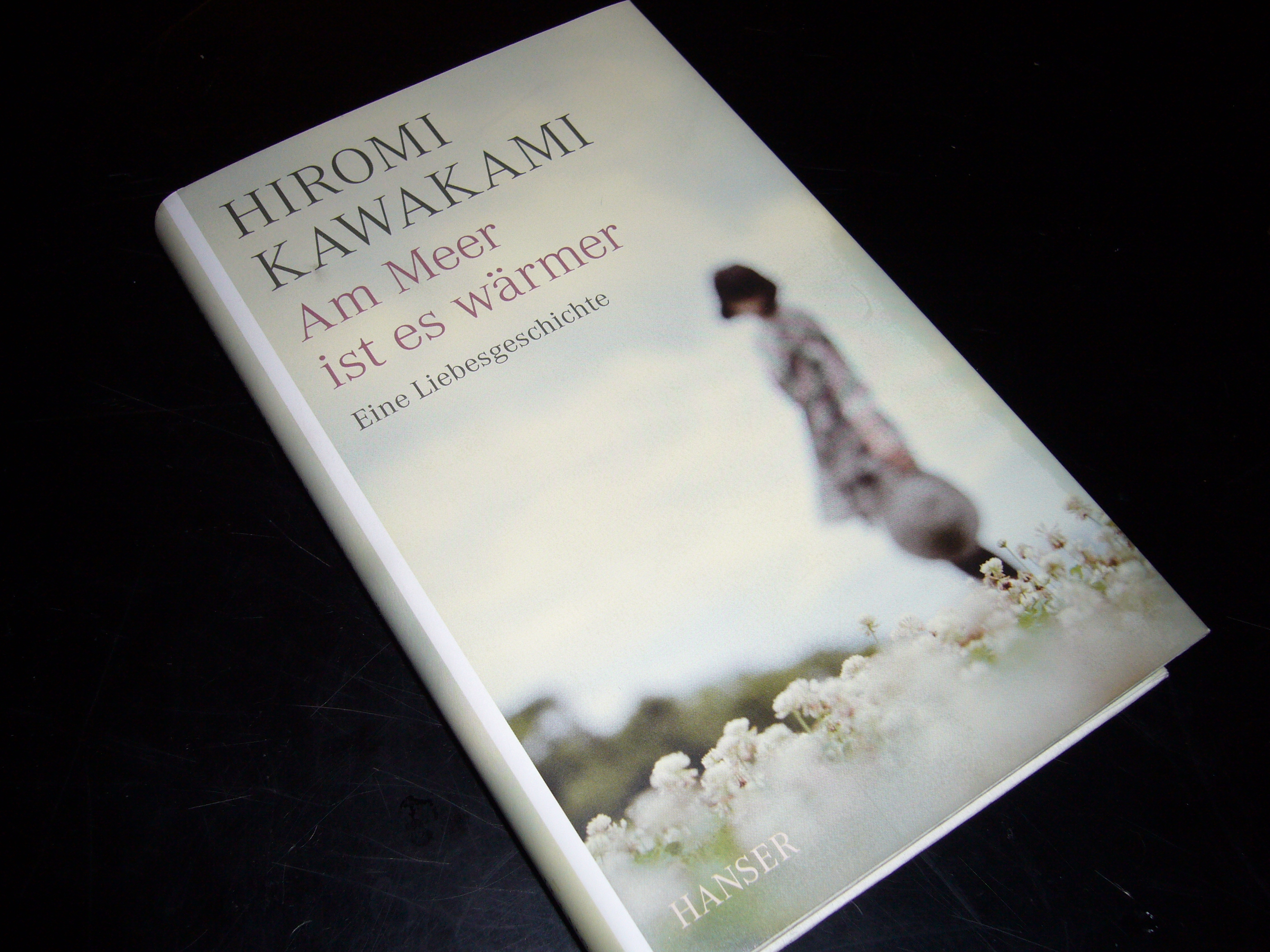
I read the book in German. I really love the cover. The woman is blurred, only the little flowers, (Immortelle, I think) at the bottom of the picture are in focus. It captures the mood of this novel much better than the English one in which the focus is on the woman.