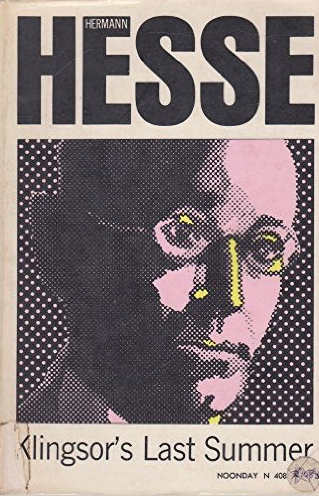
Hermann Hesse: Klingsors letzter Sommer – Klingsor’s Last Summer (1919)

Klingsor's Last Summer

The novella Klingsors letzter Sommer  or Klingsor’s Last Summer is another of Hesse’s autobiographical books. Like Veraguth in Rosshalde, Klingsor is a painter. As you may know, Hesse painted as well, so the choice of painters as alter egos makes a lot of sense. While both books are inspired by Hesse’s life and both have painters as protagonists, they don’t have much else in common. Veraguth was a realist painter, Klingsor is an expressionist. Veraguth is trapped in a loveless marriage, Klingsor is a free-spirit living an excessive life on the brink of disaster.

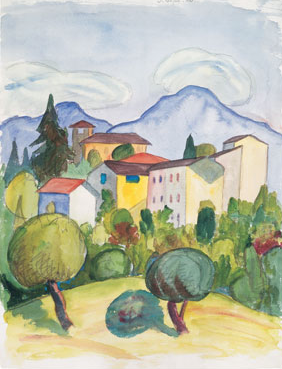
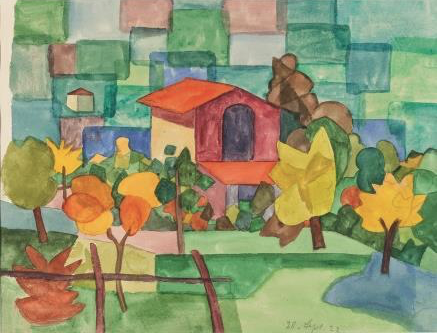
The way Hesse chose to write his novella is interesting because he seems to paint with words, tries to capture Klingsor’s expressionist work, and uses some of the most interesting and nuanced names for color. Here too, I liked the descriptions. The story is set in the Ticino region, the Italian part of Switzerland. It has one of the most beautiful landscapes I’ve ever seen. Hesse barely disguises the real names. He calls Lugano – Laguno, Sorengo – Barengo  . . . As much as I liked Rosshalde, I really didn’t care for this novella. I hated the main character too much.

Screen Shot 2016-03-10 at 08.36.55

Klingsor is an exalted, self-centred, alcoholic, womanizer and possibly bi-polar. The passages in which he is frenetic and exalted, tries to have sex with every woman he meets, drinks one bottle of wine after the other, and sees death, decay and destruction everywhere, were hard to take. I’ve met a few people in my life who had traits of Klingsor. I really have a hard time coping with this type of energy, even on paper. That said, I might not do this book any justice.
Screen Shot 2016-03-10 at 08.37.57

Nonetheless, I’m glad I read it because it’s interesting to see, how the changes in Hesse’s life are reflected in this story. When he wrote this, he’d left his wife and three kids. Subsequently, sis wife had to be sent to a psychiatric hospital and Hesse too saw a therapist. Even his painting seems to have changed and he moved away from realistic depictions, to more expressive forms.
Screen Shot 2016-03-10 at 08.40.35

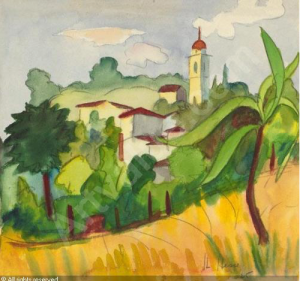
What I truly enjoyed is the way he captures expressionist paintings. His choice of words is so strong and powerful; we can see distorted landscapes, painted in striking colors. Towards the end, he paints a self-portrait that really comes to life.
Screen Shot 2016-03-10 at 08.38.38

Klingsor’s letzter Sommer is a short book. It’s essential reading for anyone who loves Hesse but not a good starting point for those who haven’t read him yet.

The biographical elements I’ve mentioned here and in my earlier post are taken from Heimo Schwilk’s Hesse biography. It came out in 2012. Unfortunately, it hasn’t been translated yet.

Hesse bio

If you’d like to read another post on Klingor’s Last Summer – here’s Pat’s (South of Paris Books) review.
Hermann Hesse: Rosshalde (1914)

Rosshalde

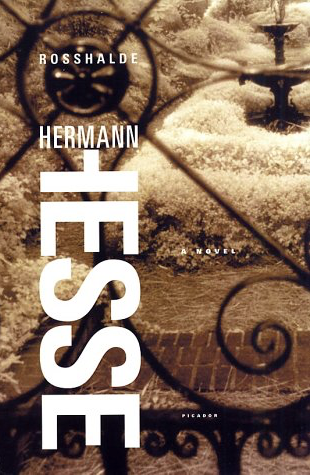
Published in 1914, Rosshalde is Hermann Hesse’s fourth novel. It tells the story of a failed marriage and the disillusionment of a painter. In many ways it’s a continuation of Gertrude. Both novels are autobiographical, Rosshalde even more so than Gertude. Hesse often tried to make sense of his own life in writing his books, that’s why critics call many of his narrators alter egos.

Johann Veraguth, the main character of Rosshalde, is a painter who is entirely dedicated to his art. The only love in his life is the love for his second son Pierre. He bought the estate Rosshalde many years ago when there was still hope for his marriage. At the beginning of the novel, he returns home one night on his own and looks at the dark house. He has moved out a long time ago and lives in his artist’s studio. He gets up very early every morning, paints until noon, then takes lunch with his wife and son and later paints again until the evening. He’s a rich and famous painter, lives a life of ease, surrounded by beautiful things, he even has servants but he’s very lonely. His wife is hard and distant and has never really understood how he could be so absorbed by his art. His first-born hates him and had to be sent to a boarding school. His best friend travels the world and only rarely returns to Europe. The only joy in his life is his little boy. If his wife allowed him to keep the boy, he would have divorced her a long time ago.

Veraguth is unhappy but he doesn’t even realize it. He’s a bit like a well-oiled machine. He produces one painting after the other, follows a strict routine. All this changes when his old friend pays him a visit. He’s shocked when he sees how Veraguth lives and tells him he has to leave. He cannot go on living in such loveless isolation. But Veraguth cannot make up his mind. He’s too attached to his boy. Nonetheless, he has to admit that his friend is right and before he leaves again, he tells him he might follow him to India and spend a couple of months with him.

I had very mixed feelings while reading this. I didn’t like the beginning all that much but from the middle on, I really started to love this book. I finished it a week ago and it’s still constantly on my mind. There’s so much to like here. But there’s also a lot that I didn’t like. I really loved the descriptions and being in Veraguth’s head when he contemplated nature, his garden, his art. Those passages reminded me of Mercè Rodoreda’s novel Jardí vora el mar. In both books, a solitary man lives in a small house, surrounded by a huge garden and follows the life that is led in the estate nearby. But these passages also reminded me of Virginia Woolf’s The Voyage Out. The end of the novel has affected me quite a bit. I can’t really say anything without spoiling it – just this much – it’s very similar to The Voyage Out as well. I also liked how Hesse depicted Veraguth. The man’s so absorbed by his work, so self-centered, that he doesn’t even notice when his kid needs him, although the boy is the only really good thing in his life. Some of these scenes were written from the small boy’s point of view and were very sad.

What I didn’t like is the idea behind the novel. As I said earlier, it’s autobiographical and closely mirror’s Hesse and his wife’s marriage. From his biography I know that Hesse believed that artists – writers, painters, musicians – should never get married and live conventional lives. His own wife didn’t really understand him and having to provide for her and his three kids took its toll on him. Unfortunately, his views are so dated. His views on marriage, artists, and especially his views on gender. When you read about his views, it’s clear that the artist is always a man and the woman, who wants children and is dependent on him financially, will become a burden. Even so, Hesse thinks that the true failure of the marriage comes from the fact that an artist makes a poor companion. He’s too narcissistic, to self-absorbed. I couldn’t agree less. I’m sure there are artists like that but there are just as many narcissistic, self-absorbed people who don’t create anything. I’m afraid, it might have been a character trait Hesse struggled with. My problem with it is that he thinks it’s a universal problem, thinks that all artists are like that.

And then there’s the language. Hesse’s a very original writer. He creates words, uses new combinations but his German feels very old-fashioned, and his choice of words are at times too emotional, too sentimental. Don’t get me wrong, in spite of these negative aspects, I’m glad I read this and really loved it. But I had to ignore his views on men, women, artists, and marriage and just enjoy the amazing descriptions, the interior life of his protagonist and the terribly tragic story.

Rosshalde might be one of the best books for someone who hasn’t read Hesse and is a bit wary of his spirituality. Those who love him, do love him for that, but those who shy away from him or don’t appreciate him, often mention that aspect. Rosshalde isn’t like his later works in that regard. It talks about transcendence of some sort, but it isn’t meant in a religious way.

Have you read Rosshalde or any other of  Hesse’s books? Which is your favourite?

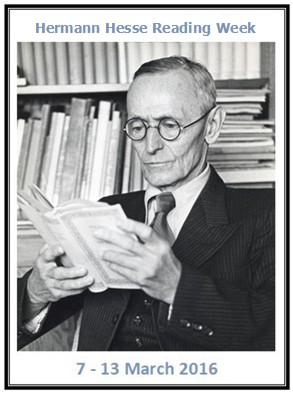
Welcome to Hermann Hesse Reading Week 7 – 13 March 2016

hesse revised

Today is the first day of Hermann Hesse Reading Week, here at my blog and over at Kaggsy’s Bookish Ramblings. I’ve been busy and have read a couple of books (Rosshalde, Klingsor’s letzter Sommer, Wanderung) and will write about them shortly. Pat (South of Paris Books) and I will both write about Klingsor on Thursday 10 March, so if anyone has read that too, try to  join our discussion.

If you participate, please use the Mr. Linky, so Karen and I can visit and comment. Just add your name (blog) + the name of the book you’ve read and then the link below.

I wish everyone a great week.


Hermann Hesse Reading Week March 7 – 13 2016

hesse revised

I think it was in October when Karen from Kaggsy’s Bookish Ramblings and I had the idea of a Hermann Hesse week. We both have come to him very early. She started reading him in her 20s, while I read my first Hesse as a teenager. I returned to him later, in my 20s, but since then, I don’t think I’ve read him again, with the exception of his poems and fairy tales.

Hesse

Initially, I wanted to reread some of my favourites, but now I’ve decided, I’ll rather pick the one or the other I haven’t read yet. So, I’m planning on reading Rosshalde and Klingsor’s letzter Sommer. 

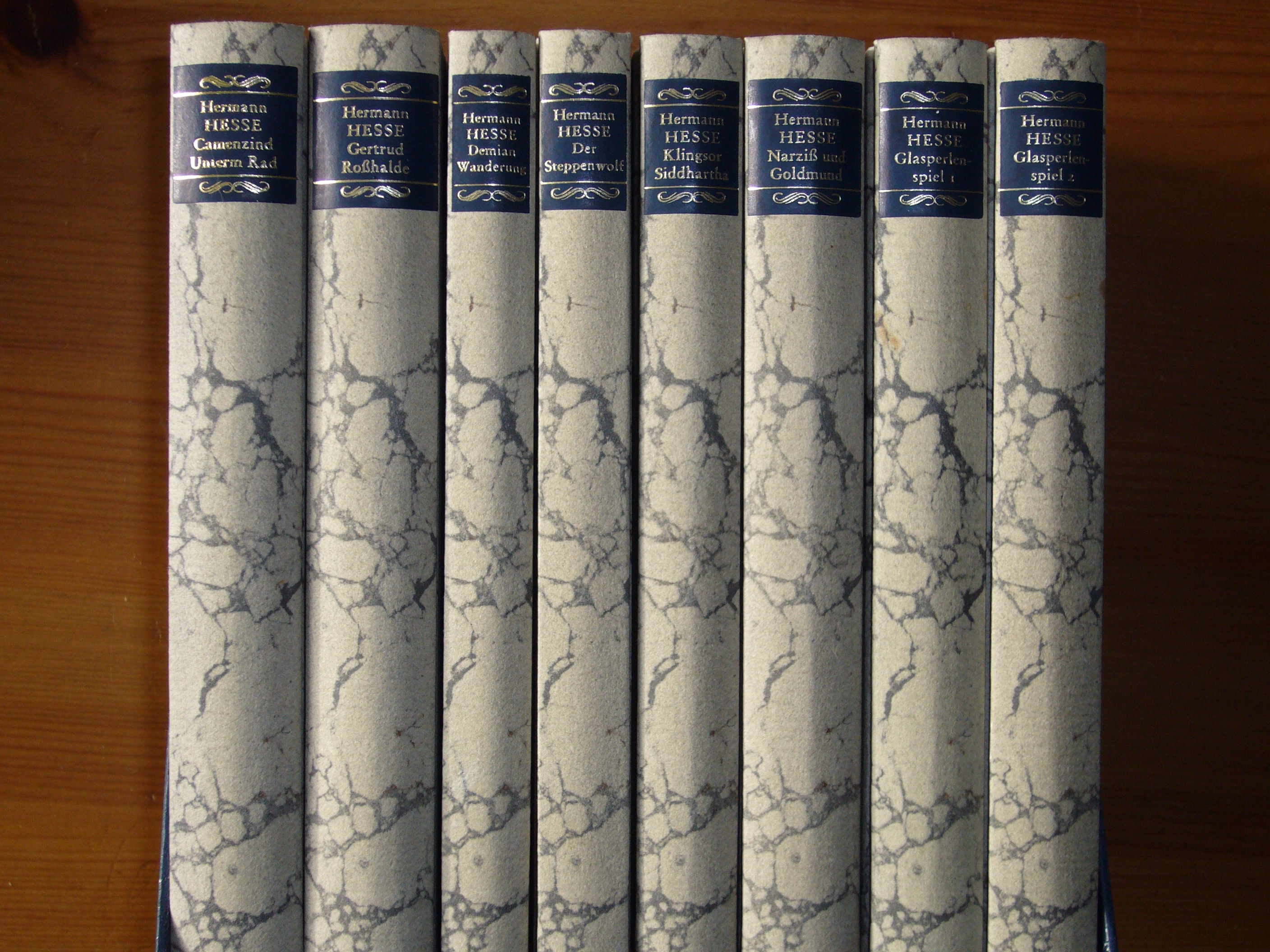
Luckily, I got this lovely collection of his novels and novellas. If I have enough time, I got a few other good choices. I also recently bought a small book that contains poems, letters, non fiction, and excerpts of some of his novels. From what I’ve seen so far, it’s great.

I hope you’ll join Karen and me. I know that Hesse is a favourite of many of the readers of my blog.

For those less familiar with him, Karen’s written a wonderful introduction. You can find it here.

Have you read Hesse? Will you join us?

Ursula Poznanski: Erebos (2011)

Erebos Poznanski

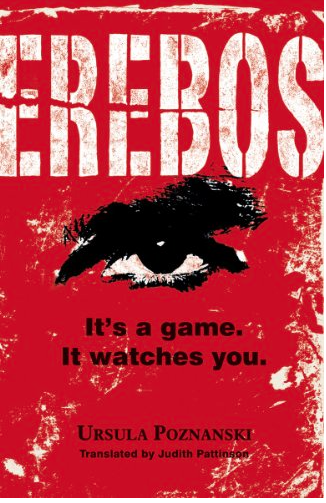
Are you playing the game – or is the game playing you? A highly addictive thriller about power, manipulation and revenge.

‘Enter. Or turn back. This is Erebos.’

Nick is given a sinister but brilliant computer game called Erebos. The game is highly addictive but asks its players to carry out actions in the real world in order to keep playing online, actions which become more and more terrifyingly manipulative. As Nick loses friends and all sense of right and wrong in the real world, he gains power and advances further towards his online goal – to become one of the Inner Circle of Erebos. But what is virtual and what is reality? How far will Nick go to achieve his goal? And what does Erebos really want?

Enter Erebos at your own risk. Exciting, suspenseful and totally unputdownable.

I must honestly say, when Lizzy suggested Erebos as her readalong title, I wasn’t thrilled. I couldn’t tell you why. Certainly not because it’s a YA novel. Maybe because I wasn’t sure whether it was some sort of fantasy or a realistic thriller? And because I was worried about the writing. Some recent German thrillers that have made it into translation were anything but well written. Imagine my surprise when I detected that Erebos wasn’t only well-written but so gripping and believable, I couldn’t put it down. It might be the thriller of the year for me. Unfortunately for this review, part of the appeal is that we don’t really know what’s going on. Is it realistic? Is it fantasy? Science-fiction? I don’t want to say too much. Only that I think it would appeal to anyone, whether you like more fantastic stories, or only read realistic novels.

So what’s it about? At a school in London, students exchange a computer game. Those who play it are not allowed to talk about it. Those who don’t, either want to be part of what feels almost like a secret society, or they openly hate the game.

Nick is at first one of those who don’t play the game. He watches his friends and is worried. What happens to them? Why are they sucked into this game like this? Finally someone passes the game on to him and he tries it out. Initially, he’s skeptical but that passes quickly and he, like all the others, is sucked into the world of Erebos.

Being addicted to a game might be bad enough, but this one seems to have an agenda of its own. It seems to know the players and their secrets and uses this against them. Part of the game are assignments in real life, and soon the virtual danger become very real.

I deliberately kept this summary very short because, as I wrote earlier, part of the appeal is discovering what’s going on.

Nick is a great protagonist and we root for him. He’s likable but flawed and undergoes important changes.

I really loved how Ursula Poznanski described the world of the game and the addictive part was shown in a very believable way. Once the assignments in the real word start, an entertaining read turns into an eerie thriller. I couldn’t stop reading, wanted to find out what was behind it all. So often thrillers have disappointing endings. Here again, Erebos is an exception. It’s pitch perfect from beginning to end. A must read for those who love YA novels and for fans of original, futuristic thrillers. I’m not surprised that Erebos has won the Deutscher Jugendbuchpreis, the German prize for Children’s Literature. It’s captivating and topical.

I finished this book before the attacks in Paris but meanwhile, I’ve heard that the terrorists also communicate via computer online games. A communication that’s particularly hard to decipher. All of a sudden, Erebos his even more topical. It certainly has a lot to say about addiction, manipulation, and retribution. Don’t miss it.

My Case for “The Artificial Silk Girl” – A Guest Post by John Lugo-Trebble

The Artificial Silk Girl

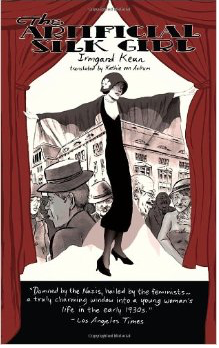
When you are part of a writers’ group, it’s only natural to discuss books. And so, a while ago, I mentioned German Literature Month on my writer’s forum and found out that one of the members. John Lugo-Trebble, had studied German literature and did research on Irmgard Keun (and other authors). While discussing, he said that he found she deserved to be more widely known, especially her masterpiece The Artificial Silk Girl Das kunstseidene Mädchen. I certainly agree with him, and so I asked him whether he felt like writing a guest post for German Literature Month. I’m very glad he said yes. John Lugo-Trebble is an American writer, living in the UK. Some of his short fiction is forthcoming on Jonathan the literary journal of Sibling Rivalry Press.

My Case for “The Artificial Silk Girl” – by: John Lugo-Trebble

Christopher Isherwood’s “Berlin Stories” was the inspiration for “Cabaret” which for an English speaking audience is often the image conjured up of Weimar Berlin. His Berlin is a decadent melting pot on the brink of implosion through the eyes of fun seeking expats. I don’t think you can argue that his observations are not important but for me, reading is like travelling and when I travel I always like to experience what locals would. This is why for me, one of the most important German texts capturing the era that should be read by English speakers is “Das kunstseidene Mädchen” (“The Artificial Silk Girl”) by Irmgard Keun.

Georg Grosz - Die Stadt

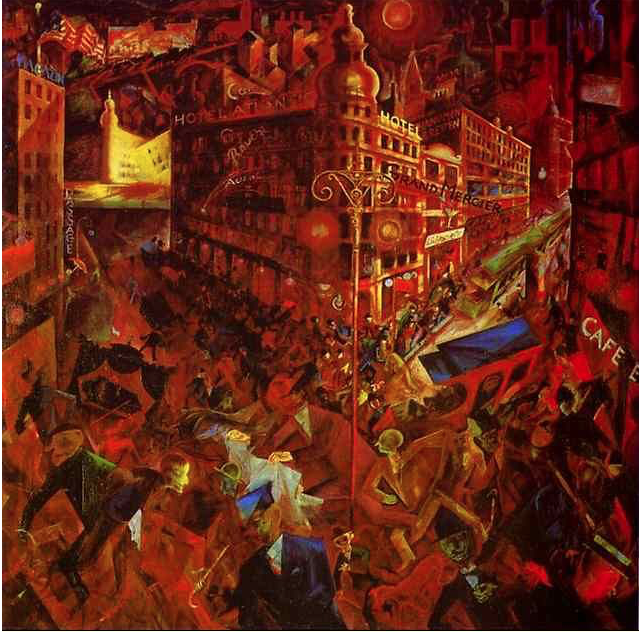
Irmgard Keun gives us not just a German insight but a female German insight to Weimar through the eyes of her protagonist Doris. Working in a theatre in Köln, young Doris craves the spotlight, like the women in the glossy magazines that are like her Bible. She wants glamour, she wants wealth. She doesn’t want to be like her parents, on the breadline. She especially fears becoming her mother and having to support a man, in a loveless marriage. Doris becomes enamoured with a fur coat at the theatre and decides to steal it. In her fur coat, she can dream of the life she so covets. She can pretend to be that wealthy young girl who deserves the finery in life. She can epitomise glamour when wrapped in the soft fur. Now a fugitive because of this coat, she runs to Berlin wherein her vain attempt in pursuing glamour she weaves through the city’s underworld of prostitutes, pimps, communists and even becoming a mistress herself. Her dreams quickly spiral out of control as she chases money, stability and ultimately love amidst the backdrop of Berlin’s economic and political turmoil; putting us in mind of one of Grosz’s paintings come alive.

On the one hand, Doris is a mirror of the limitations of the New Woman, a woman who was to be liberated from the shackles of Imperial Germany by the promise of the Social Democratic Weimar Constitution. The reality is the limitations of that liberation that came with the economic upheaval left by the Treaty of Versailles. There is though something in Doris’ tale that resonates still today and that is the pursuit of glamour, a desire for celebrity.

I was reminded only recently of “The Artificial Silk Girl” when I was watching “The Bling Ring.” For those of you who haven’t seen it, the film is loosely based on a crime spree in Los Angeles perpetrated by a group of celebrity admiring, glamour seeking teenagers who literally break into the houses of their style icons to steal their possessions. They are driven by this desire and need to be famous, to lead an untouchable existence of celebrity. I couldn’t help but think of Doris. The difference though is that Doris has a moral centre which comes forward as she sits on a bench at Bahnhof Zoo, no longer the girl start struck in pursuit of wealth, she is a woman aware of the world around her, her own limitations, and indeed her own desires. Will she head out of Berlin or stay? We don’t know, but what we do know is that the fur coat is long gone now.

Irmgard Keun is one of the few German women writers of her day who have been translated into English and I truly believe one of the finest writers of the Twentieth Century, full stop. She presents us with a protagonist who has the naiveté of youth and the observational skills of a woman of her day. You will fall in love with her vulnerability, laugh at her silliness and want to shake her till she grows up but also respect her path because she tries, even when there is no hope presenting itself. With Keun, there is a voice beyond Alfred Döblin and Hans Fallada’s portrayals of women which leave much open to debate. There is more than Sally Bowles.

*****

Thanks so much, John, for this interesting post. I hope those who haven’t done so yet, will soon pick up The Artificial Silk Girl, or one of Keun’s other great novels.

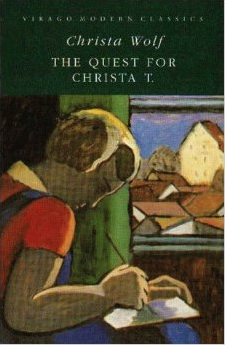
Christa Wolf: Nachdenken über Christa T. – The Quest for Christa T. (1968)

The Quest For Christa T.

I’m fond of paper weights. Especially those with a delicate glass ornament inside. Now imagine such a paper weight. Maybe there’s a fragile, colourful butterfly trapped in its centre. Take that paperweight and smash it against a wall. What you’ll be left with are shards of glass, splinters, some larger fragments, and maybe half of the butterfly will still be intact. That’s exactly what Christa Wolf seems to have done when she wrote the The Quest for Christa T. – Nachdenken über Christa T. What the narrator displays, is the fragmented story of her friend, who died too young, leaving behind a pack of notes and letters, and people who remember her, or think they remember her. The narrator sets out to capture her friend, an elusive woman, and piece together the story of her life and their friendship.

Remembering is complicated. We add, we subtract. Our memory plays tricks on us. The narrator goes back and forth between what Christa T. wrote down and what she thinks she remembers. The notes are not exhaustive. A lot has been left out. In order to capture her friend, the narrator deliberately adds, exaggerates, or embellishes.

Like the smashed paper weight, the story we read has beautiful broken parts; some are pieced together easily, others stay fragments.

The story has one chronological line, from the girls childhood, to the death of Christa T., but each chapter jumps back and forth on smaller timelines.

I really liked reading some of the passages of this book, but most of the time, I found it tiresome. And I wasn’t really interested in Christa T. I didn’t get what was so special about her. The narrator mentions rebellion and nonconformism, but on the outside her life didn’t seem rebellious or nonconformist. Are we meant to believe that having doubts, questioning the regime of the GDR was a rebellion in itself? I suppose so.

The most interesting aspect of the novel is how it shows the elusiveness of memory and of understanding another person. That’s quite well captured in the title which also evokes a central image that we encounter again and again. Sadly, the complex meaning of the title is lost in translation. “Quest” is much more active than the German “Nachdenken” – which means to think about something. A quest is a search, thinking however, can be done without moving. And then there’s the element of “nach” – which means “after” . In the image I mentioned before, we see Christa T.’s back, moving away. Very often we have the impression, all the narrator sees with clarity, is Christa T. walking away, disappearing. This is alluded to in the word Nachdenken – which sounds a bit like following someone in your thoughts.

As a whole, this book was frustrating but the different shards and pieces were beautiful. A lot is well said, subtly and brilliantly described. Many fragments are moving, especially those that deal with the loss of Christa T. The end is so sad. Not only because she is ill and dies but because they all lie to her. Doctors and friends alike. It doesn’t really allow them to say goodbye.

Another reason why I found the book frustrating is because it is muted, toned down. It seems to contain a lot of deliberate confusion. Maybe because Christa Wolf couldn’t write an unambiguous novel about a rebellious woman, without getting into trouble. Probably this might have been one reason for choosing such a fragmented, modernist approach.

I will return to Christa Wolf again but not very soon. I saw some reviews of this book. Three were more enthusiastic: HeavenAli here and Kaggsy’s Bookish Ramblings here Tony’s Reading List here. Booker Talk shares my frustration.