
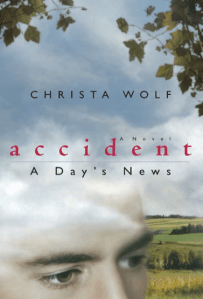

German Literature Month is almost over and we’re closing this year with a GDR week. I chose a book by one of the most famous authors from the former German Democratic Republic. Christa Wolf is the author of Cassandra, Medea, Divided Heaven, No Place on Earth, The Quest for Christa T. and many others. Apart from Medea, I’ve read the ones just mentioned. Cassandra is considered her best, but my favourite is No Place on Earth in which she imagines a meeting between two troubled writers who both committed suicide: Heinrich von Kleist and Karoline von Günderrode.
When Accident came out in 1987, it was praised a lot, but I feel it’s been almost forgotten since then. I don’t see it mentioned very often, which is a shame because it’s very topical.
Most people remember very well what they were doing the day something terrible happened. Almost everyone I know will be able to tell me what they did and where they were on 9. 11.. The disaster at the Chernobyl nuclear power plant was a major incident and those old enough will recollect it very well. It happened on April 16, 1986. I was a bit too young to fully grasp what had happened. And I was living in one of the countries far less affected. What made this disaster so catastrophic for the whole of Europe was the giant cloud. Cities and countries the cloud overflew were affected and when it rained it was particularly bad. The cloud seems to have split and that’s why in the case of Switzerland, the South was affected but not the North. In France, the Eastern part was affected, notably the Alsace region. Since that disaster there are high numbers of people with thyroid problems. There was a conference in Switzerland in 2016 in which doctors shared findings which indicate that there is still a high percentage of cancers in the population which can be linked to the Chernobyl disaster. People closer to the nuclear plant were obviously seriously affected. There’s an area of 30 kilometres around the plant which will be contaminated for thousands of years. The half-life of plutonium is roughly 24’000 years. Kiev, which is only 130 kilometres from Chernobyl, was lucky. The cloud passed them by, but it hit the smaller town of Bila Tserkva where thyroid cancer is very common.
Large portions of Scandinavia, Germany, and many Eastern European countries were also heavily affected but even the South of England was hit.
In her novella Accident Christa Wolf tells the story of that day. The narrator begins her tale by saying she can’t write about what happened in present tense and uses future perfect instead. There is something else going on in her life at that moment about which she writes in present tense. Her brother is undergoing a difficult brain surgery. The story moves back and forth between the things she’s doing, her fear about the cloud and whether it will rain, and her anxieties about her brother. It is a high-risk surgery, and he could potentially lose at least one of his senses.
She also talks to her daughters, a friend, and a neighbour. The interaction with the neighbour adds a WWII element to the story. The parts about the brother are written as if the narrator were speaking directly to him.
She listens to experts talking about the risk of nuclear power plants and listens to the government’s warnings. It’s clear they don’t really know a lot. The people are just advised not to eat any salad, nor to drink milk, and stay in as much as possible, especially should it rain. Children should not be allowed to play outside. We know now that the authorities in Russia lied and that it was far worse than they initially admitted.
I wrote earlier that this is a topical book. Many European countries are moving away from nuclear power. In some countries like Germany the debate is heated. There are so many pros and cons. If nothing goes wrong, it is by far the cleanest source of energy but if it goes wrong, then it is catastrophic. We all know how horrific Hiroshima was, yet the release of radioactive material from Chernobyl was 400 times higher. The accident in Chernobyl happened for two reasons – the plant was old and there was also human failure. Apparently, there are new technologies now that make it far safer. Many countries are developing newer, safer technologies, and smaller plants. In Germany they just blew up two of the cooling towers of the former nuclear power plant in Gundremmingen. Immediately afterwards, there was talk to go back to nuclear power.
The story of the narrator’s brother serves as an illustration for scientific advancement. In the future, machines would be able to perform this kind of surgery which would make it far less risky. The narrator isn’t anti progress or anti science, but it seems she feels that certain technologies shouldn’t have been developed. Nobody can really argue in favour of a hostile use of nuclear power. But at the end of the book, the narrator thinks that there is no greater risk than the risk of a nuclear catastrophe and that this risk alone means one shouldn’t even use this kind of energy in a positive way.
It is a peculiar little book. At times, it felt like she used these very different tenses to make it appear more literary and less like a nonfiction text. I can’t say I enjoyed reading it, but I found it extremely thought provoking. I really wonder what the world would look like if nuclear power didn’t exist.
 Beauty is a Sleeping Cat