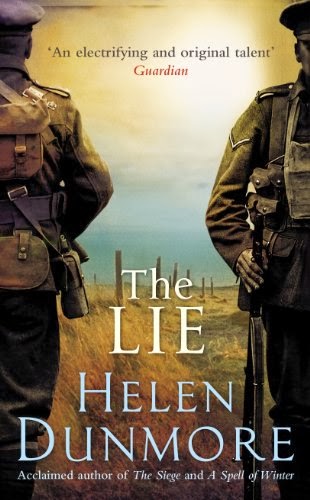
Helen Dunmore: The Lie (2014) Literature and War Readalong July 2014

The Lie

The Lie is not the first WWI novel Helen Dunmore has written. Nor is it her first book about war. While you certainly don’t have to read Zennor in Darkness, or The Siege, or her ghost story The Greatcoat, before you read The Lie, it’s interesting to see how she approaches war from different angles. The Lie is foremost about the aftermath of war. About the scarring, the wounds, in the souls, the bodies, the land.

The Lie is set after WWI in Cornwall. The narrator, Daniel, lives on a forlorn piece of land, overlooking the sea. He’s shell-shocked, but unlike so many other soldiers with post-traumatic stress disorder, who populate literature, he’s taciturn and withdrawn. Even people who know him, like his childhood friend Felicia, would not be able to tell what is going on inside of his head.

I’ve been quiet a long time, I know that. It happens. I go back in my mind. It’s not the same thing as remembering, because it has colour and smell and taste.

The land on which Daniel lives belongs to Mary Pascoe, an old woman, almost blind and frail, who lived outside of society, far from the town, all of her life. WhenDaniel returns from the war, she let’s him seek shelter on her land. When she becomes very ill and blind, Daniel takes care of her and moves into her cottage with her. She makes him promise not to fetch a doctor and to stay on her land once she’s dead.

He takes care of her until her last moment and buries her on her land. Daniel is an able gardener and can live of the land, whose soil is rich. There’s a goat and hens as well. When people start to inquire about Mary, he tell’s them she’s still alive.  The lie will be his undoing.

The story moves back and forth in time, is interwoven with flashbacks of his childhood during which he was friends with Frederick and Felicia, and flashbacks of the war.

I was green as grass. And there was first aid drill, which was like no first aid I ever saw in France. We had a dummy which kept still and didn’t scream, bleed, or stink of shit because its insides were falling out. They taught us to tie a tourniquet, and apply field dressings, and that gas lies in pockets close to the ground long after you think it’s cleared.

You’d think selfishness would be the stronger force, but it turns out that it’s not so. Tell a man to unwrap his puttees, take off his boots, dry each toe individually, examine his feet for sores and rub them all over with whale oil, and tell him if he doesn’t he’ll get trench foot which will cause his feet to go black and stink and maybe even have to cut off — well, you’d think he’d do it. But he doesn’t. He’s cold and wet and dead beat and all he wants is to get some kip. Tell him he’s responsible for the feet of the man next to him, and he does it.

Daniel fights on his own at first and later, with Frederick. Frederick and Felicia come from money, while Daniel is the son of a poor housekeeper. Frederick’s and Daniel’s friendship is tested often due to these class differences; it ultimately survives, because the attachment is so profound.

During the war the class difference almost splits them up, but their friendship survives even this test. It even survives death. We know from the beginning that Frederick is killed in France. We just don’t know how, but assume that Daniel must have witnessed it and feels guilty, as he’s haunted by his death. And by Frederick’s ghost. I thought it was strange that she chose to write another ghost story, right after The Greatcoat, but this isn’t a ghost story. I read the ghost as a symbol for how deeply rooted the trauma of war is.

All at once I know he’s going to come. The dead aren’t tied to one place. He’s as fearful as I am, more maybe. He knows what’s coming to him, and he can’t get away from it. Something’s gone wrong. Thing’s out to stop, once they’re finished, but this won’t stop. They say the war is over, but they are wrong. It went too deep for that. It opened up a crack in time, a crater maybe. Once you fall into it, you can’t get out again. The mud is too deep and it holds you.

Daniel isn’t the only one grieving. Felicia has lost her husband and her brother in the war. When they meet again for the first time, they are both wary. They have changed and are not sure  whether there is more than their connection with Frederick that brings them together, or if there is a possibility of friendship, even love.

The Lie is a poetical story. The flashbacks are so tightly woven into the progressing story that they become part of it. Nothing that Daniel does, doesn’t remind him of the war. When he repairs Felicia’s furnace, he’s transported back to the trenches. When he cultivates the land, and digs in the soil, he’s reminded of the mud in France.

The most beautiful parts are the descriptions of this forlorn country, covered in furze and bracken, smelling of salty sea air and the richness of its soil. But in spite of these beautiful passages, I found the novel and its tragic ending, extremely depressing. And I didn’t get why the lie had such tragic consequences.


Other reviews

Danielle (A Work in Progress)

TJ (My Book Strings)

Violet (Still Life With Books)


*******

The Lie is the seventh book in the Literature and War Readalong 2014. The next book is the WWI memoir Undertones of War by Edmund Blunden. Discussion starts on Friday 29 August, 2014. Further information on the Literature and War Readalong 2014, including the book blurbs can be found here.

Gabriel Chevallier: La Peur – Fear (1930) Literature and War Readalong June 2014

Fear

Most of the books we read for the Literature and War Readalong are historical novels, written by people who do not have any experience of war. But I always try to make sure to include at least one novel or memoir written by someone who had first-hand experience. Gabriel Chevallier’s Fear – La Peur is one of those. Like his narrator Jean Dartemont, Chevallier was a simple soldier during WWI. He served from 1914 to the end of the war. In 1915 he had a small break because he was wounded but was sent back to the front-line after his recovery. Reading his account it sounds like a miracle that anyone could survive this long under such circumstances. Given the title of this novel it may also come as a surprise that its author returned highly decorated. He was awarded the Croix de Guerre and the Chevalier de la Légion d’honneur.

Most of the time reading La Peur felt like reading a memoir and I suppose most of it is autobiographical. What drew me in from the beginning was the voice. I hope they were able to capture this unique and powerful voice in the English translation. A voice that mentions everything, denounces everything, and lets us get as close to the war in the trenches as possible without having been there.

The book hasn’t a plot as such, it’s more an episodic account of Dartemont’s experience of WWI and his thoughts. Not for one second does he think the war is noble, nor does he ever strive for glory. He sees right through most of the cowardly and sadistic officers and he speaks openly. Not always though. Sometimes he’s just too baffled to speak his mind like when an elderly man asks him on his leave whether they are having fun. Those at home think it’s all a great adventure, just like most of those who signed up early on.

Dartemont who was a student didn’t sign up for “gloire et patrie” (glory and homeland), he signed up because he wanted to see. He’s a very curious person, that’s probably why he never averts his eyes, no matter how scared he is. In the beginning he’s just like a participant observer. At first he’s far from the most intense fighting but once he’s seen his first battle, the first dead people and horribly wounded, fear is his constant companion.

I don’t think I’ve ever read anything quite like this. Not for one second are we led to believe that going to war is heroic. It might very well be one of the most openly anti-war books I’ve ever read. Free of any sentimentality, free of any attempt to make us swallow the bitter pill by telling some touching story. It’s just one man’s account of the most horrible things one can experience.

The parts that shocked me the most are not the gruesome descriptions of the wounded and the dead but those that show how utterly ill prepared most of the attacks were. And how incapable and idiotic most of the high command was. How can you expect to win a battle when the enemy is dug in and your soldiers are just running into open fire? No wonder there were some battles in which there were 50,000 to a 100,000 dead and wounded within two hours. All this led to the mutinies of 1917. Of course it wasn’t much better on the British side. Unfortunately many officers were not only useless but petty and sadistic, mean-spirited and small-minded, and managed to turn even times of rest into nightmares.

Seeing how scared Dartemont was all through the war, and how long he stayed in the trenches, I was wondering why he wasn’t shell-shocked. I think he must have had an extremely strong character. Unlike so many, he never looks away, not even when he’s scared. He’s always aware that any moment could be his last, that he could end up maimed for life from one second to the other. This extreme awareness, paired with a strong character, seems to have helped him stay sane through the madness.

As awful and detailed as many of the description were, I liked reading this, because I liked the narrator’s voice so much. Staying this matter of fact in such mayhem is admirable.

I’m not surprised this book went out of print in France when WWII broke out. It’s as powerful as it is subversive. Chevallier rips off the masks of all those who pretend war is noble.


Other reviews

 Guy (His Futile Preoccupations)

Judith (Reader in the Wilderness)

*******

Fear – La Peur is the sixth book in the Literature and War Readalong 2014. The next book is the WWI novel The Lie by Helen Dunmore. Discussion starts on Monday 28 July, 2014. Further information on the Literature and War Readalong 2014, including the book blurbs can be found here.

Angela Carter Week June 2014 – Wrap-up

ACW badge 2-2

This was such an exciting week. When Delia and I decided to host an Angela Carter Week we couldn’t foresee such a great success. So many fascinating posts and discussions. So many people who have either discovered a new favourite author or rediscovered her writing. What I liked best was the enthusiasm and the lively discussions and how all of our posts together are like one big tapestry, which mirrors and illustrates Angela Carter’s themes, the symbolism in her work, the topics.

It was great to see that some picked up a second book after finishing the first and certainly will go on reading her.

There were some critical comments as well. There should be, actually, after all, she’s a provocative writer and some of her topics are disturbing and can make a reader feel uncomfortable. I don’t think she ever wanted to please and that’s illustrated in some of our posts as well.

We’ve had 34 contributions, one of which from Russia. I had to use google translate to read it and wouldn’t have seen it if the writer of the post hadn’t linked to my post. Unfortunately I couldn’t leave a comment.


Thanks to everyone who joined us, to those who read Angela Carter’s books, wrote about them, discussed them and to those who read our thoughts on her work.

A very big thank you goes to Delia, my co-host.


Here are the links to all the participants’ posts.

1. Brona 14. Danielle @ A Work in Progress – Angela Carter’s Fairy Tales Part 1 27. Caroline @ Beauty is a Sleeping Cat – American Ghosts and Old World Wonders
2. Melinda Jane Harrison 15. TJ @ MyBook Strings (Love) 28. Yasmine Rose – Love
3. Bluebeard (Dolce Bellezza) 16. Priya @ Tabula Rasa (American Ghosts and Old World Wonders) 29. Vishy (The Magic Toyshop)
4. TJ @ MyBook Strings (Love) 17. Helen @ She Reads Novels (The Bloody Chamber) 30. The Reading Life Angela Carter on Tales Versus Traditional Short Stories
5. Violet @ Still Life With Books // Love 18. Brona (The Bloody Chamber – the cat stories) 31. Brona (The Fall River Axe Murders)
6. The Reading Life (The Man Who Loved a Double Bass) 19. Jane @ Fleur in her World (The Magic Toyshop) 32. Book Notes – Кровавая &#
7. Candiss @ Read the Gamut (The Fall River Axe Murders) 20. Violet @ Still Life With Books // Heroes and Villains 33. Delia @ Postcards from Asia – Nights at the Circus
8. The Reading Life “ Black Venus” plus Rushdie picks 21. Helen @ a gallimaufry (Several Perceptions) 34. Danielle @ A Work in Progress – Angela Carter’s Fairy Tales Part 2
9. Delia @ Postcards from Asia – The Bloody Chamber 22. The Reading Life “ The Company of Wolves” 35. Yasmine Rose – Fireworks
10. Caroline @ Beauty is a Sleeping Cat – The Magic Toyshop 23. Yasmine Rose – Bluebeard 36. Lit Nerd – Nights at the Circus
11. Violet @ Still Life With Books // The Magic Toyshop 24. Cathy 746 Books 37. TJ @ MyBookStrings – A Card From Angela Carter by Susannah Clapp
12. Brona (The Bloody Chamber) 25. Lindy Lit – Black Venus
13. The Reading Life “ Wolf Alice” 26. Brona (The Bloody Chamber – the rest!)
Angela Carter Week

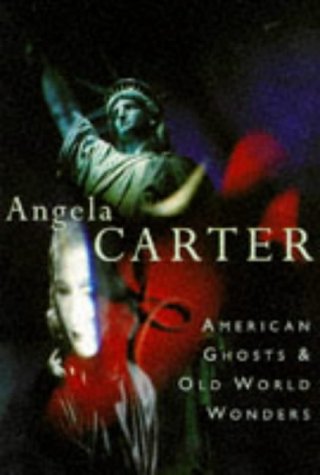
Angela Carter: American Ghosts and Old World Wonders (1993)

American Ghosts

I’m sure we all read because we like a good story but aren’t we equally keen on writing which ignites our imagination? Writing that connects us with our subconscious, our emotions and dreams? Angela Carter knows how to tell a story but more than that, she inspires. She makes us think, explore, dream, fantasize, question. Sometimes it’s not even important to understand every aspect of her short fiction but just to read one of her wonderful sentences, discover one of her splendid images is enough.

The short story collection American Ghosts and Old World Wonders is such a treasure trunk. It’s full of retellings, deconstruction, parodies, reimagining of old myths, fables and fairy tales. It wasn’t always a breezy read. I had to hunt for a few academic papers in order to fully understand the one or the other of the pieces in this book. Like in all of her collections, there were a few stories that stood out and I’ve even found a new favourite.

In this collection Angela Carter mixes myths and elements of the American Dream and/or of America as the land of dreams, the country of  one of the biggest movie industries, the country of serial killers and westerns, of endless possibilities, and juxtaposes these elements with stories from the old world – fairy tales and history. The result is stunning.

The book is divided in two parts. I’d call the first the “American” part and the second the “Old World” part.

Part I

Lizzie’s Tiger is the second Lizzie Borden story she wrote. It shows us a young fearless Lizzie who discovers the magical world of a circus and a tiger who’s living in it. It’s as much an allusion to Blake’s famous poem as it is an imagination of a time when Lizzie was still small and had options to become someone else.

John Ford’s ‘Tis Pity She’s a Whore is a pretty tongue-in-cheek and cheeky piece. What if the film director John Ford made British playwright John Ford’s drama ‘Tis Pity She’s a Whore into a movie? Well – read her story and you’ll find out what that would be like.

Gun for the Devil is another Western type story set near the Mexican border. Johnny get’s a gun and frees a girl. Sort of. The story contains an allusion to the movie Johnny Got His Gun.

The Merchant of Shadows is my favourite story in the book and has become one of my all-time favourites. A story of decay, exuberance, mystery, set in a decadent Hollywood setting, reminiscent of Sunset Boulevard (one of my favourite movies btw). A young academic comes to interview the widow of the famous film director von Mannheim (he seems inspired by von Sternheim). His widow was once a femme fatale but now she’s in a wheelchair, living with her sister who looks like a cowboy.

Here are is a sample of this deliciously lush and weird story, which contains a lot of Angela Carter’s magic, including metafiction, allusions, cultural references and a lot more:

A flight of rough-cut stone steps led up to a pool surrounded by clumps of sweet-smelling weeds; I recognised lavender. A tree or two dropped late summer leaves on scummy water and, when I saw that pool, I couldn’t help it, I started to shiver; I’ll tell you why in a minute. That untended pool, in which a pair of dark glasses with one cracked lense rested on an emerald carpet of algae, along with an empty gin bottle.

On the terrace a couple of rusty, white-enamelled chairs, a lopsided table. Then, fringed  by a clump of cryptomeria, the house von Mannheim caused to be erected for his bride.

That house made the Bauhaus look baroque. An austere cube of pure glass, it exhibited the geometry of transparency at its most severe. Yet, just at that moment, it took all the red light of the setting sun into itself and flashed like a ruby slipper. I knew the wall of the vast glittering lounge gaped open to admit me, and only me, but I thought, well, if nobody has any objections, I’ll just stick around on the terrace for a while, keep well away from that glass box that looks like nothing so much as the coffin for a classical modernist Snow White; let the lady come out to me.

No sound but the deep, distant bass of the sea; a gull or two; pines, hushing one another.

So I waited. And waited. And I found myself wondering just what it was the scent of jasmine reminded me of, in order to take my mind off what I knew damn well the swimming pool reminded me off – Sunset Boulevard, of course. And I knew damn well, of course I knew, that this was indeed the very pool in which my man Hank Mann succumbed back in 1940, so very long ago, when not even I nor my blessed mother, yet, was around to so much as piss upon the floor.

I waited until I found myself growing impatient. How does one invoke the Spirit of Cinema? Burn a little offering of popcorn and old fan magazines? Offer a libation of Jeyes’ Fluid mixed with Kia Ora orange?

This passage shows something else that strikes me every time when I read Angela Carter – how she is at the same time irreverent and full of admiration for her themes.

I liked the stories in part II a little less.

The Ghost Ships – A Chritsmas Story, I didn’t really get it but it had a few great moments. This opening for example:

‘Twas the night before Christmas. Silent night, holy night. The snow lay deep and crisp and even. Etc. etc. etc.; let these familiar words conjure up the traditional anticipatory magic of Christmas Eve, and then – forget it.

Then In Pantoland – a parody of the way fairy tales have become a pure commodity, robbed of their deeper meaning and sometimes violent aspects due to the way Disney has used them.

Ashputtle or The Mother’s Ghost contains three ways to deconstruct Ashputtle. Very different from Disnye’s Cinderalla.

Alice in Prague or The Curious Room is an homage to a Czech filmmaker. It combines Dr Dee and Alice in Wonderland. Edward Kelly is called Ned Kelly. I didn’t really understand what this figure of Australian history got to do in this text. I really love this passage:

Night was. Widow Night, an old woman in mourning, with big, black wings, came beating against the window; they kept her out with lamps and candles.

Impressions: The Wrightmans Magdalene is the reimagining of the story of Mary Magdalene. It references two artists’ representation: Georges de La Tour’s Mary Magdalene and Donatello’s Mary Magdalene. One a painting, the other a sculpture.

This collection was a wild ride, at times challenging, but mostly really captivating and enchanting.

This is the second review for Angela Carter week, co-hosted with Delia (Postcards from Asia).

PLEASE ADD YOUR OWN REVIEWS TO THE MR LINKY HERE

ACW badge 2-2


Welcome to Angela Carter Week

ACW badge 2-2

Today marks the beginning of Angela Carter Week.  We have over twenty people who would like to participate. I saw quite a few intro posts, links and announcements. Thanks everyone for that. I’m really thrilled to see so much enthusiasm.

Delia has made a list of the participants and I’ve added everyone to my bloglovin account – still, it’s possible we might not see every contribution, therefore we’d be glad if you could use the Linky below.

It’s not as sophisticated as a blogspot Linky but it does work. You just have to click on the widget to see all the entries.

I’ll be visiting and posting all through the week. Next Sunday we’ll wrap up and hopefully we’ll be able to share a list with all the links.

I wish all the participants a great Angela Carter Week!

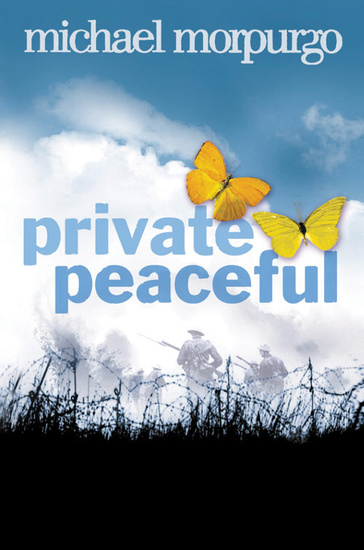
Michael Morpurgo: Private Peaceful (2003) Literature and War Readalong May 2014

Private Peaceful

British author Michael Morpurgo is one of the most appreciated writers for Children. He was the UK Children’s Laureate from 2003 to 2005 and Writer in Residence at the Savoy Hotel in 2007. He won many prizes for his fiction.

Tommo Peaceful is the narrator of Private Peaceful. He begins his story at five past ten in the evening, after everyone else has left him. He awaits the next day with anxiety but he doesn’t want any company or distraction. He wants to spend the night thinking about his life. The chapters are all given a specific time and each intro to the chapter describes briefly Tommo’s surroundings and his state of mind. After the intro Tommo tells us in flashbacks his story, from the idyllic childhood in the English countryside to the trenches of WWI.

Tommo is one of three boys. At the age of nine his father dies in an accident and Tommo feels responsible for his death. Although he and his older brother Charlie are very close, he never mentions what happened in the woods, the day their father dies. They have an older brother Big Joe who had Meningitis as a child. He can’t go to school and is easily agitated but they are still very fond of him.

Their father’s death marks a transition from a carefree life to a life of some hardship. They are at the mercy of the Colonel in whose cottage they live. The cottage is tied to a function and after the death of the father, who was the forester, they would have to leave. The Colonel’s estate is big and many people and families work for him and so Tommo’s mother is offered a position at the big house, and they can stay in the cottage.

The years go by and there is happiness and heartache in equal measures. When WWI breaks out, they don’t think they are affected. Tommo is only 16 and Charlie, who is two years older, doesn’t think of volunteering but in the end they are forced. Although Tommo is too young, he doesn’t want to abandon Charlie and pretends he’s older. Finally they are shipped to France together. From there they move on to Belgium and stay near Ypres for the following months.

They don’t see any action at first but eventually they come under heavy fire. From then on we get an impression of everything that was typical or important during WWI: trench warfare, mustard gas, rats, rain, mud, high numbers of casualties among men and horses, arbitrariness of orders, sadism of the high command, absurdity of it all . . . While it’s usually key to show but not tell, Morpurgo often tells but doesn’t show. He stays away from graphic descriptions or anything that you could call gruesome. We still get the horror because we see how it affects Tommo. Most of the time, we just don’t get to see what he sees. I think that’s a great way to go in a Children’s book.

What works particularly well in the book is the contrast between the childhood and teenage years and the war scenes. Morpurgo takes a lot of time to introduce us to his characters and to make us care for them. While some of the secondary characters are a bit stereotypical, the main characters Charlie and Tommo are well-developed. Their relationship is very close and they would give everything for each other.

As I wrote in the introduction to this month, I was particularly interested to see how a Children’s author would handle a WWI book from the point of view of a soldier. I think Michael Morpurgo did an admirable job. I’m sure, children will get a good impression for the particularities of WWI. And they will care for the characters and feel deeply about the end. For an adult reader who has read some very similar books for adults – Strange Meeting and How Many Miles to Babylon come to mind – it was not exactly a huge revelation, but in spite of that, I found the twist at the end harrowing.

Other reviews

Danielle (A Work in Progress)

 Judith (Reader in the Wilderness)

*******

Private Peaceful is the fifth book in the Literature and War Readalong 2014. The next book is the WWI novel Fear – La Peur by Gabriel Chevallier. Discussion starts on Friday 27 June, 2014. Further information on the Literature and War Readalong 2014, including the book blurbs can be found here.
Pat Barker: Toby’s Room (2012) Literature and War Readalong April 2014

Toby's Room

I’ve been procrastinating all morning. Every time I sat down to write this review I had something very urgent to do. Read the afterword of Fire and Hemlock, read the news on the Ukraine, get a cup of tea, look for cat number 2, read more news on the Ukraine, read the guardian review of Toby’s Room, urgently hunt for a book voucher, read the NY Times review of Toby’s Room, call my best friend in Odessa. I think you get the drift. Anything but writing the review.

Why?  Because I’m far from happy about this book and because I’m going to say what the critics didn’t say: it’s a mixed bag and despite a lot of good elements – mainly the choice of topic – it’s pretty much a failure or – even worse – a dishonest attempt. Still, it would be a great book club pick, as its strengths are topics and characters. That’s why I think it was a good choice for our readalong and if a few people read it, the discussion should be interesting.

So what’s Toby’s Room about? Thanks to the Guardian review, I was made aware that the title is an allusion to Virginia Woolf’s Jacob’s Room, the novel which she wrote after her brother Thoby died in WWI. It’s not surprising then that Virginia Woolf has a cameo appearance in Toby’s Room. I’ve read Jacob’s Room too long ago to make the connection, but I’m tempted to revisit it.

Elinor and her brother Toby are close, too close, one could say. One afternoon, in 1914 they spend a night together. This is deeply traumatizing for Elinor, although she’s not a victim in the whole encounter. Later when they are both in London, Elinor studying to become a painter, Toby to become a doctor, their relationship is strained.

In 1917 Toby’s reported “Missing, believed Killed”, which affects Elinor deeply. Until that day she tried to avoid thinking of the war but the death of her brother and the uncertainty of the circumstances, propel her right into it.

When Elinor finds a letter her brother wrote shortly before his death, mentioning Kit Neville, a famous painter, knows what happened to him, she barges in on Neville who’s at a hospital for soldiers with facial wounds. She disregards his state and unease and tries to force him to confess what happened. To no avail.

The second part of the novel sees Elinor join Tonks, her former teacher. Tonks is a painter and surgeon who helped a great deal in giving back some sort of face to those who had been severely disfigured. Part of his and Elinor’s work consists in drawing the wounded men before, during and after surgery. The gallery of this drawings can be visited online here (I managed to look at two).

Neville doesn’t confess to Elinor, he will confess to the far more sympathetic Paul, Elinor’s lover, whose story is told in Barker’s Life Class.

Pat Barker is famous for blending fact and fiction, for introducing us to important topics – I shy away from calling facial reconstruction “fascinating” as she herself does in her afterword – and for addressing the complexity of WWI. And she’s a very good plotter. The book reads like crime fiction. From the very beginning we are drawn along, running like donkeys after a carrot, to find out “Whatever happened to Toby?” I’m grateful for Pat Barker’s plotting skills, it made for quick reading, but when the juicy carrot I’d been hoping for proved to be a shriveled scrap, I felt let down. I didn’t buy the end. It wasn’t believable for me, but very much in line with the sensationalist beginning.

My biggest problem however was that she felt she had to start with an incest. Why was that necessary? I can relate to someone’s attachment to their brother, I didn’t need an incest to understand that they were very close and that their relationship was far from uncomplicated. This leads me to another problem I had with the book – heavy-handed foreshadowing.

Before I move on to the good parts, let me just say that I found Elinor a off-putting character. Not only did I despise her for blocking out the war, but for being so insensitive. In a way, the novel wants to tell us, it’s that character trait that made her useful. If she’d been more emotional, more sensitive, she wouldn’t have been able to draw the atrocities she saw. I don’t think that is true. I think there are people capable of deep empathy who can still do work like that.

What I liked about this novel, besides its suspenseful readability, was the choice of topics. I’d never heard of Tonks before and I found it interesting how the novel showed that the painters had to document everything in great detail but that they knew it would never be shown publicly. Some of the other painters mentioned painting landscapes as a metaphor. The war can be shown metaphorically but not realistically.

Neville isn’t a sympathetic character either but he’s a great character nonetheless. His story illustrates how hard it was for people to handle seeing facial mutilations. It was so hard that they often ceased to think about the person who was “behind” the disfigurement. They seemed to have lost their humanity with their faces and thus the repulsive reactions of the people were only occasionally questioned.

The more I read, the more I was wondering whether the fact that these injured men were sent to hospitals outside of cities was not so much for their own good as for the good of the population. These parts were done admirably well in the novel and the juxtaposition with scenes in which Elinor learns how to become a better painter through anatomy lessons and dissecting a corpse is great as well.

As a whole however I would say that this novel with its shifting POVs and sensationalist beginning and ending, is a failure. But a very thought-provoking failure.

I’m curious to hear the thoughts of others. Did you think the incest was a good choice? And what about the many different POVs and Elinor’s diary?

Other reviews

CarolineD

Danielle (A Work in Progress)

Maryom (Our Book Reviews)

The Mole

*******

Toby’s Room is the fourth book in the Literature and War Readalong 2014. The next book is the WWI novel  Private Peaceful by Michael Morpurgo. Discussion starts on Friday 30 May, 2014. Further information on the Literature and War Readalong 2014, including the book blurbs can be found here.