Ruth Rendell: The Tree of Hands (1984)

Once, when Benet was about fourteen, she and her mother had been alone in a train carriage and Mopsa had tried to stab her with a carving knife. It was some time since Benet had seen her mad mother. So when Mopsa arrived at the airport, looking drab and colourless in a dowdy grey suit, Benet tried not to hate her. But the tragic death of a child begins a chain of deception, kidnap and murder. Domestic dramas exploding into deaths and murders …threads are drawn tightly together in a lethal last pattern.

I read and reviewed A Judgment in Stone last year and have mentioned how much I liked it. It was one of my favourite reads of 2010. On one of the comment thread’s Guy Savage suggested another book by Ruth Rendell, The Tree of Hands, and that is how I discovered this novel.

I have to emphasize once more what a great writer Ruth Rendell is. This book is different from A Judgment in Stone but also very engrossing. After having read The Tree of Hands I can also see why A Kind of Intimacy was compared to Rendell’s books. The description of the streets and their inhabitants shows a lot of parallels plus the people are equally deranged.

In the Tree of Hands the stories of at least 6 people are interwoven but it is skillfully done and they are all linked together in a logical way. The novel works like those rows of domino stones that have been set up in order to see them fall one by one. The falling down of the first stone makes the others follow. One action in the novel triggers another action and they are all equally fatal and catastrophic.

I was a bit wary at the beginning as Mopsa, Benet’s mother, is said to have a mental illness. Using mental illness as an explanation for a crime is often insufferable to me. But fortunately Mopsa is just the first domino stone. Being totally irresponsible she steals a child without ever thinking of the consequences but then she leaves and lets all the other people deal with the aftermath of his kidnapping.

The book really has a chain reaction at its core and one bad decision leads to another. And it also describes quite a lot of negative, selfish and frankly bad people. What struck me, even though Mopsa is mentally ill and on top of that clearly not a good person, she is by far less deranged than some of the other nasty characters in this book.

One of the main stories is the story of Benet, a young mother and extremely successful writer who lives in a beautiful house in Hampstead. At the beginning of the book her mentally ill and very unstable mother, Mopsa, comes to visit her and her little boy, James. Benet is a very loving mother and James is the most important person in her live.

The second main story revolves around another young mother, Carol, her son Jason and her young boyfriend Barry. Carol is a superficial and unrestrained woman with a flaming temper. At the age of 28 she is already a widow and has three children from different men. Two have been taken away, only the smallest, Jason, is living with her and Barry.

At first the two strands of the story run in parallel until a tragedy happens and Mopsa steals Jason.

I am tempted to write a lot more as there are a few aspects that I find interesting but unfortunately it isn’t possible, it would spoil too much. I can however say that the novel also explores the concept of parenthood and if someone who loves a child dearly might not be a better parent than a biological parent.

Something that struck me in this book is the overuse of the sedative Valium. This dates the book. Surely nowadays people in novels don’t pop pills like sweets and they might not use benzodiazepines as often anymore. This constant use of downers and alcohol is of course symbolical and just underlines that the people in the novel do not want to face any problems or consequences of their actions.

Ruth Rendell’s writing is suspenseful, her characterizations are psychologically plausible and the descriptions of different social milieus spot-on. Do I have to mention that I will certainly read another Ruth Rendell or Barbara Vine very soon?

Dashiell Hammett: The Glass Key (1931) and Heisler’s The Glass Key (1942)

Ned Beaumont is a tall, thin, moustache-wearing, TB-ridden, drinking, gambling, hanger-on to the political boss of a corrupt Eastern city. Nevertheless, like every Hammett hero (and like Hammett himself), he has an unbreakable, if idiosyncratic moral code. Ned’s boss wants to better himself with a thoroughbred senator’s daughter; but does he want it badly enough to commit murder? If he’s innocent, who wants him in the frame? Beaumont must find out.

I have read everything Raymond Chandler has written. He used to be one my favourite authors. This might be the reason why I neglected Hammett for so long. Maybe I thought he would be too similar and that this would influence my reading.

The Glass Key was my introduction to Dashiell Hammett and although it did remind me a bit of Chandler, they are still quite different. Hammett is at the same time sparser and coarser.

At the heart of The Glass Key lies the question “Who has killed Taylor Henry?”. Taylor Henry is the son of the influential politician Ralph Henry. In an attempt to appear cleaner than he is, the corrupt politician Paul Madvig tries to associate himself with Henry. And he is in love with Henry’s daughter Janet. When Taylor is found dead, rumors start to circulate that he might have been killed by Paul. None of these people are really main characters, the central figure and exemplary tough-guy, is Ned Beaumont. He is a sort of assistant to Paul Madvig and tries, like a PI, to investigate the murder. He visits bars and clubs and people. Gets beaten up and is held captive. Women literally throw themselves at him. This all leaves him quite unfazed. No matter how much you beat that guy up, how often you threaten him, how many times you flatter him or try to seduce him, you will not get much of a reaction but a very short reply. This is as tough as tough-guys go.

The interest, at least for me, did not lie in the solving of the murder. I couldn’t care less. The appeal of this book, is the character of Ned Beaumont, this monosyllabic guy who doesn’t even flinch when he is beaten to a pulp. The other appeal is the world and the atmosphere this novel depicts.

The world of The Glass Key is a world of corruption, prohibition, easy women, hard men, bars and secret joints, bribery and violence.

And of course one has to mention the dialogue. You couldn’t find any more sparse and caustic dialogue in any novel.

Ned Beaumont advanced into the room where Lee and the Kid were.

The Kid asked: “How’s the belly?”

Ned Beaumont did not say anything.

Bernie Despain exclaimed: “Jesus! For a guy that says he came up here to talk you’ve done less of it than anybody I’ve ever heard of.”

“I want to talk to you,” Ned Beaumont said. “Do we have to have all these people around?”

“I do,” Despain replied. “You don’t. You can get away from them just by walking out and going about your own business.”

“I’ve got business here. “

After having finished the book I realized that I had the movie. It is part of a collection of Film noir movies that I had ordered before Christmas. I immediately watched it and liked it a lot.

The story is told differently. More chronological and Janet Henry’s (Veronica Lake) role is much more important. A few names have been changed. There is a club owner who is Irish in the book. He is Italian in the movie which was probably more in line with the depiction of wise guys as they populated the film noir. What I truly liked about the movie is Veronica Lake. Since I have seen L.A. Confidential (one of my favourite movies) in which Kim Basinger is compared to Veronica Lake I always wanted to see the real one. I think she is really special.

Don’t ask me whether I prefer the novel or the movie. I enjoyed reading and watching at the almost same time. It was as if the characters had stepped out of the pages at the end of the book and come alive.

I am really pleased I found the trailer which is not usual for every old movie.

Crimeculture – Books, Movies and More

victorian


I found this great site Crimeculture today and wanted to share it with you as I know that many of you also love crime, thriller, detective and suspense novels and movies. It contains a lot of information, essays, articles, lists on books and films. You will find the books and movies organized by subgenres like Victorian Detective Fiction, Classic Detective Novels, Early Hard-Boiled… Film Noir, Neo Noir, Asian Detectives. I hope you will enjoy it as much as I do. It’s a great resource.

Niccolò Ammaniti: I am not scared (2004) aka Io non ho paura (2001) An Italian Novel of Crime, Adventure and Coming of Age

One relentlessly hot summer, six children explore the scorched wheat-fields that enclose their tiny Italian village. When the gang find a dilapidated farmhouse, nine-year-old Michele Amitrano makes a discovery so momentous he dare not tell a soul. It is a secret that will force Michele to question everything and everyone around him.

Someone has offered me a gift and this person is called Niccolò Ammaniti. The gift consists of a trip to the distant land of childhood memories, of hot summers long gone. No words will be able to convey how much I liked this novel, however I am conscious that it is also a very personal experience. It has a lot to do with my cultural background (my mother was Italian) and similar childhood experiences (apart from the crime element). This novel is pure magic. A magic that I have only encountered in Italian novels so far. It’s a magic that comes from the almost cinematographic power of descriptions. This is a novel I didn’t read, I saw and experienced it. It is sensuous and descriptive like not many. And gripping. Imagine what a combination. And touching as well. (I really have to hold myself back or I will get this year’s prize for cheesiest book review.) And did I mention melancholic? Italian novels tend to be very melancholic, with bitter-sweet undertones, there is always a mix of tears and laughter. I laughed quite a few times when reading Io non ho paura.

I am not scared evokes a scorching hot summer, in the little Italian village of Aqua Traverse. The heat is suffocating, the air has acquired a density that feels like cotton, the heat feels dangerous and relentless. All around the village oceans of yellow wheat extend and in the far distance are rolling hills and little mountains. Michele, his little sister and their friends play outside all day long, they venture into places that are yet unknown, populated by ghosts and ogres, witches and demons, all fruit of their imagination. Childhood politics, with their petty punishment and ostracizing of the weakest are rendered masterly. One day the children explore an abandoned ruinous house and Michele discovers a little boy in a dug out. He won’t tell anyone what he has found, keeps it to himself. Michele learns later that the child is held hostage until his mother will comply and pay a huge ransom. Things are not exactly what they seem in peaceful Aqua Traverse and more than one illusion will be lost at the end of this summer.

Michele, the narrator, is a boy of 9, or rather, the grown up Michele, looking back on his childhood self, is the narrator. This is one of the most beautiful narrative voices I have come upon in a long time. Naïve, perceptive, and precocious at the same time.

The descriptions of an typical Italian village, Italian family life in the 70ies is spot on.

Some of the most wonderful passages are descriptions of moments Michele spends in utter solitude. At night he cannot sleep, the heat is too intense, he stands at the open window, looks out into the full moon night. Everybody is asleep, he seems to be the only one on earth, he hears the sound of little owls and crickets in the windless night…

There is another wonderful instance in which he imagines himself dead and how he would enjoy to attend his own funeral. I always used to think such thoughts as a child and these solitary moments are also very familiar. Enchanting moments of blissful loneliness.

Michele is a highly imaginative child, everything around him is full of mysteries but there are also discoveries that are sobering like when they climb a mountain that they had suspected to be full of magic and it is quite ordinary close-by.

Ammaniti, an author of the so-called letteratura pulp movement, influenced by Tarantion’s Pulp Fiction, is an astonishingly original writer. He mixes genres like the adventure and horror story with crime and elements of the coming of age story. He combines all sorts of elements from popular and sophisticated culture alike. He mentions an Italian pop song like Parole at the same time as La Traviata.

What I liked best are the masterful descriptions of the landscape and the weather.

I haven’t read anything in Italian lately, another reason why  this was a particular pleasure for me. I think it is one of the most melodious languages and being my mother’s native language it brings back childhood memories…

Other Italian authors I love are Bassani, Tabucchi and Pavese. Which are the ones you would recommend?

Io Non Ho Paura (Stile Libero)

Georges Simenon: Maigret’s Christmas or The Girl who believed in Santa Claus aka Un Noël de Maigret (1951)

Nine stories present Simenon’s dauntless detective in a series of cases in which Maigret’s paternal side is activated and his detection efforts considerably aided by some observant and resourceful children.

I haven’t read any Simenon for a long time and when I was browsing amazon. fr. and discovered Un Noël de Maigret I thought it might be fun to read it at this time of the year. I thought it would be a longer book or a collection of short stories but the book contained only a 100 page long novella. It has been taken out of a collection with the same title and reissued on its own. Maybe it was the best and longest story in the original book. The English version Maigret’s Christmas contains still all nine stories, one of which is The Girl who believed in Santa Claus, the story that I have read. So, if you are in the mood for a lot of Christmas themed Maigret, you will have to get the English version.

The story has very melancholic undertones. It is easily summarized in a few sentences. On Christmas day two neighbours of Maigret come to visit to tell him that the little step-daughter of one of the two women pretends that Santa Claus has visited her in her bedroom at night. He offered her a big doll and tried to remove some floorboards in order to access the apartment below. The step-mother, a cold and distant woman, says she doesn’t believe the little girl, she says, she thinks she made everything up. The second woman, a spinster with a crush on Maigret, has a keen interest in the little girl and forced the step-mother to come along and tell Maigret all about the odd story the child is telling.

The story behind the Santa Claus and the solving of the mystery is not that gripping. The charm of this book lies in the person of Maigret and his psychological analysis. Maigret treats people with amazing respect, he is truly non-judgemental. The book is also infused with his and his wifes sadness about their childlessness. Christmas, being the family holiday it is, reminds them of their fate in a painful way.

Simenon excels in descriptions and psychological analysis. I could compare him to some other crime authors but that wouldn’t do him any justice. He wrote before Rendell, Mankell and all the others. He is very subtle, very poignant. This is not one of his great works but it is well done and his craftmanship can be perceived in every sentence. There is no superfluous word in this book, it’s soothingly unadorned.

I have read a few non Maigret books that I enjoyed a lot (Three Bedrooms in Manhattan aka Trois chambres à Manhattan is wonderful)  but I am not too familiar with his Maigret books.

Who has read any? Which did you like? Or do you prefer those without the inspector?

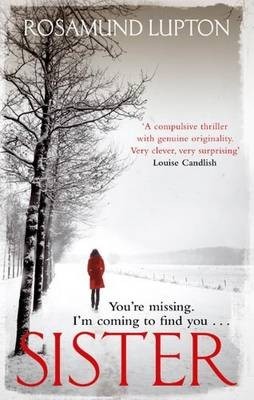
Rosamund Lupton: Sister (2010) A Great New British Thriller Writer

Nothing can break the bond between sisters …When Beatrice gets a frantic call in the middle of Sunday lunch to say that her younger sister, Tess, is missing, she boards the first flight home to London. But as she learns about the circumstances surrounding her sister’s disappearance, she is stunned to discover how little she actually knows of her sister’s life – and unprepared for the terrifying truths she must now face. The police, Beatrice’s fiance and even their mother accept they have lost Tess but Beatrice refuses to give up on her. So she embarks on a dangerous journey to discover the truth, no matter the cost.

That was a fast read. Even though this was a busy week and the novel had some 370 pages I read it in a few days. That certainly says something. I liked it a lot. The writing reminded me of Maggie O’Farrell. Should she ever choose to write a thriller, that’s what it could look like.

Sister is the story of  Tess and Beatrice, two sisters who are extremely close, even though the older one, Beatrice, lives in New York, while the younger, Tess, is still in London where she goes to an art school. When Beatrice gets the phone call from her mother saying her sister is missing she is highly alarmed and flies back to London immediately. When the sister is found dead and declared to be a suicide Bee – as her sister used to call her – is the only one who does not believe it was suicide. She is certain it was murder. And she won’t change her mind. No matter what the police, her mother or Tess’ psychiatrist say.

The story is told in part as if Beatrice was writing  a letter to her dead sister, telling her the whole story after the murderer has been found and arrested. In part she writes the letter, in part she tells the whole story to a lawyer. Consecutive flash backs. The story is also interspersed with dialogue between the sisters.  There are many red herrings as so many men who were in Tess’ life seem suspicious. The ending is quite a twist. That’s the only flaw I could find in this book. It seems a little bit artificial but then again it is not an improbable ending.

There are  many colorful characters in this novel. Art students, immigrants, doctors, scientists, policemen. The bond between those sisters is certainly the most important relationship in the book and it is very deep and moving. The story of their childhood is not an easy one which is another reason why they were so close. All through the novel Beatrice finds other people to relate to and some relationships like the one with her mother are completely transformed. Bee herself is also changed considerably. When the novel starts she is afraid of life, at the end she is ready to embrace and enjoy it.

Sister is Rosamund Lupton’s first book. The next should come out in 2011. I am already looking forward to reading it.

Ruth Rendell: A Judgement in Stone (1977)

Four members of the Coverdale family – George, Jacqueline, Melinda and Giles – died in the space of fifteen minutes on the 14th February, St Valentine’s Day. Eunice Parchman, the housekeeper, shot them down on a Sunday evening while they were watching opera on television. Two weeks later she was arrested for the crime. But the tragedy neither began nor ended there.

I discovered this novel  thanks to a suggestion from Danielle from A Work in Progress. I have read a few books of Ruth Rendell before and liked them and  I also read one she wrote under the pen name Barbara Vine but didn’t know which to read next. It is always good with prolific writers if someone can make a suggestion. I really liked A Judgement in Stone and can see why it is considered to be one of her best. It takes a very good writer to be able to captivate a reader even though the victims and the murderer are known from the very beginning. The psychological insights are absolutely convincing. Each character is so different from the other and they are all quite fascinating. Rendell adds a lot about the British class system and her description of two completely deranged women is amazing.

Because we know from the start that the main characters will be killed the book has an eery quality. It reminded me of a Greek tragedy. There is nothing to stop the course of the action.

Eunice Parchman, a middle-aged, illiterate and not very intelligent woman starts her employment with the Coverdales in summer. On Valentine’s Day she kills them. The changing of the seasons that Rendell describes with great detail adds to the feeling of the inevitable. The narrator is very present in this story, he misses no occasion to remind us, that the people he describes will meet a certain death. This reminded me of Gabriel Garcia Marquez’ Chronicle of a Death Foretold.

Eunice is not only illiterate she also lacks feelings for others. There is not the tiniest bit of empathy in this woman. Since she can’t read and sees this as a great flaw she abhors the written word and those who like to read. The Coverdales, a typical British upper class family, love to read. There are books all over their house. Eunice tries to cover up her disability as best she can and gets herself in a lot of impossible situations. One day, when running errands, she meets Joan Smith, a former prostitute who has joined some obscure Christian sect. One woman is as deranged as the other. Eunice is a cold-hearted selfish sociopath and the other a fanatic psychopath. Their alliance can only bring misfortunes.

Rendell’s  book is gripping, psychologically convincing and utterly fascinating. I’m really in the mood to read more of her books.

A Judgement in Stone has twice been made into a movie. One of them is by Claude Chabrol, La Cérémonie, starring Sandrine Bonnaire as Eunice and Isabelle Huppert as Joan.