Claire Tomalin: Jane Austen – A Life (1997)

Jane Austen

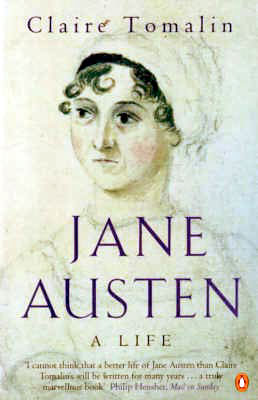
Last year I was in a Jane Austen mood for several months. I read the last of her novels I hadn’t read, watched movie adaptations, and even picked up the one or the other book inspired by her. Finally I also read Claire Tomalin’s Jane Austen biography, which I’ve finished a while ago.

Jane Austen – A Life isn’t only an excellent biography, it’s very moving as well. There isn’t all that much we know about Jane Austen but Tomalin wrote about what little we know with so much empathy and compassion that, at times, I couldn’t help but feel deeply for Jane Austen. When you read a biography you’re never sure what you will get. Some biographers are too present in the book or, what is even worse, some seem not to like their chosen subject at all. I’m glad none of this was the case here. I felt Tomalin approached Jane Austen with a lot of admiration and sympathy.

It’s hard to review a biography and do it justice, especially when it’s so carefully done, including every aspect of an author’s life. There were chapters I devoured, others, like those on the Austen neighbours, were a bit dragging. Overall however this is a wonderful biography and I could feel on every page how much passion and dedication Tomalin put into the book.

Since the book is so comprehensive, I’d like to pick just a few elements and write about those.

Tomalin, as I just wrote, is a very compassionate biographer, which made her detect things that are never explicitly stated in the testimonies or letters. She writes that seen from outside one might think that Jane Austen had a happy childhood and an unproblematic life, but when you look more closely, it becomes apparent, that there was a lot of heartache and sorrow. Tomalin mentions for example that all the Austen children were given away for up to 18 months when they were just a few months old. They grew up in the village with a wet-nurse. This means that by the age of three, they had experienced two traumatic events. First they had to leave the mother and later they were ripped from the family they hade come to see as their own.

The movie Becoming Jane, gives the wrong impression with regard to Jane Austen’s siblings. She had only one sister, but more than one brother, and because the parents had a school for boys, she and her sister grew up among many other boys. Unfortunately, because  it was a boy’s school, the two sisters had to leave the family again and go to boarding school. This, it seems, was another traumatic event as the school was quite terrible.

When I watched Becoming Jane, I wondered, like so many others, how much of the love story was true. Why did Jane Austen never get married? Was she too heartbroken and could never get over Tom Lefroy? After reading Tomalin, I have the impression that the love story which is told in the movie, is quite close to reality. There was no elopement and, as I already mentioned, Jane had more than one brother, but the depiction of the unhappy love story between her and the Irishman Tom Lefroy is pretty accurate. She had more opportunities later in life but she turned all her suitors down. She didn’t have any feelings for them.

Jane and her sister Cassandra were very close and spent their whole lives together. Seeing how many of the women around them were either constantly pregnant or died in childbed, staying single must have been some consolation to them.

I wasn’t aware that Jane Austen stopped writing for almost ten years. The chapters on this silence are by far the most tragic and interesting. One could think that the cause for her silence was small, but for Jane Austen it was a catastrophe. She loved the house in the country in which she grew up and when her parents decided to sell it – without telling Jane or her sister anything about the decision, until it was executed – she was devastated. She didn’t want to move to Bath. She didn’t like it and the house would be much smaller. There would be no garden, and no possibility to be close to nature. The impact of this move was so intense that she became depressed, shut down and didn’t write anymore. I guess it was more than just the loss of the garden though. She had a certain routine, and lack of space would prevent that she could withdraw herself from company as easily as before.

Jane Austen died quite young and, according to Tomalin, it’s not entirely clear what illness she had. Some attempts at a retrospective diagnosis have been made. She might have died from Addison’s disease, Hodgkin’s Lymphoma or bovine tuberculosis. In any case, the deterioration was slow and she suffered for more than a year before she died.

The biography contains a lot more, of course. I focussed on the tragedies of her life, but Tomalin writes extensively about the books and the influence Jane Austen’s reading had on her writing. Dr Johnson is mentioned for example and that many of Austen’s famous sentences have been inspired by him.

At the end of her biography Tomalin writes about Jane Austen:

“She is as elusive as a cloud in the night sky.” (287)

That’s exactly how I felt when I closed the book. As if I’d been watching a shadow theater. It’s the first time, I close a biography and it leaves me this sad.

Pat Barker: Toby’s Room (2012) Literature and War Readalong April 2014

Toby's Room

I’ve been procrastinating all morning. Every time I sat down to write this review I had something very urgent to do. Read the afterword of Fire and Hemlock, read the news on the Ukraine, get a cup of tea, look for cat number 2, read more news on the Ukraine, read the guardian review of Toby’s Room, urgently hunt for a book voucher, read the NY Times review of Toby’s Room, call my best friend in Odessa. I think you get the drift. Anything but writing the review.

Why?  Because I’m far from happy about this book and because I’m going to say what the critics didn’t say: it’s a mixed bag and despite a lot of good elements – mainly the choice of topic – it’s pretty much a failure or – even worse – a dishonest attempt. Still, it would be a great book club pick, as its strengths are topics and characters. That’s why I think it was a good choice for our readalong and if a few people read it, the discussion should be interesting.

So what’s Toby’s Room about? Thanks to the Guardian review, I was made aware that the title is an allusion to Virginia Woolf’s Jacob’s Room, the novel which she wrote after her brother Thoby died in WWI. It’s not surprising then that Virginia Woolf has a cameo appearance in Toby’s Room. I’ve read Jacob’s Room too long ago to make the connection, but I’m tempted to revisit it.

Elinor and her brother Toby are close, too close, one could say. One afternoon, in 1914 they spend a night together. This is deeply traumatizing for Elinor, although she’s not a victim in the whole encounter. Later when they are both in London, Elinor studying to become a painter, Toby to become a doctor, their relationship is strained.

In 1917 Toby’s reported “Missing, believed Killed”, which affects Elinor deeply. Until that day she tried to avoid thinking of the war but the death of her brother and the uncertainty of the circumstances, propel her right into it.

When Elinor finds a letter her brother wrote shortly before his death, mentioning Kit Neville, a famous painter, knows what happened to him, she barges in on Neville who’s at a hospital for soldiers with facial wounds. She disregards his state and unease and tries to force him to confess what happened. To no avail.

The second part of the novel sees Elinor join Tonks, her former teacher. Tonks is a painter and surgeon who helped a great deal in giving back some sort of face to those who had been severely disfigured. Part of his and Elinor’s work consists in drawing the wounded men before, during and after surgery. The gallery of this drawings can be visited online here (I managed to look at two).

Neville doesn’t confess to Elinor, he will confess to the far more sympathetic Paul, Elinor’s lover, whose story is told in Barker’s Life Class.

Pat Barker is famous for blending fact and fiction, for introducing us to important topics – I shy away from calling facial reconstruction “fascinating” as she herself does in her afterword – and for addressing the complexity of WWI. And she’s a very good plotter. The book reads like crime fiction. From the very beginning we are drawn along, running like donkeys after a carrot, to find out “Whatever happened to Toby?” I’m grateful for Pat Barker’s plotting skills, it made for quick reading, but when the juicy carrot I’d been hoping for proved to be a shriveled scrap, I felt let down. I didn’t buy the end. It wasn’t believable for me, but very much in line with the sensationalist beginning.

My biggest problem however was that she felt she had to start with an incest. Why was that necessary? I can relate to someone’s attachment to their brother, I didn’t need an incest to understand that they were very close and that their relationship was far from uncomplicated. This leads me to another problem I had with the book – heavy-handed foreshadowing.

Before I move on to the good parts, let me just say that I found Elinor a off-putting character. Not only did I despise her for blocking out the war, but for being so insensitive. In a way, the novel wants to tell us, it’s that character trait that made her useful. If she’d been more emotional, more sensitive, she wouldn’t have been able to draw the atrocities she saw. I don’t think that is true. I think there are people capable of deep empathy who can still do work like that.

What I liked about this novel, besides its suspenseful readability, was the choice of topics. I’d never heard of Tonks before and I found it interesting how the novel showed that the painters had to document everything in great detail but that they knew it would never be shown publicly. Some of the other painters mentioned painting landscapes as a metaphor. The war can be shown metaphorically but not realistically.

Neville isn’t a sympathetic character either but he’s a great character nonetheless. His story illustrates how hard it was for people to handle seeing facial mutilations. It was so hard that they often ceased to think about the person who was “behind” the disfigurement. They seemed to have lost their humanity with their faces and thus the repulsive reactions of the people were only occasionally questioned.

The more I read, the more I was wondering whether the fact that these injured men were sent to hospitals outside of cities was not so much for their own good as for the good of the population. These parts were done admirably well in the novel and the juxtaposition with scenes in which Elinor learns how to become a better painter through anatomy lessons and dissecting a corpse is great as well.

As a whole however I would say that this novel with its shifting POVs and sensationalist beginning and ending, is a failure. But a very thought-provoking failure.

I’m curious to hear the thoughts of others. Did you think the incest was a good choice? And what about the many different POVs and Elinor’s diary?

Other reviews

CarolineD

Danielle (A Work in Progress)

Maryom (Our Book Reviews)

The Mole

*******

Toby’s Room is the fourth book in the Literature and War Readalong 2014. The next book is the WWI novel  Private Peaceful by Michael Morpurgo. Discussion starts on Friday 30 May, 2014. Further information on the Literature and War Readalong 2014, including the book blurbs can be found here.

David Miller: Today (2011)

Today

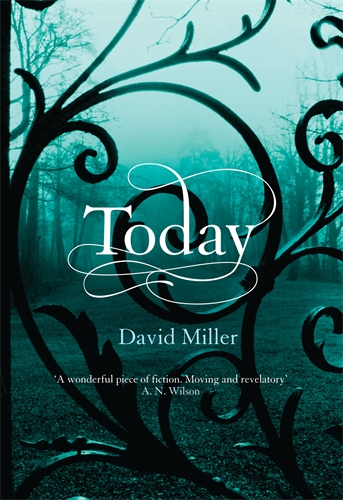
August 1924. John Conrad arrives at his parents’ home on the outskirts of Canterbury, where family and friends are assembling for the bank holiday weekend. His crippled mother has been discharged from a nursing home, his brother drives down from London with wife and child. But as the guests converge, John’s father dies. Today follows the numb implications of sudden death: the surprise, the shock, the deep fissures in a family exposed through grief. But there is also laughter, fraud and theft; the continuation of life, all viewed through the eyes of Lilian Hallowes – John’s father’s secretary – never quite at the centre of things but always observing, the still point in a turning world. Today is a remarkable debut, an investigation of bereavement, family and Englishness, beautiful in its understatement and profound in its psychological acuity.

Has the question why an author chose a certain subject matter ever overshadowed your reading experience? In the case of Today that question certainly distracted me quite a bit. It’s not the first time that I’ve been asking myself this question and usually it means that I had a problem with the book. It happens mostly with books that are inspired by true events or real people, but I’ve been wondering in other cases as well.

The book starts with a dramatis personae that lists no less than 39 characters. In a novel of barely 160 pages that is a lot. Most of these characters  appear only very briefly, nonetheless, the point of view changes almost every time, sometimes even twice in one passage. That’s a lot of moving around. Despite of the great number of characters there are a few main protagonists. The most important person however, Joseph Conrad, is looming in the text but absent. We never get to see him directly. At the beginning he’s resting in his bedroom. He had an episode of something, what exactly isn’t entirely clear, but when he dies one day later, it’s obvious that he had a heart attack.

Joseph Conrad dies on the day of his youngest son’s birthday. Because of that birthday there are far more people in the house than usual. The relationships are tense and this sudden death on a day that was meant to be a day of celebrations is awkward at best.

This could have been a nervous book, with all this jumping around from one character to the next, but it’s actually very calm. I guess that’s because most of these people are shown during introspective moments. On the first day, when Conrad is resting, it rains endlessly, and the people walk around, thinking of their relationship with the famous author, or exploring how helpless they feel.

I liked reading this book, liked how it showed how disruptive and unsettling death is, but I couldn’t understand why this had to be the story of Conrad’s death. It could have been anyone. There is no real need for this story to be about a famous person to be poignant. On the very contrary. I would say, this would have been far better, if it hadn’t been about someone famous.

Because I wasn’t entirely sure what to make of this slim, lovely, but puzzling book, I looked for reviews and found two by professional critics. I must say that was enlightening for a few reasons. Both reviews were negative, and, in my opinion, overly so, but both reviews were also faulty and that in an embarrassing way. One reviewer said the book was set on Conrad’s birthday, while it was Conrad’s son’s birthday. That’s bad but the other error is really appalling. At the begging of the story, Conrad’s secretary, Lillian Hallowes finds a book on a train and starts to read it. The author isn’t named but the beginning of the book is quoted: “Except for the Malabar Caves – and they are twenty miles off – the city of Chandrapore presents nothing extraordinary.” It’s a quote from one of my favourite authors E.M.Forster, so I recognised it right away and knew from which novel it was taken. Even when you’re not familiar with his work, you’d probably assume it’s taken from a Passage to India. Not so our reviewer. He wrote that it was taken from Howard’s End. Call me narrow-minded, but I find that shameful, especially when you write such a negative review.

David Miller is the literary agent of some of the greats of British literature like Cynthia Ozick, Tim Parks, Magnus Mills, and others. Today is his first novel. It is a quiet, thoughtful book, with lovely passages. I wouldn’t say it’s a must-read but it’s nice and I enjoyed it. I’m interested to see where Miller goes from here. While Today has awkward elements, the writing is promising.

Alexander Baron: There’s No Home (1950) Literature and War Readalong September 2013

There Is No Time

Alexander Baron was once known as the great British novelist of WWII, but since then he’s been somewhat forgotten. Three of his novels are “war novels”.  There’s No Home is one of them. For a novel about WWII it’s surprisingly peaceful and deals with a lesser known aspect of the war. When the allies invaded Sicily, and drove back the Germans to the Italian mainland, some of the troops were granted a few months of peace and quiet during which they lived among the Sicilian civilians.

There are different POV characters in the novel, but the main story focuses on Sgt Craddock. He’s the type of soldier liked by everyone, superiors and inferiors alike. He’s married with a little kid. Being away from home, first in combat and now in this eerie state of peace among the Sicilian civilians makes home seem like another world, a world far more foreign than Sicily. When he meets Graziella, falls in love with her and lives with her, almost as if they were husband and wife, only with far more openness and directness than he’s ever known with his wife, his own life in England moves farther and farther away.

The love story between Craddock and Graziella, is the only coherent story line, the rest is made of anecdotal episodes, either about civilian life or things that happen among the soldiers during the time in Sicily. The war and the fighting are far away, but eventually, they have to move on, go back to fighting and leave everything that has become dear to them.

It’s easy to see that Baron wrote from his own experience. Only someone who spent time in Italy, among Italians would be able to capture so many details, render such lifelike scenes. In the afterword we read that Baron was “adopted” by an Italian family while in Sicily, visited them often, ate with them. Most soldiers, not only those who had an Italian lover, formed close relationships with the population.

The book describes some of the absurdity of war, but it’s toned down. During this time of rest, the absurdity is felt the most in the treatment of deserters. It’s no coincidence that we have three deserters in this novel. A British, soldier, an Italian and a German one. Their treatment is very different.

I liked the way this book was written a great deal. It’s written in such a precise but effortless style, you barely notice you are reading, it felt much more like watching a movie. I appreciated that Baron chose a topic that may seem marginal to the war but that was interesting and rendered with great warmth. I suppose you could read his three war books like a trilogy, each showing another aspect of what Baron experienced during the war. After having read this novel on civilians and soldiers in repose, I’d like to read one of his other novels, From the City From the Plough, telling the story from the POV of an infantryman in combat.

Other reviews

You can find some quotes from the book on Danielle’s blog

Danielle (A Work in Progress)

*******

There’s No Home was the ninth book in the Literature and War Readalong 2013. The next is the post-war novel Everything Flows  by Russian writer Vasily Grossman. Discussion starts on Monday 28 October, 2013. Further information on the Literature and War Readalong, including the book blurbs can be found here.

Jane Austen: Persuasion (1818)

Persuasion

After having read Mansfield Park and liking it so much (as you can see here) I decided to read Persuasion, which has been mentioned by so many in the comments as their favorite Jane Austen novel. The two books couldn’t be more different. I found Persuasion much more mature, more subtle, less witty, more elegant and a bit melancholic. It’s a perfect novel, there is nothing superfluous in it; the story and the characters are rounded and the way their emotions are shown is believable and very touching. There is a lot of sadness and heartache in this novel, but, since it’s an Austen novel, the good characters are rewarded. Despite of all of this, I’m not sure I prefer it to Pride and Prejudice or Mansfield Park. The earlier novels have some imperfections, but they also show an exuberance and wit, which I enjoy. From the point of view of the love story, I think Persuasion is my favourite and I like Anne Elliot and Captain Wentworth as much or even more as Elizabeth Bennet and Mr Darcy, but I missed some of the irony and playfulness of the earlier novels. On the other hand Persuasion is very subtle and I love the more urban settings, Lyme Regis and Bath, which add to its appeal.

Anne Elliot is one of three sisters who lost their mother at an early age and grew up with a silly and vain father who, on top of that, is a spendthrift. The most important things to him and his eldest daughter, Elizabeth, who is his female counterpart, are looks and titles. Being a baronet is of the utmost importance to him. The gentle and sensible Anne suffers a great deal through their coldness and superficiality and if it wasn’t for her mother’s old friend Lady Russell, who has become her mentor, she’d be bad off in a family of self-centred, pompous fools. Her younger sister Mary is not much better and at that a hypochondriac. When the novel starts the Elliots are forced to leave Kellynch Hall and find cheaper lodgings in Bath because Sir Elliot and Elizabeth have been spending far too much. The estate will be let to Admiral Croft and his wife. Mrs Croft is the sister of Captain Wentworth, the man Anne Elliot once loved and – persuaded by Lady Russell – refused to marry because he had no money and no status yet.

Eight years later Captain Wentworth is still as handsome and likable as he used to be, but he’s also very rich. Anne who has refused every suitor, soon regrets bitterly that she refused him. Captain Wentworth on his side is still hurt and resentful. He hasn’t forgotten Anne but cannot forgive her.

Persuasion is often called a “novel of second chances”, and that’s what the love story is all about, but Austen novels are always about much more than just love and marriage. Money and the criticism of a superficial society which attached too much worth to it are central themes. In Persuasion we find a similar situation as in Pride and Prejudice: a rich man with no male heir. The way this is handled is central to the society and the times in which Jane Austen lived but, thankfully, so different from now. Should Sir Elliot die, the estate would go to a distant male relative and not to one of his daughters. It seems as if the property was tied to the name only and not so much to the family. Someone who may never even have seen a house, may be living in it, while those who spent there all their lives have to move out.This is so incomprehensible for us, feels so incredibly unjust that whole series, like Downton Abbey, illustrating this practice, are sure to generate our interest.

A large part of the second story line in Persuasion focusses on this aspect. There is an heir, but he is proud and arrogant, and it is very painful for everyone to imagine he will be living in Kellynch Hall. However, since Sir Elliot is still a good-looking man, it’s not impossible that he remarries. If a younger wife would give birth to a son, the whole situation would look entirely different. While the love story is central the “hunt” for the estate and the ensuing complications are no less important.

I’ve read all of Jane Austen’s longer novels now and it’s quite fascinating to look back, to compare, find similarities, spot differences. I’m currently reading Claire Tomalin’s Jane Austen biography and it adds another layer. So much that is mentioned in Tomalin’s book can be found in the novels. I noticed that Jane Austen never describes London, but I didn’t know she’d never been there.

Nowadays I tend to jump from one author to the next, but it has a special appeal to read everything of one writer because the books are always linked and when you’ve read them all, you can see, that despite the differences, the individual books together form a whole. In Jane Austen’s case, reading all of her books, showed all of her novels are full of vivid portraits and character sketches, full of well-observed behaviour and show the many facets of romantic attachment. But while there are similarities in the themes, there is a huge difference in mood.

Jane Austen: Mansfield Park (1814)

Mansfield Park

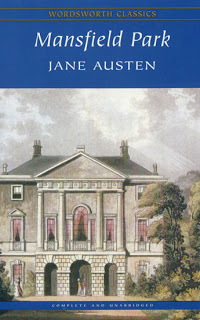
I’m nearing the end of my Austen journey. Now that I have read Mansfield Park, I’ve only got Persuasion and her short fiction left. I was surprised to like Mansfield Park so much as I know it’s not a favourite of many. The reason for this is to some extent its heroine Fanny Price. I wouldn’t go as far as saying I liked Mansfield Park better than Pride and Prejudice, but it may come in second, before Emma.

The story can be summarized briefly. Three women make three very different marriages. Mrs Price gets married to a poor man who likes his drink too much. She bears him some 12 children, one of them is Fanny. Lady Bertram marries a very rich man, owner of an impressive country estate, Mansfield Park. The third, Mrs Norris, lives near Mansfield Park with her husband in a small parsonage. The two ladies often speak about their unfortunate third sister who lives in Portsmouth in squalor and one day Mrs Norris urges the Bertrams to send for Fanny, who is about ten years old, and suggests they raise her at Mansfield Park, together with her four older cousins, Tom, Edmund, Maria and Julia.

Fanny is extremely timid but over the years she is doing well. She grows up to be an educated and very pretty young woman. She’s secretly in love with her cousin Edmund who was the only one who was nice to her. Edmund has decided to join the clergy as being the younger brother he will not have a lot of money to live on. A lot of the Bertram’s money comes from the colonies and when the plantations don’t do so well, Sir Bertram travels to Antigua with his older son.

Mrs Norris who is a widow by now had to vacate the cottage for the new pastor, Mr Grant, and while Sir Bertram travels to Antigua, Mary and Henry Crawford, the younger brother and sister of Mrs Grant, arrive and set in motion a series of dramatic events.

If you know Austen well, you know that all of her heroines are tested. Some more, some less, but in the end they are always rewarded and the reward is a happy marriage.

Fanny Price is a unusual heroine because she comes from a very poor family and the way she is treated by the Bertram’s is often quite shocking. Especially the unlikable Mrs Norris lets her feel daily that she is an inferior. Fanny reminded me much more of a Dickens character and when she is sent back to Portsmouth, as a form of punishment, towards the end of the book, it’s even more Dickensian. I don’t think we find such a close up of a poor family in any other of Austen’s novels. But Fanny Price is unusual for other reasons. She is so timid and fearful and very frail as well. I was surprised to find the portrait of a highly sensitive person who even shows some signs of what used to be called neurasthenia. She has to be careful at all times; she catches colds more easily than others, she’s more easily exhausted. Her symptoms are never as pertinent as when she stays in Portsmouth. She suffers from the noise, the dirt and the smells far more than anyone else would. I have seen her called passive by people but I would say she is quiet and withdrawn, she’s not so much a dreamer as a thinker. Sure, to some extent she is passive, but if you are told daily that you are nothing, that you have to be grateful, that you have to stay in the shadow, then it’s hard to be any other way. Even if she is passive, I don’t think she has a weak mind at all. When they want to force her to marry Henry, she opposes this strongly.

I think a lot of the dislike of Fanny Price stems from her opponent Mary Crawford. I saw people mention that they like her far better than Fanny. When the book was written, she was clearly one of the negative people but we, with our 21st Century mentalities, can’t help but like her and find a lot of what she says quite reasonable. I don’t think I spoil the novel if I mention that it is also about adultery. From our point of view Mary’s reaction to this event is understandable, but when the book was written it was quite shocking. I think small elements like this show very well why many people prefer a historical novel set in 1814 than the real thing because a writer of historical novels would take our mindset into consideration.

Mansfield Park has one of my favourite villains Mrs Norris. She’s a self-centered, selfish and cruel person and tries to exclude Fanny from every little bit of joy, denies her a fire in her room and reminds her constantly that she is an outsider. I loved to hate her and the end is so rewarding.

Mansfield Park has a minor flaw. It is Austen’s longest novel but it’s not long enough. I felt the end was rushed. Many of the most important scenes happen offstage and the final emotional developments happen too quickly. I wasn’t surprised when I watched the ITV production right after finishing the book to see, that those elements were shown in the film while the first parts were compressed. I can’t remember if Austen rushes all of her endings like this. I found it a bit disappointing, which doesn’t mean I preferred the movie version. Not at all. It’s OK but not great and it contains a lot of major changes.

I think that when people write unkindly about Fanny Price, they seem to forget that being adopted into a rich family, means that you are leaving your family behind. Being cut off from what you know, not seeing your beloved brother for years, must be a terrible shock, no matter how stately a home you get in exchange. The story of the little girl Fanny Price who became a delicate but strong heroine has moved me. It’s a rags to riches story that I wouldn’t have expected from Austen. Most of her heroines marry well and improve economically through their marriage, but they don’t start out being as destitute as Fanny.