What Did the Victorian Lady Look Like? or Women, History and Make-up

I like to read make-up artist Lisa Eldrige’s blog and also like to watch her tutorials. Recently I discovered two videos she did with historian Madeleine Marsh, the author of the book Compacts and Cosmetics: Beauty from Victorian Times to the Present Day. The book focuses not only on cosmetics but also on women’s history, their lives, the politics, culture and social circumstances of the times. The videos Lisa Eldrige did are so interesting and fascinating that I thought I’ll add them here. They are really worth watching, especially for those who love historical novels or novels from the Victorian and later eras.

As Madeleine Marsh says : “Vintage make-up is history that you can hold, smell and you can touch and I really think it makes our past come to life.”  (Madeleine Marsh in video I)

Both videos are great and will tell you a lot about the link between history and make-up. Did the Victorians use make-up? What did the Flapper look like? What was used during WWII? How did the 70s change the way we look?

I love these two videos, they are informative, fun and colorful and I hope you will like them too.

The Fiction of Nella Larsen Part II: Passing (1929) A Classic of Harlem Renaissance

Passing (1929) tackles the sensitive issue of black people who ‘pass’ for white. It also explores the desire of one woman for another – a new and daring theme for the writing of the time.

I just reviewed Nella Larsen’s Quicksand and since I liked it great deal I thought I will read and review her second novel Passing right away as well. Some details on her life can be found on the review of Quicksand.

As said, I liked Quicksand, the main character is so fascinating, still I was surprised how powerful Passing is. It’s an extraordinary story. I was hooked from the first sentence and found it extremely captivating, almost as gripping as a thriller.

Irene, a woman of mixed origins, gets a letter from another woman, Clare, with whom she grew up. The woman has a similar back ground only she has no parents. She isn’t only very light-skinned but her father was white. The two women had met in Chicago, a few years back, after having lost contact for twelve years. They met in an expensive tea room to which black people aren’t allowed. Irene is often ‘passing’ as she is very light-skinned. While she is sitting in the tea-room, enjoying her tea and the elegant surroundings, she notices another woman staring at her. The beautiful and elegant blond woman has alabaster toned skin and Irene is scared she might have found out until she realizes, she knows the woman. Irene always assumed that Clare has become a prostitute but as it seems she got married to a white man and is obviously “passing” for good. Clare invites Irene to her place to meet her husband and family and also invites another girl who also “passes” frequently.

What could have been a pleasant get-together turns into something that is hardly imaginable. Clare’s husband starts to talk about “niggers” and how much he despises them, that he would immediately leave his wife if he found out that she is “a nigger.” Picture this: there sits this condescending man, married to a woman of mixed origins, talking to her two friends of equally mixed origins and he doesn’t get. Not only does he not get, he would still leave her, if he found out although there seems to be nothing that indicates her being different in any way.

Irene doesn’t want to see Clare anymore after this. She is deeply humiliated and outraged. But Clare cannot let go. She wants to see her again. She wants to frequent “her people”. From a story about race, Passing develops into a novel of gender roles, jealousy, attraction and hatred. I don’t want to go into too much detail, but the development and the ending are quite unexpected and cruel.

Passing illustrates the complexity of notions of race even better than Quicksand.

“Yes, I understand what you mean. Yet lots of people ‘pass’ all the time.”

“Not on our side, Hugh. It’s easy for a Negro to ‘pass’ for white. But I don’t think it would be simple for a white person to ‘pass’ for colored.”

This is a highly interesting aspect and seems to indicate that African-American people are far more sensitive to race than white people, which makes the racism of white people all the more absurd. If they don’t get the difference, unless it is really obvious, what is the prejudice based on? The perception of African-Americans is much more nuanced. From my studies (I have an unfinished interdisciplinary Ph.D. on Haitian literature in my drawers) I know that in Haiti, for example, there are at least ten different expressions for skin-tones. Only a very few Haitians are just called “black”. Each skin-tone is linked to a specific social status. The lighter the better. (You could say that the suppressor’s or colonialist’s belief system has been fully internalized).

If I have to compare the novels, I think I liked Quicksand more as I found Helga Crane such a moving character.

It is sad that Nella Larsen didn’t write any other novels and I would like to know what really spurred that decision. Maybe she wanted to turn her back on her past. She had a troubled marriage and was writing during that marriage. Sometimes we cut off something that we really like just because it is tied to something unpleasant in our past.

Gianrico Carofiglio: Involuntary Witness aka Testimone inconsapevole (2002) First in an Italian Legal Thriller Series

A nine-year-old boy is found murdered at the bottom of a well near a popular beach resort in southern Italy. In what looks like a hopeless case for Guido Guerrieri, counsel for the defence, a Senegalese peddler is accused of the crime. Faced with small-town racism fuelled by the recent immigration from Africa, Guido attempts to exploit the esoteric workings of the Italian courts. More than a perfectly paced legal thriller, this relentless suspense novel transcends the genre. A powerful attack on racism, and a fascinating insight into the Italian judicial process, it is also an affectionate portrait of a deeply humane hero.

Former anti-Mafia prosecutor Gianrico Carofiglio is said to write some of the best legal thrillers Italy has to offer. I am not an expert when it comes to legal thrillers but  his novel Involuntary Witness, the first in the series centering on Avvocato Guido Guerrieri, is really good. Guerrieri is such a likable character and the themes of the novel are varied, spanning from racism, immigration, relationships and marriage, the meaning of life, to the Italian criminal system.

Guerrieri has recently been divorced and is very depressed. At the beginning of the novel he has panic attacks, can hardly sleep. He is a vulnerable, pensive  man who likes to read, have long discussions about books, movies and music. He loves St. Exupéry, Picnic at Hanging Rock and the music of David Gray. As a criminal lawyer he has to do some dubious things and tries to ignore whether his clients are guilty or not. After all, he is paid to get them out, no matter what they did. But Guerrieri has  a conscience that’s why he often wonders if what he does is really right. He also lives dangerously occasionally.
One of the best parts of the novel is the change Guerrieri undergoes. The person at the beginning of the novel isn’t the same as the one at the end. Just to watch him, follow him, first through his misery and later when he starts to enjoy life again, feels so realistic. I started to believe after a while that the description was based on a real person.

Guerrieri is good at his job, no doubt about it. There is always work for him. We sense that Carofiglio knows what he is writing about. The descriptions of the city and the court, the people, the lawyers, judges, policemen, prosecutors are realistic. The series is set in the Southern Italian town of Bari, an attractive location, close to the sea.

The story is rather simple. A nine year old boy is found murdered in a well. Due to some unfortunate circumstances a Senegalese immigrant is accused of the murder. The case looks hopeless as there is a lot of evidence against the man. Guerrieri isn’t even sure at first whether he should accept to defend him but he feels pity and finally accepts.

I wasn’t familiar with the subgenre of the legal thriller. At least not in book form. The focus is really on the trial and whether the accused will be sentenced or not. Guerrieri isn’t playing the role of an investigator. He thinks his client is innocent but he doesn’t try to find someone who might have done it or even find out why the child has been killed.

In Italy Carofiglio’s novels are considered to be much more than just thrillers and I can see why. The books seem to tell the story of an interesting man who happens to be a criminal lawyer and is excellent in his job, but this isn’t the most important element of the books. Guerrieri’s outlook on life, the way he sees and analyses people is far more important.

Involuntary Witness is an excellent book and I am certainly going to read the next in the series. I absolutely want to know what happens to Guerrieri and where life and love will lead him.

Do you know the series or any other legal thrillers that you like?

Literature and War Readalong May 27 2011: The Sea and Poison by Shusaku Endo

Shusaku Endo’s The Sea and Poison is the first WWII novel of the Literature and War Readalong. The first time I read about this book was on Parrish’s blog (here is his review). Its topic is very unpleasant. Endo focuses on the theme of morality, exploring it through the central story of the vivisection of an American prisoner of war by three Japanese surgeons.
I just discovered that there is a movie based on the book that can be watched on YouTube. I did attach the first part as a teaser.

Although it might be an unpleasant topic I’m looking forward to read my first Endo. Since it is a very short book, only 160 pages, I hope some of you will be in the mood to read along but I would understand if the topic isn’t to everybody’s liking.

Should someone want to watch the movie instead and review it, that would be great as well and I would link the review.

Delphine de Vigan: Underground Time aka Les Heures souterraines (2009)

Everyday Mathilde takes the Metro, then the commuter train to the office of a large multi-national where she works in the marketing department. Everyday, the same routine, the same trains. But something happened a while ago – she dared to voice a different opinion from her moody boss, Jacques. Bit by bit she finds herself frozen out of everything, with no work to do. Thibault is a paramedic. Everyday he drives to the addresses he receives from his controller. The city spares him no grief: traffic jams, elusive parking spaces, delivery trucks blocking his route. He is well aware that he may be the only human being many of the people he visits will see for the entire day and is well acquainted with the symptomatic illnesses, the major disasters, the hustle and bustle and, of course, the immense, pervading loneliness of the city. Before one day in May, Mathilde and Thibault had never met. They were just two anonymous figures in a crowd, pushed and shoved and pressured continuously by the loveless, urban world. “Underground Time” is a novel of quiet violence – the violence of office-bullying, the violence of the brutality of the city – in which our two characters move towards an inevitable meeting. ‘Two solitary existences cross paths in this poignant chronicle, a new testimony to de Vigan’s superb eloquence’ 

I read a review of  Delphine de Vigan’s book on Bookaroundthecorner’s Blog and really liked the tone of it. I ‘m glad I read it. It is far from cheerful but it is an important book on an important topic.

Les Heures souterraines or Underground Time is a chillingly good novel and shockingly topical. It’s accurate in its depiction of life in a corporate setting and of  life in a big city. It’s a very timely book, a book that doesn’t shy away to speak about the ugly side of  “normal lives”.
Reading the novel feels as if we secretly observed the two main protagonists, Mathilde and Thibault, at their most intimate. We follow them during the course of one day of their life. Mathilde is a single widow with three children, Thibault lives alone as well. We seem to watch them from a bird’s eye perspective and see them roam through Paris and through their lives.

Thibault is a doctor without a practice, one who makes house calls and goes from door to door where he sees a lot of misery and distress. He just left his lover and is heart-broken. He had to admit to himself that he was the one in love, she only took advantage of him.

Mathilde works for a big corporate company. She used to like her job but a few months ago she made a tiny mistake during a meeting. She dared contradict her boss and has since then become his target.  Bit by bit he wears her down, leaves her out systematically, withdraws every important project from her. He doesn’t inform her of important meetings, sets traps in order to provoke mistakes. Mathilde is at the end of her rope. She who used to be a strong person, who survived her beloved husband’s death, who raises her children on her own, who used to be a happy and succesful woman, she is about to crack, to break down. She can’t slepp anymore, she is afraid to go to work, she thinks she suffocates.

These two people should meet, they could meet, their paths cross more than once on this day.

There are many scenes I liked a lot. One of Mathilde’s little boys knows she needs all her strength and he offer’s her one of the most coveted cards of the World of Warcraft game. I liked this because World of Warcraft is a symbol for our times. It has become so important in so many people’s lives, it is a refuge, a haven to which they can escape, where they can find solace,  another life, become another person, where they feel happier than in the “real world”.

Another scene is equally good, it is the opening of the book when we are told that Mathilde went to see a psychic. The fortune-teller tells her that she will meet someone on the 20th of May, the day on which we follow her. Both scenes show us how utterly vulnerable Mathilde is. She doesn’t know how to get out of this mess.

How is this day going to end? Is Mathilde going to overcome her difficulties? How will Thibault handle all the disasters and sadness he has to face on this day? Will they meet?

I’m afraid, if you want to find out, you will have to read this novel. Don’t hesitate, it is excellent. It was nominated for the Prix Goncourt and would have been a worthy winner. It talks about things we’d rather not talk about. The loneliness in big cities, the isolation, the struggle of modern life, the hassle to commute, the abuse of power in the work place, mobbing, the inhumanity in big companies. The novel also shows that one of the most important elements is to talk about your problems, to address them, to seek help. And you have to go to the right place. Your colleagues will not help, they are afraid, the Human Resources won’t help, they follow their own agenda. The book sadly also shows that it can be too late. People can get so tired and worn out, they simply cannot fight anymore, they despair, feel terribly ashamed and give up.

It was good to read such a well written book about things that many of us have to struggle with on a daily basis.

I’d like to add one more thing on abuse of power and mobbing. The big difference is that abuse of power is a top-down thing, while mobbing is something that is done on the same level. Both are harmful and if anyone should be ashamed, it’s the people who do it. If you want to fight it, both are equally hard to handle but I think it would be a bit easier to get help if you are a mobbing victim. Nowadays big companies have special services who deal with this kind of stuff.

Literature and War Readalong April Wrap up: The Winter of the World

As usual this is the time to thank those who read along and/or showed an interest in this monthly activity.

From the comments I can deduce that we all thought pretty much the same about this book. It was a mixed bag or, to quote litlove, “a curate’s egg”. True. There was much to like in this novel but also many things that didn’t work. The descriptions of the battle scenes were graphic but well-rendered, the close look at facial wounds and the reconstruction that followed were detailed. We get a feeling for how harrowing these were but also a lot of admiration for those who tried to help, the nurses and doctors alike.

Equally well done was everything that was tied to the grave/burial of the unknown warrior or soldier. (I don’t know if anyone was thinking of this book when watching the Royal Wedding that took place in Westminster Abbey were the soldier is buried).

What we all had our problems with was the story itself. At the center of this novel is a passionate love story that leaves behind considerations of friendship and decency. If you were among the readers who have difficulties to imagine such a strong passionate love at first sight story, the novel was pretty much doomed. But also if you could accept this as a premise, like I could, you had to be able to “feel” this passion. While I got a feeling for Alex, Clare left me completely unfazed. She is a great nurse and, in this function, an admirable character but the abuse story and her feelings for Alex weren’t well rendered. At one moment I was suspecting Carol Ann Lee to want to tell us that Clare acted the way she did, because she had been abused, that ultimately she was devoid of real feelings. That’s a type of explanation I do not like at all.

I also think, as did the others, that some episodes and narrative devices should have been left out.

I still have a few novels of WWI on my TBR pile but I’m glad that we move on anyway.

Looking back, the novel of the four I liked the most was Jennifer Johnston’s How Many Miles to Babylon. However if I had to recommend one to someone who has no idea about WWI, I think I would recommend Strange Meeting.

Which was your favourite? Which one would you recommend?

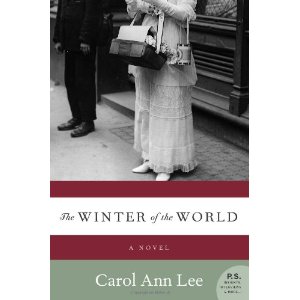
Carol Ann Lee: The Winter of the World (2007) Literature and War Readalong April

Journalist Alex Dyer made his name covering the bloody horrors of the European trenches. Yet even after the Great War is over, he cannot shake the guilt he feels for not serving on the front lines like his dearest childhood friend, Ted Eden. Worse still, Alex cannot put to rest the emotions that gnaw at him from the inside: his feelings for Clare, Ted’s wife—a woman they both have loved more than life itself. 

Carol Ann Lee’s The Winter of the World is the last novel on WWI in this read along. For the next one we will be moving on to WWII.

This wasn’t the easiest review to write as I am in two minds about this novel. There are parts in it that are so haunting and powerful but then again there were others were I was just rolling my eyes thinking “get on with it”.  Still it would be unfair to write a totally negative review because the good parts are among the best on WWI I’ve ever read.

Alex and Ted are childhood friends. They are close and attached to each other until the day Ted introduces Alex to his soon-to-be wife Clare. Very unfortunately this is a love at first sight moment for Alex and Clare. They try to fight it but, as we will see soon enough, the more the story advances, the less likely it is that they will succeed.

The marriage takes place just when the war breaks out. Ted will enlist, Alex will participate as a war correspondent and Clare will be one of the nurses in France.

The novel moves back and forth between Alex’s and Clare’s point of view. Alex sees a lot of atrocities and the descriptions are very graphic and extremely impressive without falling into the trap of being too clichéd. But since Alex isn’t fighting, it stays an outsider’s perspective. Clare’s point of view was captivating for totally different reasons. As a war nurse she has to deal with indescribable wounds and suffering. The abundance of facial wounds seems to be a trait of WWI and these parts reminded me of one of the best WWI movies I have ever seen, La chambre des officiers aka The officer’s chamber based on the eponymous novel by Marc Dugain. We seem to get an insider’s view of this truly harrowing aspect of the “Great war”. I can hardly imagine what it must have been like to have been the victim of this kind of facial mutilation and to be rejected by those you loved and who once loved you. The reactions of the relatives and fiancées were often brutal. Through Clare’s eyes we also get an equally close look at what mustard gas did to those who became its victims and how they suffocated or drowned slowly.

The only men more popular than I was were the ones in wheelchairs, or those with empty sleeves pinned against their chest. Everyone wanted to talk to them, to do something for them. Children presented them with flags and in the railway stations they got free tea or coffee. It was different for the ones whose faces had been destroyed. People averted their eyes quickly, the blood flooding their skin. No one wanted to make eye contact with a disfigured soldier; they were modern-day lepers.

While the war moves on – not stopping at Christmas, as was expected – the love affair develops as well. Clare and Alex meet secretly but are finally driven apart by conflicting emotions and wishes. Alex feels he needs to tell Ted everything, while Clare wants to protect him and keep the affair secret.

Through Alex’ voice we hear what it must have been like to cover this war as a correspondent. The journalists were not allowed to tell the truth. The numbers of casualties were not mentioned nor were the biggest defeats spoken of. While Clare’s parts rather focus on individuals, Alex’ parts illustrate the enormity of the losses. He evokes the incredible amount of wounded, disfigured and killed soldiers. At moments I had the feeling of seeing all these dead men standing in one huge row before my inner eye. When we visit those cemeteries we get a feeling for those massive losses.

He imagined a thin line linking the cemeteries along the old Western Front, from the smallest graveyards hidden away within woods to those huge, silent cities on the plains where the most ferocious battles had been fought. Some bore the names given to them by the soldiers themselves – Owl Trench, Caterpillar Valley, Crucifix Corner – while others were named after the battalion who had buried their own men there. He imagined how tha line would look from the air; so thick in parts that it resembled a child’s scribble, for they were everywhere these Gardens of Stone.

The novel slowly moves towards the culminating point which is the burial of the “unknown warrior”. The name is chose deliberately as “warrior” sounded more inclusive than “soldier”. The grave which is really located in Westminster Abbey was meant to commemorate all the dead fighters of this war, not only the infantry men. The burial is one of the best and most powerful parts in this novel.

Despite all these impressive elements, I had my problems, as I said. The biggest part of the story is told by Alex. He tells Lombardi, a guy he meets in Flanders after the war, why he is so tormented, why he cannot get over the war. I didn’t get this narrative device at all.  I would have preferred a more straightforward story, not this artificial telling of what happened to someone who has nothing to do with it. This was a common technique in 19th century novels but I think it doesn’t add anything to a modern novel at all. The next biggest negative aspect was the coincidence. I found it highly unlikely that Alex would meet Ted at the end. The third thing that I didn’t think well-done is the love-triangle. I think it was unnecessary that Alex and Clare had an affair. The descriptions of Alex’ feelings worked very well for me but not those of Clare. And the guilt-theme was just an element too much. Last but not least I missed Ted’s point of view.

I have a lot of questions at the end of this novel and would be curious to know what others thought.

Was this really the tone of a WWI novel? Especially the love-affair seemed very WWII to me but maybe that impression stems from the similarity to Pearl Harbor.

What about the facial wounds, does anyone know whether this was a consequence of the trenches? In The officer’s chambers, the young officer loses half of his face on the battle field, but I have really never heard so much about this type of injury from any other war.

Why do you think Carol Ann Lee left out Ted’s point of view? I think she might have risked to fall into the trap of cliché but I am not sure that’s why she chose to leave it out.

I’m really curious to read your thoughts.

Here are other reviews

Anna (Diary of an Eccentric)

Danielle (A Work in Progress)

*******

The Winter of the World was the fourth book in the Literature and War Readalong. The next one will be Shusaku Endo’s The Sea and Poison aka Umi to dokuyaku. Discussion starts on Friday May 27, 2011 .