Best Books of 2013

P1030826

I was going to make a best of list per genre but finally opted against that and tried to pick one or two favourite books per month. I could have included many more but I did something I haven’t done before – I tried to make the list before going through the blog, which means that all the books on my list were not only books I loved while reading them, but books I still remember.

January

Amanda Eyre Ward – How To Be Lost (2005)

February

Hjalmar Söderberg – Doctor Glas (1905)

March

Anna Raverat – Signs of Life (2012

April

Karen Thompson Walker – The Age of Miracles (2012)

May

Klaus Modick – Sunset (2011)

Elizabeth Haynes – Into the Darkest Corner (2011)

June

Harriet Lane – Alys, Always (2012)

Lisa Moore – February (2010)

Michelle Paver – Dark Matter (2010)

July

Alexis M. Smith – Glaciers (2012)

August

J. G. Ballard – The Drwoned World (1962)

Philippe Claudel – Grey Souls (2003)

September

Jane Austen – Mansfield Park (1814)

October

S.J. Bolton – Now You See Me (2011)

November

Sarah Kirsch – Die Regenkatze (2007)

Eduard von Keyserling – Schwüle Tage (1916)

December

Alice McDermott – Someone (2013)

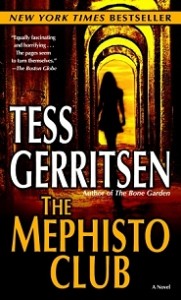
Tess Gerritsen: The Mephisto Club (2006) or Why I Prefer Rizzoli & Isles

The Mephisto Club

I’ve read Tess Gerritsen’s The Surgeon pre-blogging. It was an OK read, although looking back I can’t remember all that much. This summer I discovered Rizzoli & Isles, the TV series based on Gerritsen’s books. I really love that series, but the whole time I was wondering whether I’d simply not paid any attention while reading The Surgeon or whether books and series were that different. Since I still had The Mephisto Club somewhere on my piles I read it to find out. I must say, they do not have a lot in common. I did recognize some traits of Rizzoli, the detective, but Isles is a completely different character and so are the others. I basically love Rizzoli & Isles because of the friendship between the two protagonists, which is so endearing. None of that is in the books.  They are never together outside of work and there doesn’t seem any special connection between them at all. And all of the humour is missing. While they are two opposite characters in the series, they still have a deep bond, which evolves over time. So, if I want some of that Rizzoli & Isles friendship magic, I’ll have to stick to the TV series.

What about The Mephisto Club? Like The Surgeon, it’s OK, I’d say I even liked it better and I found the idea behind it quite interesting. The book tries to explore one explanation for the existence of evil. While it’s highly speculative, I still found it an oddly compelling idea.

In The Mephisto Club, Detectives Rizzoli and Frost and medical examiner Dr Isles are chasing a serial killer who commits a gruesome murder, leaving symbols and signs at the crime scene. The first murder is soon followed by others and some traces lead to a mysterious club called The Mephisto Club: a group of people who have dedicated their lives to proving the existence of Satan.

The story line that focusses on the law enforcement and the discovery of the crime was quite suspenseful but there are chapters which are written from the point of view of the perpetrator and some from the point of view of someone he hunts. I found that very heavy-handed and thought that this and the prologue gave away the solution. Finding who is the murderer is less important than catching him and avoiding to become the next victim.

I’ve read a few crime novels this year and while this was a quick read, it’s not one of my favourites and I’ll pick up another author next. I’m really looking forward to the next season of Rizzoli & Isles though. It is a crime series but unlike most others, it dedicates at least 40% of every episode to stories about the lives of the main characters. It’s also nice that for once the central team is composed of two women and not like in so many others (Bones, The Mentalist, Castle) of a woman/man duo.

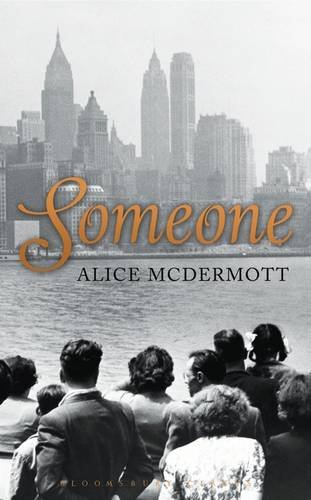
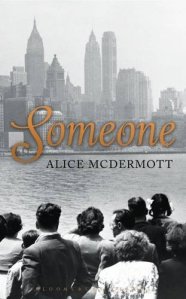
Alice McDermott: Someone (2013)

Someone

Someone begins on the stoop of a Brooklyn apartment building where Marie is waiting for her father to come home from work. It is the 1920s and in her Irish-American enclave the stories of her neighbours unfold before her short-sighted eyes. There is war-blinded Billy Corrigan and foolish, ill-fated Pegeen – and her parents’ legendary Syrian-Irish marriage – the terrifying Big Lucy, and the ever-present Sisters of Charity from the convent down the road.

As the years pass Marie’s own history plays out against the backdrop of a changing world. Her older brother Gabe leaves for the seminary to study for the priesthood, his faith destined to be tested to breaking point. Marie experiences first love – and first heartbreak – marriage and motherhood, and discovers how time can reveal us all to be fools and dreamers, blinded in one way or another by hope, loss or the exigencies of life and love.

It took a while until the title Someone of Alice McDermott’s latest novel made any sense, but once it did, I thought it was a brilliant choice. It refers to the narrator, Marie, the Brooklyn-born daughter of Irish immigrants, an unremarkable woman whose life story becomes meaningful because it is so universal. She is just “someone”, nobody special, just a woman who was born in the 20s, has experienced the aftermath of WWII, first love, work for an undertaker, marriage, her fist child, loss, grief and finally old age. It’s a mix of intense joy and pain told in delicately evocative scenes, in which every detail is rendered with a lot of care. Some say Philip Roth is the master of writing scenes. Alice McDermott maybe his female counterpart.

“Someone” also refers to other people in the book. One girl says, that there is always someone kind somewhere and when Marie, after her first heartbreak, asks her brother Gabe if she will ever find love, he tells her that someone will love her one day.

Someone isn’t told chronologically. It moves back and forth in time, picking the most important moments of Marie’s life. If it wasn’t for the writing it wouldn’t be as impressive as it is, but Alice McDermott is a writer you could read simply for her craft.

While reading I was wondering how this book that is so deeply rooted in Brooklyn would compare to Colm Toíbín’s novel Brooklyn. Just like it is the story of one woman’s life, it’s also the story of the changes Brooklyn undergoes. The way Marie’s neighbourhood is described makes you think much more of village life than life in a big city, but then again, that’s typical of the largest cities, in which some inhabitants never venture any future than their neighbourhood. Marie is particularly attached to Brooklyn. Unlike her brother Gabe she never wanted to leave or even work anywhere else. That’s why she comes to work for an undertaker, a job she’s wary of at first. It proves to be an opportunity to learn a lot about life and loss.

Since this novel is told entirely in elaborate scenes, one more wonderful than the next, I couldn’t even pick a favourite. I loved how they were descriptive and at the same time full of hidden meanings and allusions.

It’s one of those books, I’ll read again, some day, just to see, once again, how she did it, how she captured the tiny gestures of people, the way they hold themselves, the way they speak and betray their feelings in doing so.

But I didn’t only love it for the craft. I loved it for its themes – birth, marriage, family, religion, faith, too many to name them all –  and for its quiet gentleness, the belief in kindness and the many characters who all hope for a fulfilled life, but face as much disappoinment as joy and happiness. And I loved it for some lovely insighst like this one on sleep.

All the thought and all the worry, all the faith and philosophy, the paintings  and the stories and the poems, all the whatnot, gone into the study on heaven and hell, and yet so little wonder applied to the sinking into sleep. Falling asleep. All the prayers I had said before bed throughout my life, all the prayers I had made my children say – Our Father, Hail Mary, Glory Be – the Confiteor if some transgression had taken place – missed the mark entirely. It was grace, the simple prayer before meals, that we should have been murmuring into our clasped hands at the end of the day: Bless us, oh Lord, and this thy gift, which we are about to receive.

I’d love to read another of her novels. Does anyone have suggestions?

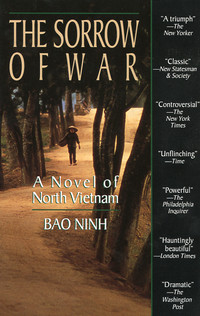
Literature and War Readalong December 30 2013: The Sorrow of War aka Thân phận của tình yêu by Bao Ninh

The Sorrow of War

We’ve all seen movies or read books on the war in Vietnam from an American perspective. Bao Ninh’s The Sorrow of War aka Thân phận của tình yêu is told from the other side. The author was a North Vietnamese soldier and the book is based on his experiences.  The majority of the books we’ve read this year were set far away from the frontline. With this last novel of this year’s readalong, we return to the territory of the soldier.

Here’s the blurb

Kien’s job is to search the Jungle of Screaming Souls for corpses. He knows the area well – this was where, in the dry season of 1969, his battalion was obliterated by American napalm and helicopter gunfire. Kien was one of only ten survivors. This book is his attempt to understand the eleven years of his life he gave to a senseless war.

And the first sentences

On the banks of the Ya Crong Poco, on the northern flank of the 3B battlefield in the Central Highlands, the Missing In Action body-collecting team awaits the dry season of 1976.

The mountains an jungles ae water-soaked and dull. Wet trees. Quiet jungles. All day and all night the water steams. A sea of greenish vapour over the jungle’s carpet of rotting leaves.

*******

The discussion starts on Monday, 3o December 2013.

Further information on the Literature and War Readalong 2013, including all the book blurbs, can be found here.

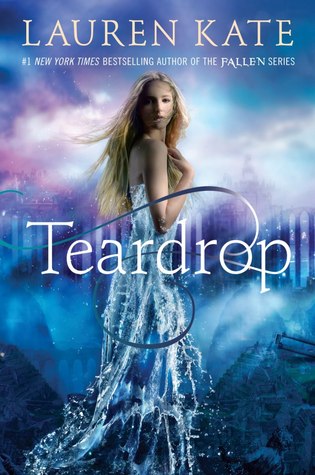
Lauren Kate: Teardrop (2013) Teardrop Trilogy I

Teardrop

Seventeen-year-old Eureka won’t let anyone close enough to feel her pain. After her mother was killed in a freak accident, the things she used to love hold no meaning. She wants to escape, but one thing holds her back: Ander, the boy who is everywhere she goes, whose turquoise eyes are like the ocean. And then Eureka uncovers an ancient tale of romance and heartbreak, about a girl who cried an entire continent into the sea. Suddenly her mother’s death and Ander’s appearance seem connected, and her life takes on dark undercurrents that don’t make sense.

I’ve been interested in Lauren Kate’s Fallen series ever since I first heard about it but somehow never managed to read it. That’s why I was so pleased when I was sent a review copy of Teardrop, the first in her new YA series.

Eureka has lost her mother in an accident. A rogue wave washed over a bridge and threw the car into the ocean. Eureka who was in the car with her was miraculously saved. We know from the beginning who saved her but we don’t know why her mother had to die.

Eureka has a hard time coping. She even tries to take her own life. That her father’s second wife bullies her into going to therapy doesn’t help. Slowly Eureka loses interest in in everything and she’s angry that nobody understand that you can not just forget an accident and a loss like that.

Nobody seems able to reach Eureka, not her family, nor her friend Cat, or her best friend Brooks who changes in odd ways. But there is Ander. A guy who appears seemingly out of nowhere at every moment.

Her mother has left Eureka a strange book and a mysterious stone. She finds an old woman who is capable of translating the book which seems to date back to Atlantis.

As if Eureka’s life wasn’t difficult enough, Brooks disappears and she is followed and threatened by a group of people Ander seems to know. Questions upon question arise, the most confusing one: Why is Eureka not allowed to cry?

There were a few things I really liked about Teardrop. First of all the setting. The story is set in Louisiana, somewhere near New Iberia. I loved the descriptions, loved how Eureaka runs in the rain, the evocation of humidity and lush vegetation. I think I even liked the setting and the atmosphere far better than the characters or the story. Eureka is a girl I felt for. She is isolated in her grief and surrounded by people who have not the tiniest bit of empathy. I think that was captured well. The love story was a bit too superficial for me but maybe there will be more depth to it in later books. The story which circles around the myth of Atlantis is unique, unfortuntaley the foreshadowing that Lauren Kate uses takes away some of the surprise. The end is a cliffhanger and if book two was already out,  I’d pick it up. I really loved the setting, the importance and symbolism of water and I’m interested to see where this is going.

Thanks to Random House for the review copy

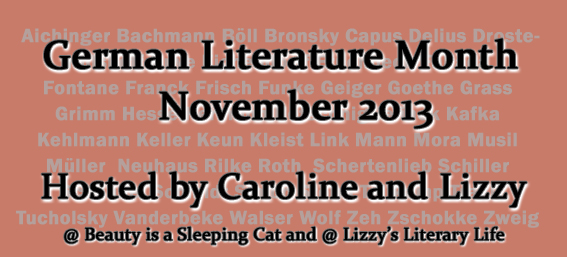
Looking Back on German Literature Month 2013

image

German Literature Month 2013 is over. It’s time to thank everyone for participating. Some have shown extraordinary enthusiasm. I’m not sure about the statistics of the last years but I’d say with 127 posts, this year was a success.

If you’d like to get an overview, visit our special German Litertaure Month page, which will guide you to all the contributions.

While the month ends on my blog, there is still something going to happen on Lizzy’s. A generous editor has provided a set of books for a lucky winner, who will be announced on Wednesday. Don’t miss visiting her blog then.

I was a bit afraid that there wouldn’t be as much interest this year but that was clearly not the case. Thanks again to all of you.

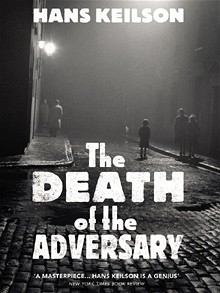
Hans Keilson: The Death of the Adversary – Der Tod des Widersachers (1959) Literature and War Readalong November 2013

Death of the Adversary

I wish it hadn’t happened but it did. I couldn’t finish Hans Keilson’s novel The Death of the AdversaryDer Tod des Widersachers. Not because I ran out of time but because – frankly – I hated it. I hate parables and books that whiff of Kafka (and are not Kafka) and  . . . If  you want to write about Nazism and the rise of Hitler, why don’t you mention it. Why does Hitler have to be referred to as “B”? Why is it never stated that the narrator is Jewish . . . It’s obvious, of course, but the way this is handled is just annoying.  Ilse Aichinger does a similar thing in her novel Herod’s ChildrenDie grössere Hoffnung, but it never feels like mannerism, it’s powerful, expressive and chilling.

I’ve read about 2/3 of The Death of the Adversary and there were passages I thought masterful but they had nothing to do with Nazism and/or oppression but were mainly taken from either childhood or young adult memories. There is a story in which the narrator tells how he forged stamps. This was psychologically subtle. There are other instances in which we see that Keilson’s observations are the result of his being a psychiatrist.

The book’s central story tells how a young Jewish boy first learns about his adversary “B”, a man who slowly rises to political power. His power can be felt in the growing number of followers and how they accept his theories and apply his laws and rules, which first lead to exclusion of the Jews, and then to their persecution. I don’t see what is gained in calling Hitler “B”. Did he want to show the universality of evil? He wanted to show the banality of it, which becomes obvious when he sees the man. And the way he treats the adversary as a recurring motif, showing that he is  s much on the inside as on the outside  . . .  Most of the time, I agree, things are not black or white but I don’t want this concept applied to Hitler and Nazism.

There is also a parable-in-the-parable – the story of the elks and the wolves, which I found particularly ambiguous. Elks were living under the best conditions, however they were not striving but dying. Why? Because there were no wolves. In order to live they would have needed adversaries.

I almost always finish books because some stories need every single passage to become a whole. Given that The Death of the Adversary is not only a parable but a disjointed book – I wouldn’t really call it a novel -,  I’m pretty sure, the end wouldn’t have made me think differently. From what I’ve seen so far, Keilson might be a good writer but he’s not a novelist.

I know that I’m one of a very few who didn’t like this book. But I really didn’t and although I’m sure that Comedy in a Minor Key is different – I’m not going anywhere near Keilson’s fictional work  for a while.

Other (favorable) reviews

Lizzy (Lizzy’s Literary Life)

Mel u (The Reading Life)

*******

The Death of the Adversary was the eleventh book in the Literature and War Readalong 2013. The next is the Vietnamese novel The Sorrow of War aka Thân phận của tình yêu by Bao Ninh. Discussion starts on Monday 30 December, 2013. Further information on the Literature and War Readalong, including the book blurbs can be found here.