That Doesn’t Mean What You Think it Means by Kathryn Petras and Ross Petras- Misused Words and Their Tangled History – A Post a Day in May

Are you fond of words and their etymology, their meaning, their use? Do you chuckle when someone misuses a word and the sense of the sentence is totally not what the speaker/writer intended? I’m one of those people. Endlessly fascinated by words and their meaning. Easily amused by their misuse.

If you’re like me, then That Doesn’t Mean What You Think It Means is the perfect book for you. The authors have compiled 150 entries in which, starting from a quote in which a word is misused, they explain the history, the various changes in the meaning of certain words and their correct use. Some words are on their own like scarify or refute, others paired with a word that either sounds similar or has a similar meaning like ingenious/ingenuous, hurdle/hurtle. There are also expressions like begs the question. The entries are in alphabetical order starting with a priori and ending with wet your appetite/whet your appetite.

Many of the quotes made me chuckle, but so did the entries. They are not only informative but often very funny.

Here’s the beginning of the entry for preternatural

“Whole Foods . . . is the largest supermarket in Manhattan. Milling about its preternaturally clean aisles and sculptured displays of produce, shoppers move pastorally slowly by New York standards.” – From Greening the red, white, and blue: The bomb, big business, and consumer resistance in post-war America

Unless you think finding grass-fed beef steaks for 6.99$ a pound is a paranormal event, going to Whole Food isn’t a supernatural experience. It seems kind of ordinary to us.

The authors then go on to explain the Latin source of the word, compare it to the word supernatural, which is close, mention where it’s been used and how and then end with the definition.

I was surprised that I don’t mix up many of these words, even though English isn’t my native language, but that is certainly because many of the words are Latin or Greek based and can also be found in French and German. Plus I had eight years of Latin at school.

But there were word pairings like nauseous and nauseated that I also misuse. I didn’t know that you shouldn’t say you feel nauseous about something but nauseated. The thing that makes you feel nauseated is nauseous.

Even though I was familiar with many of the words, I didn’t always know where exactly they came from or how they were used formerly. Nauseous, for example, really did once mean nauseated in the US.

Here are a few more of the pairings that are often misused or mixed up:

all together/altogether, loath/loathe, tortuous/torturous, economic/economical.

Nobody is likely to misuse the words of this entry any day soon:

Pandemic/Epidemic/Endemic

“In 2016, the board clashed with directors of the film Udta Punjab, a film depicting the drug pandemic in the west Indian state of Punjab, when it asked for multiple cuts.” CNN

They obviously mixed up pandemic and epidemic.

I bought this book when it came out in 2018 and since then it has become a favourite to which I return again and again. I always discover something, always learn something. How to really use some words or about the original and former use. It’s a book that would appeal as much to those who love grammar as to those who are interested in the origin of words.


 

Simple Passion by Annie Ernaux – French Life Writing – A Post a Day in May

I own everything Annie Ernaux has written up to The Years but have only read a few of her books. Since her books are so short, she seemed an excellent choice for my May project.

Annie Ernaux is divisive. Some people adore what she does, others are put off. Those who love her, praise her honesty, those who don’t, find her indecent. I go back and forth between these two reactions. Sometimes I find it a bit too much, as well. At other times, I’m just so fascinated.

What helped me get along with her better, was to see her oeuvre as a whole. Sure, you can read single books, but you will get so much more out of reading her, when you read more or all of her. It’s never just about the story or the topics of a book with her, it’s always about the process of writing and giving meaning. Writing about a woman’s life, her body, and often, her sexuality.

Several books have been rewritten Simple Passion, her account of her love affair with a Russian diplomat, is one of those. She wrote another book about her affair many years later – Se perdre (To lose oneself – not translated, I think). Aa a reader, you often wonder – Why does she write about this? Why does she have to reveal herself like this and so does she. You’re always part of the writing process as well, part of the thought processes behind the writing.

In Simple Passion (Passion Simple), Annie Ernaux analyses a love affair she had with a married man, the previous year. The affair lasted over a year and was all-consuming. She couldn’t think of anything else but him. Couldn’t find interest in anything else or anyone else, unless they somehow reminded her of him or had something in common with him. She sat whole days next to the telephone, waiting for his call. Spent whole afternoons preparing for his arrival; shopping new clothes, painting her nails, applying new make-up.

The absence of a call is agony. A call is bliss. She’s completely dependent on this man and doesn’t exist outside of their meetings. It’s never as apparent as when she goes on a holiday to Florence. She doesn’t even want to look at anything. Just wants to think of him, imagine how he would see the place.

The book describes everything. Her weakness, her dependence, her desire, her obsession. It’s like reading the account of a drug addict. She’s aware of that herself but there isn’t anything she can do. She wonders sometimes, if he feels the same, but she has no idea. Conversation isn’t exactly part of the whole affair. Sex is important, everything else, not so much. But that is also because of the language barrier. It’s not said in this book that he’s Russian, but in a later book it is revealed. She doesn’t speak Russian, and his French, while good, is not always accurate. He has difficulties to translate deeper meaning.

Since he’s a diplomat, it’s always clear, the affair will end. When it does, she’s shattered. And she takes note of the world around her again. And writes about her affair. It takes her five months during which the Berlin wall falls and the Ceaușescus are executed.

After having finished to write about her affair, she suddenly feels shame. A shame she never felt during the affair, a shame that comes from the idea to publish.

I found the way she described this affair interesting. Most of it rang so true. Haven’t we all waited next to a phone before? Spent afternoons getting ready or endlessly talking and thinking about our love interest? I never found it problematic, that she’s honest. I found it problematic that she never questions having an affair with a married man. Not once. It’s all about her and her feelings. He’s only interesting as far as he’s the object of her desire. And the other woman? It’s as if she doesn’t exist. Obviously, this shows how honest she is, as it doesn’t really make her look good.

People were shocked when this came out in the 90s. Also, because it was a departure from her earlier work and because it’s so explicit about female desire and sexuality. It was certainly courageous to write and publish this at the time. Nowadays, I find it a bit sordid. Not because of the descriptions – it’s never very explicit anyway – but, as I mentioned, because there’s another woman. If it’s a feminist act to live our passions, isn’t it also a feminist act to think of the other woman? I’m not judging that it happened, that would be naive, these things do happen, but that she’s never thinking or writing about it.

After the translation of The Years, Annie Ernaux received a lot of attention outside of France. She’s interesting, well worth exploring, but I’d say, this isn’t the best entry point to her work.

If you’d like to read another review – here’s on I wrote on A Woman’s Life. I liked that one a great deal.

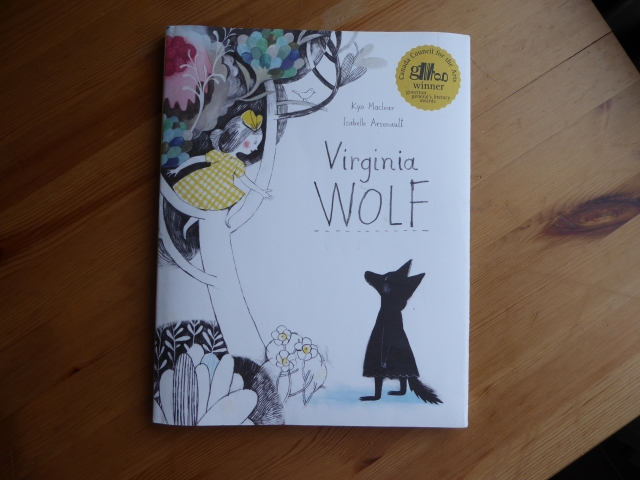
Virgina Wolf by Kyo Maclear and Isabelle Arsenault – Virginia Woolf for Children – A Post a Day in May

I’m very fond of picture books for children, especially those that also have an appeal for adults. They are often real works of art like this collaboration between Kyo Maclear and Isabelle Arsenault. The idea to introduce children not only to Virginia Woolf but to dark moods caught my interest immediately. Virginia Wolf is loosely based on the relationship between the sisters Vanessa Bell and Virginia Woolf.

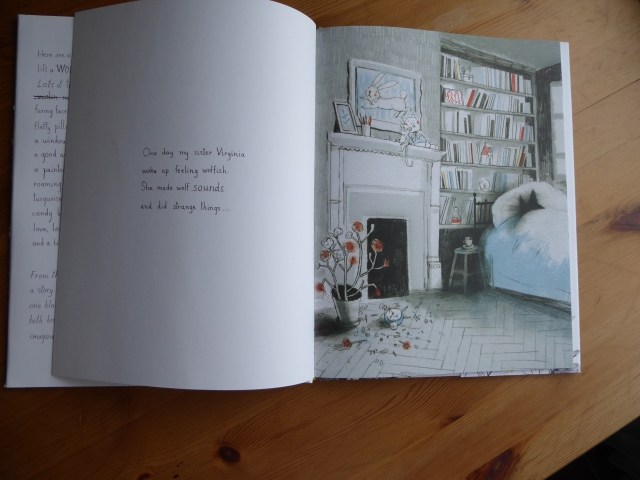
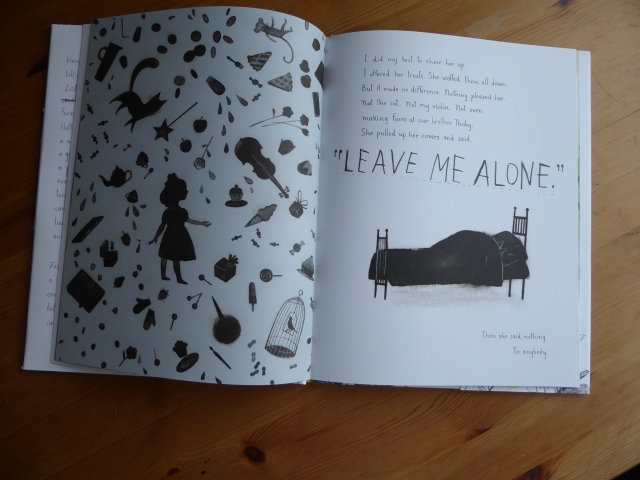
One day, Vanessa’s sister Virginia wakes in a wolfish mood. She isn’t interested in anything. The colours are gone and all she wants to do is stay in bed, under her covers.

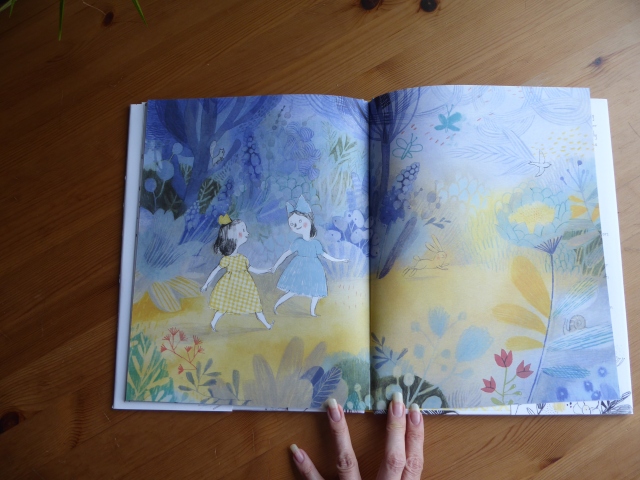
Vanessa thinks long and hard how she could help her sister and finally comes up with an idea. She begins to paint an imaginary place called Bloomsberry on the bedroom walls, using stunning colors. There’s a beautiful garden with flowers and a swing. Soon, Virginia joins her sister and begins to paint as well.

The way this book speaks about dark – or wolfish – moods is done in such a delicate way. It shows what it feels like to be in this mood and how it affects families and friends. But it also tries to show a way out. The amazing thing is that the book doesn’t downplay the mood at all but it also doesn’t overwhelm children. It gets the balance just right. Grown-ups know that Virginia Woolf suffered from depression, but for children she just has a very bad day.

This is from the inside of the book cover jacket:

Here are a few things to help lift a WOLFISH mood:

Lots of treats,

Violin music,

funny faces (sometimes),

fluffy pillows,

a window and clouds,

a good art box,

a painted ladder,

roaming space,

turquoise birds, candy blossoms,

love, love, love,

and a big imagination.

Kyo Maclear has collaborated with other illustrators. I love that she chooses topics that one doesn’t immediately associate with a children’s book. One of her books is about famous chef Julia Child, another one about the fashion designer Elsa Schiaparelli. They both look lovely too.

In the short video that I attached she explains that the book can be understood without knowing who Virginia Woolf is, but that adults can bring their knowledge to the books and will enjoy it in a very different way from the children. This is very clever because, in the end, it’s not kids who buy these picture books but adults who will also read the books to their kids.

https://www.youtube.com/watch?v=7TJXDgEbOGI

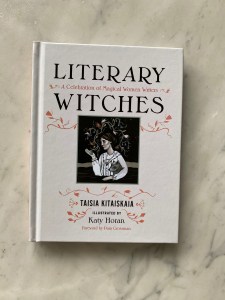
Literary Witches by Taisia Kitaiskaia and Katy Horan – A Collection of Magical Women Writers – A Post a Day in May

Taisia Kitaiskaia’s Literary Witches – A Collection of Magical Women Writers, illustrated by Katy Horan, is similar to We Are Artists, the book I wrote about two days ago. Only this time, it’s not women artists but writers from around the world that are celebrated.

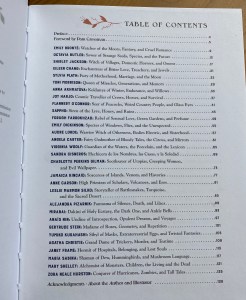
In thirty chapters, Kitaiskaia and Horan pay homage to as many writers. Some like Emily Brontë, Sylvia Plath, Virginia Woolf, Agatha Christie, and Toni Morrison are well known. Others, like Iranian poet Forugh Farrokhzad or Argentinian poet Alejandra Pizarnik, might be a little less familiar. Or, at least, I didn’t know them. The wide range allows many readers to discover new names.

Here is the Table of Contents.

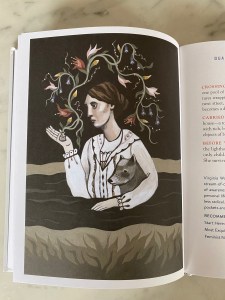
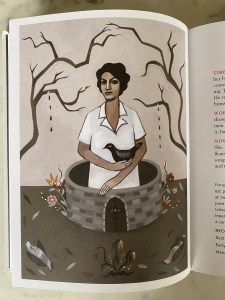
The biggest difference between this and We Are Artists is the way it is presented. The biographies are only one paragraph long and not seven pages like in the book about artists. The illustrations also depict the women and something that symbolizes their writing.

Additionally to the biographical paragraph, you find, on the same page, three fictional paragraphs, inspired by the authors. You could call them flash fiction pieces. They are dreamlike explorations of the writer’s consciousness.

What I liked best are the illustrations. I think Katy Horan is terrific. And I also find the biographical paragraphs useful, especially because there’s also a list of the most important works of the authors.

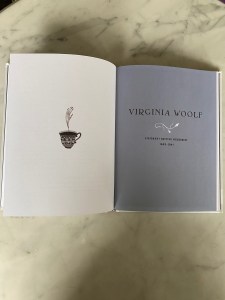
To give you a better idea I’ve chosen three chapters that should help illustrate the book.

Virginia Woolf’s chapter

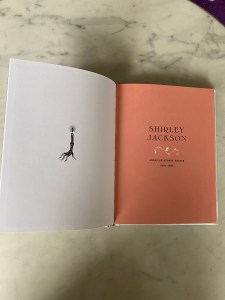
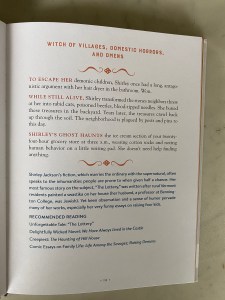
And Shirley Jackson

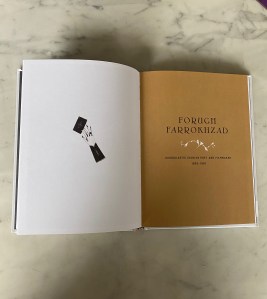
And Iranian poet Forugh Farrokhzad

Literary Witches was published in 2017 and I think I’ve had it since then. I pick it up quite frequently as I like it very much. It’s not the kind of book that I read from beginning to end, more one that I browse.

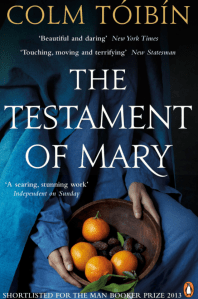
The Testament of Mary by Colm Toíbín – An Irish Novella – A Post a Day in May

I remember how intrigued I was when Colm Toíbín’s novella The Testament of Mary, based on his own play, came out in 2012. I love it when authors give historical, fictional or mythical characters a voice. Even though, I was so keen on reading it, it languished on my piles for so many years. Finally, thanks to my project A Post a Day in May, I’ve read it and loved it. It’s beautiful and daring. Engaging and thought-provoking.

The book is set many years, decades even after the crucifixion. Mary lives alone, in isolation in a house in Ephesus. She has two guardians who visit frequently. They ask her many questions about the past, about Jesus. She doesn’t talk. She keeps her memories, of which she has many, to herself.

I remember everything. Memory fills my body as much as blood and bones.

She has reason not to talk to these men because they have an agenda. They want to make sure that her memories and what she says about them corresponds to their truth. They are about to write the history of Jesus and their view, their interpretation of what happened differ completely from Mary’s.

It’s never said who these two men are, but as Toíbín mentions in an article, it could be St. Paul and St. John. It’s not important. What is important is what they wrote and that is the story we are familiar with.

Mary’s story is completely different. It’s a story of loss and grief for a son, who had lost his way. A son who attracted misfits, criminals, and fanatics and had to pay a terrible prize for the turmoil he and his followers created. She speaks about several of the most famous elements of the story of Jesus. Lazarus, the wedding at Cana, the walking on water. All these things she hasn’t witnessed and doubts. What she saw is a man who barely recognizes her, who has become a stranger, but a stranger she still loves deeply. While she hasn’t seen his “miracles”, she’s seen the crucifixion and has been traumatized by it. And then she tells us something very surprising – she wasn’t there when they took him off the cross. She didn’t witness his resurrection. She fled because she knew they would come after her and after other members of the family, friends, and followers.

In Ephesus, she also remembers the days when she was a practicing Jew. The Sabbaths she liked so much. Nowadays, she prays to the goddess Artemis.

I lived mostly in silence, but somehow the wildness that was in the very air, the air in which the dead had been brought back to life and water changed into wine and the very waves of the sea made calm by a man walking on water, this great disturbance in the world made its way like creeping mist or dampness into the two or three rooms I inhabited.

I loved this book. Loved the tone and mood. Mary’s sorrow, grief, and trauma are beautifully described. I was surprised to read her interpretation of things. It’s against everything that we know from the testaments. Jesus is described like a rebel but not exactly like a rebel with a cause. More like an outlaw. I like that Toíbín gave Mary her humanity back, looked at what happened through the eyes of a mother who had to witness her son being crucified. The crucifixion is described in detail. No gratuitous violence but still explicit.

I wonder what practicing Christians, especially Catholics, think about this book. I haven’t found a lot online. I was raised a Catholic but since I’m anti-clerical, I left the church a long time ago. I was surprised that I found some elements disturbing. The story of Lazarus, for example, reads like a creepy zombie story. I even found this book sacrilegious in places. Even if he might not have been the son of God, I always think of Jesus as supremely good. In the end, it looks like Toíbín wants to say the religion only exists because of the interpretation of the facts by those who wrote it down.

This is a short book and, still, one could write pages and pages about it. I hope I could do this complex book justice. It’s so beautiful and engaging.

If You Come Softly by Jacqueline Woodson – A New York Setting – A Post A Day in May

I’ve had Jacqueline Woodson’s novel(la) If You Come Softly (published in 1998) on my piles for almost ten years. When I discovered her name on this year’s Women’s Prize For Fiction Longlist, I decided it was finally time to read it. I was a bit surprised to find her on that list, as I thought she only wrote books for Young Adults and I don’t seem to remember having seen any YA titles on the past lists. I suppose, one could also call Red at Bone a YA novel, as the protagonist is a young woman.

I know, a lot of people shy away from reading YA literature but that’s a real shame as one can find some of the most original writing under that label.

The epigraph to If You Come Softly and the title are taken from a poem by Audre Lorde

If you come as softly

as the wind within the trees

You may hear what I hear

See what sorrow sees

I couldn’t think of a better epigraph to set the tone and capture the mood of this beautiful, mournful book.

If You Come Softly tells the love story of Jeremiah and Ellie. They fall in love at first sight on their first day in their new private school. Ellie lives with her parents in a huge flat overlooking Central Park. Jeremiah is from Brooklyn. He too, is from a rich family. His dad is a famous film director, but nobody at his new school knows that. Nobody even thinks that Jeremiah’s family has money, they think he attends the expensive school because of a scholarship. Why would they think that, you may wonder? Because Jeremiah is black, and this school is mostly white. And so is Ellie who is white and Jewish.

These two young people couldn’t care less about the colour of their skin and, while they think it might be difficult to be together, they do not expect it to be this difficult.

This is a very short book and I’m still surprised it manages to be so deep. Love at first sight stories often don’t work but this one does. Woodson conveys the feelings so well. There’s something magical about Jeremiah’s and Ellie’s love. And it’s exactly that soft, mellow magic that stands in such stark contrast with the world these two live in.

Towards the end, when Jeremiah is on his way to visit Ellie, there’s a very short passage that punched me in the gut.

He hated lying to his father. Yes, he did go to Central Park, but it was to hang out with Ellie- to sit and talk with her for hours and hours.

“You be careful over there. No running.”

Ever since he was a little boy, his father had always warned him about running in white neighbourhoods. Once, when he was about ten, he had torn away from his father and taken off down Madison Avenue. When his father caught up to him, he grabbed Miah’s shoulder, Don’t you ever run in a white neighbourhood, he’d whispered fiercely, tears in his eyes. Then he had pulled Miah toward him. Ever.

I think this passage hit me so hard, because as a reader one instinctively understands, on a very visceral level, what it means: One senses how scary it must be to be a black person in a world where even running can be dangerous.

As I said before, this is a short book but it’s powerful and tightly written. You won’t find a superfluous word or passage. Only key scenes that manage to move and touch.

I can see why Jacqueline Woodson won so many awards. I’m pretty sure, I’ll read more of her. She might even become a favourite writer.

A word about the cover – Since I bought my book ten years ago, the cover I added, is the old cover. Sadly, they have changed it meanwhile. This one worked so well on so many levels.

Hetty Dorval by Ethel Wilson – A Canadian Novella – A Post a Day in May

Hetty Dorval is Canadian author Ethel Wilson’s first novel, or novella. It was published in 1947. I came across this book on Heavenali’s blog who reviewed the Persephone edition.

The book, which is mostly set in British Columbia, tells the story of how Frankie Burnaby fell under the spell of a mysterious stranger, Hetty Dorval. The story, told in first person by Frankie herself, begins when young Frankie, an impressionable schoolgirl, meets the elegant, beautiful, and charismatic Hetty Dorval. Mrs Dorval has bought a cottage, far off any other houses, and lives there alone with a housekeeper. Hetty who tells Frankie that she doesn’t really like people visiting her, nonetheless, invites Frankie to her house, where she gives her tea and sings for her. Before Frankie leaves, Hetty makes her promise, not to tell anyone. It won’t take long until loyal Frankie gets in trouble because of this. Her parents find out and forbid her to ever visit Hetty again. They won’t tell her why but it’s clear that Hetty has a reputation.

After this initial meeting ends so abruptly, Frankie doesn’t see Hetty anymore and shortly after, Hetty moves away. But that’s not the last Frankie or the reader have heard of Mrs Dorval. Over the next years, Frankie and Hetty will cross paths several times. Every time, Frankie is a little older and every time, she sees more clearly what kind of person Hetty Dorval is. Soon there’s nothing left of the early enchantment but total disillusion.

Hetty Dorval is a short novel. It is flawed but that didn’t diminish my enjoyment. Hetty is a fascinating character. She’s a free spirit but, sadly, also painfully narcissistic. I enjoyed seeing how Frankie’s perception of her changes over the years.

What I liked the most about this short book (just over 100 pages) were the descriptions of the landscape. Most of the story takes place in British Colombia, at the confluence of the Fraser and Thompson rivers. Young Frankie is often on horseback and explores her surroundings. I had another picture of Canada in my mind. Not one where sage-covered hills abound. The way Ethel Wilson describes it is so beautiful.

Here’s a short quote that illustrates this. It’s taken form the end of the book. Hetty is speaking.

“Do you remember that mare I had in Lytton? Juniper? Wasn’t she a beauty? Sometimes when the moon was full I used to saddle Juniper and ride at night down to the Bridge, and across, and up to the Lillooet road and off into the hills. And Frankie, it was so queer and beautiful and like nothing else. Though there was nothing round you but the hills and the sage, all very still except for the sound of the river, you felt life in everything and in the moon too. All the shapes different at night. And such stars. And once in the moonlight the geese going over. I remember the shadows the moonlight made on the ground, great round sage-bushes all changed at night into something alive, and everything else silver. And once or twice the northern lights – yes, really. And the coyotes baying in the hills to the moon – all together, do you remember, Frankie, such queer high yelling as they made, on, and on, and on?” (p.105)

What also seems worth mentioning is Ethel Wilson’s knack for ominous sentences. I can’t explain this in detail as it would ruin the book but in one case, she uses it to foreshadow and in another to hint at a possible tragedy in a character’s life. The result is uncanny.

Overall this was a unique and enjoyable reading experience.