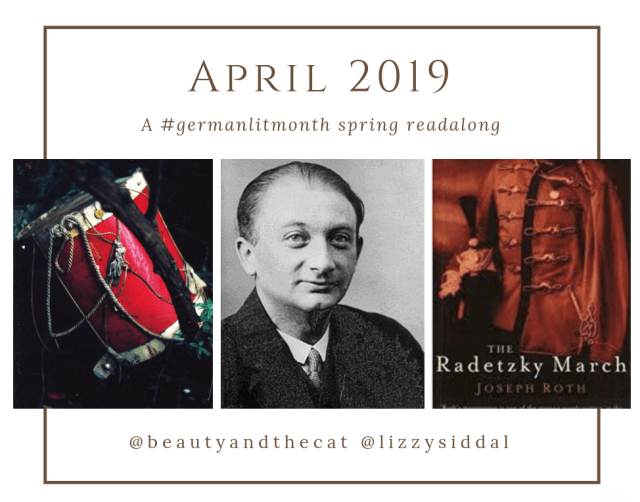
The Radetzky March Readalong – Part 1


SPOILER WARNING – The answers and questions give away important plot points


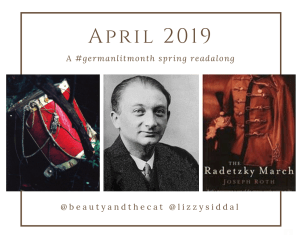
Welcome to the #germanlitmonth spring readalong of Joseph Roth’s more famous novel, The Radetzky March.  What enticed you to readalong with us?

I’ve read the book ages ago, in school, however, because we started it towards the end of a semester, we never finished it and because we were moving on to other books, I also never finished it for myself. Although more than one book has been spoilt because I read it in the class room, this one wasn’t. I really loved it, just never found the time to get back to it. The longer I waited, the clearer it became, that I couldn’t just read the final chapters but had to start from the beginning.

Which edition/translation are you using and how is it reading?

I’m reading it in the German original. A paperback edition. Unfortunately it is one of those without any introduction or notes. This is decidedly one of those books where notes would have come in handy.

Is the novel living up to your expectations?

It’s in many ways much better than I remembered it. I don’t think I caught how intertwined the themes of death, dying, and the end of an era were. I also didn’t remember how much it focussed on one person and how male-dominated it was.

How would you comment on the first few sentences? Is this an effective opening? “The Trottas were not an old family.  Their founder had been ennobled following the battle of Solferino.  He was a Slovene. The name of his village – Sipolje – was taken into his title.  Fate had singled him out for a particular deed. He subsequently did everything he could to return himself to obscurity.” (Translation: Michael Hofmann)

I found this very typical for its time, but a bit clunky for a contemporary reader. It’s vital information, of course. It also works as foreshadowing of many of the themes, especially the last sentence. It’s just not the kind of beginning that invites you with open arms, so to speak.

Roth subscribed to Chekhov’s view that a writer “should not be a judge of his characters or what they say, but an impartial witness”.  That doesn’t mean that we as readers need to be the same! How do you feel about the hero of Solferino’s crusade to return to obscurity? What are the ramifications of this for his descendants?

I got where he was coming from. I didn’t think he ever saw himself as particularly heroic and the way what he did was described in the school book made him seem even more heroic. On the other hand, his behaviour is typical of the older Trotta’s. They are such a strict, pedantic, joyless lot. And it seemed like he didn’t feel he was deserving of his title.

Carl Josef von Trotta follows his grandfather into the military.  Is his life there honourable and meaningful? Is his fateful relationship with Dr Demant’s wife innocent?

I was wondering while reading these chapters and came to the conclusion that the relationship possibly was innocent. Roth mentions physical contact when it happens but he doesn’t mention it here. I could be wrong, of course, but it would make Demant’s death even more tragic.

Roth may not judge his characters, but his sights are aimed at other targets: the social order and the military code of honour, for instance.  How does Roth critique these?

I think the duel and subsequent death of two officers shows very well how Roth felt about the code of honour. The whole story is absurd and so is the outcome. It doesn’t even matter, whether or not Trotta and Demant’s wife were having an affair. One has also the feeling Demant doesn’t even do it because of his pride, but because he thinks he has to. I’ve come across other duels in novels and they are always used as a means to show how cruel the code of honour was. But I don’t think I’ve ever come across one with quite that outcome. The double death makes it even more cruel and absurd.

Do you have any further comments on this section?

What struck me the most in this section was Carl Joseph’s reaction to Mme Slama’s death. It’s almost as if it hit his core and he wasn’t the same from then on. He immediately associated her death with the decay of her body. I suspect, although I have no proof whatsoever, that this is rather how Roth felt about death. The images of worms eating decaying bodies is recurring. Obviously, it also echoes the death of the monarchy. As a reaction of such a young man, it seemed extreme, but her death could also have triggered an underlying depression, which became aparent in these morbid thoughts.


Peach by Emma Glass – Dylan Thomas Prize 2019 Blog Tour @dylanthomprize

Emma Glass’ Peach is one of the books on this year’s Dylan Thomas Prize Long List. The prize is awarded for the best published literary work in the English language, written by an author aged 39 or under. The prize is named after the Swansea-born writer, Dylan Thomas, and celebrates his 39 years of creativity and productivity. I’m very glad I was invited to participate in the blog tour.

When I chose Peach from the longlist, I wasn’t entirely aware of what type of book this would be. I knew it was about a teenage girl who goes to college, has a boyfriend named Green, a best friend, a cat, a baby brother and parents who just seem to have rediscovered sex. And I knew that something horrible, a sexual assault, happens to her. What I didn’t realize was how artful this book would be. I don’t think I’ve ever read anything quite like it outside of poetry or flash fiction. The way Emma Glass works with sound, repetitions, alliterations, onomatopoeia is astounding. What is even more astounding is that this book, while experimental to some degree, still is immensely readable. In many ways, the style she uses seems to tell us that the unspeakable cannot be named. It has to be evoked.

Given the topic, the book isn’t for the faint of heart and it had one of those moments I’ve come to dread – cruelty against an animal. (Spoiler – why do most perverted people in books always, sooner or later torture an animal – mostly, like in this case, a cat?)

I’ve seen some critics argue that this book fell flat because it’s surreal and, at the end, Peach seems to disintegrate. I would disagree. It’s a shocking topic, told in quite horrific short chapters, but there are also some playful absurd moments that I found very impressive and convincing. Many authors who write about horrible things, like Kafka, to name one of the most famous, used the absurd to describe what’s too awful to name. And Emma Glass does just that.

To give you an impression of her stellar writing, I’ll leave you with a few quotes. Nothing captures this book as well as quotes.

The first sentences:

Thick stick sticky wet ragged wool winding round the wounds, stitching the sliced skin together as I walk, scraping my mittened hand against the wall. Rough red bricks ripping the wool. Ripping the skin. Rough red skin.

Page 39

My legs feel heavy and I’m dragging my feet. Shovelling snow with my shoes. Leaving lines behind from my lead legs.

Page 72/73

I lie down on the sofa and shut my eyes. My hands fall straight down to my tummy. Strange. How strange it is. Naturally grasping the firm mass doesn’t feel so strange any more. The lump I have been lugging though loathsome heavy hurting full, it feels like me, like part of me. Ingrained. Embedded. I think about cells, multiplying, millions, every second, every millisecond for millions of seconds how big can I get? How big will I be before I burst? Cells linking, holding hands, making chains, chains winding, chains winding around my core. Spores sporing, pouring.

One more element I’d like to mention are the chapter headings which are equally artful and playful. Here are just a few:

Seam Stress

Sun Screen

Forest for Rest

Final Pieces, Final Peace

Emma Glass was born in Swansea. She studied English Literature and Creative Writing at the University of Kent, then decided to become a nurse and went back to study Children’s Nursing at Swansea University. She lives and works in London. Peach is her first book.

Thanks to Bloomsbury Publishing for a review copy

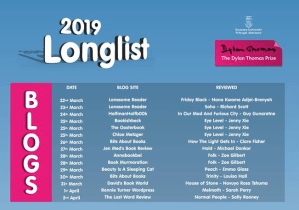
This year’s longlist of 12 books comprises eight novels, two short story collections and two poetry collections:

  • Nana Kwame Adjei-Brenyah, Friday Black (Houghton Mifflin Harcourt (US) and Riverrun (UK))
  • Michael Donkor, Hold (4th Estate)
  • Clare Fisher, How the Light Gets In (Influx Press)
  • Zoe Gilbert, Folk (Bloomsbury Publishing)
  • Emma Glass, Peach ((Bloomsbury Publishing)
  • Guy Gunaratne, In Our Mad and Furious City (Tinder Press, Headline)
  • Louisa Hall, Trinity (Ecco)
  • Sarah Perry, Melmoth (Serpent’s Tail)
  • Sally Rooney, Normal People (Faber & Faber)
  • Richard Scott, Soho (Faber & Faber)
  • Novuyo Rosa Tshuma, House of Stone (Atlantic Books)
  • Jenny Xie, Eye Level (Graywolf Press)

Get Ready for the Radetzky March Readalong Starting April 4th

Readalong Schedule

Part One on Thursday  April 4

Part Two on Thursday April 11

Part 3 on Thursday April 18

*****

The readalong begins in 10 days time on April 4th with a discussion of Part One of Joseph Roth’s masterpiece. There will be  reading questions for those who wish some guidance, but we need email addresses so that we can send them to you (about a week before each discussion).

If you’d like to receive the questions, please comment ensuring you fill in the email field in the comment form. (No-one else will see it that way.) Alternatively, follow @lizzysiddal or @beautyandthecat on twitter and let us know you want to read with us. We can then DM the questions to you.

There is no obligation to answer all or any of our questions. As always with #germanlitmonth reads, you can read/write/blog/tweet as you please. But we had a fantastic experience, when we did it this way with Effi Briest. And there’s just as much to discuss about The Radetzky March.

Lizzy and I are looking forward to this immensely.

*****

Readalong Schedule

Part One on Thursday  April 4

Part Two on Thursday April 11

Part 3 on Thursday April 18

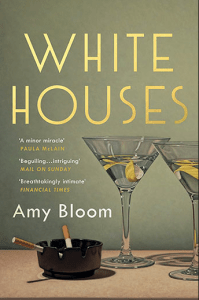
Amy Bloom: White Houses (2018)

I’m not that familiar with most of the pre-Reagan American presidents and even less with their respective wives, but Eleanor Roosevelt was someone who had piqued my curiosity, years ago, as a teenager. I read a terrific book by Gloria Steinem, called a Book of Self Esteem and she made a comparison between Eleanor Roosevelt and Margaret Mead. Both women were highly intelligent and successful, but not exactly known for their conventional beauty. As Steinem showed, Mead couldn’t have cared less, while Roosevelt, when asked by an interviewer, whether she had any regrets looking back on her life said: “Just one. I wish I had been prettier.” This struck me as incredibly sad and touched me because it was so frank. I also wondered, what kind of life she thinks she’d have had if she had been prettier. After all, she was married to one of the most popular US presidents. When I came across Amy Bloom’s latest novel White Houses and saw it was about her relationship with Lorena Hickock, I remembered the Steinem book and picked it up. I wasn’t surprised to find out that Eleanor Roosevelt’s looks were also an important topic in this novel.

Of course, White Houses, is a novel, not a nonfiction book, so we have to assume Bloom took some liberties, nonetheless it was fascinating for many reasons. I had an idea of president Roosevelt, like many do, and while I still believe he was one of the better presidents, I don’t think he was that good a man. At least not, judging by this novel. Not only was he a philanderer but quite cruel to his mistresses. When they had served their purpose, he dropped them like a hot potato. But this is only a tiny part of what this book is about.

He was the greatest president of my life-time and he was a son of a bitch every day. His charm and cheer blinded you, made you deaf to your own thoughts, until all you could do was nod and smile, while the frost came down, killing you were you stood. He broke hearts and ambitions across his knee like bits of kindling and then he dusted off his hands and said, Who’s for cocktails? If Missy’s stroke hadn’t killed her, Franklin’s cold heart would have.

White Houses is told by Lorena Hickock, a journalist and writer who seems to have had a love affair with Eleanor Roosevelt. Quite a passionate affair, as it seems. They were drawn to each other physically, emotionally, and intellectually.

While she may not have been a great beauty, Eleanor was very attentive and caring, which endeared her to people.

We love the attentiveness of powerful people, because it’s such a pleasant, gratifying surprise, but Eleanor was not a grand light shining briefly on the lucky little people. She reached for the soul of everyone who spoke to her, every day. She bowed her head towards yours, as if there was nothing but the time and necessary space for two people to briefly love each other.

For many years, Hickock lived with the Roosevelts at the White House. Just like Eleanor accepted her husbands affairs, he seems to have accepted that his wife had hers.

We learn a lot about Lorena Hickock who came from a dirt poor family, was abused by her father and later, during the depression, abandoned. It’s remarkable that she was able, in spite of her hardships, to get a good education and become one of the first female journalists who covered important cases, like that of the Lindbergh baby.

Eleanor came from a totally different background but there’s still a lot of tragedy there. Even though she had six children, she was only really attached to one and he died shortly after his birth. The other kids were brought up by Franklin’s mother, the bossy clan matriarch with whom Eleanor didn’t get along too well. It seems to have been clear for everyone that motherhood was never Eleanor’s calling. And she hated having sex with her husband. It’s sad to think that she still had to go through so many pregnancies.

Since they were public figures, it’s easy to imagine how difficult the relationship between Lorena and Eleanor was. Maybe it was because of that or because of other reasons, but they slowly drifted apart. The book begins right after Franklin D. Roosevelt’s death and then moves back and forth in time. The short period after her husband’s death, marks also the end of the love story between Eleanor and Lorena. Why? We don’t know.

White Houses is a elegantly written novel. It’s fascinating and has some wonderful scenes that I enjoyed a lot. The relationship between the women is very affectionate.

We drove to a cabin overlooking the ocean at dusk and unpacked before dark. We shared a brandy and the last of the pretzels and stood in our nightclothes on the little porch, the big quilt around us. The mottled, bright white moon pulled the tide like a silver rug, onto the dark pebbled beach. It should have been a starry sky, but it was deep indigo, like the sea below, with nothing in it but the one North Star.

What I found very well done was the way Bloom described the White House. It is, after all, not only a famous house, but a place where a family, their friends, and entourage live, in other words, it is someone’s home. And that aspect of home, is well captured.

While the novel had many interesting elements, I was a little disappointed. I was left with too many questions and felt I would have done better to pick up a biography. But maybe that’s unfair, as I didn’t regret reading it. Both women are so fascinating and the book manages to show what a complex person the president was.

They loved him. History should show him to be a great man, a great leader, a silver-tongued con man and a devil with women, but if it doesn’t show that they adored him, it’s not telling the truth.

And it does its title justice. It evokes both sides of the White House – the public place and the home of a family.

César Aira – El Tilo – The Lime Tree

Argentinian writer César Aira has been on my radar for a while. I don’t think I have come across any negative reviews of his work so far. On the contrary, most of his readers were more than enthusiastic. Aira is known to be one of the most prolific writers. To this day, he’s written over one hundred books. Obviously, his books are mostly on the short side, nonetheless, it’s an impressive number. It’s also a number that makes it difficult for first time readers to choose a book. Since I’d read a few rave reviews of The Lime Tree, I decided to start with that.

The Lime Tree tells a fictional childhood memoir, set right after the fall of Peronism. The narrator is an older man, looking back on his childhood, exploring the role of History on his personal history. The distinction between History with a capital H and history is a major theme of this novel. The way families, in this case, poor Argentinian families are influenced by the History of the country, its politics, is central. For someone who knows little about Latin American – or Argentinian history – it was very interesting. The book explained very well how someone like Perón could be so popular with the working classes who were hoping for social mobility.

Perón and the fall of Perón, were important for the narrator’s family and therefore also for the narrator himself. But there were other things that would play a role. His father, a very good-looking man, was ‘black’, probably of Indian descent, while his mother is described as dwarf-like and very ugly. His father, an ardent Peronist, suffered from his nerves, after the end of Peronism, and hardly spoke while his mother was a loud, chatty woman.

This duality might help to explain his marriage. My mother was white; she came from a respectable, middle-class family, and if she had acquiesced to an alliance with the ‘black’ populace, it was because her physical deformity made it impossible for her to marry at her own level. The alternative would have been to remain unmarried, and as far back as I can remember, she was always expressing her horror at the condition of ‘spinster’.

For the reader, many of the episodes in the novel are amusing, but when you look at them closely, you notice how much pain and tragedy these parents experienced.

Some readers have complained that Aria doesn’t write chronological tales and that it can be quite challenging to read him. I didn’t mind this at all. Reading The Lime Tree was like listening to the monologue of an older relative who is reminiscing, telling stories of his life, jumping from one topic to the next but always picking up the lost thread again. As with many elements of this book, there’s an echo of this reading experience in the text.

Back then, people had so much time, they would tolerate the craziest monologues. I can’t have been the only one who listened to them with pleasure.

It was fascinating to learn more about a place, Colonel Pringles, in Argentina, during a specific period, the 50s. I found Aria’s approach to telling a story interesting because it mirrored his topic – History and personal history and the way they influence each other. And there are many wonderful, colourful scenes and story elements that I liked a lot, like the description of the way they lived – in one room of an abandoned inn. I would actually love to see this made into a movie.

Will I read more of Aira? It’s possible, but I don’t think I would read him in English again. I just felt very far from the original text. That doesn’t mean the translation isn’t good. I’m sure it is. I just wanted to hear the original cadence. I noticed that there’s a new collection in Spanish due to come out in May – here. It contains ten of his short books. Maybe I’ll pick it up.


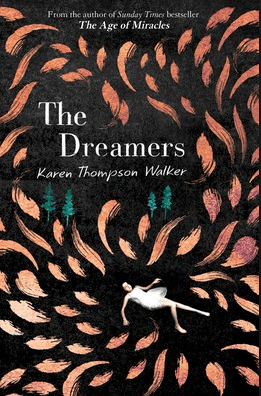
Karen Thompson Walker: The Dreamers (2019)

Karen Thompson Walker’s first novel, The Age of Miracles, was my favourite book of 2013. I adored that book so much. It’s mood, tone, and intriguing premise stayed with me. Needless to say that when I saw that she finally had a second novel out, I had to read it.

The premise of the The Dreamers is maybe not as intriguing as the apocalyptic premise of The Age of Miracles, but it’s still interesting. In a small college town in Southern California, a girl falls asleep and doesn’t wake up anymore. Soon there’s another one and then another one until there’s an epidemic. The city gets cordoned off. Nobody can enter, nobody can get out. More and more people fall asleep and don’t wake up. They all have one thing in common—they seem to be dreaming constantly. When the first girl dies, people get even more alarmed. The hospital is flooded and many of the staff fall asleep as well. Soon there are almost more sleepers than people awake and many of the sleepers die.

Unlike her first book, this one is told from multiple perspectives. The main characters are – two small girls whose father’s a survivalist, two college kids, a psychiatrist from out-of-town, and a husband and wife with a tiny baby. It was interesting to see the story told from many angles but unfortunately, it also meant it didn’t have the impact of The Age of Miracles. There was no specific tone or mood, just good-story telling. I definitely wanted to know why they fell asleep and what would become of them.

Once I finished it, I had to admit I felt underwhelmed. I thought at first that it was because my expectations were too high but then I realized that it reminded me too much of Camus’ La peste. It’s possible that this is just an unfortunate coincidence, but it’s equally possible she meant this as some sort of retelling. I didn’t read any other reviews or author interviews, so I have no idea. Unfortunately, for her, it’s hard to compete with Camus. That said, I’m sure many people will love this as it explores a topic we’re all, to some extent, afraid of – the outbreak of an epidemic. Her approach isn’t personal but social. She explores how fear affects people. She looks at the moral choices people make to either save themselves or help others.

There’s a quote from Catherine, the psychologist that I like a lot:

Worry, she reminds her patients, is a kind of creativity. Fear is an act of the imagination.

Seeing how people react to this unknown, contagious, and potentially life-threatening affliction illustrates the quote. People’s behaviour depends so much on what they imagine will happen.

The book also does ask some universal questions about illness and morality. There are so many who fall asleep and need help that, after a while, those still in good shape have to make choices who they will help. Someone they know? A younger child instead of an older person? Randomly? And what about pets – once food gets scarce inside of the city, should they still be fed?

Given the title, which isn’t The Sleepers but The Dreamers, it’s not surprising  that the nature of reality is another important theme. How do we really know we’re awake when sometimes dreams are so vivid we can’t tell we’re sleeping?

While I was a bit disappointed, expecting something with a similar tone and mood to her first novel, and because it reminded me of Camus, I still found this a compelling book. Her writing flows so well and the pace and structure are very balanced. And there are so many topical themes that make it ideal for a discussion group.

Joseph Roth – Radetzky March Readalong

You may remember talk of a spring Radetzky March readalong (or re-readalong for those who are already acquainted) during 2018 German Literature Month.  All who were interested in participating were asked to comment on their favoured month, and it turned out that April was favoured by most.

Now April is beginning to look rather full. Stu is hosting Penguin Classics week at the beginning of the month (8th-15th) and Karen and Simon are hosting the 1965 club at the end of the month (22nd-28th).  So where can Lizzy and I slot this readalong?

As the novel is divided into 3 parts of nearly equal length, we’ve decided on the first 3 weeks of the month. (There is a Penguin Classics edition, so, if you’re reading that, you can kill two birds with one stone!) And to tie in with #translationthurs, we’ll discuss Part One on Thursday  April 4, Part Two on Thursday April 11 and Part 3 on Thursday April 18.

We both loved the detailed discussion of the Effi Briest readalong, way back when during the first German Literature Month. So we’re intending to send out discussion questions for each part of the discussion.  You can answer these or post your own thoughts, entirely as you please.  If you’re intending to participate, please leave a comment and your email below.

More details nearer the time, but we wanted you to pencil in the dates now – before the month of April just gets too full for most of us!