Claudia Piñeiro: All Yours – Tuya (2003) An Argentinian Crime Novel

I had never heard of Claudia Piñeiro before I saw her book All Yours reviewed on Guy’s blog. I wanted to read more Latin American literature this year and an Argentinian crime novel sounded like a good start.

All Yours, or Tuya as it is called in Spanish, is as entertaining as it is amusing. It introduces us to the world of Inés, a middle-aged housewife, mother of Lali and wife of Ernesto. A real perfectionist when it comes to her home and keeping up appearances, a master in the art of self-delusion. More than once while reading I was exclaiming “What a nutter”.  Of course I was glad that she was such a nutter as this is why Tuya is so entertaining.

When Inés discovers a lipstick-written note, a heart signed “All Yours”, in her husbands briefcase, we are at first startled to hear that she doesn’t think it’s all that bad. After all, she believes, sooner or later all men cheat on their wives. The outcome purely depends on how gracefully the wife handles it.

Since her own unfaithful father left her mother after having been confronted with his infidelity, Inés decides not to act but to observe. One night when her husband is called to his office – there seems to be a computer related emergency which happens quite frequently -, she follows him. Of course he doesn’t drive to the office and Inés observes him while he meets with his secretary in Palermo Park. They are fighting and at one point Ernesto pushes the secretary away. The woman trips, falls and breaks her neck in the fall. How wonderful, Inés thinks, she will help her husband to cover up the whole incident. She will provide him with an alibi… But for the time being, she stays in the dark, drives home and doesn’t say a word that she has watched everything. Inés is happy, she believes that the secretary was Ernesto’s lover, and now that she is dead, nothing can separate them anymore. Right? Not quite, as we will see and from here on, things do not go as planned at all.

This isn’t the only instance in which Inés is wrong and we start to learn that absolutely nothing is at is seems in this novel and that what Inés pretends to be a picture book family is in reality rotting from the inside.

All Yours is told in alternating points of view. The most important parts are Inés’ first person narratives. Being a highly unreliable narrator, she tries to pretend everyting is fine until the very end of the book. Other parts of the story focus on Lali, Inés’ daughter. They are in dialogue form and reveal that the daughter has as much to hide as her parents but that she knows everyting about the two of them. Lali blames and hates her mother more than anyone else and towards the end of the book we realize she may have reason. Some of the chapters are police reports and third person narratives. Each of these elements together give the reader the full picture.

All Yours reminded me a lot of German crime writer Ingrid Noll’s novels in which seemingly harmless and invisible women start to develop their criminal and vengeful side. They are perfectionists, driven by an urge to save appearances at any price. We don’t warm to these women, we don’t feel for them but we enjoy the delicious frisson that we experience while following them on their journey towards retribution.

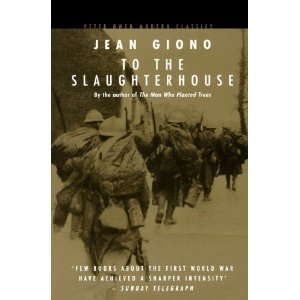
Jean Giono: To the Slaughterhouse – Le grand troupeau (1931) Literature and War Readalong March 2012

There are so many different ways to write about war. Some novels focus on the experience of the soldier, some will focus on what the civilians go through, some move back and forth between the front lines and the home front. While Jean Giono’s Le grand troupeau – To the Slaughterhouse does move back and forth, the book is still completely different from anything else that I have read so far.

Giono’s technique does need some getting used to. What he describes is equally beautiful and horrifying. The result may very well be one of the most radical anti-war books that I have read.

If you are looking for an action-driven novel, this isn’t one to turn to, Giono’s novel is far more like the description of paintings. I was reminded of Otto Dix’ WWI paintings more than once. Some of the very visual descriptions in this novel are as graphic and gruesome as Dix’ work.

The war has come to a little village in the French Provence region. All the men are drafted and go to war, leaving the women, old men, children and animals behind. Some of the men are shepherds. They have to abandon their herds. Left on their own,  the animals are endangered, they have accidents, get wounded. One day a massive herd enters the village. It’s an awful sight. So much suffering, so much pain.

Julia’s husband Joseph has gone to war, as has her sister-in-law’s young lover, Olivier. The story moves back and froth between life in the village and the men. It’s more a series of pictures than a real story. Very powerful and graphic pictures.

Giono chose to show us how war affects the body. It’s not the fighting he is interested in but what happens when someone is wounded. How the wounds fester, how the juices flow out the dead bodies. The rats which are always mentioned in WWI novels are present here as well but we see how they eat the faces of the dead men.

I had a faint feeling in my stomach for most of the time while reading but I saw what he wanted to achieve and I thought the idea was amazing. He didn’t stop at describing the horrors of the war and what it did to the bodies of the men, he described the beauty as well. The scents in the air, the taste of food, the beauty of the landscape.

There are hunting scenes and scenes of slaughter and the bodies of the dead animals resemble those of the dead and wounded men.

Human beings and animals both suffer pain, their bodies are vulnerable and frail, they can be killed and harmed and wounded and the result will be the same. At one point he goes one step farther, describing how the earth suffers too, when her body is ripped open by explosives. Giono includes the entirety of creation in his novel and shows that every being existing in this world, wants beauty, love and tenderness, shelter and food and when this is not provided, when aggression is let loose, the body is harmed, wounded and the being ultimately dies.

It’s a highly symbolical novel, with a profound message of peace. It was hard to read but I am glad I did. It really would be hard to find a more eloquent anti-war statement and a book which manages like this one, to show, that since we all, animals and human beings alike, suffer pain, we are equal. This profound message makes To the Slaughterhouse not only a plea for human rights but for animal rights as well.

Other reviews

Danielle (A Work in Progress)

To the Slaughterhouse is my fourth contribution to the War Through the Generations Challenge hosted by Anna and Serena.

*******

To the Slaughterhouse was the third book in the Literature and War Readalong 2012. The next one will be Helen Humphreys’ Coventry. Discussion starts on Monday April 30, 2012.

Muriel Spark E-Book Giveaway and Readalong Plans for April and May

With my own Literature and War Readalong and Carl’s Once Upon a Time Challenge which has just started, April and May look like busy months but in a very good way. Since I’m quite excited about some of the events I wanted to share them with you. There are some great readalongs taking place and it would be nice if the one or the other reading this would join as well.

April Reading Along with Beauty is a Sleeping Cat

The first readalong is Frank Delaney’s Ireland which im going to read together with Mel u from The Reading Life. The choice is inspired by his Irish Short Story Month. We will read and post on it either in week 2 or 3, in April. Should you want to join us, please leave a comment on my or Mel’s blog.

Emma from Book Around the Corner is hosting a yearlong book club and I’m going to join for the next book which is Tracy Chevalier’s Remarkable Creatures. The readalong takes place on Thursday, April 26.

In May I’m going to join Bettina (Liburuak) for a readalong of Alice Walker’s The Color Purple. The readalong takes place on May 31st. Details will be announced on Bettina’s blog, beginning of May.


As you know, Muriel Spark week, hosted by Simon (Stuck in A Book) and Harriet (Harriet Devine’s Blog) is going to take place from April 23 – 29.

Open Road Integrated Media has just released eight of Muriel Spark’s novels and I’m very glad that I have the opportunity to give away two e-books.

The first e-book I’m giving away is the famous The Prime of Miss Jean Brodie. It’s a book I personally liked a lot.

If you would like to win this e-book, just leave a comment. The giveaway  winner will be announced next Tuesday, April 3 2012.

As I said before, Open Road Media offers two e-books. Which one will be the second book is up to you, that’s why I included a poll. Please vote for the second book you would like to be given away.

Please don’t click the category “other”. I couldn’t get rid of it but it doesn’t exist.

The book with the highest poll result will be given away next week.

The poll has been moved and can be found here

Returning to Virginia Woolf

Maybe it’s because I’m reading Alexandra Johnson’s books and Virginia Woolf is an author who is central in them or perhaps it is because of Sigrun’s (sub rosa) Virginia Woolf project which I like to follow, whatever it is, Virginia Woolf was often on my mind lately.

I have this odd habit that when I like an author a lot I try to keep at least one of his or her books for later. There are a few authors whose complete works I have read but, due to my reluctance to run out of books to look forward to, they aren’t numerous.

Virginia Woolf is one of those authors where the thought I may finally have read all she has ever written fills me with a certain apprehension. While I’m still keeping Moments of Being for later, I have finally started The Voyage Out, the only novel I hadn’t read yet.

It’s funny to return to her and finalize the reading of her novels with the first book she wrote. It feels as if I had completed a circle. I started reading Virginia Woolf with Mrs Dalloway. I didn’t know that Mrs Dalloway was a returning character. I didn’t even know that Virginia Woolf had any returning characters. But here she is, in The Voyage Out, Mrs Dalloway, in all of her “glory”. Was she always this obnoxious? Frankly, I don’t remember. What I remember of my first Virginia Woolf novel was how much I liked the style.

The Voyage Out is very different from later books but at the same time it contains so many aspects typical for Virginia Woolf”s writing. I know many people read the body of work of an author they cherish chronologically but in her case, reading backwards wasn’t a bad choice. One could too easily overread important aspects of this early novel or, as was done when it was published, dismiss it as being nothing special.

Reading The Voyage Out makes me realize once more what I like the most about her writing. Yes, the style, especially in the later novels, is fantastic, with its flow of interior monologue, the way she uses time and how she describes the passing of time. But there is something else that stayed with me forever since the day I have read Mrs Dalloway. Her writing has an exhilarating quality, an effervescent intensity of feeling that made me think of a German expression which I adore: “Champagner Wetter” or “Champagne weather”. Champagne weather is used to describe a very fresh but sunny spring morning on which the air is still cool, nature has returned to life, the first tentative, tiny leaves appear, the first blossoms can be seen. It’s already a bit warm in the sun but still chilly in the shade. It’s like drinking the first glass out of a freshly opened, nicely cooled Champagne bottle. It bubbles and goes to your head. Virginia Woolf’s novels are full of scenes conveying the mood of champagne weather.  

I will write a “proper” review once I have finished the book but I’m enjoying it too much to wait until then. So far I can see that the story is told chronologically and sequentially, nothing daring really. But there is already a very striking way of writing about people’s interior lives. One of the main themes is the role of women and the way they are treated or rather mistreated by society. Parts of the novel reminded me of E.M. Forster, others of Henry James’ Portrait of a Lady. Rachel, one of the main characters, has a lot in common with Isabel Archer. Still there are scenes which are already typically Woolf. She had a very particular way of showing the passing of time or how the interior worlds of people coexist. There is a wonderful scene towards the middle of the novel in which we see a hotel at night.  First we see it from the outside, all its windows are illuminated, the people are getting ready to go to bed. Later we approach and enter the building, brief glimpses into the various rooms draw pictures of the inhabitants. At the end of the scene, they are lying in their beds, separated only by thin walls, dreaming or just sleeping, drifting off into unknown territory, as if on a big ocean liner. It is a recurring scene really, as the book starts with the voyage on a ship.

It is possible that I will start rereading her books in chronological order when I have finished The Voyage Out and Moments of Being. My favourite of her books are Mrs. Dalloway, To the Lighthouse and Flush. I didn’t like The Years or The Waves much and can never even keep them apart. I also didn’t care for Orlando at all. Not sure why, it’s generally a favourite of many people but I remember I found reading it was painfully boring. Jacob’s Room and Between the Acts were two I liked but the memory of them is barely more than a vague impression.

I often hear people say, they are intimidated by Virginia Woolf, just like many are intimidated by Proust or James Joyce. For those who didn’t dare reading her so far, The Voyage Out and Flush are excellent starting points.

Have you read The Voyage Out or any other of Virginia Woolf’s novels? Which is your favourite?

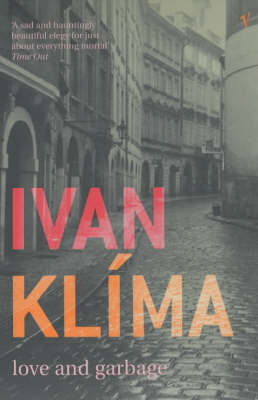
Ivan Klíma: Love and Garbage – Láska a smetí (1988)

Donning an orange vest, the narrator–a banned Czech writer–sweeps the Prague streets with a group of the society’s other outcasts–an old sailor given to drink, a sickly teenager, a foul-mouthed former beauty, a failed inventor, and an ex-pilot. As they go about their mindless job, the narrator learns of the dreams and sorrows of his coworkers and meditates on the life and work of Franz Kafka, the power of literature, and his relationship with his dying father. 

Love and Garbage is my first book by Czech writer Ivan Klíma. It’s said to be one of his best. Klíma had a difficult life. Born in Prague in 1931, he spent some years of his childhood in the concentration camp Theresienstadt.  Later he was an editor in his home town. He spent 1969/70 in the US where he taught Czech literature at a university but when he returned to Prague in 1970 he was forbidden to publish until 1989. Love and Garbage contains a lot of Klíma’s own story but it isn’t, as he says, autobiographical.

The narrator, a writer who isn’t allowed to publish, starts working as a street sweeper. The slow and contemplative work allows him to explore his city, to think about his life and an essay on Kafka he is writing and helps him forget his lover. Because he chose to work as a street sweeper and it isn’t necessity who forces him to do this job, he likes it. He likes his colleagues, most of them are outcasts too. The work he is doing doesn’t only allow him to think about his life but it turns into a philosophical meditation on what the society deems worthless. Garbage and human beings alike. As a child the writer who is Jewish lived in Theresienstadt and most of his relatives were killed. The Jews, he muses, were like garbage for the Germans, worthless and had to be discarded and burned. The novel is full of linked symbols and elements, of scenes that are mirrored and repeated.

After he was forbidden to publish, he was desperate, caught in a marriage that didn’t mean much anymore, to a wife who had started a new life. She was studying psychology and trying to help others while he spent his days locked inside, chasing thoughts, trying to write. During this time he meets the sculptor Daría and falls passionately in love with her. When the affair ends, he decides to sweep the streets. This is symbolical as well, he starts to clean the city around him, to make room inside for another, clean start.

The writer is working on an essay about Kafka and often returns to him. He is reminded of Kafka constantly. For him, Kafka was the purest possible writer, an outcast like himself, not really understood and unhappy in love.

When the novel begins, the narrator is heartbroken but that doesn’t explain the sadness in the book. The sadness comes from looking back, thinking about his childhood in the concentration camp and all the people he lost. The only person still alive from that period is his father but he is very old and ill. The saddest thing is that despite everything that happened in the past and that his country had to endure, instead of having a better life now, they live under a communist regime. The constant threats and lack of freedom make life unbearable. His affair with Daría is an attempt at finding happiness but it turns bitter eventually and when he tells his wife about it, it seems at first that he will end up losing both women.

Love and Garbage is a challenging read. It demands concentration as the story moves back and forth in time, breaking up the chronology, sometimes up to three times per page. It took a bit of getting used to but once I had read a few pages I liked it. This type of writing doesn’t allow you to fall into some sort of reader’s trance but wakes you up constantly. This may sound like a gimmick but that’s not what it is at all. It’s a cunning way to mirror the narrator’s interior life.  It’s not so much an interior monologue as a way to render how freely thoughts move, unlike the person who thinks them. We easily move back and forth in our minds, a childhood memory can be followed by some thoughts about the past day. In our minds we can go wherever we want, at any time we choose.

I have read a lot of Czech writers who wrote in German but only a very few who write in Czech. As I have found out, Love and Garbage was meant as an answer to Kundera’s Unbearable Lightness of Being which Klíma considered to be chauvinistic.

I liked Klíma’s writing. It’s unusual, complex, poetic and highly descriptive. There is hardly an aspect of human life that isn’t touched and that’s why the book is like a delicately woven tapestry. One pattern evokes another one, one angle mirrors the next, all is linked and intertwined. Poetical passages follow psychological insights, philosophical thoughts come after realistic descriptions. The book is sad but the way the writer fights for the tiniest bit of happiness and the richness of his interior life are so beautiful, they illuminate the book from within.

Have you read Klíma or other Czech writers?

Maureen Gibbon: Thief (2010)

Maureen Gibbon’s novel Thief is a powerful account of a young woman who has been raped as a teenager and now, in her thirties, is still trying to come to terms with this event. The life she is leading is like a walk on a tightrope. One dangerous boyfriend follows the next and even as a very young teenager she already led a promiscuous and risk-taking life.

At the beginning of the novel, she has left the Twin Cities and rented a lonely cabin near a lake. A bit too lonely maybe or she wouldn’t place an ad in the local newspaper looking for a “Great kisser, good listener”. One of the men who answers her ad, is Alpha Breville, an inmate in a state penitentiary. She writes and finds out that he was convicted because he raped a woman seven years ago.

What is it that makes her write back and go and visit this man week after week? She thinks it is because she is looking for closure and he will help her with this. Or is it once more her addiction to danger, sex and romance? It’s a little bit of everything, as we come to understand. But while Alpha sits behind bars, she still sees other men. One of them a cowboy who reveals to be as dysfunctional as all the others she has left before.

This is a highly disturbing book. Disturbing, honest and intriguing. I was very captivated and found it believable. I used to read a lot of psychology books and some of them were dedicated to addictions. The portrayal of a self-destructive, promiscuous woman who acts out via sex and romance was realistic for me. After I finished it, I noticed, how numbed Suzanne is, she is very self-destructive, seeks out men who have the potential to harm her, falls in love as soon as she had sex with a man, even a complete stranger, but she remains unemotional. The most important thing for her is, as soon as something is over, to find someone new.

The big question at the heart of the story is whether the rape victim and the rapist can heal each other and whether she brought the rape upon herself. This last question was particularly disturbing.

Maureen Gibbon has been raped as a young girl, just like Alice Sebold, the author of The Lovely Bones. The difference in their approach is interesting. I didn’t like The Lovely Bones but I liked Thief.

It’s a book that would be ideal for an open-minded discussion group or book club. Open minded because it asks uncomfortable questions about rapists and their victims and also because there is some very explicit sexual content. It’s not gratuitous as one of the topics is sexual addiction but I felt I needed to say it.

Literature and War Readalong March 30 2012: To the Slaughterhouse – Le grand troupeau by Jean Giono

Jean Giono’s To the Slaughterhouse – Le grand troupeau is the last WWI novel of this year’s readalong. Giono is one of the great French writers, famous for books like L’homme qui plantait des arbresThe Man Who Planted Trees, Joy of Man’s Desiring – Que ma joie demeure orLe hussard sur le toit – The Horseman on the Roof which has been made into a successful movie. His books are deeply rooted in the South of France and he is often compared to Pagnol.

I try not to be too enthusiastic this time, but, let me just say, cautiously, I think, this should be a good book. At least he is an author who has never disappointed me so far and I’m even planning on (re-)reading a few of his other books this year, like Colline, Un de Baumugnes and Regain, the so-called Pan trilogy. Giono is famous for the way he describes the joy of life and that’s why I’m particularly interested to see how he treated such a bleak subject.

Here are the first sentences

Last night they watched as all the men left. It was a thick August night smelling of corn and horse-sweat. The animals were harnessed in the station-yard. The big plough-haulers had been tied up to the shafts on the carts; their solid rumps held back the loads of women and children.

The train moved off quietly in the night, spattering the willow trees with embers as it took on speed. Then all the horses started moaning together.

*******

The discussion starts on Friday, 30 March 2012.

Further information on the Literature and War Readalong 2012, including all the book blurbs, can be found here.