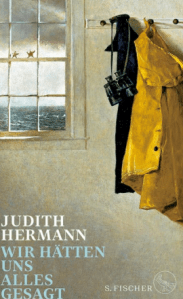
Judith Hermann – We Would Have Told Each Other Everything (Wir hätten uns alles gesagt)

We all have authors whose every book we read. For me, Judith Hermann is one of those authors. She’s best known for her short stories but has also written novels and now, finally, her long awaited first memoir. Or rather a series of lectures on life and writing that reads like a memoir. We Would Have Told Each Other Everything will be published in English next April. Two of her short story collections, Summer House, Later and Nothing but Ghosts are available in English. Her third short story collection Lettipark, a book of five connected stories, Alice, and her two novels Aller Liebe Anfang (Tony just let me know this and Letti Park were translated) and Daheim don’t seem to have been published in English.

Hermann is a bit of a phenomenon. Her first short story collection, Summer House, Later, which came out in 1998, was published to high acclaim. Critics and readers adored it. Nobody had written quite like her before. She seemed to capture the lifestyle and mood of a whole generation – the generation of those who were in their twenties in the late 90s. She wrote about things other people didn’t write about. Young people hanging out, travelling, doing nothing, just living their life. Most of the stories are set in Berlin, Judith Hermann’s hometown. I loved that book so much, found myself in so many of the stories and have been a loyal reader ever since. Sadly, even though I liked almost everything she has written, I found, like many of her critics and readers, that she was never able to achieve again what she had achieved in her first book. Some critics were already harsh when the first book came out. Over the years the criticism got worse. I never really understood why the reviews were at times so harsh, even cruel. When her first novel came out, one critic wrote she couldn’t write and had nothing to tell. In the memoir Judith Hermann addresses this review and what she has to say is very interesting. In many ways, her response to this reproach lies at the heart of these lectures.

Judith Hermann has never spoken much about her life, her childhood, or where her inspiration came from. Her answers to certain questions were always evasive. The book explores in detail why this was the case and it also investigates what is autobiographical and how she transforms what she has experienced and turns it into literature. At the beginning of the book, she describes how she ran into her psychoanalyst, late one night in Berlin. She discovered this psychoanalyst through a friend who went to see him and then spontaneously decided to go to see him as well. It seems the friend’s therapy was already over when she began to see the therapist, nonetheless, she never told her friend, Ada, that she went to see him too. We learn that this was rather typical of her. She hardly ever spoke to people or told them anything about herself or her childhood. The more we read about her past, the better we understand why she was silent. The trauma of two world wars, mental illness, emotional abuse, were all part of her difficult childhood.

All her stories are inspired by her life, but nothing is recognizable as such. That is because of her writing technique. She writes draft, after draft, after draft, erasing every time what is closest to what happened to get to a deeper meaning and truth. Very similarly, her psychoanalyst taught her to write down a dream and then write it down again the next day and once more on day three. The thing that would be missing, would be the most essential element of the dream, the element because of which the dream was dreamt, so to speak. Talking about her writing she says that in the end she sometimes no longer knows what really happened and what didn’t.

When she read the criticism I mentioned before, she agreed with the critic. Yes, she really didn’t have anything to tell because she couldn’t really tell what was important.

A large part of the book is dedicated to her friendship with Ada and the group of friends that surrounded Ada. Many of these scenes reminded me of some of her stories. She spent a lot of time with these friends. They spent whole summers together in the house near the sea that belongs to Judith Hermann’s family. These scenes are so wonderfully evocative. The friendships she has with these people, particularly with Ada, are very intense. They experience so much together yet they don’t really talk. This chosen family, she says, showed a very familiar lack of words and speechlessness to her own.

The last part of the book is set during Corona and the early lockdowns. During that time, she moved to the countryside and made a new friend, Jon. They spent a lot of time together but this time, her silences aren’t easily accepted, almost cost her this new friendship. And that’s where the title comes from. There’s a moment during which she would have told Jon everything about her life. It doesn’t happen but she will tell him later why she is so evasive.

Many of the things she describes in this book are relatable to anyone who has suffered (childhood) trauma. So often, one can’t find a way out of silence. It’s often the whole purpose of a therapy to be able to finally tell someone everything.

I’m not entirely sure I managed to capture how much I loved this book. But I did. It will make my end of year best of. It was one of those books I didn’t want to end. She achieves something quite magical – she lets us know a lot about herself and her writing process, but she also allows us to discover ourselves more deeply. Just like she does in her best stories.

The German title of this book is interesting. During these lectures she mostly uses the word “erzählen” – “to tell a story”. For the title, however, she uses “sagen” – “to tell”. This shows, in my opinion, that she’s come full circle. She used to tell stories but left out most of what really happened in her life. Through the new friendship with Jon, and in writing these lectures, she breaks the silence and speaks about the things behind the stories. I wonder if there will be another novel or book of stories from her. In some ways it would make sense if this was her last book. I hope not though.

For those who don’t want to wait for the publication of the English book there is either a part or even the whole translation by Katy Derbyshire on the Granta website here.

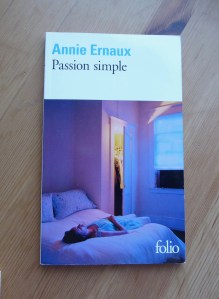
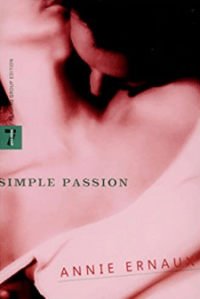
Simple Passion by Annie Ernaux – French Life Writing – A Post a Day in May

I own everything Annie Ernaux has written up to The Years but have only read a few of her books. Since her books are so short, she seemed an excellent choice for my May project.

Annie Ernaux is divisive. Some people adore what she does, others are put off. Those who love her, praise her honesty, those who don’t, find her indecent. I go back and forth between these two reactions. Sometimes I find it a bit too much, as well. At other times, I’m just so fascinated.

What helped me get along with her better, was to see her oeuvre as a whole. Sure, you can read single books, but you will get so much more out of reading her, when you read more or all of her. It’s never just about the story or the topics of a book with her, it’s always about the process of writing and giving meaning. Writing about a woman’s life, her body, and often, her sexuality.

Several books have been rewritten Simple Passion, her account of her love affair with a Russian diplomat, is one of those. She wrote another book about her affair many years later – Se perdre (To lose oneself – not translated, I think). Aa a reader, you often wonder – Why does she write about this? Why does she have to reveal herself like this and so does she. You’re always part of the writing process as well, part of the thought processes behind the writing.

In Simple Passion (Passion Simple), Annie Ernaux analyses a love affair she had with a married man, the previous year. The affair lasted over a year and was all-consuming. She couldn’t think of anything else but him. Couldn’t find interest in anything else or anyone else, unless they somehow reminded her of him or had something in common with him. She sat whole days next to the telephone, waiting for his call. Spent whole afternoons preparing for his arrival; shopping new clothes, painting her nails, applying new make-up.

The absence of a call is agony. A call is bliss. She’s completely dependent on this man and doesn’t exist outside of their meetings. It’s never as apparent as when she goes on a holiday to Florence. She doesn’t even want to look at anything. Just wants to think of him, imagine how he would see the place.

The book describes everything. Her weakness, her dependence, her desire, her obsession. It’s like reading the account of a drug addict. She’s aware of that herself but there isn’t anything she can do. She wonders sometimes, if he feels the same, but she has no idea. Conversation isn’t exactly part of the whole affair. Sex is important, everything else, not so much. But that is also because of the language barrier. It’s not said in this book that he’s Russian, but in a later book it is revealed. She doesn’t speak Russian, and his French, while good, is not always accurate. He has difficulties to translate deeper meaning.

Since he’s a diplomat, it’s always clear, the affair will end. When it does, she’s shattered. And she takes note of the world around her again. And writes about her affair. It takes her five months during which the Berlin wall falls and the Ceaușescus are executed.

After having finished to write about her affair, she suddenly feels shame. A shame she never felt during the affair, a shame that comes from the idea to publish.

I found the way she described this affair interesting. Most of it rang so true. Haven’t we all waited next to a phone before? Spent afternoons getting ready or endlessly talking and thinking about our love interest? I never found it problematic, that she’s honest. I found it problematic that she never questions having an affair with a married man. Not once. It’s all about her and her feelings. He’s only interesting as far as he’s the object of her desire. And the other woman? It’s as if she doesn’t exist. Obviously, this shows how honest she is, as it doesn’t really make her look good.

People were shocked when this came out in the 90s. Also, because it was a departure from her earlier work and because it’s so explicit about female desire and sexuality. It was certainly courageous to write and publish this at the time. Nowadays, I find it a bit sordid. Not because of the descriptions – it’s never very explicit anyway – but, as I mentioned, because there’s another woman. If it’s a feminist act to live our passions, isn’t it also a feminist act to think of the other woman? I’m not judging that it happened, that would be naive, these things do happen, but that she’s never thinking or writing about it.

After the translation of The Years, Annie Ernaux received a lot of attention outside of France. She’s interesting, well worth exploring, but I’d say, this isn’t the best entry point to her work.

If you’d like to read another review – here’s on I wrote on A Woman’s Life. I liked that one a great deal.

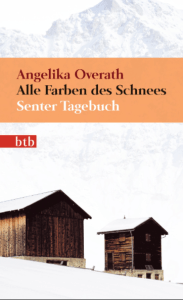
Angelika Overath – All the Colors of Snow – Sent Diary – Alle Farben des Schnees

Have you ever dreamt of moving to the place where you spend your holidays? That’s exactly what German journalist and writer Angelika Overath did in 2007. She, her husband, and their youngest child moved to Sent, a small village in the Engadine region of Switzerland. Before that, they lived in Tübingen, Germany, where her husband was a professor at the university. Her two older children stayed in Tübingen.

Shortly after they moved, Overath was asked whether she wanted to write something for a local newspaper about moving to her holiday home. That article was the starting point to this book— a diary of a little more than a year in her new home Sent.

I read a few of the diary entries in an anthology and liked them so much that I wanted to read her whole book. As a child, we used to spend many holidays in the Engadine region. My mother had a Swiss friend whose family owned a holiday home there. The scenery is spectacular and I was always fascinated to see how differently the seasons changed in the mountains. I never spent a Christmas there, only New Year, but it must be lovely as the parts I read in the anthology, and now reread, take place during Christmas and Overath describes so many wonderful things and interesting customs.

The descriptions of the changing seasons are some of the best parts in Overath’s “diary”. That and her joy to be somewhere she loves as much as she loves the Engadine. She describes what it takes to change status, to move away from being a tourist and become a local. In her case, it’s not that easy because, as you may know, the Engadine region is the Swiss region, where the fourth Swiss language – Romansh (Rätoromanisch) is spoken. People speak some German and Swiss but they distinctly prefer to speak their own language and in order to get fully accepted it’s better to learn to speak the local language.

While her son, who is only seven when they move, picks up Romansh easily at school, and her husband has a greater facility to learn Romansh, it’s not that easy for Angelika Overath to learn the language. But since she’s so enthusiastic, she uses a special way for herself, which I found quite ingenious and well-worth copying. In order to familiarize herself with the language, especially the nuances of the vocabulary – many words sound similar but have  a completely different meaning – she began to write poetry in Romansh. The result is quirky and playful. It’s a brilliant way to learn a new language.

I enjoyed this book a lot because of the beautiful descriptions of the landscape, and the many interesting people that populate these pages. The Overaths have a rich social life and meet many fascinating people. Sent seems to be a place that attracts a lot of foreigners, artist, writers. It’s also a place people seem to return to after having stayed abroad for a while.

My only small reservation concerns the term “diary”. In my opinion, this is rather a notebook than a diary. Angelika Overath herself, her interior life is almost completely absent from these pages. One can sense it was meant for an audience and not as personal as diaries normally are. But that’s a tiny reservation. It’s such a rich and diverse book that has a lot to say about moving to another country, learning a new language, new ways of living. It also describes beautifully the charm of living in a small community. And her love for the mountains, the short but intense summers, and the long, cold, snowy winters, can be felt on every page.

Sadly, so far, none of the books by Angelika Overath have been translated into English. This book would be interesting for American readers as there are several entries set in the US, during the summer, when both she and her husband teach at a college in Vermont. Since I liked the way she wrote, I might try one of her novels next.

Did you ever want to move to a place where you spent your holidays? I know I did. I often dream of moving to the South of France. It wouldn’t be a challenge language-wise, so, maybe, that doesn’t count.

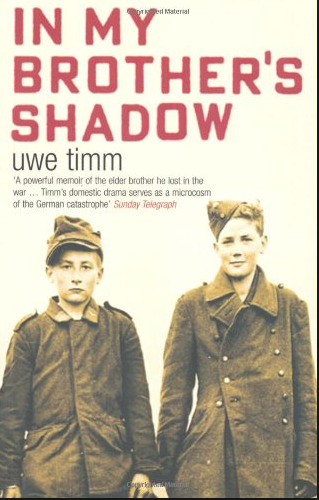
Uwe Timm: In My Brother’s Shadow – Am Beispiel meines Bruders (2003)

in-my-brothers-shadowuwe-timm

Maybe you’ve never heard of Timm’s novella The Invention of Curried Sausage. If you haven’t, do yourself a favour and get it because it’s marvellous. Possibly because I loved that novella so much, I stayed away from In My Brother’s ShadowAm Beispiel meines Bruders, although I’d been keen on reading it since it came out in 2003. There’s not one reader or critic who doesn’t think it’s essential reading. But we all know how it goes – everyone praises something, and one has read another book by an author that one loved  . . . I’m glad I finally overcame my reluctance because if ever a book was essential reading – then it’s this one. And for many reasons, not only as a brilliant WWII and post-war memoir.

In his memoir In My Brother’s Shadow, Timm doesn’t only try to reconstruct his brother’s life and find out who he really was, but examines his own family and the German post-war society. Timm was born in 1940, the third and last child of his parents. His sister and brother were both over sixteen years older. His brother Karl-Heinz was his father’s favourite. When Karl-Heinz was severely wounded and later died in 1943, on the Eastern Front, in the Ukraine, his father was devastated. The older son was everything he’d wished for. He would take over his business. He was courageous and heroic, unlike little Timm who’s squeamish and dreamy.

Although soldiers weren’t allowed to write a diary, Karl-Heinz did and after he died of his wounds, it was sent back to his parents.

When he’s almost sixty and both of his parents and sister dead, Uwe Timm, rereads the diary and the brother’s letters and decides to write this memoir.

It is clear from the beginning that he doesn’t consider his brother to be a hero. He’s too shocked by some of the diary entries. They are cold and devoid of any compassion with the soldiers and civilians he kills. Karl-Heinz is a member of the SS Panzer Division Totenkopf (Skull and Crossbones). One of the SS’s notorious elite divisions. But what shocks Timm even more, and that’s because it’s also part of the post-war mindset, are the omissions. He knows his brother was present when some of the most horrific extermination operations went on, but he doesn’t mention anything. And in the end, he even stops writing his diary because, as he writes, it doesn’t make sense to write about awful things.

Reading Timm’s account, you can feel that he was ashamed and horrified that he had a brother like this. And he’s ashamed and horrified because of the way people spoke right after the war. Many found it perfectly OK that Jews were killed and were only angry about losing the war. Many others said they “didn’t know” but it was clear they had only chosen not to know.

The silence and passivity of the masses disgusted Timm. He also found out that many soldiers were given a choice whether they wanted to be part of a firing squad or not. Hardly anyone said no. Interestingly though, saying no, had absolutely no consequences. They didn’t choose to fire people because they were scared but simply because they wanted to.

Timm also explores his father’s authoritarian education methods which were pretty typical for that time. Kids had to obey and if they didn’t  they were slapped, hit or worse. Psychologists have found out a long time ago that this “black pedagogy” as it is called was one of the reasons why Hitler and Nazism were so successful.

While the book is harsh on his family and many other Germans, it still captures the suffering. His family, like so many others, lost everything when Hamburg was destroyed in ’43. For many years they lived in a cellar.

In My Brothers’ Shadow is also amazing as a book about writing a memoir. What it means to dig deeper and find family secrets. It’s not surprising, he was only able to write about everything so honestly, after his parents and sister were dead.

Uwe Timm is a wonderful, stylish writer that’s why this memoir has many poetic elements. It is a fascinating and touching story of a German family.

One thing that Timm’s elegant and poignant memoir illustrates admirably well – silence is political. Looking the other way is not innocence it’s complicity. This should be self-evident, unfortunately, it wasn’t then and it’s still not now. I’m glad I finally read this memoir. Especially just after Kempowski’s novel. They are great companion pieces.

The Art of Time in Fiction by Joan Silber

The Art of Time in Fiction

It’s rare that I read a nonfiction book with as much enthusiasm as Joan Silber’s The Art of Time in Fiction.  Given the topic it’s not surprising though. I’ve long suspected that one of the key elements dividing literary fiction and genre fiction might be the use of time. I’m thinking of the artless use of the split-narrative that we find in almost every crime novel these days. Or the time-split in historical genre novels. Silber’s title is well-chosen, because using time masterfully is really an art.

She divided her book into different chapters, each dedicated to another use of time, another technique. I noticed, when compiling the list that when it’s done really well, we hardly notice what approach an author chose. I really appreciated the many examples she gave and from which she quotes extensively. Of course, this makes it a dangerous book for book addicts because it makes you want to add to your piles.

I will go through the categories, describing them briefly and adding the examples Joan Silber chose.

Classic Time

The first category was “classic time”. In this approach the author describes the story chronologically, chosing only a brief time span. There isn’t a lot of back story, nor flashbacks. I’d say it is the category that shows the most, tells the least.

The best example for classic time is:

  • Scott Fitzgerald – The Great Gatsby


Long Time

When an author tells a character’s whole life and the story spans over many years and decades, then we have an example of long time. I think it’s the category I’m the least fond of, but stories like Flaubert’s A Simple Heart, that capture a whole life, condensing long stretches, and only needs some forty pages, are not to be dismissed.

The examples quoted are:

  • Anton Chekhov – The Darling
  • Gustave Flaubert – A Simple Life/Un Coeur Simple
  • Jhumpa Lahiri – The Namesake
  • Carol Shields – The Stone Diaries
  • Arnold Bennett – The Old Wives’ Tale
  • Guy de Maupassant – Une Vie
  • Yu Hua – To Live
  • Evan Connell – Mrs Bridge
  • Virginia Woolf – To the Lighthouse

Switchback Time

The use of flashbacks, dreamlike sequences, non-linear storytelling, might be what appeals to me the most.

Here are a couple of examples for this type of storytelling:

  • Alice Munro – A Real Life, The Progress of Love, Carried Away, The Albanian Virgin
  • James Baldwin – Sonny’s Blues


Slowed Time

Proust’s In Search of Lost Time might be the most prominent of this category. In a movie there would be the use of slow motion. It’s an arresting technique that captures sensory and sensuous details like no other.

A few examples:

  • Nawal al-Sadaadawi – The Thirst
  • Don DeLillo – Videotape
  • Marcel Proust – In Search of Lost Time


Fabulous Time

This is the realm of magical realism and folk and fairy tales. It’s characterized by uncertainty and a reversal of natural time and disregarding the laws of time.

The examples used to illustrate this are:

  • Gabriel Garcia Marquez – One Hundred Years of Solitude, Chronicle of a Death Foretold
  • Italo Calvino – Italian Folktales
  • Arundhati Roy – The God of Small Things


Time as Subject

One of the most interesting uses of time in fiction is when it’s made the subject of the story. I’ve never read Fitzgerald’s Winter Dreams, which seems to be similar to The Great Gatsby, but uses time differently. Since I’m planning on re-reading The Great Gatsby, I’m looking forward to comparing it to Winter Dreams.

Here are the examples given in the book:

  • F.Scott Fitzgerald – Winter Dreams
  • Katherine Anne Porter – Old Mortality
  • Henry James – The Beast in the Jungle
  • Leo Tolstoy – The Death of Ivan Ilych
  • Alan Lightman – Einstein’s Dream
  • Chinua Achebe – Things Fall Apart
  • Gabriel Garcia Marquez – Love in the Time of Cholera
  • Denis Johnson – Out on Bail
  • Martin Amis – Time’s Arrow
  • Charles Baxter – First Light
  • Jorge Luis Borges – The Secret Miracle
  • Ambrose Bierce – An Occurrence at Owl Creek Bridge
  • Italo Calvino – Invisible Cities

I can’t say there’s one of these approaches I don’t like, but I guess books in which the time is a subject and what Silber calls “switchback time” might be those I like the most.

This is a wonderful little book that will appeal to readers and writers alike. It’s part of “The Art Of” series books published by Graywolf Press.

What about you? Do you prefer any of these categories? Or do you enjoy the use of split timelines/narratives more?


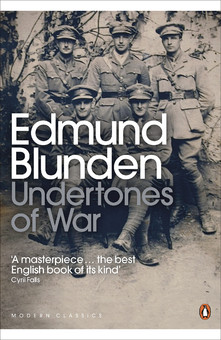
Literature and War Readalong August 29 2014: Undertones of War by Edmund Blunden

Undertones of War

Edmund Blunden’s Undertones of War is one of the most famous WWI memoirs. Blunden was a poet who enlisted at the age of twenty and took part in the battles at the Somme, Ypres and Passchendaele. My edition, which is The University of Chicago Press edition, contains a number of his poems. It will be interesting to compare the accounts of the trenches with the poems inspired by the landscape.

Here are the first sentences

I was not anxious to go. An uncertain but unceasing disquiet had been upon me, and when, returning to the officers’ mess a Shoreham Camp one Sunday evening, I read the notice that I was under orders for France, I did not hide my feelings. Berry, a subaltern of my set, who was also named for the draft, might pipe to me “Hi, Blunden, we’re going out: have a drink.”; I could not dance. There was something about France in those days which looked to me, despite all journalistic enchanters, to be dangerous.

And  some details and the blurb for those who want to join

Undertones of War by Edmund Blunden (UK 1928) WWI, Memoir, 288 pages

In what is one of the finest autobiographies to come out of the First World War, the distinguished poet Edmund Blunden records his experiences as an infantry subaltern in France and Flanders. Blunden took part in the disastrous battles of the Somme, Ypres and Passchendaele, describing the latter as ‘murder, not only to the troops, but to their singing faiths and hopes’. In his compassionate yet unsentimental prose, he tells of the heroism and despair found among the officers. Blunden’s poems show how he found hope in the natural landscape; the only thing that survives the terrible betrayal enacted in the Flanders fields.

*******

The discussion starts on Friday, 29 August 2014.

Further information on the Literature and War Readalong 2014, including all the book blurbs, can be found here.

Vivian Gornick: The End of the Novel of Love (1997) Essays on Literature

The End of the Novel of Love

In these essays Vivian Gornick examines a century of novels in which authors have portrayed women who challenge the desire to be swept away by passion. She concludes that love as a metaphor for the making of literature is no longer apt for today’s writers, such has the nature of love and romance and marriage changed. Taking the works of authors such as Willa Cather, Jean Rhys, Christina Stead, Grace Paley and Hannah Arendt, Gornick sets out to show how novels have increasingly questioned the inevitability of love and marriage as the path to self-knowledge and fulfilment.

Vivian Gornick is an essayist and memoirist. Her collection The End of the Novel of Love contains a wide range of essays on different authors and topics. The title is the title of one of the essays. Almost all the essays circle to some extent around the topic of love. Some of the essays are more biographical, others focus more on a theme and compare and analyse different authors and works.

There are biographical essays on Kate Chopin, Jean Rhys, Willa Cather, Christina Stead and Grace Paley. I liked the one on Willa Cather and Grace Paley best, as Gornick is less judgmental in them than in some of the others. In the essay on Paley she says that despite the fact that her range isn’t all that wide, that Paley often writes about the same things again and again, her stories are still excellent because in her stories the voice is the story. What is unique in her stories is that people don’t fall in love with each other but with the desire to be alive.

There have been three story collections in thirty-five years. They have made Paley famous. All over the world, in languages you never heard of, she is read as a master storyteller in the great tradition: people love life more because of her writing.

The book contains two essays on people who are not fiction writers: Hannah Arendt and Clover Adams. While I’m familiar with Arendt and her work, I didn’t know the tragic story of Clover Adams, the wife of Henry Adams, who took her own life in 1885. The suicide struck Henry Adams particularly hard as he thought of Clover and himself as two parts of a whole, while, very clearly, Clover had an inner life of her own and didn’t share most of her distress. Clover was, according to Gornick, extremely intelligent and witty, which fascinated Adams. He fell in love with her mind right away, but didn’t show much kindness when he wrote about her as being anything but handsome. And even his praise of her intelligence doesn’t really read as a praise because he feels obliged to add – implicitly and explicitly – that she’s witty and intelligent “for a woman”.

The most interesting essays in the collection are those on themes, in which Gornick analyses and compares several works.

In Diana of the Crossways Gornick compares George Eliot’s Daniel Deronda, Edith Wharton’s The House of Mirth, George Meredith’s Diana of the Crossways and Virginia Woolf’s Mrs Dalloway. Gornick tells us that while the three books written by women are brilliant, they aren’t a success, unlike Diana of the Crossways, which is a stunning novel, because it goes one step further.

Each of these three novels was written by a brilliant woman with the taste of iron in her mouth. Each of them gives us a sobering portrait of what it feels like to be a creature trapped, caught stopped in place. Yet no one of these novels penetrates any deeper than the others into the character’s desire to be free: all that is achieved here is the look and feel of resistance. (…)

George Meredith, in his late fifties, had the experience and the distance. Meredith knew better than Woolf, Eliot, and Wharton what a woman and a man equally matched in brains, will, and hungriness of spirit might actually say and do, both to themselves and to one another. (…)

Diana Warwick is one of the first women in an English novel both beautiful and intellectually gifted who needn’t be dismissed as vain, shrewd, and ambitious before we can get on with it.

Ruthless Intimacies analyses the relationship between mother and son in D.H.Lawrence’s Sons and Lovers, and the relationship between mothers and daughters in Radclyffe Hall’s The Unlit Lamp, May Sinclair’s Mary Oliver, Virginia Woolf’s To the Lighthouse and Edna O’Brien’s short story A Rose in the Heart of New York. The relationships in these novels are symbiotic and swallow up the daughters completely. They struggle their whole lives to free themselves. I can relate to that all too well and would really love to read The Unlit Lamp and Edna O’Brien’s short story. Both sound pertinent and excellent.

Tenderhearted Men focusses on author’s who write in the vein of Hemingway about men and women. Raymond Carver, Richard Ford and André Dubus. Gornick dismisses them as too sentimental. They cling to a dated idea of men being saved by women, without trying to understand them.

The End of the Novel of Love is interesting. It states the obvious but the obvious was still worth stating. Most of the tragic (love) stories of the past like Madame Bovary and Anna Karenina, but also books like The House of Mirth are unthinkable in our day and age. Marriage and society have changed so much. Adultery doesn’t have the social consequences it had. I thought this part of the essay interesting, but I didn’t like that she chose to illustrate her concept in picking apart Jane Smiley’s novella The Age of Grief and calling it not only unmoving, but a failure. Harsh words. Maybe it’s true. I haven’t read it but I don’t like this type of unkind criticism.

Gornick’s writing is very accessible, a lot of her insights are fascinating and made me think, but, as I mentioned before, she’s very judgmental, which made me cringe occasionally. It made Gornick come across as very unkind. See for example this passage taken from the essay on Kate Chopin.

One of her biographers makes  the point that Chopin never revised, Chopin herself, announced, in interview after interview throughout her professional life, that the writing either came all at once, or not at all. I think it the single most important piece of writing we have about her. She seems to have considered this startling practice a proof of giftedness, rather than of the amateurishness that it really was.

Although I didn’t care for some of her harsh judgments, I thought many of her observations were pertinent and fascinating and I’d certainly read another of her books. I’m interested in her memoir Fierce Attachments and her book on creative non-fiction The Situation and the Story: the Art of Personal Narrative.

If you’re interested here’s the first chapter on Diana of the Crossways.