Marie de France’s Bisclavret – A Werewolf Story from the 12th Century

lais-of-marie-de-france

I’ve always been fond of The Lais of Marie de France, a collection of folk tales set in a mythical Brittany. For a book this old, they are surprisingly approachable and entertaining. Marie de France’s identity isn’t clear. She is, as indicates her name, most probably from the Île de France and it’s said that she must have spent some time at the English court.

Looking for something to read for  Once Upon a Time I remembered her werewolf story Bisclavret. Bisclavret means werewolf in Breton. In the rest of France he’s called “loup-garou”. The werewolf belief is widespread in Brittany. I myself grew up with it, as my grandmother was from Morlaix, in Brittany.

I didn’t remember the whole of the story and was surprised to find similarities with Selkie stories, in which it’s crucial, that the Selkie, once a woman, should find her skin again, or she will never be able to return to her Selkie form. Bisclavret follows a reversed logic. The clothes of the man equal the skin of the Selkie.

Bisclavret tells the tale of a gentle woman who is upset because her husband is absent regularly. She presses him to tell her where he spends his nights. She suspects he has taken a mistress. The husband does at first not tell her what he is doing during full moon nights, but when he sees her jealousy, he gives in and confesses that he is a werewolf. During full moon nights, he goes to the forest, takes off his clothes and transforms. It’s vital for him to put his clothes back on. Should anything prevent that, he wouldn’t be able to become human again.

Bisclavret is one of many stories among the Lais whose female protagonist is a “femme coupable” – a guilty woman. In this case she is guilty of betrayal. She herself takes a lover, tells him her husband’s secret and, one night, they follow him and steal his clothes. He is now condemned to stay a wolf. Hunted down by the king and his men, he is spared, because he shows a gentle nature. He follows the king to the court and becomes his pet. He is liked by everyone at court because he is so well-behaved, until one day he attacks a man and later a woman.

I’m not going to reveal the end because I’d like to put you in the mood, to pick up either the whole collection or at least this story.

Marie de France is one of the very earliest story tellers. Her art is still fresh and powerful today and well-worth discovering. My edition is bilingual old French/new French. I don’t know whether there is a French version in the English edition, or whether it’s only a translation.

This post is a contribution to Carl’s Once Upon a Time Challenge. The review site can be found here.

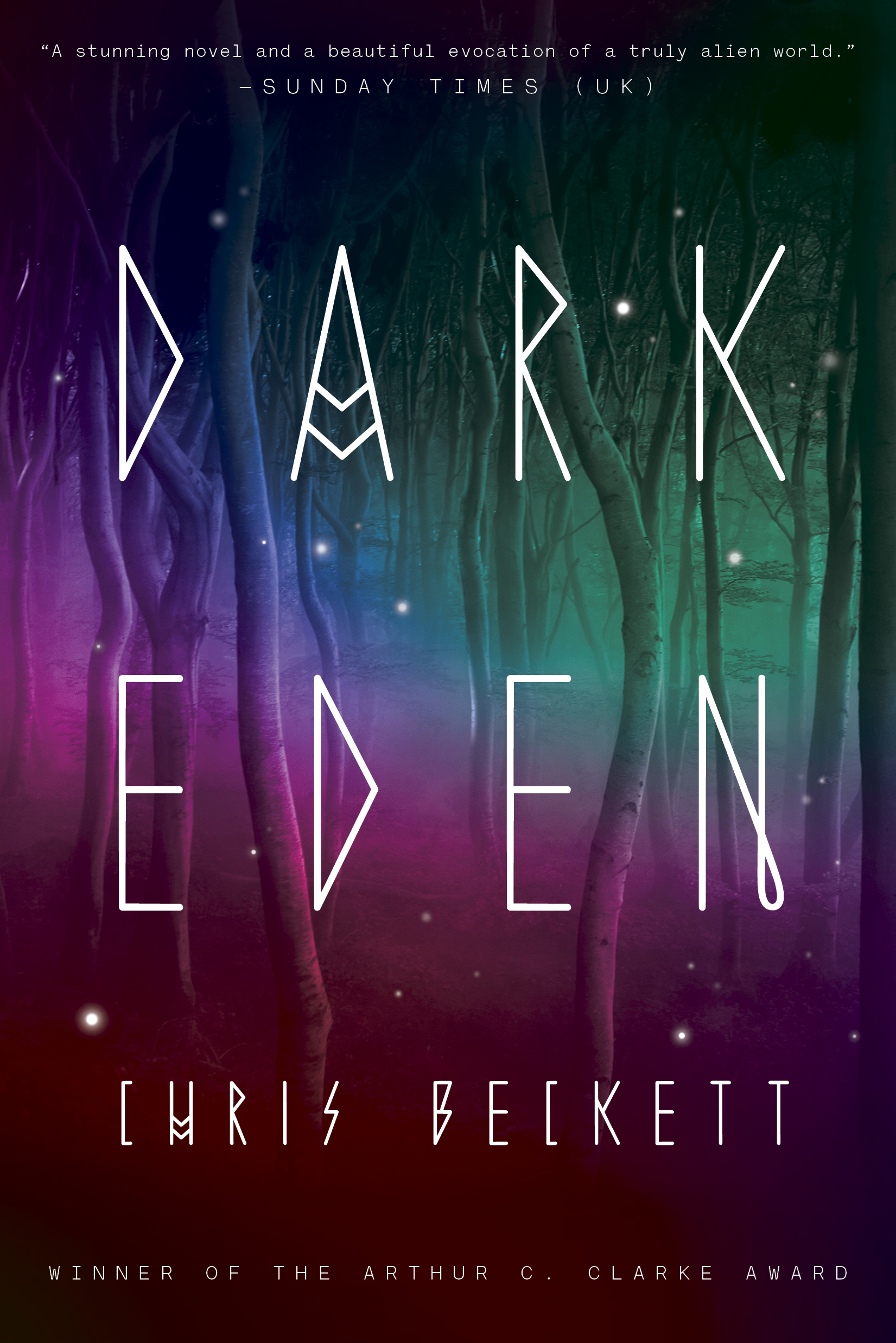
Chris Beckett: Dark Eden (2012)

DARK_EDEN

Chris Beckett’s novel Dark Eden was last year’s Arthur C. Clarke Award winner, which usually guarantees that a book is at the more literary end of the Sci-Fi spectrum. For once I can understand why a novel received an award. Dark Eden is nothing if not a tour de force. It’s as original as it is philosophical; in its themes as much as in its execution. Reading it wasn’t only a brainy experience, it was quite visceral as well. Beckett’s world felt so realistic, the everyday life of the people is described in all its strangeness and boring repetition, that I felt sucked in.

As a linguist and cultural anthropologist, I found the civilisation Beckett created extremely fascinating and thought-provoking. What would happen if a part of our high culture, a tiny fragment of our civilisation – two people to be precise – were abandoned on an alien planet, with nothing but their clothes, some paraphernalia and nothing else? This is what happens to Thommy and Angela, the ancestor’s of the people we meet in Dark Eden. The world they encounter is strange and dark. Light and warmth come from the lantern trees. Food abounds at first. The two humans can eat fruit and hunt the strange six-limbed animals of Dark Eden. Angela and Thommy procreate and once the story begins, the population of Dark Eden has risen to 532 people. Food is scarce by now. The perpetual darkness is hard on them. They have not ventured further because their creation myth traps them. After 160 years, or wombtimes as they call it, they are still waiting for a “veekle” from Earth to return and bring them back to their planet of origin. A planet that sounds like paradise to them. A planet where there is “lecky trickity” and daylight coming from a giant star.

Cultural anthropology studies – among other things – the development of civilisations from hunter-gatherers to (nomadic) herders to agriculturalists and more advanced civilisation. In Dark Eden this evolution is reversed at first and then starts to move through the aforementioned stages. The descendants of Angela and Thommy are hunter-gatherers, on the verge of becoming herders. And they have an oral tradition again; writing and schools have been abandoned a long time ago. Many of the words are written phonetically to illustrate that. “Rayed Yo”, “Veekle”, “Secret Ree”, “Wind Oh”. The sentence structure is simple and words like “very” don’t exist but instead of them, the narrators repeat words. “Very sad” becomes “sad sad” or even “sad sad sad”. I thought this was ingenious but – in all honesty – it got a bit on my nerves as well.

As we all know, a story needs conflict and the conflict arises in the form of a “newhair”. John Redlantern is only 20, but he questions the traditions who keep them trapped in this one place, waiting forever for an air ship that never comes. He dares the unspeakable. He challenges the elders and is finally cast out. What the elders didn’t expect – he’s struck a chord with many. Staying in one place means that food is getting scarcer and people are afraid of starving. When he leaves, a group of newhairs joins him.

John’s frustration has a lot to do with survival but is about something else als well. John’s suggestion to leave their dwelling place has something to do with leaving behind the past. Everything they do or think revolves around a distant time and place. They hope to be saved and brought back one day. They re-enact the story of Thommy and Angela again and again and, while waiting to be saved, they don’t really enjoy life or live freely.

What false hope can do to people is only one thought-provoking element, which is part of a profound analysis of meangless rituals and religion.

The structure of the novel is interesting as well. It has two main first person narrators and at least six minor narrators. That breaks up the monotony and gives Beckett the opportunity to show more than one view of the same story. The multiplicity of stories is another important theme in the book:

There are lots of different stories branching away all the time from every single thing that happens. As soon as a moment has gone, different versions of it start to be remembered and told about. And some of them carry on, and some die out, and you can’t know in advance which version will last and which won’t.

Dark Eden  describes a world in which sexuality is lived freely, in which nobody has ever murdered anyone and in which even the crippled and disfigured are treated like everyone else. But it’s not a peaceful society. Hatred and aggression simmer under the surface and can only be contained as long as absolutely nothing in the daily or yearly routine is changed. Once John questions tradition and sets in motion change, violence erupts.

The end is well done and logical. Pretty much what I had expected but that wasn’t disappointing. However, closing the book was a relief. The world Dark Eden describes is a wondrous place, filled with abundant vegetation and a strange and haunting fauna, but it’s bathed in perpetual darkness, and very suffocating.

Dark Eden is a novel that touches on many different topics – religion, family, tradition, overpopulation, hope, creation myths, languages etc. –  it’s philosophical and anthropological in scope and certainly testifies that Sci-Fi can still contribute a fresh and thought-provoking exploration of the human condition and our culture.

Thanks to Broadway Books for the review copy.

Literature and War Readalong April 28 2014: Toby’s Room by Pat Barker

Toby's Room

With Pat Barker’s novel Toby’s Room, we’re leaving the American Civil War behind and move on to WWI. All the books following Toby’s Room are dedicated to WWI.

Pat Barker is one of my favourite writers and her Regeneration Trilogy one of my favourite books. I read all three volumes (RegenerationThe Eye in the DoorThe Ghost Road) back to back and was genuinely sad when I turned the last page. It wasn’t only a story about WWI, but about shell shock, the development of two young disciplines (anthropology and psychiatry) and some of the famous poets who fought in the trenches. My love for her trilogy prevented me from picking up any of her other books, but now, some six years after I’ve read her masterpiece, I’m in the mood, to find out how I will like another of her novel. The scope of Toby’s Room is much smaller, the topics not as varied, but I still hope I won’t be disappointed. As far as I can judge from the blurb, Toby’s Room is a harrowing tale, touching on themes like disfigurement and facial reconstruction.

The first paragraph

Elinor arrived home at four o’ clock on Friday and went straight to her room. She hung the red dress on the wardrobe door, glancing at it from time to time as she brushed her hair. that neckline seemed to be getting lower by the minute. In the end her nerve failed her. She hunted out her pink dress, the one she used to wear for dancing classes at school, put it on and stood in front of the cheval mirror. She turned her head from side to side, her hands smoothing down the creases that had gathered round the waist. Oh dear. No, no, she couldn’t do it, not this time, not ever again.She wriggled out of it and throw it to the back of the wardrobe. Out of the window would have been more satisfying, but her father and brother-in-law were sitting on the terrace. She pulled the red dress over her head, tugged the neckline up as far as it would go, and went reluctantly downstairs.

And  some details and the blurb for those who want to join

Toby’s Room by Pat Barker (UK 2013), WWI, Novel, 272 pages

Pat Barker returns to the First World War in Toby’s Room, a dark, compelling novel of human desire, wartime horror and the power of friendship.

When Toby is reported ‘Missing, Believed Killed’, another secret casts a lengthening shadow over Elinor’s world: how exactly did Toby die – and why? Elinor determines to uncover the truth. Only then can she finally close the door to Toby’s room. Moving from the Slade School of Art to Queen Mary’s Hospital, where surgery and art intersect in the rebuilding of the shattered faces of the wounded, Toby’s Room is a riveting drama of identity, damage, intimacy and loss. Toby’s Room is Pat Barker’s most powerful novel yet.

*******

The discussion starts on Monday, 28 April 2014.

Further information on the Literature and War Readalong 2014, including all the book blurbs, can be found here.

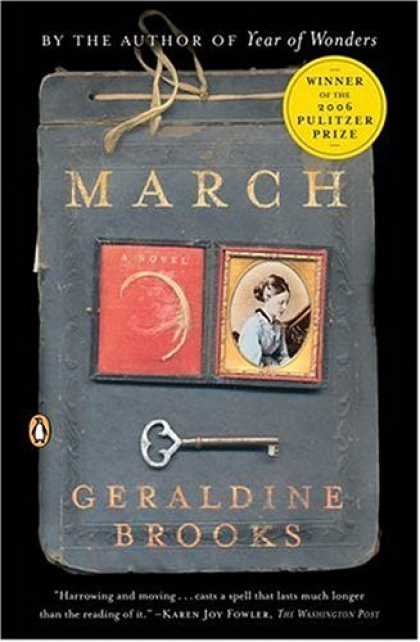
Geraldine Brooks: March (2005) Literature and War Readalong March 2014

March

It seems I have far less stamina than before, when it comes to finishing books I don’t like, even when they are my own readalong choices. While I did finish this novel, I must admit I read large portions of it diagonally, after having suffered through the first 15o pages. I’m not quite sure why I disliked March so much, I only know I did.

March tells the imagined story of the absent father in Louisa May Alcott’s Little Women. The father of the four girls has joined the Northern troops as a chaplain. The father is the narrator of the book – with the exception of a few chapters towards the end, which are told by his wife. Many of the chapters start with a letter to his wife, then they describe things that happen in the present and move back to the past, showing how March developed a sensibility for the cause or how he became an abolitionist.

As a young man, March toured the South as a peddler and that’s how he came into contact with Grace, a very cultivated and intelligent slave.  Together they wanted to teach a young girl to read and write, an undertaking that had fatal consequences. March falls in love with Grace and when he meets her again, later in the book, now a married man and father, it puts a lot of emotional pressure on him.

For the creation of the character March, Geraldine Brooks used the biography of Louisa May Alcott’s father Bronson Alcott. She introduces real characters like Emerson and Thoreau and the militant abolitionist John Brown. Introducing real characters, giving March the biography of a real person, could have made this book very authentic, but for me that’s what made it artificial and turned it into a pamphlet.

The many scenes leading to March’s awareness of the mistreatment of slaves and the stories that took place during the war, are harrowing and described in great detail, but they didn’t work for me either because of the voice. The biggest problem I had with this book was the voice. The tone was that of a goody-goody and often mawkish and preachy. At no time did I have the feeling of being transported to 19th Century America, but I never forgot that I read a book written by a 21st Century author with all the sensibilities of our time, with our thoughts, feelings and outrage about slavery. I’m sure that people who fought against slavery at the time, were outraged as well, still, it didn’t ring true. What diminished the message in this book was the combination of anti-slavery views and transcendentalist beliefs, which led to a peculiar mix that annoyed me.

Geraldine Brooks won the Pulitzer for this book, but, frankly, I don’t understand why. The style is heavy and preachy, the tone mawkish. The only passages that worked were the descriptions. Those were great.


Other reviews

*******

March is the third book in the Literature and War Readalong 2014. The next book is the WWI novel Toby’s Room by Pat Barker. Discussion starts on Monday 28 April, 2014. Further information on the Literature and War Readalong 2014, including the book blurbs can be found here.

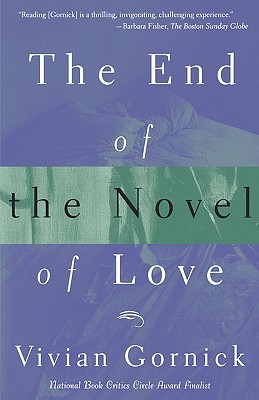
Vivian Gornick: The End of the Novel of Love (1997) Essays on Literature

The End of the Novel of Love

In these essays Vivian Gornick examines a century of novels in which authors have portrayed women who challenge the desire to be swept away by passion. She concludes that love as a metaphor for the making of literature is no longer apt for today’s writers, such has the nature of love and romance and marriage changed. Taking the works of authors such as Willa Cather, Jean Rhys, Christina Stead, Grace Paley and Hannah Arendt, Gornick sets out to show how novels have increasingly questioned the inevitability of love and marriage as the path to self-knowledge and fulfilment.

Vivian Gornick is an essayist and memoirist. Her collection The End of the Novel of Love contains a wide range of essays on different authors and topics. The title is the title of one of the essays. Almost all the essays circle to some extent around the topic of love. Some of the essays are more biographical, others focus more on a theme and compare and analyse different authors and works.

There are biographical essays on Kate Chopin, Jean Rhys, Willa Cather, Christina Stead and Grace Paley. I liked the one on Willa Cather and Grace Paley best, as Gornick is less judgmental in them than in some of the others. In the essay on Paley she says that despite the fact that her range isn’t all that wide, that Paley often writes about the same things again and again, her stories are still excellent because in her stories the voice is the story. What is unique in her stories is that people don’t fall in love with each other but with the desire to be alive.

There have been three story collections in thirty-five years. They have made Paley famous. All over the world, in languages you never heard of, she is read as a master storyteller in the great tradition: people love life more because of her writing.

The book contains two essays on people who are not fiction writers: Hannah Arendt and Clover Adams. While I’m familiar with Arendt and her work, I didn’t know the tragic story of Clover Adams, the wife of Henry Adams, who took her own life in 1885. The suicide struck Henry Adams particularly hard as he thought of Clover and himself as two parts of a whole, while, very clearly, Clover had an inner life of her own and didn’t share most of her distress. Clover was, according to Gornick, extremely intelligent and witty, which fascinated Adams. He fell in love with her mind right away, but didn’t show much kindness when he wrote about her as being anything but handsome. And even his praise of her intelligence doesn’t really read as a praise because he feels obliged to add – implicitly and explicitly – that she’s witty and intelligent “for a woman”.

The most interesting essays in the collection are those on themes, in which Gornick analyses and compares several works.

In Diana of the Crossways Gornick compares George Eliot’s Daniel Deronda, Edith Wharton’s The House of Mirth, George Meredith’s Diana of the Crossways and Virginia Woolf’s Mrs Dalloway. Gornick tells us that while the three books written by women are brilliant, they aren’t a success, unlike Diana of the Crossways, which is a stunning novel, because it goes one step further.

Each of these three novels was written by a brilliant woman with the taste of iron in her mouth. Each of them gives us a sobering portrait of what it feels like to be a creature trapped, caught stopped in place. Yet no one of these novels penetrates any deeper than the others into the character’s desire to be free: all that is achieved here is the look and feel of resistance. (…)

George Meredith, in his late fifties, had the experience and the distance. Meredith knew better than Woolf, Eliot, and Wharton what a woman and a man equally matched in brains, will, and hungriness of spirit might actually say and do, both to themselves and to one another. (…)

Diana Warwick is one of the first women in an English novel both beautiful and intellectually gifted who needn’t be dismissed as vain, shrewd, and ambitious before we can get on with it.

Ruthless Intimacies analyses the relationship between mother and son in D.H.Lawrence’s Sons and Lovers, and the relationship between mothers and daughters in Radclyffe Hall’s The Unlit Lamp, May Sinclair’s Mary Oliver, Virginia Woolf’s To the Lighthouse and Edna O’Brien’s short story A Rose in the Heart of New York. The relationships in these novels are symbiotic and swallow up the daughters completely. They struggle their whole lives to free themselves. I can relate to that all too well and would really love to read The Unlit Lamp and Edna O’Brien’s short story. Both sound pertinent and excellent.

Tenderhearted Men focusses on author’s who write in the vein of Hemingway about men and women. Raymond Carver, Richard Ford and André Dubus. Gornick dismisses them as too sentimental. They cling to a dated idea of men being saved by women, without trying to understand them.

The End of the Novel of Love is interesting. It states the obvious but the obvious was still worth stating. Most of the tragic (love) stories of the past like Madame Bovary and Anna Karenina, but also books like The House of Mirth are unthinkable in our day and age. Marriage and society have changed so much. Adultery doesn’t have the social consequences it had. I thought this part of the essay interesting, but I didn’t like that she chose to illustrate her concept in picking apart Jane Smiley’s novella The Age of Grief and calling it not only unmoving, but a failure. Harsh words. Maybe it’s true. I haven’t read it but I don’t like this type of unkind criticism.

Gornick’s writing is very accessible, a lot of her insights are fascinating and made me think, but, as I mentioned before, she’s very judgmental, which made me cringe occasionally. It made Gornick come across as very unkind. See for example this passage taken from the essay on Kate Chopin.

One of her biographers makes  the point that Chopin never revised, Chopin herself, announced, in interview after interview throughout her professional life, that the writing either came all at once, or not at all. I think it the single most important piece of writing we have about her. She seems to have considered this startling practice a proof of giftedness, rather than of the amateurishness that it really was.

Although I didn’t care for some of her harsh judgments, I thought many of her observations were pertinent and fascinating and I’d certainly read another of her books. I’m interested in her memoir Fierce Attachments and her book on creative non-fiction The Situation and the Story: the Art of Personal Narrative.

If you’re interested here’s the first chapter on Diana of the Crossways.

Literature and War Readalong March 31 2014: March by Geraldine Brooks

March

Geraldine Brooks is an Australian-born writer whose second book, the Civil War novel March, received the Pulitzer Prize in 2006. The book is inspired by Louisa May Alcott’s famous novel Little Women. March tells the story of the absent father. Right from the beginning of Little Women we know that the father is fighting for the Northern forces in the Civil War.

Jo said sadly, “We haven’t got father, and shall not have him for a long time.” She didn’t say “perhaps never”, but each silently added it, thinking of father far away, where the fighting was.

I’ve always meant to read one of her novels and this seemed a good choice. It will be interesting to compare this to Killer Angels.

Here are the first sentences

October 21, 1861

This is what I write to her: The clouds tonight embossed the sky. A dipping sun gilded and brazed each raveling edge as if the firmament were threaded through with precious filaments. I pause there to mop my aching eye, which will not stop tearing. The line I have set down is, perhaps, on the florid side of fine, but no matter: she is a gentle critic.My hand, which I note is flecked with traces of dried phlegm, has the tremor of exhaustion.

And  some details and the blurb for those who want to join

March by Geraldine Brooks (Australia 2005) American Civil War, Novel, 304 pages

Brooks’s luminous second novel, after 2001′s acclaimed Year of Wonders, imagines the Civil War experiences of Mr. March, the absent father in Louisa May Alcott’s Little Women. An idealistic Concord cleric, March becomes a Union chaplain and later finds himself assigned to be a teacher on a cotton plantation that employs freed slaves, or “contraband.” His narrative begins with cheerful letters home, but March gradually reveals to the reader what he does not to his family: the cruelty and racism of Northern and Southern soldiers, the violence and suffering he is powerless to prevent and his reunion with Grace, a beautiful, educated slave whom he met years earlier as a Connecticut peddler to the plantations. In between, we learn of March’s earlier life: his whirlwind courtship of quick-tempered Marmee, his friendship with Emerson and Thoreau and the surprising cause of his family’s genteel poverty. When a Confederate attack on the contraband farm lands March in a Washington hospital, sick with fever and guilt, the first-person narrative switches to Marmee, who describes a different version of the years past and an agonized reaction to the truth she uncovers about her husband’s life. Brooks, who based the character of March on Alcott’s transcendentalist father, Bronson, relies heavily on primary sources for both the Concord and wartime scenes; her characters speak with a convincing 19th-century formality, yet the narrative is always accessible. Through the shattered dreamer March, the passion and rage of Marmee and a host of achingly human minor characters, Brooks’s affecting, beautifully written novel drives home the intimate horrors and ironies of the Civil War and the difficulty of living honestly with the knowledge of human suffering.

*******

The discussion starts on Monday, 31 March 2014.

Further information on the Literature and War Readalong 2014, including all the book blurbs, can be found here.

Ellen Gilchrist: In the Land of Dreamy Dreams (1981)

In the Land of Dreamy Dreams

In the Land of Dreamy Dreams, Ellen Gilchrist’s acclaimed 1981 debut collection of short stories, introduced readers to a remarkable Southern voice which has sustained its power and influence through her more than 20 subsequent books. Gilchrist has a distinctive ear for language, and a deep understanding of her flawed, sometimes tragic characters. These fourteen stories, divided into three sections — There’s a Garden of Eden, Things Like the Truth, and Perils of the Nile — are about mostly young, upper-class Southern women who are bored with the Junior League and having babies, and chafe against the restrictions of their sheltered lives. Talented and bright, but living in the shadow of men — their husbands and fathers — they resort to outrageous actions in pursuit of freer lives and uncompromised love, despite the consequences. This collection first introduced readers to some of Gilchrist’s most beloved characters, such as Rhoda Manning and Nora Jane Whittington

I came across Ellen Gilchrist by chance. I was looking for books set in New Orleans and saw one of her short stories Rich in an anthology. I wasn’t familiar with her and looked her up and finally ordered a used copy of her first collection In the Land of Dreamy Dreams. It’s very rare that I read a whole short story collection in a few days, but I did in this case. There was a unity of setting, mood and atmosphere, and even one returning character that it read almost like a novel in stories.

Most of the stories are set in New Orleans, only a few take place in other places. The first or third person narrators are all women. Some are still small girls, many are teenagers, a few are grownups and some are elderly. About 50% of the stories are set in the 40s, the others in the 70s.

Hope and failure, perversion and innocence are some of the themes. The descriptions are rich and lush, the tone ranges from lyrical and  dreamy to bitter and sarcastic. Some of the stories have the atmosphere of a humid, stuffed boudoir, others exude an air of rich elegance.

In a few sentences Gilchrist can capture a whole life, including its tragedy and beauty. I liked the beautiful, hopeful stories, in which the protagonists were heading for a life full of intense and sensuous moments best. But I can’t deny that the more cruel stories like “Rich” – in which people get richer and richer and finally end in tragedy – or the stories Suicides and Indignities were powerful and even made me gasp.

To give you a taste – this is the beginning of Indignities

Last night my mother took off her clothes in front of twenty-six invited guests in the King’s Room at Antoine’s. She took off her Calvin Klein evening jacket and her beige silk wrap-around blouse and her custom-made  brassiere and walked around the table letting everyone look at the place where her breasts used to be.

She had them removed without saying a word to anyone. I’m surprised she told my father. I’m surprised she invited him to the party. He ever would have noticed. He hasn’t touched her in years except to hand her a cheque or a paper to sign.

My favourite stories were There’s a Garden of Eden in which a fortysomething woman and her young lover take a boat and navigate the flooded streets of New Orleans to get to her mother, 1944 in which a young girl meets a glamorous war widow who shows her to make the most of live. I also loved Traveler in which a plain girl travels to her beautiful cousin in the South. The cousin has just lost her mother who’s left her wardrobes and wardrobes full of expensive clothes, underwear, perfumes and make-up. The plain girl reinvents herself on this vacation and doesn’t want to return home. Summer, an Elegy is a story with a languorous mood, but it made me feel uncomfortable as it describes the love affair of two eight year-olds. It contains one of my favourite passages.

The afternoon went on for a log time, and the small bed was surrounded by yellow light and the room filled with the smell of mussels.

Long afterward, as she lay in a cool bed in Acapulco, waiting for her third husband to claim her as his bride, Matille would remember that light and how, later that afternoon, the wind picked up and could be heard for miles away, moving toward Issaquena County with its lines of distant thunder, and how the cottonwood leaves outside the window had beat upon the house all night with their exotic crackling.

I haven’t read anyone quite like Ellen Gilchrist but she still reminded me of a few authors. Tennesse Williams came to mind – A Streetcar Named Desire as much as The Roman Spring of Mrs. Stone – because of the setting and some of the older characters. But she also reminded me of Julie Orringer whose intricately woven sentences and lush descriptions are similar and there’s some of Yoko Ogawa’s cruelty in this collection as well. Funny enough Ogawa’s last short story collection has the English title Revenge. One of Gilchrist’s best stories is called Revenge as well. Coincidence? Who knows.

If you like rish, complex short stories, full of allusions and sensual descriptions, sometimes mean, sometimes dreamy – then do yourself a favour and get a copy of this wonderful book.