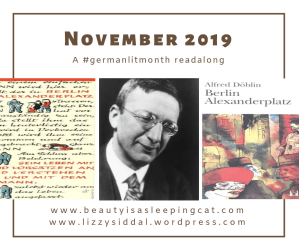
Berlin Alexanderplatz Readalong – Part 2

I don’t think I’ve ever been this inactive during a German Literature Month and I’m sorry about that. I had made plans but now I even struggle to keep up with our readalong. It’s like everything that is annoying and time-consuming came at the same time, robbing me of what precious little time I had to begin with.

  1. What do you make of Döblin’s structuring of the novel?  The short summaries at the beginning of each chapter, each section? The montage technique? 

I think the structuring works well in this context, as it breaks up the narrative and, in doing so, moves away from traditional storytelling techniques. Since Franz is pretty much a guinea pig for Döblin to demonstrate his world view, identification with the protagonist was never his aim. The short summaries convey an ironic tone but also mirror older books, that had a similar approach. I’m thinking of Candide, or Grimmelshausen’s Simplicissimus. Both have tragic heroes the authors use to illustrate their philosophy and world view. Obviously, the older protagonists are very different from Franz. They aren’t criminals or depraved people, but, just like him, victims of the circumstances.

  1. Women and the treatment of women in Berlin Alexanderplatz …. Discuss.

This is such an interesting question. So far, we haven’t seen any positive depictions of women. There will be one in the next book but so far, I’m constantly shaking my head and would like to talk some sense into them. Why do they fall for these men? I can only assume it’s mostly about sex. Many of these relationships are between a pimp and his women, and those can be very complicated. Dependency and addiction come into play. Seeing how so many women are attracted to Franz, I was wondering what he looked like. I don’t seem to remember reading a description. The way Döblin depicts women made me wonder what relationships he had with women. But then again, one can’t say that the men are described in a more positive way.

  1. This section introduces Reinhold, who will prove to be Franz Biberkopf’s main antagonist.  What do you think of Biberkopf’s initial underestimation of Reinhold?

Unfortunately, underestimating Reinhold is quite typical for Franz who is anything but astute. In some ways, one could say, the author wanted to show that Franz is, despite what he does, not a totally bad person and he doesn’t immediately think bad of people or situations. You can’t be entirely bad, if you’re this naïve. One could also say, that Franz triggers something dark in Reinhold.

  1. What was the highlight of this section for you? What the lowlight?

The last scenes were the highlight and the lowlight. I had a hard time believing that Franz didn’t realise was he was signing up for when he joined Pums, Reinhold and the others. I’m not entirely sure what Döblin wanted to tell us. That Franz really meant to become a better man, but was stupid enough not to see what was coming? Franz is decidedly not a very intelligent man, but I think Döblin’s intention was another one.  Once more, Döblin shows us that Franz is a construct. An invention he uses to make us see certain things. He deliberately places him in harm’s way and then pushes him even further down, to illustrate how unfree Franz is. Franz can decide to become better as much as he likes, it won’t work because it’s not up to him. Society and fate are against him. And, most of all, his author who won’t stop before he has destroyed him completely. At least, that’s how it feels at this point.


Berlin Alexanderplatz Readalong – Part 1

Due to some time constraints this and next week, my post is very short.

Welcome to the #germanlitmonth readalong of Alfred Döblin’s Berlin Alexanderplatz.  What enticed you to readalong with us?

When I buy a book in a bookshop, I sometimes keep the receipt. I did so in this case and that’s how I know that the book has been on my shelves for 19 years. I bought it in September 2000. I know that when I bought it, I was extremely keen on reading it. But for some reason I didn’t and because I always felt it was a book that had to be read during autumn – possibly because I visited Berlin in autumn – I postponed it from year to year. When Lizzy mentioned she wanted to read it during this GLM, I decided that the time had finally come.

Summarise your initial expectations.  Are they being met?

It’s pretty much how I expected it. Highly readable in some places, and more experimental in others. I struggled more reading the first book than I thought I would. I wasn’t in the right frame of mind, but once I made more time for reading it and saw certain patterns in the storytelling emerge, I was captivated.

Which edition/translation are you using and how is it reading? If you’re reading the original German, is there anything noteworthy about Döblin’s language?

I’m reading the German original and am constantly thinking that it’s almost impossible to translate this adequately because of the extensive use of Berlin vernacular. But since Döblin uses a collage/montage technique there are other challenges. He uses bits from songs, slogans, poetry, and many other sources. Occasionally he uses them verbatim, quite often though, he changes words. Of course, you can translate them, but they won’t mean the same to a foreign reader. With the changes, they might even be more unrecognizable. I was also wondering, if the translators really caught all the allusions and quotes. They would have to be extremely knowledgeable about German culture and literature

The more descriptive passages, especially those in which the narrator/author are present are very beautiful. There’s a rhythm and sound to his sentences that’s unique. The choice of words is very careful.

What are your first impressions of Berlin and Franz Biberkopf?

Because of the way Döblin chose to tell this story, I think of Franz as a guinea pig or a marionette. I feel like I see the threads, the author is using to make him move. I can’t think of him as a real person at all. Interestingly, I feel very differently about Berlin. The city comes across as more of person than Franz. The city comes to life. One has the feeling of experiencing a particular moment in a very particular place.

Welcome to German Literature Month IX 2019

Welcome all! It’s that glorious time of the year again – a full month of Germanic literary indulgence! This is just a quick admin post as there may be newcomers who wonder how this event works.

1. Read anything you want in any language you want … as long as the material was originally written in German.

2. You can follow the themed reading schedule, or ignore it completely by reading as you please for the entire month.

3. If you’re joining in the Berlin Alexanderplatz readalong, please leave an email address to receive the readalong discussion questions.

4. Share what you are reading and what you felt about it by using the tag #germanlitmonth on your blog posts, tweets, instagram shots or booktube videos.

5. Please add a link to each review on the linky at www.germanlitmonth.blogspot.com. (This is an invaluable help when pulling together the author index at the end of the event. Check out the indices from previous years if you’re looking for something to read.)

6. Have fun!

Announcing German Literature Month 2019

2019 is a significant year in terms of German history, both actual and literary. It’s

  • 30 years since the Fall of the Wall;
  • 100 years since the Founding of the Weimar Republic; and
  • 200 years since publication of Goethe’s West-Eastern Divan.

Lizzy and I have decided to include all of the above into the plan for GLM IX!

To commemorate The Fall of the Wall there will be an ex-DDR week. For the founding of the Weimar Republic, the badge has been converted to Bauhaus-favoured sans serif typography and we will host a readalong of Alfred Döblin’s seminal Berlin Alexanderplatz. Last, but definitely not least, there will be a Goethe Reading Week.

There will also be plenty of read-as-you-please time so you can choose from the whole gamut of German-language literary pleasures (writing from outside Germany, historical and crime fiction, graphic novels, etc) entirely according to your heart’s desire.

The reading schedule looks like this:

01-02.11.19 Read as You please
03-09.11.19 Ex-DDR week
10-16.11.19 Read as You Please
17-23.11.19 Goethe Reading Week
24-30.11.19 Read as You Please


The Berlin Alexanderplatz readalong will take place on 4 Saturdays commencing on 9.11. More details and sign-up post to follow shortly.

As always, to participate in German Literature Month you can stick to the plan, pick and choose only the parts that interest you, or follow your own path entirely. You can read in any language you want. The only rule is that whatever you read must have originally been published in German.

All that remains now, is for you to search through your shelves, your library catalogues or maybe undertake a shopping expedition! German Literature Month IX will be here before you know it! Will you join us?


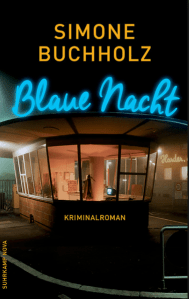
Simone Buchholz – Blue Night – Blaue Nacht – German Literature Month Crime Readalong

Blue NightBlaue Nacht is the sixth book in Simone Buchholz’ Chastity Riley series and the first to be translated into English. I discovered the book last year in a book shop, not realizing it was part of a series, or I would have started with book one. Oddly, the English translation has the subtitle “Chastity Riley book 1”. Be it as it may, I’m so glad I finally read it. I love noir and this is noir at its best.

State attorney Chastity Riley has done a few stupid things and so she’s not working in the state attorney’s department anymore but for the witness protection. This bores her no end. Feeling she needs some change, she takes her car and drives to the country. The car breaks down and Chastity is stranded somewhere on the road. Where other people would look for the beauty around them, all she sees is a lack of streets and people. And too much countryside. Yikes. Barely gone for a few minutes, she misses Hamburg, the Reeperbahn, the seedy haunts, her ex-gangster lover Klatsche, and the bars where she drinks until the early hours. This beginning sets the tone and introduces a character who is witty, sarcastic, laconic, lyrical, and always different.

Back in Hamburg, she’s assigned to look after a man who has almost been killed. He’s been beaten up severely and has lost one finger. It looks a lot like retribution. With cunning, kindness, and a lot of beer, Chastity manages to get his trust. While he doesn’t reveal his identity, he gives her enough information to begin investigating a crime ring.

The story is definitely interesting and offers a look into the drug problems big cities with large ports like Hamburg face these days. Cheap, dangerous drugs, produced in the East, are distributed in the West with maximum profit. The people in charge are able to wash their money and while everyone knows it, the law can’t touch them.

As interesting as the story is, it pales in comparison to the cast of characters and the style. Chastity Riley is a loner at heart but one with a crowd of friends. Some were formerly criminals, some are policemen, bar tenders, restaurant owners. A charming element of the book is that they all get a voice. In between the regular chapters are chapters in which each of the protagonists, including the nameless man, the criminals, Chastity and her friends get their say. In some books this type of approach doesn’t work, but here it lifts the book to another level.

I read a lot of crime novels this year, but this is the one I liked the most. The voice is so unique, the style so brilliant that it can keep up with a lot of literary fiction that is published these days. And the mood and tone are reminiscent of some of the best noir I’ve read in recent years.

I read this in German, that’s why there are no quotes. Please visit Pat’s blog (added below) to get an idea of the style

Other reviews:

Pat – South of Paris Books


Mechthild Gläser’s The Book Jumper – Die Buchspringer – German Literature Month Readalong

The Book Jumper is a children’s book by German author Mechthild Gläser.

Amy and her mother flee Bochum to take refuge on a forgotten Shetland island. Years ago, when she was pregnant with Amy, her mother left the island just as helter-skelter as they left Bochum now. Amy never knew why. She also never knew her dad. The island, the castle, and Amy’s grandmother are all very mysterious, but not as mysterious as learning that Amy is a book jumper, like everyone in her family. Book jumping is an important ability that gets lost once people get older. Together with two other young people Amy is taught in the art of book jumping. In the beginning book jumping novices have to stick to a favourite book. In Amy’s case that’s The Jungle Book. She is told that it’s important not to stray from the path of the story or to interfere with it. The book jumpers are vital for literature because they have to make sure that the stories remain exactly as they were originally written down.

Among other things, Amy is taught that she can only jump into a book from a specific spot and when she puts the open book on her face. She realizes soon, that this isn’t a necessity for her. She can jump into any book pretty much from wherever she wants. Already on her first jump into the jungle book, she strays from her path and meets Goethe’s Werther. Together with him, she travels in the no-man’s-land between different stories or enters other novels, like Alice in Wonderland. It doesn’t take long until she realizes that there’s something wrong in the land of literature. It seems that a thief is stealing ideas and important story lines get either jumbled or lost. Together with Werther and Will, another book jumper, Amy tries to catch the thief. Unfortunately, the thief is quite dangerous. He kills a beloved literary character and, in the end, even attempts to kill Amy and her grandmother. I can’t really tell much more without spoiling the story.

When Lizzy proposed to read this, I really liked the premise of the book. The idea to jump into your favourite novels, meet favourite characters was so appealing. Sadly, this didn’t work for me. I read it pretty quickly, it had some amusing moments and characters, especially Werther, but it felt quite lifeless. Even the love story between Will and Amy, did only work at first. The solution to the story felt forced. The only thing I liked, was Amy’s back story.

The book is initially amusing, but not exactly a must-read. Something was missing. It may sound weird, but it isn’t fantastical enough. I also didn’t like that Mechthild Gläser spoils a few classic stories by giving away the ending. On top of that, the German blurb is misleading. We’re led to believe Amy will become friends with Elizabeth Bennett, but she only sees her once and very briefly. I hope others enjoyed this more than I did.