Dashiell Hammett: The Glass Key (1931) and Heisler’s The Glass Key (1942)

Ned Beaumont is a tall, thin, moustache-wearing, TB-ridden, drinking, gambling, hanger-on to the political boss of a corrupt Eastern city. Nevertheless, like every Hammett hero (and like Hammett himself), he has an unbreakable, if idiosyncratic moral code. Ned’s boss wants to better himself with a thoroughbred senator’s daughter; but does he want it badly enough to commit murder? If he’s innocent, who wants him in the frame? Beaumont must find out.

I have read everything Raymond Chandler has written. He used to be one my favourite authors. This might be the reason why I neglected Hammett for so long. Maybe I thought he would be too similar and that this would influence my reading.

The Glass Key was my introduction to Dashiell Hammett and although it did remind me a bit of Chandler, they are still quite different. Hammett is at the same time sparser and coarser.

At the heart of The Glass Key lies the question “Who has killed Taylor Henry?”. Taylor Henry is the son of the influential politician Ralph Henry. In an attempt to appear cleaner than he is, the corrupt politician Paul Madvig tries to associate himself with Henry. And he is in love with Henry’s daughter Janet. When Taylor is found dead, rumors start to circulate that he might have been killed by Paul. None of these people are really main characters, the central figure and exemplary tough-guy, is Ned Beaumont. He is a sort of assistant to Paul Madvig and tries, like a PI, to investigate the murder. He visits bars and clubs and people. Gets beaten up and is held captive. Women literally throw themselves at him. This all leaves him quite unfazed. No matter how much you beat that guy up, how often you threaten him, how many times you flatter him or try to seduce him, you will not get much of a reaction but a very short reply. This is as tough as tough-guys go.

The interest, at least for me, did not lie in the solving of the murder. I couldn’t care less. The appeal of this book, is the character of Ned Beaumont, this monosyllabic guy who doesn’t even flinch when he is beaten to a pulp. The other appeal is the world and the atmosphere this novel depicts.

The world of The Glass Key is a world of corruption, prohibition, easy women, hard men, bars and secret joints, bribery and violence.

And of course one has to mention the dialogue. You couldn’t find any more sparse and caustic dialogue in any novel.

Ned Beaumont advanced into the room where Lee and the Kid were.

The Kid asked: “How’s the belly?”

Ned Beaumont did not say anything.

Bernie Despain exclaimed: “Jesus! For a guy that says he came up here to talk you’ve done less of it than anybody I’ve ever heard of.”

“I want to talk to you,” Ned Beaumont said. “Do we have to have all these people around?”

“I do,” Despain replied. “You don’t. You can get away from them just by walking out and going about your own business.”

“I’ve got business here. “

After having finished the book I realized that I had the movie. It is part of a collection of Film noir movies that I had ordered before Christmas. I immediately watched it and liked it a lot.

The story is told differently. More chronological and Janet Henry’s (Veronica Lake) role is much more important. A few names have been changed. There is a club owner who is Irish in the book. He is Italian in the movie which was probably more in line with the depiction of wise guys as they populated the film noir. What I truly liked about the movie is Veronica Lake. Since I have seen L.A. Confidential (one of my favourite movies) in which Kim Basinger is compared to Veronica Lake I always wanted to see the real one. I think she is really special.

Don’t ask me whether I prefer the novel or the movie. I enjoyed reading and watching at the almost same time. It was as if the characters had stepped out of the pages at the end of the book and come alive.

I am really pleased I found the trailer which is not usual for every old movie.

Erri de Luca: Tre cavalli aka Three Horses (1999) The Scent of Earth, Sage and Flowers Pervading a Story of Love, Pain and War

Three Horses

From Argentina to Italy, the intense, metaphysical and poetic story of a gardener in love, by Italy’s most prominent writer. “A MAN’S LIFE LASTS AS LONG AS THREE HORSES. YOU HAVE already buried the first.” Somewhere along the coastline of Italy, a man passes his days in solitude and silence, tending a garden and reading books of travel and adventure. Through these simple routines he seeks to quiet the painful memories of the past: a life on the run from Argentina’s Dirty War; a young bride “disappeared” by the military; a terrifying escape through the wilds of Patagonia. Yet everywhere he turns, new life is pulsing, ready to awaken his senses, like the force that drives his fruit trees into bloom. People and events from the past and present migrate into patterns assigned by a metaphysical geometry. A woman of the world reintroduces him to love. An African day laborer teaches him the meaning of gratitude. In this intense narrative, every acute observation, every nuance, becomes a means of salvation. Using a language that is both gripping and contemplative, Three Horses is an unforgettable tale.

Imagine the smell of warm earth, the scent of sage, the intense aroma of mimosas. These are evoked like musical themes in this beautifully sensuous novel that reads like a hymn to beauty and pain. But Three Horses is about much more than this. It introduces us to one of the most endearing narrators. A while back Litlove had a post on favourite male characters. If I had read Erri de Luca’s  Tre cavalli at the time, I would have mentioned the narrator as one of the most appealing characters of all time.

I only read second-hand books. I lean them against the bread basket, I turn the page and it stays like this. This is how I chew and read. (…) Like this, at lunch time, I sit in the bistro, always on the same chair, I order soup and wine and I read.

I liked him from the start, this taciturn, profound reader, quietly eating, turning the pages but still open to everything around him. Open to life, and every little sign of it, even open to love, despite what he has been through. A man like a tree, deeply rooted in earth, poetical and down-to-earth at the same time. Through him, we catch glimpses of a painful past, a lover killed by the military junta in Argentina, thrown from a helicopter into the sea. Is this why he only reads novels with a watery theme?

You are also drawn into a war because you are ashamed of staying out of it. And then grief snatches you and keeps you there as a soldier of rage.

The narrator is back in Italy. He is a gardener and to touch the earth, to smell the richness of the herbs, sage, thyme, rosemary keeps him alive.

The sauce and a handful of oregano already announce the summer. I take a pinch and inhale it to awaken my senses.

This novel is so beautiful it is hard to describe. The narrator meets Làila and falls deeply in love. He meets Selim, a man from an unnamed African country who tells him to read the future in the ashes of burned laurel leaves. Everything is connected. Selim sells the mimosas that the narrator offers him, he sells the thyme and the rosemary. He pays back in kindness and friendship and even more if needed.

The gentleness and the tenderness of the narrator is overwhelming. He is a good man, a man who is trustworthy. A man who has the gift of being able to be a true friend. A reader who believes humans are changed through books much more than through the things they experience. A listener who lives life with all of his senses.

The days go by like this. In the evening, at home, I crush raw tomatoes and oregano over drained pasta and I nibble cloves of garlic in front of a Russian book.

Despite this gentleness he is capable of violence, he was a soldier, he killed people. He would even be able to commit a murder. Would he kill for the woman he loves? Or would someone else kill for him? Would that make him less of a murderer?

I’m often drawn to slim novels, novels that have been written by writers who are also poets. This is one of the most intense I have read in a long time. It has a floating quality, still it is very effortless to read, you could read it in one sitting but that would be a shame. It is too beautiful to rush through.

I was many times reminded of the poems of Octavio Paz.

Làila listens to me and she is so close to my ear that she manges to breathe islands into it.

De Luca writes about the relationship of Italy and Argentina in his foreword. Until 1939 Argentina let 7 million immigrants enter the country. Over half of that number came from Italy. You can easily hear the Italian influence on the Argentinian Spanish. It’s much softer and closer to Italian than any other variety.

De Luca is one of the very great Italian storytellers. His books are translated in many languages but only a very few are available in English.

The quotes are translated from the French as I read the novel in its French translation Trois chevaux.

For those of you who understand Italian I attached this homage. Those who don’t understand it can still try to feel the rhythm of his language. This is pretty much the rhythm of the novel.

Historical Novels

100 Must-Read Historical Novels (Bloomsbury Good Reading Guides)

I always thought that I didn’t like historical novels or that it was at least a genre that I hardly ever read. Still, when I came upon this little book (it’s a very small size) on amazon I was curious and as it was one that you can open and browse (as you can when clicking on the picture) I had a look and was astonished how many of them I had read or knew. I found Pat Barker’s Regeneration in it as well as Kate Grenville’s The Secret River and Penelope Fitzgerald’s The Blue Flower. Willa Cather is mentioned alongside with Umberto Eco’s The Name of the Rose and Giuseppe Tomasi di Lampedusa’s The Leopard. I was so curious that I finally had to order it and I am glad I did. It’s a great little book.

100 Must-read Historical Novels describes 100 books in detail, with a brief introduction to the author and  a summary of the book. Other books of the author are mentioned as well as books that are similar and movies based on the book.

In between the entries on the authors are book lists with themes. You can find a list of books on World War I and its aftermath, a list with books on the American West, a list with historical novels on Asia, a list with historical fiction for children, novels on ancient Greece and Egypt, The Renaissance, The Middle Ages and so on and so forth.

I picked two lists as examples and reproduced them for you:

Black History Fiction

David Dabydeen, A Harlot’s Progress

Barbara Hambly, A Free Man of Colour

Lawrence Hill, The Book of Negroes

Toni Morrison, A Mercy

Walter Mosley, Devil in a Blue Dress

Caryl Philipps, Cambridge

William Styron, The Confession of Nat Turner

Margaret Walker, Jubilee

Writers’ Lives

Andrew Taylor, The American Boy (Edgar Alan Poe)

Julian Barnes, Arthur & George (Sir Arthur Conan Doyle)

Anthony Burgess, Nothing Like the Sun (William Shakespeare)

Frederick Busch, The Night Inspector (Herman Melville)

Tracy Chevalier, Burning Bright (William Blake)

J.M. Coetze, The Master of Petersburg (Fyodor Dostojevsky)

Michael Didbin, A Rich Full Death (Robert Browning)

Helen Dunmore, Counting the Stars (Catullus)

Carlos Fuentes, The Old Gringo (Ambrose Bierce)

Tom Holand, The Vampyre (Lord Byron as one uf the undead)

Michèle Roberts, Fair Exchange (William Wordsworth)

Steven Saylor, A Twist at the End (O.Henry)

C.K. Stead, Mansfield (Katherine Mansfield)

Colm Toibin, The Master (Henry James)

Of those mentioned here I have Colm Toibin’s The Master and A Mercy on my TBR pile. I did start The American Boy but never really got into it but Devil in a Blue Dress is a favourite.

I realize that my understanding of historical novels was slightly narrower than what is shown in this book and maybe that was based on a misconception. A historical novel had to be set before the 20th century. That’s why I wouldn’t have considered Pat Barker to be a writer of historical novels. According to Nick Rennison, the author of the book guide, he applied the same rule that Sir Walter Scott once applied. In order for a novel to be called historical, the events that are described must have taken place at least 60 years prior to the year in which the writer lives.

My favourite three historical novels (in a narrow sense) are: Françoise Chandernagors L’allée du roi aka The King’s Way, Margaret Mitchell’s Gone with the Wind and Tracy Chevalier’s Girl with a Pearl Earring.

I know that many of you love historical novels. Which would be your top three?

Anne Tyler: Back When We Were Grownups (2001)

The first sentence of Anne Tyler’s 15th novel, Back When We Were Grown Ups, sounds like something out of a fairy tale: “Once upon a time, there was a woman who discovered she had turned into the wrong person.” Alas, this discovery has less to do with magic than with a late-middle-age crisis, which is visited upon Rebecca Davitch in the opening pages of the book. At 53, this perpetually agreeable widow is “wide and soft and dimpled, with two short wings of dry, fair hair flaring almost horizontally from a centre part”. Given her role as the matriarch of a large family–and the proprietress of a party-and-catering concern, The Open Arms–Rebecca is both personally and professionally inclined towards jollity. But at an engagement bash for one of her multiple stepdaughters, she finds herself questioning everything about her life: “How on earth did I get like this? How? How did I ever become this person who’s not really me?”

Did you ever have the feeling you are living the wrong life? You should be somewhere else and someone else? I think this did happen to me in the past a few times and this may be one of the reasons why I could relate so well to Rebecca, the main character of this novel. This was my first Anne Tyler novel and I liked it a great deal. It’s a marvelous novel. Warm, rich, touching. It’s not a novel in which there is a lot of action, not at all, there are a few intense scenes the rest are flashbacks, thoughts, feelings. Back When We Were Grownups explores if there are signs that we live the right life, if there are signs that we could read before things happen, “Prophetic Moments”, as Rebecca calls them.

Or is it just like Poppy, her late husband’s great-uncle states:

“And that’s where he and I differed,”  Poppy said. “Because I was always telling him, ‘Look,’ I said. ‘Face it,’ I said. ‘There is no true life. Your true life is the one you end up with, whatever it may be. You just do the best you can with what you’ve got,’ I said.”

During a picnic with her family Rebecca all of a sudden has this strong feeling of being at the wrong place. She is a fifty something widow, mother and grandmother and professional hostess. The house she has inherited from her husband, a grand old mansion, is used as a place where people can celebrate parties, weddings, birthdays. One of her daughters is a chef and does the cooking.

Rebecca looks back on her life and the turning point, the one moment that made her embark on this life that she has suddenly become so unsure of. When she was still a young woman, studying for a degree, dating a fellow student, Will, she was invited to a party at the mansion she is now living in and meets the older son of the family. He sees her and chooses her immediately, as his companion and as the mother for his three little daughters. His wife abandoned him for a dubious career as a singer and the poor man struggles to keep his girls happy. When he sees Rebecca she strikes him as someone very cheerful, which she wasn’t, as she thinks looking back. Two weeks later they are married. She has left her highschool sweetheart and moves in with this older man and the three little girls. They have a daughter of their own and organize parties at their house. Six years later he dies suddenly.

Rebecca wonders if she shouldn’t have stayed with Will, pursued her studies. At present she lives with her husbands 99-year-old great-uncle. The old man is somewhat demented but still appears very intelligent and articulate, just very forgetful. His wish is a birthday party for his hundredth birthday. Rebecca is afraid of all the effort this will require and doubts he will even remember it the next day but someone says that he will still enjoy it while it lasts and so she gives in.

The birthday party is really the culmination point of the novel. It’s a wonderful final scene, very rich and full of life. The old man enjoys every moment of it and describes to those gathered around him with great minutiae every instant of this memorable day.

He must be nearing the finishing line now; he was dressing for the party (“…the crackly  feel of starched shirtsleeves when yu slither your arms inside them…”) And anyhow Rebecca was enjoying this. It was sort of like a report on what it was like to be alive., she decided. let’s say you had to report back to heaven at the end of your time on earth, tell them what your personal allotment of experience had been: wouldn’t is sound like Poppy’s speech? The smell of radiator dust on a winter morning, the taste of hot maple syrup…

This is one of the best and most touching scenes in a novel that is full of wonderful moments.

But before we arrive at Poppy’s birthday, we follow Rebecca as she tests the possibilities she might have missed. She contacts Will after all these years, gets some books from the university.

This is a novel about possibilities, lost dreams, second chances, family and love and ultimately about chosing the right path and belonging. I really loved this book. I liked Rebecca and many of the other characters, especially Poppy, the great-uncle. I liked how it shows that choosing a partner also means choosing a life and that maybe sometimes when we feel we are just drifting we are actually just sliding along because we are on the right path. Back When we Were Grownups also takes a very close look at parenting and step parenting. Rebecca never makes a difference between any of her girls.

I always like novels that explore alternative life styles or unusual families and big old houses. Rebecca lives with her late husbands great-uncle, every Thursday the whole family gathers at her place, every evening she is on the phone with her best friend, her brother-in-law. She is surrounded by people and life, still there are these moments for which I loved the book even more:

And anyone would agree that “Stardust” was a melancholy song. So that was probably why, in the middle of “How Old Are You?” she felt an ache of homesickness in her own house.

Did you read any novels by Anne Tyler? I got Dinner at the Homesick Restaurant (said to be her best) and The Amateur Marriage that I would like to read next.

If I had to compare her, there are some recent authors who came to my mind, Rachel Cusk and Ayelet Waldman and maybe Rebecca Miller.

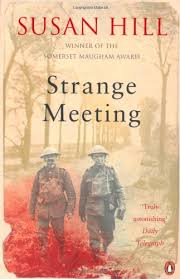
Susan Hill: Strange Meeting (1971) Literature and War Readalong January


John Hilliard, a young subaltern returning to the Western Front after a brief period of sick leave back in England, finds his battalion tragically altered. His commanding officer finds escape in alcohol, there is a new adjutant and even Hilliard’s batman has been killed. But there is David Barton. As yet untouched and unsullied by war, radiating charm and common sense, forever writing long letters to his family. Theirs is a strange meeting and a strange relationship: the coming together of opposites in the summer lull before the inevitable storm.

Strange Meeting, is set in the English countryside and the trenches in France, at the beginning of WWI. The book is divided into three parts. The first is written from John Hilliard’s point of view, the second mostly from David Barton’s and the third could be called the combined one. At the heart of the story is the juxtaposition of two very different themes; the intense and emotionally intimate friendship between John Hilliard and David Barton on the one hand, and the horrors of WWI on the other. The following quotes taken from page 158 illustrate this perfectly well:

“But they (the Germans) must know we are up to something.”

“Oh yes, though that fact is never obvious to High Command, whose faith in the Element of Surprise in the attack is really very touching and quite unshakeable.”

And a few lines later:

“Has it always been like that? Has it always been so easy for you to love people? To get on with them, to bring them out, say the right things at the right time? Have you always made friends as you’ve done out here?”

Whoever is familiar with novels or movies on wars knows that one of these two will die. It is the aim of books and movies on war to show an individual, to pick one person out of an anonymous number and to tell his story. As horrible as it is for us to know that in some offensives – especially in the early WWI ones – far over 100 000 young men were killed in less than an afternoon and millions died senselessly during the course of this war, we still need to be told an individual’s story and not only a huge number, to be touched emotionally. From the beginning of the novel until its end, the shadow of death hangs over these two young people and this is what makes it so touching. We know, one of them is doomed. It’s like a Greek tragedy.

Hilliard and Barton meet in France, during the first summer of WWI, in a bombed out village, away from the trenches and the front line. Hillard has just returned from a short sick leave to England. He is shocked to find his company reduced to a fraction. His commanding officer is drinking and seems to have lost his faith completely.

We lost three quarters of the Battalion in a day and a half. Getting on for two dozen officers. Mayor Gadney, young Parkinson, Ward – all the best. Half of them went because we didn’t get an order telling us the second push was cancelled. They just went on. You were well out of it. I’m glad you were out of it.

But Hilliard’s stay in England was horrible too. He couldn’t sleep, had no one to talk too. He showed signs of  shell-shock, only not enough to not return. The mindless cheerfulness of the people around him who had no idea what it was like to be in the trenches was unbearable. They did neither realize how useless the losses were, nor how futile the missions. The newspapers only gave a purified version and people everywhere were convinced, the war would be over by Christmas. Hilliard was suffering from this feeling of isolation and haunted by the images and smells that were stuck in his mind. He found the smell of roses revolting, the sweetness reminded him of the smell of dead bodies. He would have liked to talk to his sister, the only person from his family he felt close to, but finds her estranged. She is about to get married and he doesn’t approve of her choice until he realizes, there is really no one else left, most other young men are dying in France.

When he returns to France and finds out that most of the men of his company are dead, he also hears that there is a new guy that he will share his quarters with.  They don’t meet directly at first, instead we follow Hilliard into the room that they will share and discover Barton through his things.

The lettering (on the valise) was upright and plain and clear, done in black ink. The leather of the valise still shone, the buckles were not yet tarnished. There was a tortoise-shell backed hairbrush and comb and a slab of chocolat Meunier. A copy of The Turn of the Screw and of the complete works by Thomas Browne, and one of the Psalms, bound in navy morocco. Hilliard reached out a hand towards it, hesitated, drew his hands back.

This passage tells us such a lot in a few words. The new guy is still untarnished, naive, it seems he has prepared himself for a summer camp. Hilliard resents this at first but when he finally meets Barton and gets to know him, he understands that Barton would always have packed the same things, no matter where he would have gone. His belongings mirror his being and how he always tries to see the sunny side of things and make the best of it. Hilliard has never met anyone like Barton. He is cheerful, easygoing, open, direct and very communicative. Even though he is reluctant at first, Hilliard is swiped away by Barton’s exuberance. For the first time in his life he starts to open up to another person and speaks about himself and his feelings.

Part II is mostly told from Barton’s point of view and consists in large parts of letters home to his family. Barton writers the longest letters Hilliard has ever seen. This strikes him as his family sends expensive parcels but short, polite and distant notes.

The two friends are not at the front yet, Barton will still have to find out what life in the trenches is like but he already sees someone killed and feels responsible for the man’s death.

There is something all the men hate about this place. Now, I can sense it myself. Something old and bad and dead, a smell a feeling you get as you walk across the street. It is not simply the bodies lying all about us, and the fact that the guns are firing, it is something else, something…

Part III is set in the trenches and we see a considerably changed and disillusioned Barton who has been sent on a reconnaissance mission on which he has seen people get killed. They know by now that High Command prepares for a big offensive. Since most of these are high in losses their morale is low. Being the new guy,  Barton is sent on several reconnaissance missions without Hilliard who goes almost crazy when he imagines Barton might get hurt or killed. When the offensive finally begins the two friends are separated in the chaos and one of them dies.

Strange Meeting does an incredible job at rendering what it was like to be in France in the summer of 1914. It captures the difference between the relative luxury encountered by the companies who wait off the front line and the ugliness and ordeal of the trenches. Susan Hill describes all the details that we can also find in history books, memoirs and letters. She describes various elements that were typical for WWI, the futility and high losses of the offensives, the chaotic and bad planning, the underestimation of the situation and possible duration of the war. The trenches are rendered accurately. Once they are there we read about the constant shelling, the noise, the rats, the mud, the dirt, the stink, the wetness and the cold.

As accurately as she renders the dreary trenches and the sadness and futility of it all, it is not surprising to read the following in her afterword:

Yet I have not told the whole truth, for although I have accounted for my obsession with the First World War, I am still sometimes troubled by thoughts of those two young men of whom I became so very fond while I was writing about them and who stand for thousands upon thousands of others, so full of youth, strength and bright promise, who were slaughtered in a war perhaps more futile and meaningless than any other in history. I wrote the novel in memory of them and in tribute to them. But I hope it is not thought of only as a novel whose “subject is the war and the pity of war”, for, more than anything else it is about human love.

Srange Meeting is indeed a novel about friendship, much more than about the war. The war serves as a backdrop and an explanation for this very intimate exchange. In civilian life, men were not this close, opening up would have taken much longer. Strange Meeting excels in rendering the intensity of the feelings of two people for one another and the tragedy of their fate. As strange as this may seem, although the description of their feelings for each other can only be called love and Barton does also tell Hilliard that he loves him, I never had the feeling they were gay. Apparently Susan Hill has been asked if Hilliard and Barton did have a physical relationship and she denied this. As said this never occurred to me either. It is really about emotional love. It is sad that we immediately have to think that there must be some sexual attraction involved as soon as two people have very strong feelings for each other.

I read somewhere that it wasn’t possible to say if Strange Meeting had been written by a man or a woman. I would contradict this. I think we can feel that it was  written by a woman. This is mostly due to Barton’s narrative voice and the nature of their conversations. They constantly ask each other how they feel, speak out everything, clarify, share their emotions.

I think Strange Meeting is  a beautiful novel about a unique and fateful meeting that took place during one of the darkest moments of European history.

What did you think?

Other reviews:

Anna (Diary of an Eccentric)

Danielle (A Work in Progress)

*****

Strange Meeting was the first book in the Literature and War Readalong. The next one will be Jennifer Johnston’s How Many Miles to Babylon. Discussion starts on Friday February 25, 2011 .

John Marsden: Tomorrow, When the War Began (1993) An Australian Page-turner

When Ellie and her friends go camping, they have no idea they’re leaving their old lives behind forever. Despite a less-than-tragic food shortage and a secret crush or two, everything goes as planned. But a week later, they return home to find their houses empty and their pets starving. Something has gone wrong–horribly wrong. Before long, they realize the country has been invaded, and the entire town has been captured–including their families and all their friends. Ellie and the other survivors face an impossible decision: They can flee for the mountains or surrender. Or they can fight.

Sometimes you want to read for pure entertainment, something that is fast-paced, action-packed but still interesting. Tomorrow, When the War Began is exactly like that, a real page-turner. I discovered the book on Jenclair’s blog last year and am really glad I read it. I am not too much into  series but this start into the Tomorrow Series was really gripping. Too bad that it isn’t an independent book. It’s rather a series in the spirit of the TV series Lost. It always ends when it’s most supenseful, when something big happens. You really have to go on reading if you want to know what’s going to happen next. Jenclair has read all the books meanwhile. You can find her second review here.

Ellie and her friends go camping instead of participating in a cattle show that takes place during Commemoration Day. They make a trip into the Australian mountains and discover a place that very possibly no one has ever seen before. Or only one person, a hermit, who is said to have lived there. The hermit is a man who has been accused of the murder of his wife and baby and escaped into the mountains.

The place they discover is enchanted. It seems to belong to another world, untouched by civilization. They enjoy their stay a lot and leave only reluctantly. When they arrive at their homes, the coming back is a brutal one. Their houses and farms have been abandoned, their animals are dead or dying. Bit by bit they discover that Australia has been invaded and all the people are captives.

The adventures that follow are numerous and dangerous. They first need to find out what happened, then they need to make decisions. How are they going to live and where? How will they hide, what will they eat? It seems natural that they return to the hidden place in the mountains. The country is swarming with foreign soldiers and every expedition is a trial.

We never hear who has invaded the country but we learn why. People in neighbouring poor countries couldn’t accept that a lot belongs to a few rich people and they came to redistribute what is here.

What I liked particularly is the setting. I have never been to Australia but I have seen movies and it is a country whose landscape fascinates me. The setting is rendered very well, in a very descriptive manner. I liked the exploration of topics like war, murder, social justice and injustice. I was just wondering for a moment if it is ethical, to base a book on the idea that poor people or a poor country could act in such an aggressive way. I think what Marsden had in mind, was raising the awareness that there are people less well off than those in the Western hemisphere. Another question that arose was whether they would have the military power to invade.

The characters are not all equally well drawn, two stay a bit schematic but that may change in the future books, maybe they will be more developed.

If you want to read something that is really absorbing, this is a good choice.

Did I mention it is a YA novel? I often enjoy the topics they explore and this is no different. Part one of the series has been made into a film. I haven’t seen it, no idea if it is any good.

Do you like series and if so which ones?

Edith Wharton: Madame de Treymes (1907) Novella with Parisian Setting

Madame de Treymes (Penguin 60s)

Set in Paris, Wharton’s 1907 novel explores the theme she and Henry James so often examined; the conflict between American innocence and corrupt Europe.

Even a short novel like Madame de Treymes (just 80 pages long) shows you what a masterful writer Edith Wharton was. This is the oldest of her novels that I have read so far. It came out after her enormous success The House of Mirth (1917) which I want to read very soon as well. The Age of Innocence (1920) and Ethan Frome (1911), both books that I have read, are later ones. Another one that I have found in my hopelessly overstuffed book shelves is Summer (1917).

Madame de Treymes has a Parisian setting which always appeals to me, as sentimental as this may be. It is a cruel little book and a very surprising one. All in all there is not a lot of description of the city itself, the novel rather offers an analysis of the society. It is interesting to see how Americans perceived the Parisian society and the differences in their respective values.

John Durham knew Mme de Malrive when she was still called Fanny Frisbee. Once a lively young American woman, she has become but a mere shadow of herself. She married into the Faubourg St Germain society, meaning Parisian upper-class. Stuffy, traditional and very unwelcoming to outsiders. She lives separated from her husband as he has cheated on her. She would like a divorce but is afraid to lose her son and doesn’t want to move him from Paris. Durham always liked Fanny and intends to marry her and, if needed, stay with her in Paris.

The only person Fanny trusts is Mme de Treymes, her sister-in-law, who disapproves as much of her brother as Fanny herself. Durham turns to her for help and what follows is a tragedy of manners, if I may say so.

This little story, as beautifully written as it is, made feel quite chilly. I am surprised to see that the Parisian upper-classes (to which I never belonged but am fairly familiar with) haven’t changed that much.

The differences between the American and the Parisian way of life is nowhere to be seen so well as when Durham and his sister visit Fanny at her house. The house, a rundown old mansion in a poky street, causes the follow exclamation from his sister:

“Well, if this is all she got by marrying a Marquis”.

Wealth meets status and it is funny to see how those down-to-earth rich Americans are absolutely not impressed with the shabby elegance they encounter. On the other hand, they were not aware of the power of ancestry and heritage which reignes in the society into which Fanny has married.

Durham felt, as he observed them, that he had never before known what “society” meant; nor understood that, in an organized and inherited system, it exists full-fledged where two or three of is members assembled.

But Wharton doesn’t only dissect the French society she also lays bare the lack of culture of some of the Americans.

To Mrs Durham, with her gentle tourist’s view of the European continent, as a vast museum in which the human multitudes simply furnished the element of costume, the Boykins seemed abysmally instructed, and darkly expert in forbidden things (…)

As the title indicates, Mme de Treymes is the central figure, the most complex character, much more than you can deduce from this post. She is also married to the wrong man and lives a scandalous life, having a  lover, yet she would never even think about leaving her husband. This would be too open a rebellion against the society of which she is a much more integral part than Durham and Fanny realize.

Mme de Treymes is a wonderful example of what an adept writer can achieve even in such a short form as the novella.

The topic of the American in Paris is interesting and would certainly be worth exploring further. Hemingway, Gertrude Stein and many more come to mind who wrote about it.

I think that to this day Paris is the city Americans are mostly likely to visit if they have to make a choice. At least that is what I have been told lately by different Americans. Maybe we could call this the “mythical Europe”.

Should you like to read another review of one of Edith Wharton’s books, Guy Savage just reviewed The Old Maid which rekindled my interest in Wharton that had unfortunately been dormant for a while. As soon as I get a chance I will continue with Summer and The House of Mirth. She is such a wonderful writer and one of a few where I could imagine reading everything she has written.

Which is your favourite Edith Wharton novel? I remember I liked The Age of Innocence a great deal.