The Fiction of Nella Larsen Part I: Quicksand (1928) A Classic of Harlem Renaissance

Born to a white mother and an absent black father, and despised for her dark skin, Helga Crane has long had to fend for herself. As a young woman, Helga teaches at an all-black school in the South, but even here she feels different. Moving to Harlem and eventually to Denmark, she attempts to carve out a comfortable life and place for herself, but ends up back where she started, choosing emotional freedom that quickly translates into a narrow existence.

The foreword states that if we don’t call Jane Toomer’s Cane a novel then the most accomplished novel of the Harlem Renaissance movement would be Nella Larsen’s Quicksand.  I discovered Nella Larsen just recently while compiling books for different reading projects I have started, one of them being dedicated to African-American writers. Nella Larsen is, like Zora Neale Hurston, and some other African-American writers, a mystery.

Nella was born to a Danish mother and a West Indian father. These mixed origins are reflected in her work. She wrote only two novels, Quicksand and Passing (which I will review later) and three short stories. After an unsavoury accusation of plagiarism concerning her last short story, she stopped writing. This may or may not have been the reason, it isn’t exactly clear. Before she started writing she was a nurse, later became a librarian and after she stopped writing, worked as a nurse again during the last 30 years of her life. A lot – like in Zora Neale Hurston’s case – isn’t clear. It was never really established when she died, she went under many different names and she fabricated stories around her biography which obscured the facts.

Quicksand is a wonderful novel. I enjoyed it a great deal. It has so much to offer and reminded me at times of the novels of Elizabeth Taylor which is high praise. Helga Crane, the main character, is one of the most interesting heroines I’ve come across recently. A fascinating character. Quicksand explores different themes, the most important are race and gender. It was interesting to read about this. What would it be like if you were constantly aware of the color of your skin? If what you look like is more defining than who you are? For Helga this is doubly tragic as she is, like Nella Larsen herself, of mixed origins. The mother is Danish, the father Afro-American. She isn’t accepted by the Whites and mostly has to hide her white heritage from the Black people around her. There is such a thing as a Harlem High Society and Helga, being a beautiful woman, frequents this society, the cabarets, cocktail parties, salons in which endless discussion on race bore her.

At the beginning of the novel she is a teacher in Naxos but restlessness and contempt for the methods that are applied there, lead her to leave and go back to her home town Chicago. This wasn’t such a good idea, as she has to realize, as it is hard for her to find another job. On top of that she loves nice things, clothes, accessories and spends too much.

Luck is on her side and she finds an employer who takes her to New York, introduces her to the high society of Harlem. A beautiful rich widow, Anne, lets her live at her place until, once more, after some months, she is restless and decides to go to Denmark to visit her mother’s sister.

In Denmark she experiences another side of racism. She is paraded and admired like an exotic animal. One of the most famous men, a painter, wants to get married to her. She enjoys her stay in Denmark. Like before in New York, she thinks at first that she has found “her place”, her home. But once more she gets restless and returns to New York.

Offers for marriage are frequent and equally frequent are her refusals. It is also typical for Helga to be happy when she newly arrives in a place and to see it lose its lustre after a while. When the enthusiasm fades, she is prone to nervous attacks, panic and depression. At the end of her second stay in New York, this happens again.

Helga’s life is a sequence of bad choices, of restlessness, pervaded by a deep feeling of not belonging. When, in a stormy night, she lands in some Christian congregation, she grasps the opportunity to be “saved” and when the pastor asks her to marry him, she accepts and follows him to Alabama.

Her first months in Alabama are full of bliss. She enjoys married life, to be the wife of an important man. There are a few signs here and there that this is superficial and the surface will crack soon but before her first child is born, she is feeling happy.

Everything contributed to her gladness in living. And so for a time she loved everything and everyone. Or thought she did. Even the weather. Ad it was truly lovely. By day a glittering gold sun was set in an unbelievably bright sky. In the evening silver buds sprouted in a Chinese blue sky, and the warm day was softly soothed by a slight cool breeze.And night! Night, when a languid-moon peeped through the wide-open windows of her little house, a little mockingly, may be. Always at night Helga was bewildered by a disturbing medley of feelings. Challenge. Anticipation. And a small fear.

The last part shows us a broken Helga. Someone who looks back on a ruined life, who hates motherhood or rather bearing children. By now  she is the mother of five children and we know there will be more.  She tries to make friends but her natural elegance and haughty looks keep her always outside.

I really liked this book, because I liked the writing and I loved Helga Crane. She is an endearing character with all her wishes, her longing, the restlessness and the feeling of being an outsider wherever she goes. We can see in her every outsider, every human being who doesn’t fully belong, every one who is looking for something to transcend the ordinary. She stands for so many people who are different. But she also stands for the many women who find it hard to live the life of a wife and mother, who are worn out by birth. 

Helga is a tragic figure and did remind me of a friend of mine who, full of hope for something better, turned down every good job offer he got and finally, running out of opportunities,  had to go for something far below his capacities in the end.

There are many interesting parts on race and gender and the criticism of many aspects – for example Christian faith and its promises of a later redemption in which so many Afro-Americans believed and which held them down for so long – are intriguing.

I’m looking forward to read her stories and her second novel Passing.

I should add that both novels are very short, only 130 pages long. I hope this tempts you.

Literature and War Readalong April Wrap up: The Winter of the World

As usual this is the time to thank those who read along and/or showed an interest in this monthly activity.

From the comments I can deduce that we all thought pretty much the same about this book. It was a mixed bag or, to quote litlove, “a curate’s egg”. True. There was much to like in this novel but also many things that didn’t work. The descriptions of the battle scenes were graphic but well-rendered, the close look at facial wounds and the reconstruction that followed were detailed. We get a feeling for how harrowing these were but also a lot of admiration for those who tried to help, the nurses and doctors alike.

Equally well done was everything that was tied to the grave/burial of the unknown warrior or soldier. (I don’t know if anyone was thinking of this book when watching the Royal Wedding that took place in Westminster Abbey were the soldier is buried).

What we all had our problems with was the story itself. At the center of this novel is a passionate love story that leaves behind considerations of friendship and decency. If you were among the readers who have difficulties to imagine such a strong passionate love at first sight story, the novel was pretty much doomed. But also if you could accept this as a premise, like I could, you had to be able to “feel” this passion. While I got a feeling for Alex, Clare left me completely unfazed. She is a great nurse and, in this function, an admirable character but the abuse story and her feelings for Alex weren’t well rendered. At one moment I was suspecting Carol Ann Lee to want to tell us that Clare acted the way she did, because she had been abused, that ultimately she was devoid of real feelings. That’s a type of explanation I do not like at all.

I also think, as did the others, that some episodes and narrative devices should have been left out.

I still have a few novels of WWI on my TBR pile but I’m glad that we move on anyway.

Looking back, the novel of the four I liked the most was Jennifer Johnston’s How Many Miles to Babylon. However if I had to recommend one to someone who has no idea about WWI, I think I would recommend Strange Meeting.

Which was your favourite? Which one would you recommend?

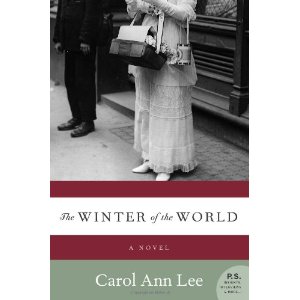
Carol Ann Lee: The Winter of the World (2007) Literature and War Readalong April

Journalist Alex Dyer made his name covering the bloody horrors of the European trenches. Yet even after the Great War is over, he cannot shake the guilt he feels for not serving on the front lines like his dearest childhood friend, Ted Eden. Worse still, Alex cannot put to rest the emotions that gnaw at him from the inside: his feelings for Clare, Ted’s wife—a woman they both have loved more than life itself. 

Carol Ann Lee’s The Winter of the World is the last novel on WWI in this read along. For the next one we will be moving on to WWII.

This wasn’t the easiest review to write as I am in two minds about this novel. There are parts in it that are so haunting and powerful but then again there were others were I was just rolling my eyes thinking “get on with it”.  Still it would be unfair to write a totally negative review because the good parts are among the best on WWI I’ve ever read.

Alex and Ted are childhood friends. They are close and attached to each other until the day Ted introduces Alex to his soon-to-be wife Clare. Very unfortunately this is a love at first sight moment for Alex and Clare. They try to fight it but, as we will see soon enough, the more the story advances, the less likely it is that they will succeed.

The marriage takes place just when the war breaks out. Ted will enlist, Alex will participate as a war correspondent and Clare will be one of the nurses in France.

The novel moves back and forth between Alex’s and Clare’s point of view. Alex sees a lot of atrocities and the descriptions are very graphic and extremely impressive without falling into the trap of being too clichéd. But since Alex isn’t fighting, it stays an outsider’s perspective. Clare’s point of view was captivating for totally different reasons. As a war nurse she has to deal with indescribable wounds and suffering. The abundance of facial wounds seems to be a trait of WWI and these parts reminded me of one of the best WWI movies I have ever seen, La chambre des officiers aka The officer’s chamber based on the eponymous novel by Marc Dugain. We seem to get an insider’s view of this truly harrowing aspect of the “Great war”. I can hardly imagine what it must have been like to have been the victim of this kind of facial mutilation and to be rejected by those you loved and who once loved you. The reactions of the relatives and fiancées were often brutal. Through Clare’s eyes we also get an equally close look at what mustard gas did to those who became its victims and how they suffocated or drowned slowly.

The only men more popular than I was were the ones in wheelchairs, or those with empty sleeves pinned against their chest. Everyone wanted to talk to them, to do something for them. Children presented them with flags and in the railway stations they got free tea or coffee. It was different for the ones whose faces had been destroyed. People averted their eyes quickly, the blood flooding their skin. No one wanted to make eye contact with a disfigured soldier; they were modern-day lepers.

While the war moves on – not stopping at Christmas, as was expected – the love affair develops as well. Clare and Alex meet secretly but are finally driven apart by conflicting emotions and wishes. Alex feels he needs to tell Ted everything, while Clare wants to protect him and keep the affair secret.

Through Alex’ voice we hear what it must have been like to cover this war as a correspondent. The journalists were not allowed to tell the truth. The numbers of casualties were not mentioned nor were the biggest defeats spoken of. While Clare’s parts rather focus on individuals, Alex’ parts illustrate the enormity of the losses. He evokes the incredible amount of wounded, disfigured and killed soldiers. At moments I had the feeling of seeing all these dead men standing in one huge row before my inner eye. When we visit those cemeteries we get a feeling for those massive losses.

He imagined a thin line linking the cemeteries along the old Western Front, from the smallest graveyards hidden away within woods to those huge, silent cities on the plains where the most ferocious battles had been fought. Some bore the names given to them by the soldiers themselves – Owl Trench, Caterpillar Valley, Crucifix Corner – while others were named after the battalion who had buried their own men there. He imagined how tha line would look from the air; so thick in parts that it resembled a child’s scribble, for they were everywhere these Gardens of Stone.

The novel slowly moves towards the culminating point which is the burial of the “unknown warrior”. The name is chose deliberately as “warrior” sounded more inclusive than “soldier”. The grave which is really located in Westminster Abbey was meant to commemorate all the dead fighters of this war, not only the infantry men. The burial is one of the best and most powerful parts in this novel.

Despite all these impressive elements, I had my problems, as I said. The biggest part of the story is told by Alex. He tells Lombardi, a guy he meets in Flanders after the war, why he is so tormented, why he cannot get over the war. I didn’t get this narrative device at all.  I would have preferred a more straightforward story, not this artificial telling of what happened to someone who has nothing to do with it. This was a common technique in 19th century novels but I think it doesn’t add anything to a modern novel at all. The next biggest negative aspect was the coincidence. I found it highly unlikely that Alex would meet Ted at the end. The third thing that I didn’t think well-done is the love-triangle. I think it was unnecessary that Alex and Clare had an affair. The descriptions of Alex’ feelings worked very well for me but not those of Clare. And the guilt-theme was just an element too much. Last but not least I missed Ted’s point of view.

I have a lot of questions at the end of this novel and would be curious to know what others thought.

Was this really the tone of a WWI novel? Especially the love-affair seemed very WWII to me but maybe that impression stems from the similarity to Pearl Harbor.

What about the facial wounds, does anyone know whether this was a consequence of the trenches? In The officer’s chambers, the young officer loses half of his face on the battle field, but I have really never heard so much about this type of injury from any other war.

Why do you think Carol Ann Lee left out Ted’s point of view? I think she might have risked to fall into the trap of cliché but I am not sure that’s why she chose to leave it out.

I’m really curious to read your thoughts.

Here are other reviews

Anna (Diary of an Eccentric)

Danielle (A Work in Progress)

*******

The Winter of the World was the fourth book in the Literature and War Readalong. The next one will be Shusaku Endo’s The Sea and Poison aka Umi to dokuyaku. Discussion starts on Friday May 27, 2011 .

Herman Melville: Bartleby the Scrivener. A Story of Wall Street (1853)

bartleby

Academics hail it as the beginning of modernism, but to readers around the world—even those daunted by Moby-Dick—BARTLEBY THE SCRIVENER is simply one of the most absorbing and moving novellas ever. Set in the mid-19th century on New York City’s Wall Street, it was also, perhaps, Herman Melville’s most prescient story: what if a young man caught up in the rat race of commerce finally just said, “I would prefer not to”?

There is a specific reason, why I read Melville’s novella Bartleby. I have just read and reviewed Delerm’s novel Quelque chose en lui de Bartleby and since it was obviously inspired by Melville’s story, I had to read it.

I was never tempted to read Moby Dick although my parents had a copy with beautiful etchings. I can’t tell you why but some books just do not sound like you would like them.

Reading Bartleby I was very surprised how humorous it is. The characters are very eccentric and so is the story. It is basically the story of a young man called Bartleby who just doesn’t want to comply. Like the raven, in Poe’s eponymous poem, he has his stereotypical sentence which is “I would prefer not to.” Whatever it is he is asked to do, Bartleby invariably refuses it uttering the sentence I just quoted.

Bartleby is told in the first person peripheral, by a lawyer who has his office on the Wall Street. He once hired Bartleby as a copyist or scrivener. He already had three different copyists, each one of them with his own eccentricities, that’s why at first he didn’t pay too much attention when Bartleby declares that “he would prefer not to” read the copies together with anyone else.

The lawyer thinks at first that this is just a whim but soon enough it is obvious that there is more to it. While in the beginning he doesn’t want to read with the others, never goes out or seems to eat, after a certain time Bartleby stops working altogether. On a Sunday morning the lawyer makes another discovery which leaves him quite fazed. Bartleby never leaves the office. He stays there over night and during the weekends.

As much as he threatens him, offers him money, tries to negotiate, Bartleby doesn’t work anymore and he doesn’t leave either. If he wants to get rid of him, the lawyer has to take extreme measures. After some time and many frustrations, he decides to change the office and move away from Wall Street.

Not long after he has moved, he hears complaints by the new lawyer about Bartleby. The man is still there and haunts the building.

I’m not going to tell you the end in all its details, it should just suffice to say that the narrator tells the reader, that he thinks he might have found out what drove Bartleby to this extreme behavior. Bartleby used to work for another lawyer handling “Dead Letters”. I must admit I had no idea what “dead letters” are. It reminded me vaguely of Gogol’s Dead Souls and it proved that the association wasn’t totally wrong. “Dead letters” are letters that never reach their recipient because he has died or disappeared or left without leaving an address.

While reading this novella I was reminded of many other books. Not only Poe’s The Raven came to mind but some of Poe’s other writings. He didn’t only write Tales of Mystery and Imagination but a fair amount of absurd tales like we find them again in Kafka’s work. The already mentioned Gogol came to mind as well. I was also reminded of the first scene in Balzac’s Le Colonel Chabert (see my review in which the clerks bicker and quarrel.

Bartleby is the tale of someone who gives up on life, who stops participating and contributing. He is tired of it all. I often wonder when I see beggars in the streets how many chose to live like that. I met Clochards in Paris who told me that the hassle of a job, an apartment, a wife and children was just too much for them and they found it easier to live on the street. At first this may seem absurd but thinking of it for a while, it may make sense.

If it hadn’t been for Delerm, I wouldn’t have read this novella but I’m glad I did. It’s surprisingly modern. It is interesting to discover its intertextuality and a  more thorough analysis would be fascinating. I’m sure Kafka read it, as sure as I am that Melville was influenced by Poe, Gogol and maybe Balzac. However, I must say, I don’t think that Delerm’s Spitzweg and Bartleby have much in common.

On Philippe Delerm’s Blogger Novel “Quelque chose en lui de Bartleby” (2009)

« http://www.antiaction.com est pris d’assaut. Beaucoup de compliments, qu’Arnold a d’abord trouvés
outranciers, mais on s’habitue vite. Ces enthousiasmes sont souvent signés d’un prénom féminin
accompagné d’une adresse e-mail, mais M Spitzweg s’est promis de ne pas répondre. Certaines
correspondantes comprennent cette attitude : “Ne perdez pas votre temps. Continuez seulement à
cueillir le meilleur des jours.” Cueillir le meilleur des jours pour des Stéphanie, des Valérie, des
Sophie ou des Leila, voilà qui n’est pas sans flatter l’ego d’Arnold, même s’il cueille davantage
encore pour des Huguette ou des Denise ». Arnold Spitzweg crée son blog : l’employé de bureau discret jusqu’à l’effacement cède à la modernité mais sans renier ses principes. Sur la toile, à contre-courant du discours ambiant, il fait l’éloge de la lenteur. Ses écrits intimes séduisent des milliers d’internautes…. Comment vivra-t-il cette subite notoriété ?

I have read a few novels by Philippe Delerm and especially Autumn, his historical novel on the life of the Pre-Raphaelite painter Dante Gabriel Rossetti and his muse Lizzie Siddal, is an absolute favourite of mine. As a matter of fact I liked it so much that I keep his second novel on the life of another famous painter (Carl Larsson), Sundborn, unread on my TBR pile. Unfortunately only one of his books, La première gorgée de bière aka The Small Pleasures of Life has been translated into English. It’s a series of impressions and descriptions of life’s little pleasures. I did like it but not as much as his other books, some of which are novels, others are a combination of little sketches and photos (Paris l’instant).

Quelque chose en lui de Bartleby tells the story of Arnold Spitzweg, an invisible little clerk who is working for La Poste in Paris. Originally from the Alsace region he still loves Paris as much as when he first arrived. He lives an uneventful life, dreams of a unlived love affair, has an occasional lover, but all in all he likes to be left alone and just watch life pass. When someone tells him about a new phenomenon called “blogging” his curiosity is piqued. After a few inquiries he immediately starts his own blog in which he notes in minute details all the little things he observes around him, explains his way of seeing life, of enjoying the simple things and staying outside of it all as a pure observer.

It doesn’t take long and his blog has the first comments. After a while there are more and more until he is a real celebrity, even mentioned on the radio. While at first he wrote exactly what he wanted to write, fame makes him self-conscious and he starts to censor himself. When he realises that he doesn’t write for his pure pleasure anymore, he simply stops blogging.

Quelque chose en lui de Bartleby takes place during one hot summer in Paris. While everyone is gone on holidays, Mr Spitzweg, walks all over Paris, discovers and rediscovers streets, places and little corners and enjoys the city to the fullest. Since I love and miss Paris, I enjoyed all these details. They are well captured. And the parts on blogging are really interesting. From the start Spitzweg doesn’t answer comments or only rarely. He wants to be read but he doesn’t want to get in contact with his readers. I have noticed that there are quite a few bloggers like that out there. I often wonder what is in it for them. The reasons for blogging are probably as numerous as the bloggers who write the blogs. On the other hand I know from my own experience that a blog that gets many comments doesn’t necessarily have many readers, and you may have numerous readers but hardly any comments. I know that I wouldn’t want too many comments as I want to respond to each and every one. The more, the harder. It’s as simple as that. I’m not a crowd person and the people I call “friends” are well-chosen. The same goes for my blog, I suppose. I “know” those who leave comments on my blog. It’s not a crowd of strangers that I cannot place.

I could really understand Mr Spitzweg when he started to feel self-conscious. It did happen to me a few times. Fortunately I got rid of it but occasionally (on my German blog) I have thoughts like “Who is going to want to read this?” or “Oh my, what are they going to think?”.

And what about Bartleby? In the novel Arnold Spitzweg thinks that we are all a little bit like Bartleby and since he emphasized this so much I thought I need to read Melville’s novella. The review will follow tomorrow.

I’m not sure whether what I wrote made it obvious or not but I really liked this little novel. It isn’t one of his best but it contains everything I like in Delerm and I liked his character Spitzweg a lot. He is a very gentle and atypical man who gets picked on quite a lot. Especially by other men. There is also a little bit of gender discussion hidden underneath it all.

Delerm’s novel is not the first blogging novel I saw. I think Joanne Harris has written one and I vaguely remember another one. Has anyone read a novel about blogging?

Louise Welsh: Naming the Bones (2010)

Knee-deep in the mud of an ancient burial ground, a winter storm raging around him, and at least one person intent on his death: how did Murray Watson end up here? His quiet life in university libraries researching the lives of writers seems a world away, and yet it is because of the mysterious writer, Archie Lunan, dead for thirty years, that Murray now finds himself scrabbling in the dirt on the remote island of Lismore. Loaded with Welsh’s trademark wit, insight and gothic charisma, this adventure novel weaves the lives of Murray and Archie together in a tale of literature, obsession and dark magic.

I read a few intriguing reviews of Louise Welsh’s books and Naming the Bones was the one that tempted me the most. Set in Glasgow, Edinburgh and on the Island of Lismore, off the West Coast of Scotland, this is a very atmospherical read. The first 150 pages or so, it did remind me a lot of Kate Atkinson but farther into the novel, this changed considerably. And that is a bit sad. The novel had the potential to be great but the denouement wasn’t to my liking and so I would say, yes, it is a very good novel but not a great one.

Murray Watson, a professor of English literature at the University of Glasgow has a passion that makes him ask for a sabbatical. Since he was a very young guy, he loved the poems of Archie Lunan. Lunan has only had one slim collection published before he died an untimely and mysterious death. Living on the Island of Lismore for a certain time, together with Christie, his girl friend, he took a boat in stormy weather and never returned.

Murray wants to write his biography, do extensive research on the poet, interview people who knew him and secretly wishes to find a few undiscovered poems. Fergus Baine, the head of the department and husband of Murray’s lover Rachel, disadvises this approach. He tells him to concentrate on the poems, not the man.

It is obvious that Naming the Bones is exploring these two approaches to literature; the biographical one and the one leaving out everything related to the life of the author.

Murray is an interesting character. We meet him at a junction in his life. He has just been dumped by Rachel and realizes that Fergus may have known all along that he had an affair with her and that he may not have been the only one whith whom she had affairs. Fergus and Rachel seem to have a very unhealthy relationship.

Murray’s father died of Alzheimer’s and Jack, his brother, who is an artist, made an installation, showing their demented father on film which infuriates Murray.

Murray is a good looking, very attractive man and his charms are the reason why all through the novel women feel attracted to him.

What reads for the first 100 and so pages like a character study and an adventure story circling around the core theme of researching a deceased poet, starts to get dismal once it seems obvious that some of the people in Murray’s life knew Archie and that there may be secrets tied to Archie’s death that are far more disturbing than the possibility that Archie committed suicide.

When the reasearch in Edinburgh and Glasgow is finished, Murray leaves for the Island of Lismore where Christie lives. She doesn’t want to give him an interview or any other information, still Murray wants to see the place where Archie lived and died.

As beautiful as the island may be, it is a lonely and desolate place. Murray’s mood seems to get darker and darker, along with the developments in the novel. It also seems as if other people looking into Archie’s life had met with an untimely death and the further we read into the novel the more uncanny it gets.

I saw the term “gothic” mentioned a few times along with this book and couldn’t understand the use at first. I love gothic books but I do not like the blend of gothic and crime/thriller because that invariably means that  a “satanistic cult” or some such thing serves as part of the background. It’s not as bad as that here but the elements are present. Lucky the outcome isn’t tied to anything supernatural or occult. What we find out at the end just shows some young people’s depravity.

As said in the beginning, this is a very atmospherical novel. I have been to Scotland and know Glasgow and Edinburgh as well as some of the islands off the West Coast and I must say they are very well rendered. It is also an extremely well written novel, the numerous main and secondary characters are without any exception interesting and complex. There is more than one theme explored in this book which gives it additional depth. Welsh tackles topics like old age, research, poetry, alternative life styles, modern relationships, death and suicide with intelligence and a great deal of insight.

All this together makes Naming the Bones a very entertaining read on an autumn or winter afternoon when the world outside is as rainy, stormy and dark as the world in the novel. If you like a gothic atmosphere, you will enjoy this a great deal.

Here’s the island’s website should you plan a trip to Scotland: Island of Lismore.

Peter Handke: Wunschloses Unglück aka A Sorrow Beyond Dreams (1972)

Peter Handke’s mother was an invisible woman. Throughout her life—which spanned the Nazi era, the war, and the postwar consumer economy—she struggled to maintain appearances, only to arrive at a terrible recognition: “I’m not human any more.” Not long after, she killed herself with an overdose of sleeping pills.

Peter Handke’s Wunschloses Unglück or A Sorrow Beyond Dreams is the bleak account of a German woman’s life. It is the story of Handke’s mother, her struggle, her despair, her suicide.

The author starts with his own motivation to write this book, the attempt to make sense to put into words what is hardly comprehensible and to escape a feeling of being utterly numb. What did surprise me at first is his choice to call the account novella. Not memoir. After a few pages I realized that he wanted to make this an exemplary account. His mother’s life stands for numerous invisible women’s lives. When I finally got that, I felt like standing in a corner of a room and just scream. It’s such an outrageous account. It’s outrageous and infuriating and sad because it’s such a common story. Numerous women born in small towns (or even cities) between the wars lead lives like this. No one took them seriously, no one thought they should have a proper education. They were oppressed, and crushed, ridiculed and held small. All they were offered was the proverbial Kinder, Küche, Kirche (Children. Kitchen, Church).

Handke has by now become one of the most controversial German authors, but at the time of the publication of Wunschloses Unglück he was still the German literary Wunderkind, so too speak.

Handke’s mother is born in Kärnten, a region in Austria, in the early 1920s. She belongs to the Slovenian speaking minority. Despite a joyless childhood and hardly any education – she is only a girl – , her curiosity and interest in many things make her leave home and enjoy life for a while. She is only a young woman, almost a girl still, when she gets pregnant from a married man. He is the love of her life and she will never love anyone else after this. Afraid of the shame and what would become of her and the child she gets married as fast as she can to someone else. They live in Berlin and stay there until after the war when poverty and the difficult situation in the bombed city drive them back to the village in Austria from which she came.

What follows is indeed exemplary and that is why it’s so sad. Her husband starts drinking and hits her. She gets pregnant at least another five or six times, three of the children she aborts herself. The society in which she lives consists of uncultured peasants. She looses all interest in life and starts to develop all sorts of ailments. In the end she has a chronic headache that is so severe that she can hardly think, barely see and speak. She goes to a doctor who diagnoses a nervous breakdown, gives her pills. She does get a little bit better. She starts to visit girlfriends, reads extensively. She reads the books Handke gives her and with the help of those books, she speaks about herself for the first time.  She tries to have some fun but her marriage is so love- and joyless, she can hardly stand it. Her husband has tuberculosis and is gone often, when he is back, they sit and stare silently at opposite walls. She says she wants to die by she is afraid of death. She starts speaking about how to kill herself and finally writes long letters of goodbye to everybody. She buys a red umbrella, goes to the hairdresser, has her nails done, lies on her bed and swallows all the tablets she has.

When Handke hears of her suicide his first reaction is one of pride. He is proud of her. After a while he starts to feel horrible. He starts to write about her but that doesn’t help. He wakes regularly in terror and dread.

Handke could have chosen numerous ways to tell this story, more personal ones. Throughout the narration he hardly ever uses perosnal pronouns like “I” or “she” but always “one did this, one did that”. The alienation is as complete as possible.

Handke is famous for his style, unwieldy at times but sparkling here and there with metaphors and sentences that you don’t find often. If you want to get to know him, it isn’t a bad thing to start with a short text like this one.

A Sorrow Beyond Dreams has been published by Pushkin Press and by the The New York Review Book Classics. It’s extremely depressing but a very important text. It describes in details the life of many a woman in Catholic petite bourgeoisie in dreary post- war Germany and Austria. It speaks of the misogyny and sexism that pervaded the society. The poverty, the struggles, the joylessness. Manic saving, mistrust of anything that looked like frivolity and be it only reading a book. It’s an oppressing account but worth reading.

Handke didn’t only write depressing books. He has, amongst a lot of other books, written the script of one of the most beuatiful movies, Wim Wender’s Himmel über Berlin aka Wings of Desire.