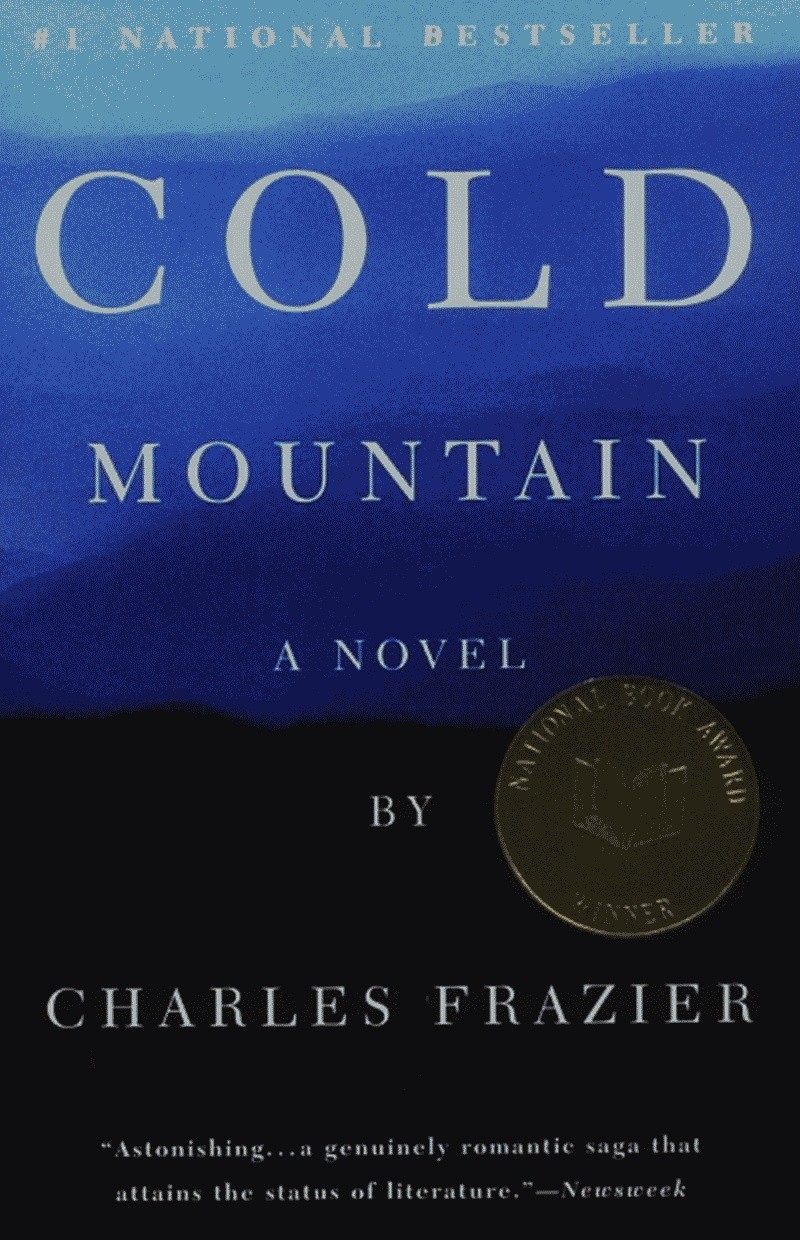
Literature and War Readalong December 30 2011: Cold Mountain by Charles Frazier

While I’m busy collecting the titles for next year’s Literature and War Readalong I should not forget to make you aware that there is still one more book on the list for 2011. Initially I had chosen two books on the US Civil War but German Literature Month made me remove The Killer Angels from the list.

This year’s last readalong title is Charles Frazier’s Cold Mountain. I’ve watched the movie a while back but don’t remember all that much apart from a stunning cinematography. I’ve heard a lot of good things about the novel and especially the friendship between the two women is said to be very compelling so I’m really looking forward to reading it and find out if I will like it or not. For some reason I think it’s a particularly good choice for December.

For those who have no idea what it’s all about and whether or not it’s worth joining here’s the blurb.

Charles Frazier’s debut novel, Cold Mountain, is the story of a very long walk. In the waning months of the Civil War, a wounded Confederate veteran named Inman gets up from his hospital bed and begins the long journey back to his home in the remote hills of North Carolina. Along the way he meets rogues and outlaws, Good Samaritans and vigilantes, people who help and others who hinder, but through it all Inman’s aim is true: his one goal is to return to Cold Mountain and to Ada, the woman he left behind. The object of his affection, meanwhile, has problems of her own. Raised in the rarified air of Charleston society, Ada was brought to the backwoods of Cold Mountain by her father, a preacher who came to the country for his health. Even after her father’s death, Ada remains there, partly to wait for Inman, but partly because she senses her destiny lies not in the city but in the North Carolina Blue Ridge.

S.J. Bolton: Sacrifice (2008)

Danielle recently wrote about S.J. Bolton’s book Now You See Me and I really liked the tone of it and wanted to read one of her books. I got her first novel Sacrifice instead because I liked the idea of a book set on The Shetland Islands. I know some of the islands off the Scottish coast and I find the landscape incredibly beautiful.

Tora, an obstetrician from London, is married to a man from The Shetland Islands. Duncan hasn’t been living on the islands for over twenty years but now he wants to return and Tora follows him. She has found a job in a local clinic. They live in a house in the country, quite far away from any other houses or farms which doesn’t bother Tora too much as she grew up on a horse farm.

The novel opens with Tora trying to bury her beloved horse Jamie. While digging in the field she finds something utterly disturbing, namely a corpse wrapped in fabric. Whether the dead person has been lying in its peat grave since the earliest days of Shetland Civilization or been buried recently isn’t sure at first but the police soon find out, the body hasn’t been dead for longer than two years. When they unwrap the corpse they discover something quite grisly. The dead womans heart has ben cut out and there are runic symbols carved into the skin of her back. On top of that the dead woman must have given birth right before she was killed.

Tora is a very determined woman and the shock to find a body on her land triggers an urge to help find the killer. Being a doctor allows her to have access to much more information than even the police. She teams up with a police woman, Dana, also a foreigner, who has a hard time being accepted by the locals. The two women start to dig quite deep into some mysterious things. Tora’s investigation isn’t entirely legal but she can’t stop it, even less when she discovers that the dental records of a woman who has died of cancer two years ago match the records of the dead body in her peat field.

From the early moments in the novel, it’s obvious that Tora endangers herself with this investigation. And when she wakes one night and thinks that someone is in her bedroom, she is sure her life is threatened.

The fact that Tora lives in this lonely house on her own most of the time, because Duncan is away for work, heightens the feeling of threat. She and Dana stumble from one eerie discovery to the next and I really speeded through the 550 pages because I wanted to find out what was going on.

This is a book to read in almost one sitting, if you break the speed for a while, which I did, you lose momentum and the end might not go down so well. I saw Danielle reviewed Sacrifice here as well and there is a comment from the author saying that she herself wasn’t too sure about the ending (if you intend to read this book don’t read the authors’ comment it does give away a lot).

I can only say, this is a great read, if you rush through it but a part of the explanation was a disappointment for me. It’s too unbelievable. Still, the book works well on many levels. It’s very suspenseful and has a great atmosphere. Something I really liked was the description of the friendship between Tora and Dana. They both do not easily trust other people but they soon feel quite close. Also these are not your typical “women in jeopardy”, they are threatened but they are gutsy and can fight for themselves. Being threatened worries them but doesn’t keep them from going on. I might very well read another S.J. Bolton. Judging from the comment she left on Danielle’s blog, I could imagine, she did in her more recent books stay away from stretching believability too much.

German Literature Month – Final Wrap up and Hans Fallada Giveaway

It’s hard to believe but German Literature Month is already over. I enjoyed it a lot. I’ve read quite a few books I liked, I discovered many others. I’ve read a few incredibly great reviews. I also discovered some blogs that I will be following in the future.  I hope all of you did enjoy it as much as I did. Judging from the amount of posts, readalong participants and comments I think it was a success and I would really like to thank all of you for the enthusiasm and support. Including all the introductory and readalong posts we have had over 170 contributions.

Some of you have been very prolific. The three participants with the most posts are Tony (Tony’s Reading List), Emma (Book Around The Corner) and Amateur Reader – Tom (Wuthering Expectations). While Tony was focusing on novellas, Emma has read a novel for each theme and Tom has delighted us with some very funny and unusual posts on plays. I’m sorry that some of the books Emma chose where not to her liking. Thanks to the discussions with her and others I discovered that while German literature is not all “dead people and WWII”, German literature in translation could really give this impression.

I’ve seen more than one contribution that stunned me. If I had to name all the great posts I would have a hard time.

Melville House Books who have already been very generous have given us the great opportunity of a final giveaway of four books by Hans Fallada. Since we wanted this to be a bit of special giveaway, we have already chosen the winners.

We decided that we will pick four posts, each from another group of posts, and give each of the writers one of the books by Fallada.

The first book will go to the person who has written the most amazing post. When we saw this contribution we all went “Wow” and “Blimey!”

The second book will go to Lizzy’s favourite Effi Briest readalong contribution.

The third book goes to the person who wrote The Silent Angel review I liked the most.

The last book goes to the person who has written the most original post on Kleist as we considered “Kleist week” to be some sort of readalong as well.

Seeing Tony’s dedication, his creativity and his very funny re-interpretation of Kafka’s The Castle (Das Schloss – The Play Act One – Das Schloss – The Play Act Two  – Das Schloss – The Play Act Three – Das Schloss – The Play (Director’s Cut) ), it was evident from the start that he should be a winner – only Tony likes his German books to be in German and not in translation. This is why he will get his present on Lizzy’s blog. I hope it’s fine by him.

Courtesy of Melvillehouse Publishing

Hans Fallada’s

Little Man, What Now? goes to

Vishy (Vishy’s Blog) for an absolutely astonishing post that can be read like an introduction to the most important writers of German Literature German Short Stories.

Every Man Dies Alone goes to

Fay (Read, Ramble) for a wonderful interpretation of Heine’s Sea Spectre in Effi Briest On Heine’s Sea Spectre in Effi Briest.

Wolf Among Wolves  goes to

Rise (in lieu of a field guide) for having written the review of The Silent Angel that I would have liked to have written and which gives a feel for its poetical qualities The Silent Angel by Heinrich Böll.

The Drinker goes to

Richard (Caravana de Recuerdos) for his enthusiastic and unorthodox review of The Duel that involved the much-loved expression “primal ambiguities”,  the discovering of Kleist’s rock star potential and, at the same time, imitated Kleist’s meandering style.

Last but not least I have a personal giveaway title which is from an author I love and who is often compared to Fontane. Thomas Mann considered him to be one of the finest German writers ever. When I read his book Wellen I thought it felt as if Schnitzler and Fontane had met to write a book together. It’s one of my favourite books ever. The author is Eduard von Keyserling. Apart from his early novels his books have not been translated into English but I’m sure that the winner will manage to read him in German. For those interested, his books are available in German and French.

Eduard von Keyserling’s Wellen goes to

Lizzy for having been a terrific co-host.

I really wonder if it will not feel strange, all of a sudden, when I realize tomorrow that the month is really over. Hmmm… Will I feel sad? A little bit. But I’m already making new plans…

Please send me your address via beautyisasleepingcat at gmail dot com.

Please do not miss Lizzy’s wrap up and giveaway.

Theodor Storm – Bulemanns Haus -The House of Bulemann

I often return to Storm’s short stories and novellas in autumn and winter. Not many know how to create an atmosphere like he does. His stories are either set in one or the other Northern town with their narrow, winding little alleyways, flanked by high houses with pointy gabled roofs and small, dark gardens or near the marshes and the dykes along the coast. His stories are realistic and eerie at the same time. Stories of unhappy love can be found as well as fairy tales or ghost stories. Many of his characters have become odd, whimsical and embittered through misfortune and loneliness. Two days ago, rummaging in my book shelves, I found a collection of short stories entitled “Katzen – Texte aus der Weltliteratur“, classic stories with a cat theme. When I looked through the contents I discovered a story by Storm called Bulemanns Haus. Should you like to read it in German here is the link Bulemanns Haus. I couldn’t find an English translation but it’s a very typical Storm story and can give you an impression whether you’d like to read him.

Bulemanns Haus is a story that reminded me a lot of A Christmas Carol only it is more sinister. In a German town, somewhere in the North, stands an abandoned old and dilapidated house. People pretend that they often see a face behind the dirty windows and at night they hear a scurrying sound as if huge colonies of mice were running through the house. The house used to belong to Bulemann, a bachelor who inherited the house from his father, a pawnbroker. He inherited the house, including all the objects people had left. Bulemann had been on a ship for many years and was said to have sold his black wife and their children and chosen to come back, accompanied by two cats only.

The first thing he did upon his return was selling all the objects in the house and making a fortune. The money was hidden everywhere. He was rich and avaricious and treated people in a mean and nasty way. Even his cats were frequently abused. When his impoverished sister turned up with his sickly nephew to ask for charity, he turned them down promptly and didn’t even care, some time later, when it looked as if the child was going to die. His sister who asked for help once more, was turned down again.  Before she left the house, she cursed her brother and soon afer her departure something weird was going on with Bulemann’s cats. It looked as if those two animals were growing. They got bigger and bigger daily and were finally capable not only of fighting back their master but of keeping him in check and finally imprison him.

The years went by, the cats were hunting mice at night and Bulemann was shrinking until he wasn’t much more than a helpless gnome, condemned to spend all eternity in an empty house with two giant cats.

Storm wrote a poem with a similar title In Bulemanns Haus which you can read here in German.

I thought this story was quite eerie, reminiscent of some of E.T.A. Hoffmann’s tales. My favourite Storm story so far was Immensee. But The Dykemaster aka The Rider on the White Horse is equally good. Vishy reviewed them recently here and here and Lizzy has written a review of a lesser known collection Carsten the Trustee.

When it comes to 19th century German writers I would say that from a language point of view Fontane and Storm are two of the most accomplished writers, only surpassed by The Brothers Grimm who have written the most beautiful German you can find. Should you never have read anything by The Brothers Grimm, Mel U found a great online resource for 19th Century German stories which he shares here.

Do you have a favourite story by Storm?

Bulemanns Haus und andere Geschichten   Theodor Storm 32825 Blomberg Bild 1

Heinrich Böll: The Silent Angel – Der Engel schwieg (1951) Literature and War Readalong November 2011 Meets German Literature Month

Written between 1949 – 1951 Der Engel schwieg  or The Silent Angel is unique in many ways. Unique for German literature but also in Böll’s work. I have already written about it in my post on Sebald’s The Natural History of Destruction. Böll’s novel, which is one of the rare to depict a German city after the massive bombings by the Allies, had to wait 40 years for its publication. For this reason many of the chapters have been re-used in other books and if you are familiar with Böll the one or the other scene or description may appear familiar. All the important themes of Böll’s work can already be found here. Criticism of post-war Catholicism, compassion with those who have nothing, with those who suffer. His books often circle around the same elements, motives and themes and although he doesn’t always use the same style, this gives the impression of a very organic work that, read in its entirety, gives an excellent panorama of Post-war Germany.

The Silent Angel is one of the most important works of the so-called “Trümmerliteratur” (the literature of the ruins). The story as such can be told in a few sentences. It’s May 8 1945. Hans, a deserter, returns from the war without a passport. He tries to find the woman of a comrade who died instead of him. While walking the bombed and destroyed city he meets a woman who lives in an appartment in a house that is almost a ruin. He feels a strong connection to her and asks her if he can stay with her. She has lost her baby in an air raid, his wife has died as well and so, like two castaways, they are stranded together in this apartment. At first they both envy those who died but slowly they find their way back to love, hope and some kind of livable future.

It isn’t said but we know that the city which is described is Köln, Böll’s hometown. The description of the despair of the people, how tired they are physically and psychologically is impressive. The way he depicts their struggle to find bread, their fight to survive in those ruins is powerful. There is one scene in which Hans tries to visit someone and to walk a distance which used to take him ten minutes, he takes an hour because of  all the debris and the rubble. As I said before, Catholicism is an important theme in Böll’s work and in this novel, in which the greed of some Catholics is shown in all its ugliness, the description of the bombed churches becomes a very significant additional meaning.

What impressed me the most apart from the descriptions of the ruined city is how tired these people are. They spend days and days on end in their beds, staring at their walls. Finding something to eat, moving about the city, coming to terms with was has happened, takes an unimaginable effort, drains them of all their energy. All they have left is exhaustion.

This must sound very depressing but Böll isn’t only a writer of despair. He describes hopelessness but his characters overcome it, they find hope and the courage to go on living. The negative people have their positive counterparts. The greedy Dr. Fischer who doesn’t care for anything but money and for whom Catholic artifacts are just collectible items finds his counterpart in the gentle priest who helps Hans. The priest is the embodiment of a pure, compassionate Catholicism.

I was wondering while reading The Silent Angel whether I thought it was well written. I think he could have improved the structure, some passages read like short stories, some elements could have been left out, all in all it feels a bit loose at times which isn’t the case in his later work. His later novels are much more condensed but Böll has a gift for description which is rare. And he represents a rare model of moral integrity, he is an author who wrote for those who have nothing, who tried to unmask hypocrisy and uncover everything that was fake and phony in post-war Germany. I don’t know all that many authors who are so humane.

I have read The Silent Angel before. It isn’t my favourite Böll novel but since it’s an excellent example of “Trümmerliteratur” it seemed a great choice for the readalong. I’m very interested to know what others thought of this book.

Other reviews

Christina (Ardent Reader)

Danielle (A Work in Progress)

Fay (Read, Ramble)

Lizzy (Lizzy’s Literary Life)

Rise (in lieu of a field guide)

Tony (Tony’s Reading List)

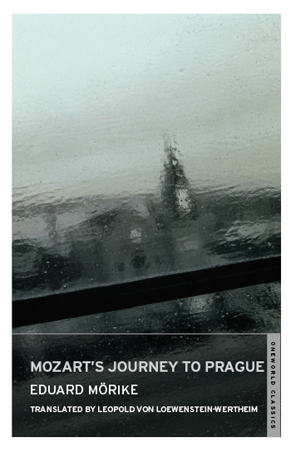
Eduard Mörike: Mozart’s Journey to Prague – Mozart auf der Reise nach Prag (1855)

This is one of those books that I had meant to read since years. Now that I have read it, just after reading Kleist, I must say, I couldn’t imagine another classic as far from Kleist as Mörike. Mozart’s Journey to Prague is a truly lovely piece of writing. Sunny, cheerful but still profound, thoughtful and with a melancholic undertone. All in all one could say the sunniness is deceptive.

It’s the year 1787 and Mozart and his wife Konstanze are on a journey to Prague for the opening of Don Giovanni. They are cheerful but not without worries. Money is a big issue in Mozart’s life. Money and his health. He never rests, never stops running from one invitation to the next, working till the early morning, hardly sleeping.

His needs were various, above all his passion for all the pleasures of society were extraordinarily strong. Honoured and sought out as an incomparable talent by Vienna’s noblest families, he seldom or never declined invitations to dinners, parties and soirées. In addition he would entertain his own circle of friends with befitting hospitality. The Sunday musical evening, a long-established tradition in his house, or the informal luncheon at his well-furnished table with a few friends and acquaintances two or three times a week, were pleasures he refused to forgo. Sometimes, to his wife’s dismay, he would bring unannounced guests straight in off the streets, a very varied assortment of people, dilettanti, artistic colleagues, singers and poets. The idle parasite whose sole merit lay in an untiring vivacity, ready wit and the coarser sort of humour was made as welcome as the learned connoisseur or the virtuoso musician.

They talk about a few of these things but they are enjoying themselves as well. Mozart steps out of the carriage in a forest and gets all enthusiastic about the trees, the beauty of nature of which he hardly sees anything in Vienna.

A little later they stop at a village and Konstanze rests in a guest house while Mozart goes for a walk in someone’s garden. Lost in his thoughts he carelessly snaps an orange from a little tree and halves it with his knife. He immediately gets arrested by the gardener and brought in front of the noble man whose park he has entered. Lucky for him they recognize him and are delighted to have him there.

The little tree is very dear to the daughter of the noble man. It has once been a gift from Mme de Sévigné herself. The little tree was about to die but thanks to a skillful gardener has recovered. His oranges were counted and the tree was meant as a gift for the daughters engagement.

Mozart and his wife are invited to spend the day and the evening of the engagement with the family. He plays the piano, sings, introduces them to Don Giovanni.

There is a lot of cheering, drinking and laughing but towards the end the daughter of the family feels a chill. She is convinced that Mozart is burning from an inner fire, that he consumes himself too fast and will not live much longer. The novella finishes with a sad poem by Mörike that ends the book on a melancholy note.

Mörike wrote this novella as an homage to Mozart whose music he adored. He tried to capture the beauty and the cheerfulness of his music and the man himself but did not omit the fact that Mozart wasn’t able to refrain himself. He couldn’t live in a moderate way, was excessive in everything, burned the candle on both sides and did, as we all know, not live very long.

Reading this novella felt at times like watching a painter paint a very colorful painting, drawing flowers and trees, a sunny blue sky but in the upper left corner of the painting we can see a dark cloud slowly starting to spread.

Mozart was without any doubt a genius and there is always a mystery surrounding them. One could wonder whether he was living and working so excessively, as the novella wants us to believe, because he knew deep inside he was going to die young or whether his excesses led to his untimely death.

It’s a very visual novella, lovely and enchanting but profound as well.

The review is part of German Literature Month – Week IV Kleist and the Classics

Wednesdays are wunderbar – Pick and Mix Classics

Since it’s classics week the giveaway will be a classic. Classics is something many people already own. In order to make sure that you can win books you do not already own One World Classics offers to two people to pick and mix any two classics from their catalogue.

Interested? Then hop over to Lizzy’s blog for details .

The giveaway is part of German Literature Month.