
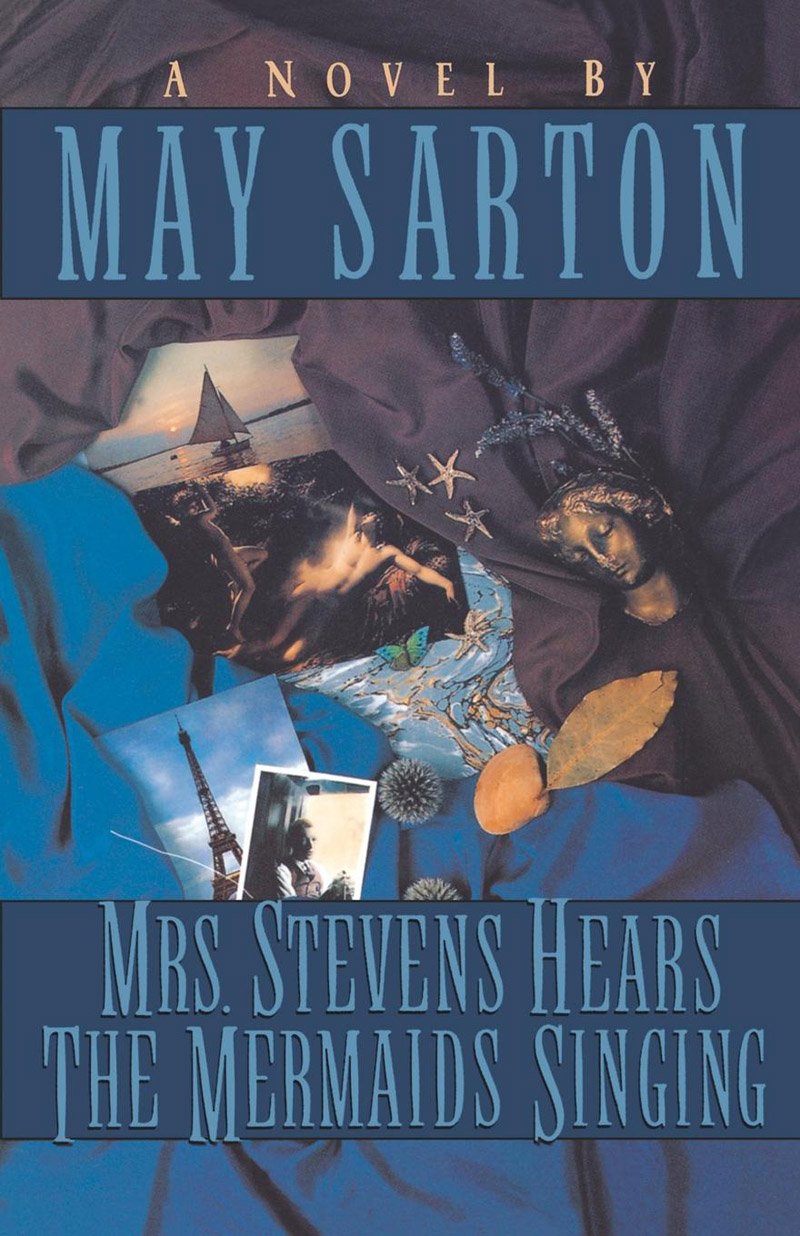
I came across May Sarton for the first time when I was reading Susan Tiberghien’s memoir Looking for Gold, in which Tiberghien wrote about her year in Jungian analysis. The books she mentioned were Sarton’s famous diaries Plant Dreaming Deep and Journal of a Solitude. I got them both but never read them so far. When Danielle (A Work in Progress) started writing regularly about Journal of a Solitude last year, mentioning in particular one entry in which Sarton wrote how much a negative review of one of her novels hurt her, I realized that I hadn’t even been aware that Sarton had also been a novelist and not only a poet and diarist. That made me curious and I decided to read one of her novels. Since the title Mrs Stevens Hears the Mermaids Singing reminded me of one of my favourite movies I’ve Heard the Mermaids Singing (I’m sure it’s no coincidence that Rozema chose that title) I picked that novel.
Mrs Stevens Hears the Mermaids Singing is the story of an elderly poet, Mrs Hilary Stevens, who has just published a highly successful volume of poems. The story focuses on one particular day on which an interview takes place but her whole life is unfolded as well. Two younger people, an aspiring young woman poet and a male critic are coming to see Hilary to interview her. Mrs Stevens is very anxious. She is aware that if the interviewers are any good, they will dig deep and trigger a lot of buried emotions and memories.
The book consists of four parts. The first called “Hilary” shows us the poet on her own, the morning before the young interviewers arrive. The second part “The Interviewers” describes the two young people on their way to Mrs Stevens and shows just how anxious they are as well. The third part is dedicated to “The Interview” and moves back and forth in time. We follow the interview and flashbacks reveal episodes of Hilary’s life, which she doesn’t want to share with her interviewers. The last part is called “Mar”. Mar is the name of Hilary’s protegé, a young gay poet who reminds her of herself as a young person.
The part I liked best was the first in which we see Hilary on her own. She has chosen to live a solitary life (I guess pretty much like the author) and relishes every minute. She lives close to the sea and finds solace and inspiration in watching the landscape, the trees, how sunlight falls on certain flowers. She has her small rituals and fixed schedule to which she sticks unrelentlessly. In this part she also thinks about what it means to get older and how the inner young self contrasts with the older out self, the aging body, and what it means to face the frailties of old age for someone living a solitary life.
The interview was broken up by pauses. Hilary has to interrupt the interview several times when memories overwhelm her and she retreats to her room, leaving the two interviewers on their own. In these pauses she thinks of the past which is revealed in flashbacks. I found this technique somewhat heavy-handed but it was still powerful. The topics of the interview circle around inspiration, the muse, the difference between men and women as artists.
Mrs Stevens Hears the Mermaids Singing is of importance in Sarton’s work because it is the first book in which she wrote about homosexual love. I found it interesting that Hilary had relationships with men and women and didn’t try to compare but felt each brought out another part of herself. Not all of the relationships are love affairs. The strong bond she has with Mar, for example, is free of physical attraction.
I found this novel highly engaging and inspiring. It’s full of insights and subtle observations on mundane and sublime things alike. There is a moment in the beginning in which Hilary complains that the world seems to strive towards chaos at all times. She takes her ashtrays as an example and states that she sometimes has the feeling, all she’s doing is emptying her ashtrays which get full again within seconds. I can’t say I haven’t had similar thoughts – not with regard to ashtrays -; there definitely is an absurd futility in housework.
At times reading this novel was like meeting a very interesting person who has given thought to everything. She finds thinking about housework, her cat, the light in the corner of a room, just as important as to ponder the deeper meaning of her life, the sources for her creativity, the deep bond between human beings. What I didn’t care for were those many observations on the difference between men and women and the assumption that it is dangerous for a woman to become a poet because it can endanger her fulfillment as a wife and mother. Yeah well. I agree to some extent but the problem isn’t an essential one, as she tries to make us believe, but a social one. If our society was different, these problems wouldn’t exist in that way. Unfortunately these thoughts and reflexions made the book feel quite dated.
As much as I liked reading this, it never really felt like a novel. On the other hand, I loved to get a glimpse at someone’s rich inner life and I might even read this again some day. Since I have a feeling Hilary Stevens is a lot like May Sarton, it certainly made me keen to read Sarton’s diaries, but I’m not sure I’ll read many more of her novels.
 Beauty is a Sleeping Cat