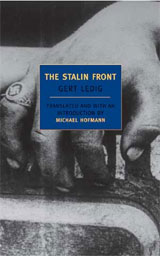
Literature and War Readalong November 30 2012 Meets German Literature Month: The Stalin Front – Die Stalinorgel by Gert Ledig

It is thanks to last’s year’s German Literature Month during which I read Sebald’s On the Natural History of Destruction that I discovered Gert Ledig’s The Stalin Front  –  Die Stalinorgel (1955).

In this novel Ledig depicts the atrocities of the Eastern Front. The fact that he is so explicit about the horrors and destruction is, according to Sebald, the reason why Ledig was forgotten and only rediscovered thanks to Sebald’s lectures and later book.

Here’s what is written about the book on the nyrb site

Gert Ledig (1921–1999) was born in Leipzig and grew up in Vienna. At the age of eighteen he volunteered for the army and was wounded at the battle of Leningrad in 1942. He reworked his experiences during the war in this novel Die Stalinorgel (1955). Sent back home, he trained as a naval engineer and was caught in several air raids. The experience never left him and led to the writing of Vergeltung (Payback) (1956). The novel’s reissue in Germany in 1999 heralded a much publicized rediscovery of the author’s work there.

Here are the first sentences

Prologue

The Lance-Coropral couldn’t turn in his grave because he didn’t have one. Some three versts from Podrova, forty versts south of Leningrad, he had been caught in a salvo of rockets, been thrown up in the air and with severed hands and head dangling, been impaled on the skeletal branches of what once had been a tree.

I hope that some of the participants of this year’s German Literature Month will join us. As you can deduce from the first lines –  this is a very graphic novel.

*******

The discussion starts on Friday, 30 November 2012.

Further information on the Literature and War Readalong 2012, including all the book blurbs, can be found here.

German Literature Month – A Quick Update

Like last year, Lizzy is compiling all the reviews in one big final post which will be a great resource for anyone interested in German literature.

But since part of the appeal of this event is to find new books and new blogs I thought you might be keen to check out what’s happening while the event is still ongoing. That’s why I have set up a German Literature Month 2012 Page where I am collecting all the posts. Today is day 3 of this year’s German Literature Month and we have already 20 posts. That’s so amazing.

Please check out the posts, especially the intro posts are interesting as they contain book lists and reading plans something we all love to see.

Here as a teaser the contributions of the first 2 days (in order of their chronological appearance)

Introduction to GLM (Tony’s Reading List)

Introduction GLM (Obooki’s Obloquy)

The Fury by Paul Heyse (The Reading Life)

Five from the Archive: Contemporary German Literature (Lizzy’s Literary Life)

Brigita and Rock Crystal by Adalbert Stifter (Tony’s Reading List)

German Literature Recommendations II – 89 Shorty Story and Novella Writers You Should Read(Beauty is a Sleeping Cat)

Introduction to GLM (The Little Red Reader Library)

Introduction GLM (A Fiction Habit)

Introduction to GLM (Vishy’s Blog)

Introduction to GLM (AJ Reads)

From the Diary of a Snail by Günter Grass (Winstonsdad’s Blog)

The Journey to the Harz by Heinrich Heine (Obooki’s Obloquy)

Introduction to GLM (Everybookhasasoul)

What not to drink when reading Matthias Politicky (Lizzy’s Literary Life)

Dyning by Arthur Schnitzler (Winstonsdad’s Blog)

Lieutnat Gustl and Fräulein Else by Arthur Schnitzler (Beauty is a Sleeping Cat)

The Collini Case by Ferdinand von Schirach (The Little Red Reader Library)

Introduction to GLM (Tabula Rasa)

German Literature – A Short Introduction by Nicholas Boyle (Vishy’s Blog)

Confusion by Stefan Zweig (His Futile Preoccupations)

It’s not too late to join. You can sign up formally on Lizzy’s blog here or just leave a comment.

If I have missed a post, please let me know.

Arthur Schnitzler: Short Fiction – Lieutenant Gustl (1900) and Fräulein Else (1924)

Austrian writer Arthur Schnitzler was one of those whose books were burned in Nazi Germany. Hitler considered him to be a typical example of what he called ‘Jewish filth’. What infuriated the Führer and created a lot of controversy among other readers of the time was, among other things, how outspoken Schnitzler wrote about sexuality, notably in his most famous play Round Danca aka La Ronde (Der Reigen). La Ronde is easily one of the best plays to convert people who don’t read plays,  as it’s such a stunning piece. It’s a play about promiscuous and venal love in which we always see one of the two characters from the preceding scene in the next one too.

Schnitzler was highly influenced by Freud, a fact that is most apparent in Dream Story aka Dream Novella (Traumnovelle) on which Stanley Kubrick’s last movie The Eyes Wide Shut. While I liked the movie a great deal, I was pleased to find out the novella is even better.

I have read both The Dream Novella and La Ronde some years ago and wanted something else and finally decided to re-read Lieutnant Gustl and (after Tony’s suggestion) added Fräulein Else. Both are available in the collection Short Fiction.

They are both written entirely as interior monologues, a technique which was very new at the time and also influenced by Freud’s theories. At 35 pages, Lieutenant Gustl is the shorter of the two, Fräulein Else is twice that size.

Both monologues show young people in distress. Both are victims of their society. The effect of listening to their hidden fears and desires, their hopes and wishes, their silliness and despair, is spellbinding.

Lieutenant Gustl takes place in Vienna during one night. Gustl is a young officer and has a history of duels to show for. When we are introduced to him during a Oratorioum which bores him to death, we also learn that this is the evening before another duel with a doctor will take place. Gustl is all about honour and reputation. All that is on his mind are girls and the hope people will respect him. When on the way out of the theater, a master baker insults him, he feels there is only one way to save face – he has to kill himself. As the man is below him, he couldn’t ask for satisfaction in a duel. He spends the whole night debating, looking at pros and cons of his decision, imagining the reaction of the people he knows when they will find out about his death, remembers similar cases like his. At the same time he displays how much he loves life.

Fräulein Else’s story is similar but far more tragic. Else is a young girl from a rich family whose father, a gambler, again and again maneuvers the family into impossible situations. While she stays in Italy at a hotel with her aunt, her cousin and a few other people she knows, her father has lost a lot of money, some of which belongs to his charges. Because he has lost such a lot of money before, he owes most of his family and acquaintances already a fortune and there is nobody left he could ask this time. Else’s mother decides to write to her and begs her daughter to save her father. There is a rich man, Dorsday, staying at the hotel with her, someone who fancies her and the mother thinks if Else asks him, he will lend her the money. This puts Else in a very delicate situation. Not only is she deeply ashamed, she also senses that asking a man like Dorsday for money will lead to complications and most certainly he will want something in exchange. The story is quite upsetting as we get the feeling the parents know very well that this request is as if they were asking her daughter to prostitute herself. Else, like Gustl, contemplates suicide, sees herself dead, imagines escape routes and hopes for help.

What finally becomes of Else and of Lieutnant Gustl is for you to find out. I would really encourage you to read these stories, if you haven’t done so already. I liked them a great deal and think Schnitzler may be one of my favourite authors. What impressed me a lot as well was how fresh the stories and the language are. The society has changed but the things that are at stake are still the same: love, death, money. And the style is precise and emotional without ever being sappy or sentimental.

German Literature Recommendations II – 89 Novella and Short Story Writers You Should Read

First of all, welcome to German Literature Month. I’m sure it will be an exciting journey for all of us. If you participate, please leave comments so that we can visit your blogs and add your posts to a final list. We will most probably not do as many wrap up posts this year but the occasional update will surely appear on the one or the other blog.

Last year I published a post called German Literature Recommendations – 20 German Novels You Should Read. It was based on Marcel Reich-Ranicki’s famous “Der Kanon der deutschen Literatur”. There were many questions about missing authors in the comment sections. Many famous and outstanding writers were not on that list which made it look like an omission but in many cases they were not on that list because Reich-Ranicki considered them better at writing novellas and short stories.

In order to fill the gap left by last year’s post, I have decided to post his list on novellas and short stories. I indicate the authors (over 80 names) and some of their best stories with their German titles. For those who are famous it’s easy to find the English equivalent as it will be in collections, for others it’s more difficult. If you have a particular interest in an author or a story but difficulties to find it in English – or French… Don’t hesitate to send me an e-mail. If it’s available, I’m sure I can find it for you.

The first week of this year’s German Literature Month is dedicated to novellas and short stories, if you still don’t know what to read, I’m sure you will find suggestions on the list.

I’ve already read two, one of them is on the list below, it’s Schnitzler’s Leutnant Gustl, which is available under the same title in English.

For more details on the different weeks, please visit the German Literature Month Announcement.

  • Johann Wolfgang Goethe: Die Sängerin Antonelli; Die wunderlichen Nachbarskinder; Der Mann von funfzig Jahren
  • Friedrich Schiller: Der Verbrecher aus verlorener Ehre
  • Johann Peter Hebel: Der kluge Richter; Eine merkwürdige Abbitte; Kannitverstan; Drei Wünsche; Moses Mendelssohn; Ein teurer Kopf und ein wohlfeiler; Unverhofftes Wiedersehen; Drei Worte; Glimpf geht über Schimpf
  • Jean Paul: Des Feldpredigers Schmelzle Reise nach Flätz
  • Ludwig Tieck: Des Lebens Überfluss
  • E. T. A. Hoffmann: Ritter Gluck; Der Sandmann; Das Fräulein von Scuderi
  • Heinrich von Kleist: Das Erdbeben in Chili; Die Marquise von O…; Michael Kohlhaas; Die Verlobung in St. Domingo; Der Zweikampf; Anekdote aus dem letzten preußischen Krieg
  • Clemens Brentano: Die Schachtel mit der Friedenspuppe; Geschichte vom braven Kasperl und dem schönen Annerl
  • Adelbert von Chamisso: Peter Schlemihl’s wundersame Geschichte
  • Jacob und Wilhelm Grimm: Hänsel und Gretel; Aschenputtel; Rotkäppchen; Die Bremer Stadtmusikanten; Der Gevatter Tod; Dornröschen; Schneewittchen; Rumpelstilzchen
  • Joseph von Eichendorff:
    Das Marmorbild; Aus dem Leben eines Taugenichts; Das Schloss Dürande
  • Franz Grillparzer: Der arme Spielmann
  • Annette von Droste-Hülshoff: Die Judenbuche
  • Jeremias Gotthelf: Die schwarze Spinne
  • Heinrich Heine: Aus den Memoiren des Herren von Schnabelewopski; Florentinische Nächte; Der Rabbi von Bacherach
  • Wilhelm Hauff: Die Geschichte von Kalif Storch; Der Zwerg Nase
  • Eduard Mörike: Das Stuttgarter Hutzelmännlein; Mozart auf der Reise nach Prag
  • Adalbert Stifter: Turmalin
  • Georg Büchner: Lenz
  • Theodor Storm:
    Immensee; Die Söhne des Senators; Hans und Heinz Kirch; Der Schimmelreiter
  • Gottfried Keller: Romeo und Julia auf dem Dorfe; Die drei gerechten Kammacher; Kleider machen Leute; Der Landvogt von Greifensee
  • Theodor Fontane: Schach von Wuthenow; Stine
  • Conrad Ferdinand Meyer: Der Schuss von der Kanzel; Gustav Adolfs Page
  • Marie von Ebner-Eschenbach: Krambambuli
  • Ferdinand von Saar: Schloss Kostenitz
  • Eduard von Keyserling: Die Soldaten-Kersta
  • Arthur Schnitzler: Sterben; Der Ehrentag; Leutnant Gustl; Der Tod des Junggesellen;Fräulein Else; Spiel im Morgengrauen
  • Gerhart Hauptmann: Bahnwärter Thiel
  • Frank Wedekind: Die Schutzimpfung
  • Heinrich Mann: Gretchen
  • Jakob Wassermann: Der Stationschef
  • Hugo von Hofmannsthal: Das Märchen der 672. Nacht
  • Thomas Mann: Der kleine Herr Friedemann; Tristan; Tonio Kröger; Schwere Stunde;Wälsungenblut; Der Tod in Venedig; Unordnung und frühes Leid; Mario und der Zauberer
  • Rainer Maria Rilke: Die Turnstunde
  • Hermann Hesse: Knulp; Klein und Wagner
  • Martin Buber: Abraham und Lot
  • Robert Walser: Sebastian; Ein unartiger Brief
  • Alfred Döblin: Die Ermordung einer Butterblume
  • Robert Musil: Das verzauberte Haus; Tonka
  • Stefan Zweig: Die Weltminute von Waterloo; Schachnovelle
  • Ernst Weiß: Franta Zlin; Die Herznaht
  • Franz Kafka: Das Urteil; Die Verwandlung; Vor dem Gesetz; Ein Bericht für eine Akademie; Ein Landarzt; In der Strafkolonie; Ein Hungerkünstler
  • Lion Feuchtwanger: Höhenflugrekord
  • Egon Erwin Kisch:
    Wie ich erfuhr, daß Redl ein Spion war; Die Himmelfahrt der Galgentoni
  • Ernst Bloch: Fall ins Jetzt
  • Gustav Sack: Im Heu
  • Gottfried Benn: Gehirne
  • Georg Heym: Jonathan
  • Kurt Tucholsky: Rheinsberg
  • Franz Werfel: Der Tod des Kleinbürgers
  • Joseph Roth: April; Stationschef Fallmerayer; Die Legende vom heiligen Trinker
  • Heimito von Doderer: Acht Wutanfälle
  • Carl Zuckmayer: Geschichte von einer Geburt
  • Bertolt Brecht: Der Augsburger Kreidekreis; Der verwundete Sokrates;
    Die unwürdige Greisin
  • Elisabeth Langgässer: Saisonbeginn
  • Anna Seghers: Der Ausflug der toten Mädchen; Post ins Gelobte Land;
    Bauern von Hruschowo
  • Hans Erich Nossack: Der Untergang
  • Marie Luise Kaschnitz: Der Strohhalm; Lange Schatten; April
  • Marieluise Fleißer: Avantgarde
  • Elias Canetti: Die Verleumdung; Die Lust des Esels
  • Wolfgang Koeppen: Schön gekämmte, frisierte Gedanken;
    Ein Kaffeehaus; Jugend
  • Max Frisch:
    Der andorranische Jude; Skizze eines Unglücks; Glück
  • Arno Schmidt: Seelandschaft mit Pocahontas; Die Umsiedler
  • Peter Weiss: Der Schatten des Körpers des Kutschers
  • Wolfgang Hildesheimer: Ich schreibe kein Buch über Kafka;
    Das Ende einer Welt
  • Heinrich Böll: Der Mann mit den Messern; Wiedersehen in der Allee; Wanderer, kommst du nach Spa …; Doktor Murkes gesammeltes Schweigen
  • Wolfdietrich Schnurre: Das Manöver
  • Friedrich Dürrenmatt: Die Panne
  • Wolfgang Borchert: Das Brot
  • Ilse Aichinger: Spiegelgeschichte
  • Franz Fühmann: Das Judenauto; König Ödipus
  • Siegfried Lenz: Der Verzicht; Ein Kriegsende; Ein geretteter Abend
  • Martin Walser: Ein fliehendes Pferd; Selbstporträt als Kriminalroman
  • Günter Grass: Katz und Maus
  • Günter Kunert: Alltägliche Geschichte einer Berliner Straße; Die Waage
  • Christa Wolf: Kein Ort. Nirgends
  • Thomas Bernhard: Die Mütze; Wittgensteins Neffe
  • Gabriele Wohmann: Wiedersehen in Venedig; Sonntag bei den Kreisands
  • Adolf Muschg: Der Ring; Der Zusenn oder das Heimat
  • Uwe Johnson: Jonas zum Beispiel
  • Ulrich Plenzdorf: kein runter kein fern
  • Peter Bichsel: Die Männer; Sein Abend; Der Mann mit dem Gedächtnis
  • Hans Joachim Schädlich:
    Besuch des Kaisers von Russland bei dem Kaiser von Deutschland
  • Jurek Becker: Die beliebteste Familiengeschichte
  • Hermann Burger: Der Orchesterdiener
  • Peter Handke:
    Das Umfallen der Kegel von einer bäuerlichen Kegelbahn
  • Christoph Hein: Der neuere (glücklichere) Kohlhaas
  • Botho Strauß: Die Widmung
  • Christoph Ransmayr: Przemysl