Elizabeth Bowen: The Heat of the Day (1948) Literature and War Readalong March 2013

The Heat of The Day

Elizabeth Bowen’s The Heat of the Day introduces us to London during WWII. The novel starts on a Sunday in 1942 and ends exactly two years later. London is a ghostly city. Many houses are but ruins, other’s are abandoned. People’s lives have changed, relationships are formed much more quickly but they end as abruptly too. Social differences become smaller, the society is less strict as a whole. Everything is perceived more intensely. The seasons, the hours of the day, the light. The beauty and spookiness of the time is captured in evocative passages like the one below.

Out of the mists of morning charred by the smoke from ruins each day rose to a height of unmisty glitter; between the last of sunset and first note of the siren the darkening glassy tenseness of evening was drawn fine. . . . The diversion of traffic out of blocked main thoroughfares into byways, the unstopping phantasmagoric streaming of lorries, buses, vans, drays, taxis past modest windows and quiet doorways set up an overpowering sense of London’s organic power–somewhere here was a source from which heavy motion boiled, surged and, not to be damned up, forced itself new channels.

The very soil of the city at this time seemed to generate more strength: in parks the outsize dahlias, velvet and wine, and the trees on which each vein in each yellow leaf stretched out perfect against the sun blazoned out the idea of the finest hour. Parks suddenly closed because of time-bombs–drifts of leaves in the empty deck chairs, birds afloat on the dazzlingly silent lakes–presented, between the railings which girt them, mirages of repose. All this was beheld each morning more light-headedly: sleeplessness disembodied the lookers-on.

In reality there were no holidays; few were free however light-headedly to wander. The night behind and the night to come met across every noon in an arch of strain. To work or think was to ache. In offices, factories, ministries, shops, kitchens the hot yellow sands of each afternoon ran out slowly; fatigue was the one reality. You dared not envisage sleep.

The main story centers on Stella, her lover Robert, her son Roderick and the intelligence agent Harrison. The side story involves two girls, Louie and Connie. It’s a peculiar story. Harrison visits Stella one night and tells her that Robert is a spy working for the Nazis. Harrison could protect him to some extent if Stella was willing to become his lover.

It’s hard to imagine what it would feel like to hear something like this about the man you love. Stella doubts it at first but Harrison has proof and after a few months she accepts it and confronts Robert.

I’m not exactly sure why Elizabeth Bowen chose this topic or why she chose to paint the portrait of a likable Nazi spy. I didn’t feel this was believable at all.

If you put the story aside and concentrate on other elements, you will find an excellent description of wartime London. I liked the many side stories far more than the main story as such. The female characters are all interesting. There is Stella who was perceived as a fallen woman as it was said she had walked out on her husband. Nettie, the wife of a distant Irish uncle lives in a home for mentally ill patients but is perfectly fine. Louie sleeps with various men, to feel closer to her husband who is stationed in India. The status of women has changed a lot at the time, the society is less rigid, many could finally break free,

Robert, although far less of a character than most women in this novel, is interesting because he symbolizes the wounded men who came back after Dunkirk, unfit for future service. Many of these men must have been very bitter. I’m not sure though that an experience like this would have pushed many to become Nazi spies.

All in all this was a disjointed reading experience. I liked the atmosphere and the mood, didn’t care for the story and often had the feeling Elizabeth Bowen cannot write novels. As much as I liked her shorter prose and could forgive her for many convoluted sentences, in this book she went too far. According to Glendinning’s biography, her editor changed many sentences and told her many times to work on them. It’s not that they are long – long sentences hardly bother you when you read German or French literature – but the structure is weird. Let me give you a few examples.

In the street below, not so much a step as the semi-stumble of someone after long standing shifting his position could be, for the fist time by her, heard.

Or her way to break up dialogue and add long complicated tags

“This is certainly,” she agreed, with the affability of extreme disdain, “rather a point.”

This one is hilarious

“Absolutely,” he said with fervour, “not! Though you know I do wish I knew what’s rattled you.”

While I would still recommend to read The Heat of the Day for many different elements, I’m not so keen on reading another of her novels soon unless someone tells me there is one in which the sentences are not as contorted. For the time being I’ll stick to the short stories.

Other reviews

Anna (Diary of an Eccentric)

Lizzy (Lizzy’s Literary Life)

TBM (50 Year Project)

*******

The Heat of the Day was the third book in the Literature and War Readalong 2013. The next is the WWI novel The Wars by Canadian writer Timothy Findley. Discussion starts on April 29, 2013. Further information on the Literature and War Readalong, including the book blurbs can be found here.
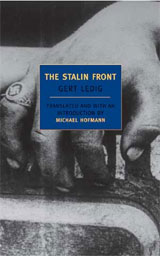
Gert Ledig: The Stalin Front – Die Stalinorgel (1955) Literature and War Readalong Meets German Literature Month November 2012

The Stalin Front is one of the most unsparingly honest accounts of the Eastern Front. It’s accurate and graphic in its depiction of the horrors of the battle field. The wounds, the cold, the fear and the utter uselessness of it all is captured in spare prose. It’s hard to find another novel which is as explicitly anti-war as this book. Interestingly it is exactly this unpolitical but strong anti-war statement for which Ledig would be criticized later. In his book there are no beastly Nazis or inhuman Russians, but living, breathing, suffering humans, some German, some Russian. At the end of the day, it’s not important. What is important is to show that war is awful, that it saves nobody, literally rips apart the “good” and the “bad” alike and turns each party into a suffering mess.

Ledig chose a rather impersonal way to tell his story. Most of the people in this novel have no name – with the exception of the Russian officers – but are introduced with their ranks. This makes it easier to follow them and also helps to keep the story at arm’s length at first. Later in the story, with little remarks here and there, which reveal the men’s unique stories and characters, we start to see them not only as ranks but as individuals. There is for example the Major whose every hope is crushed when he is informed that his wife and only child have died.

The central story, set during two days, somewhere near Stalingrad, focuses on the defense of a hill. This is a totally futile and senseless thing to do. The Germans can’t keep the hill, their lines have been broken through by the Russian tanks but the orders are clear; they have to stay. The losses on both sides are equally heavy, morales are low everywhere.

I was afraid The Stalin Front would be hard to read but it wasn’t. It was a surprisingly quick read and although it is very graphic it was bearable because Ledig isn’t a manipulative writer. It’s much more as if he had painted with words and I was often reminded of the work of Anselm Kiefer.

Ledig’s book was successful when it came out but soon forgotten because it was considered too dark, too bleak. There is no hope in this book, no heroic figures, there isn’t even right or wrong, just suffering and futility. The absurdity is underlined by small things. Seeing the tanks approach and knowing there would be certain death, many of the men try to escape. Some cross the line and flee to the Russians, others desert or simply look for an outpost which is farther away from the front line. Doing this without explicit order is like deserting. Although everything collapses, the hill is lost, most of the men will die, the high command gives stupid orders like fighting to the last moment and has people who try to save their lives courtmartialled.

The Stalin Front has been compared to All Quiet on the Western Front and I agree, it is equally good but even less sentimental as Ledig chose to have more than a handful of main characters and did not just focus on one person. This makes identification more difficult but I was glad for that. It may sound weird but I really liked this book. I think it’s important and should be much more widely read. No matter what reasons contribute to starting it, ultimately, war is ugly for all the parties involved. The Stalin Front exemplifies this eloquently and forcefully.

Other reviews

Danielle (A Work in Progress)

Lizzy (Lizzy’s Literary Life)

Richard (Caravana de recuerdos)

Rise (in lieu of a field guide) – not part of the readalong per se but worth reading all the same.

*******

The Stalin Front was the eleventh book in the Literature and War Readalong 2012. The next one will be Michael Herr’s Dispatches. Discussion starts on Friday 28 December, 2012.

Forbidden – Ostracized – Banned – German Women Writers Under National Socialism

Edda Ziegler’s fantastic book on German women writers under National Socialism Verboten – Verfemt – Vertrieben (Forbidden – Ostracized – Banned) was easily my favourite read this year. I hope that some English language editor will buy the rights to this book and have it translated. It’s an introduction to the most prominent German women writers under National Socialism, a detailed historical account of the times and an analysis of publishing history.

Edda Ziegler is a professor of German Literature and non-fiction writer. Unlike some academics she manages to write in an engaging way and still offers a world of information.

The book is divided into 7 chapters which are dedicated to different aspects of the life of women writers before and after National Socialism. Each chapter contains stories of different writers and at least three more elaborate biographies as examples.

Chapter 1 looks at the so-called Asphaltliteratur, just before 1933. Vicki Baum, Mascha Kaleko and Irmgard Keun are the chosen examples. Asphaltliteratur was a term applied by the Third Reich to denigrate modern literature “without value”, meaning not popular and nationalist enough. The three writers were successful before the Nazis came to power and stayed relatively successful and famous until today. Vicki Baum fled to the US very early where she led quite a glamorous life. These women were considered to write “Unterhaltungsliteratur” – literature of escapism – because they wrote about the life of women. Edda Ziegler shows very well, that it was far more difficult for German women to be taken seriously as writers as for men. The situation was very different in England or the US.

Chapter 2 is dedicated to those writers whose books were burned by the Nazis, like Annette Kolb, Erika Mann and Gertrud Kolmar.

Chapter 3 looks into the ways that lead women into exile. Prominent examples are Else Lasker-Schüler, Grete Weil, Veza Canetti and Hermynia Zur-Mühlen. This was one of the most gripping chapters. Many writers dedicated themselves to help others flee. There are some astonishing acts of heroism mentioned. Varian Fry, an American journalist, is mentioned quite often. Together with German authors, like Lisa Fittko who wrote a memoir about this time, he helped numerous authors to flee from France to unoccupied Morocco and the US and the UK. After 1933, many emigtared to the Netherlands and France but when the war broke out that wasn’t safe anymore. Some emigrated to the UK and the US, Anna Seghers and some other communist writers went to Mexico.

Chapter 4 is dedicated to life in exile. Gina Kaus, Hertha Narthorff and the women around Bertolt Brecht (Elisabeth Hauptmann, Margarete Steffin, Ruth Berlau) illustrate this aspect. Some authors like the Manns were able to make the most of life in exile and there were some interesting author’s colonies in the US.

Chapter 5 tells about the trauma for writers to lose their native language. Anna Seghers, the writers in the concentration camp Gurs and Nelly Sachs are mentioned in-depth. Erika Mann was one of the rare examples who started writing in English but many of the others struggled incredibly. And even if they managed after a while, it was hard and the loss was always felt.

Chapter 6 contains examples of women who went into an interior exile. Ricarda Huch and Marieluise Fleisser are the two examples. These women simply withdrew from life around them and lived apart and on their own.

Chapter 7 which is called “estranged” looks into life after 1945. Some women returned to Germany, many stayed abroad. The biographies of Hilde Domin and Rose Ausländer exemplify these two possibilities.

The book is written in an engaging way, many of the biographies are incredibly tragic but most are testimonies of astonishing resilience. Edda Ziegler has managed to get rid of the myth of the helpless German women writers. Most of her biographies show that women did cope far better in exile than men. They were more ingenious than their male colleagues. Contrary to what was generally believed, far less women committed suicide. Even before 1933 women writers were always forced to take care of their families,to assure that everyone was fed and clothed, they were used to survive writing and working in parallel. They even started to sew and type to make a living without making a fuss like so many of their husbands or partners.

The most tragic examples for me were those who were already elderly when the Nazis came to power and those who were incapable of learning another language. Even some women who emigrated to Palestine encountered these difficulties.

Sure, some women didn’t survive, the interior exile could become the last step before madness and a few women committed suicide but, overall, I think this book carries a message of hope. It shows us that women are capable of being active, creative and to survive under the most dreadful circumstances. Needless to say that I ended up with a long list of books I’d like to read. A few have been translated and some of those I’d like to mention here.

Anna Seghers who is famous for The Seventh Cross, wrote a book while she was in transit in the South of France. It is called Transit and seems to be one of the most accomplished accounts of this painful chapter of the life of those who left Germany. Fellow writers like Erich Weiss who tragically committed suicide in Paris when the Germans occupied the city are mentioned. The book had a somewhat turbulent history as Seghers who returned from exile to live in East Germany had added some criticism of communism. Transit will be reissued in May 2013 by the NYRB.

Hilde Spiel’s novel The Darkened Room (Lisas Zimmer) sounds like one of the most interesting ones and I hope to be able to read it soon. Set in New York it tells the story of various immigrants who cannot or do not want to return to Germany. Hilde Spiel was Austrian and spent the war years in London. She has published memoirs which all seem available in English as well.

Before ending this lengthy post I’d like to mention two very interesting parts which were dedicated to the wife of Elias Canetti, Veza Canetti, and the women around Bertolt Brecht like Elisabeth Hauptmann, Margarete Steffin and Ruth Berlau. These were very enlightening pieces as they showed those men in a less than favourable light. Brecht really didn’t apply any socialist ideas while he was reigning over his harem. While he had a sexual relationship with all of the women in the beginning of their relationship, he soon abandoned each woman for another one. The weird thing is, that they all stayed and worked for him. A lot of his writings should be attributed to the one or the other woman around him. Exile reinforced this dependency. Brecht preached “non-possession” and equality but this meant, de facto, that they all contributed to his work without any rights or without ever being thanked and mentioned.

I could write much more but I will stop here. I’ve mentioned a few of the important names, those who read German will easily find their books and some may be available in English too. The novels of Irmgard Keun and Vicki Baum, both successful then and now, are still available and highly recommended reading.

Literature and War Readalong November 30 2012 Meets German Literature Month: The Stalin Front – Die Stalinorgel by Gert Ledig

It is thanks to last’s year’s German Literature Month during which I read Sebald’s On the Natural History of Destruction that I discovered Gert Ledig’s The Stalin Front  –  Die Stalinorgel (1955).

In this novel Ledig depicts the atrocities of the Eastern Front. The fact that he is so explicit about the horrors and destruction is, according to Sebald, the reason why Ledig was forgotten and only rediscovered thanks to Sebald’s lectures and later book.

Here’s what is written about the book on the nyrb site

Gert Ledig (1921–1999) was born in Leipzig and grew up in Vienna. At the age of eighteen he volunteered for the army and was wounded at the battle of Leningrad in 1942. He reworked his experiences during the war in this novel Die Stalinorgel (1955). Sent back home, he trained as a naval engineer and was caught in several air raids. The experience never left him and led to the writing of Vergeltung (Payback) (1956). The novel’s reissue in Germany in 1999 heralded a much publicized rediscovery of the author’s work there.

Here are the first sentences

Prologue

The Lance-Coropral couldn’t turn in his grave because he didn’t have one. Some three versts from Podrova, forty versts south of Leningrad, he had been caught in a salvo of rockets, been thrown up in the air and with severed hands and head dangling, been impaled on the skeletal branches of what once had been a tree.

I hope that some of the participants of this year’s German Literature Month will join us. As you can deduce from the first lines –  this is a very graphic novel.

*******

The discussion starts on Friday, 30 November 2012.

Further information on the Literature and War Readalong 2012, including all the book blurbs, can be found here.

Maria Àngels Anglada: The Auschwitz Violin – El violi’ d’Auschwitz (1994) Literature and War Readalong October 2012

Is there anything that would make life in a concentration camp bearable? Anything that could make it worth living? Is it justified that talent will help you survive? And if you do, how can you go on living? Maria Àngels Anglada’s short and powerful novel The Auschwitz Violin – El violí d’Auschwitz asks precisely these questions.

When Climent, a famous violinist, is invited to Krakow in 1991 for a concert, he meets the elderly Polish violinist Regina who plays on an exquisite violin. He is intrigued, he thinks he should know the luthier but, as he is told, he doesn’t. He is curious and she is keen to share the story of the beautiful instrument. The violin has been made by Daniel, Regina’s uncle, a luthier who was sent to Auschwitz. Regina was only a small girl then. She had lost her parents in the ghetto but was saved and spent the war with a non-Jewish family who let her pass as their daughter.

Daniel who is still a young man, is only saved and not exterminated right away with many others because he pretends to be a carpenter. He helps to build a greenhouse for the sadistic and despotic camp Commander and later, when the commander finds out that he is a luthier, he is ordered to build a violin for him. Another captive, Bronislaw, will have to play on it during one of the dinners the Commander gives for other Nazis. Both their lives depend on Daniel’s success. If he wasn’t such a talented and passionate luthier, he wouldn’t stand a chance to make such a delicate instrument, with hands that are rough and split from the cold and material that is far from perfect.

Working on the violin changes everything for Daniel. It isn’t only a means to survive, like helping with the greenhouse was, but it gives sense to his days, makes a human being out of him again.

The way his workshop in Poland  is described and how he makes the new violin, with so much care and love, infuses this book with beauty, despite the horrors which are evoked as well.

Every chapter begins with a quote from a historical official document in which life in the camp is rendered in a statistical and factual manner. There are reports about shootings, about medical experiments and other atrocities. This adds another layer to the book, echoes the horrors Daniel has to endure and stands in stark contrast to the beauty he experiences while remembering his old life and crafting the violin.

When the instrument is finished, Bronislaw, the violinist, plays Corelli’s Sonata “La Folia” on it. Schindler, a passing figure in the novel, tells someone about Bronislaw and he is freed and brought to Sweden.

It’s a beautifully written book but a bit light at times. I don’t know if working on an instrument would really have transformed the days at the camp like this.

The idea that two people can better their lives, maybe even save it, because of their talents struck me as cruel but realistic. It’s certainly true that those with special talents had a higher chance to live longer or even survive. What does that say about us humans.? Do we always need a reason to help? Talent, looks, frailty, illness, as long as there is something different and special. The thought made me shudder because it’s at the core of so much injustice in this world, not only in the concentration camps.

Since Corelli’s Sonata “La Folia” is so important in the book, I attached a recording. It’s a very haunting piece.

The Auschwitz Violin manages to capture the horror’s of the concentration camps without being horrifying. I think Anglada wanted to tell us that there can be beauty in the most horrible places. I hope that’s true.

Other reviews

Anna (Diary of an Eccentric)

Danielle (A Work in Progress)


*******

The Auschwitz Violin was the tenth book in the Literature and War Readalong 2012. The next one will be Gert Ledig’s The Stalin FrontDie Stalinorgel. Discussion starts on Friday  30 November, 2012.

Literature and War Readalong October 2012: The Auschwitz Violin – El Violi` d`Auschwitz by Maria Àngels Anglada

Maria Àngels Anglada who died in 1999 was considered to be one of the most important Catalan writers of the 20th Century. She won many prizes and was widely read. The Auschwitz Violin – El Violi`d`Auschwitz was translated a year ago and when I saw it in a book shop I thought it’s a perfect choice. It’s slim, seems well written and tells the story of a musician and his struggle to stay human during his imprisonment in Auschwitz.

Here are the first sentences

December 1991

I always have trouble falling asleep after I perform at a concert. It keeps playing in my mind, like a tape going round and round. I was more keyed up than usual because this concert had been special: it marked the two hundredth anniversary of Mozart’s death. The recital was held in Krakow, a city of wonderful musicians, in a makeshift auditorium in the bellissima Casa Veneciana.

*******

The discussion starts on Monday, 29 October 2012.

Further information on the Literature and War Readalong 2012, including all the book blurbs, can be found here.

Richard Bausch: Peace (2008) Literature and War Readalong September 2012

Richard Bausch’s Peace (2008) is set in Italy during WWII. An American  recon squad comes upon a group of people and a cart. A German officer and a German prostitute are hiding on the wagon. When they turn it around, the German officer opens fire and kills two of the young American soldiers. Corporal Marson shoots him, while Sergeant Glick shoots the woman in the head.

It’s the end of WWII and German troops are retreating but not without trying to take down anyone they can with them. The mountains are hostile territory, it’s cold and it rains constantly. The little troop of men is demoralized. The life of a recon squad is usually very dangerous, they have to find out where the German line is and might accidentally already be behind the lines. After the shooting of the officer and the whore, three of the men are sent on recon again. Sgt Marson, Ash and Joyner. On their way they meet Angelo, a frail and very old Italian man and force him to guide them.

Marson, Ash and Joyner are as different as three people can be. Marson is the oldest, he’s 26, married and has a child. Joyner and Ash are 20. Ash seems to be deeply traumatized by something he experienced in Africa and which wakes him every night. He seems to be a good sort but starts to annoy Marson because he wants to denounce Glick. The murder of the prostitute has shocked him and he thinks Glick should be brought to justice. While Marson agrees with him, he feels it’s not the right time and he has problems of his own. They are on a very dangerous recon mission, it’s very cold and raining. They don’t know where they are and have to rely on a man he doesn’t completely trust. Many of the Italians have surrendered, many never really participated but there are still a lot of fascists who would gladly kill them. Plus he fights a battle with his conscience. Before shooting the German officer he had never killed anyone up close and the memory of it makes him sick. Tensions between the four people would be high anyway but Joyner is an aggressive bigot, anti-Jews, anti-Communists, anti-drinking. But swearing and abusing people constantly which is a huge contradiction.

Matters get even worse when it starts snowing and they hear shots. They find a dead German and later hear more shots coming from a village where, as the old man explains, Jews are being executed.

The three men are really tested and have to go to their limits. They fight the cold, are in enemy territory, traumatized by what they have seen so far and by their conscience.

I must honestly say I was not too impressed with this book. It’s told in chapters alternating between the past of the three men, what they had experienced in Palermo and their actual recon mission. The central conflict or theme, drawing the line between justified killing and murder, is shown but it didn’t move me. The book exemplifies how much it meant for soldiers to kill, it underlines that in WWII shooting someone from up close was in no way common and could cause a huge problem, triggering moral conflicts. Unfortunetly I never felt that conflict.

It’s hard to say why this book did so not work from me. I felt Bausch wanted to tell a story that wasn’t his and I suspect he watched a few movies in order to get a feel for what it was like but ultimately I felt he couldn’t make this story his and tell it in a moving way. In this it reminded me of Coventry but looking back I’d say, I liked that much more.

I’m aware this is a bit of an uninspired review but I’m really unfazed by this book.

I hope others did read along. I’m very interested to hear their thoughts.

Other reviews

Danielle (A Work in Progress)

Victoria (creativeshadows)

*******

Peace was the ninth book in the Literature and War Readalong 2012. The next one will be Maria Angels Anglada The Auschwitz Violin – El violí d’Auschwitz. Discussion starts on Monday 29 October, 2012.