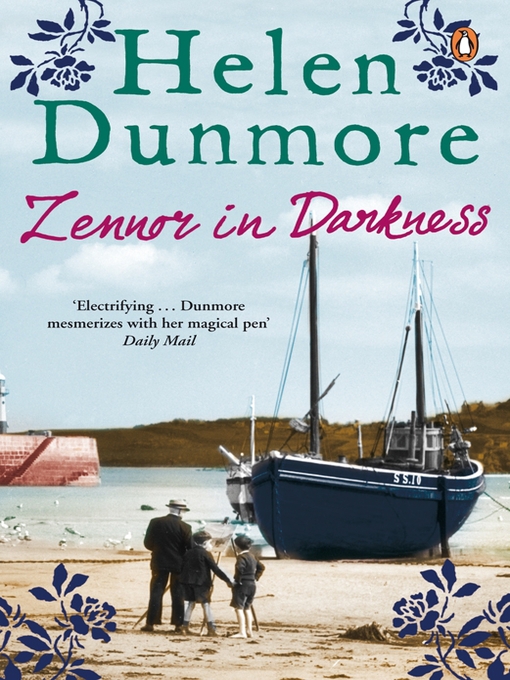
Helen Dunmore: Zennor in Darkness (1993) Literature and War Readalong January 2012

Helen Dunmore’s first novel Zennor in Darkness is set on the Cornish coast in 1917. The sound of war can be heard from afar. The first young men return from France, some of them are missing limbs, others are shell-shocked like Claire Coyne’s cousin John William. Although the war is present on every page, in the suspicions of the people, the fear that all the boys will be drafted, the noise the wind blows over from France, the scarcity of money and food, this is a novel of dreamlike beauty. Dunmore conveys the soft light of the Cornish coast, the beauty of the lovely landscape, the slow pace of life. This softness is mirrored in the way she changes the point of views, blurring the edges, softening the transitions, so that it feels as if one person’s consciousness and interior monologue, was flowing gently into that of another character. Reading it made me dreamy and I felt as if I was watching a water-color come to life. I read this book very slowly. I could have finished it in a few evenings but I put it aside frequently to make it last.

Zennor in Darkness interweaves the fictional story of Claire Coyne, and her cousin John William with the story of D.H.Lawrence and his wife. Claire lives alone with her father. Her mother who died while she was still very little was from Cornwall, while her father is an outsider, just like Lawrence. He comes from a rich Londoner family and was always seen as an intruder. Claire’s maternal grandparents, her aunts, uncles and cousins live close by. The children are a tight-knit community since they were little kids. They are so close that, although it seems logical for us, nobody suspects Claire and John William to be lovers.

The war has taken its toll, hundreds of thousands are dead and a lack in officers makes it possible for someone like John William who isn’t noble, to become an officer. He returns from France for a brief visit before he will join a training camp where he will stay a few months before being sent back to France.

Before his return Claire has befriended D.H. Lawrence. She is fascinated by him and even more so by his attractive German wife, Frieda. Not everyone is happy about their stay in Zennor. Germans are suspected to be spies and people would like to see them gone. Lawrence and his wife are happy in Cornwall. Their dream of a community of like-minded people has been shattered after Katherine Mansfield and her husband have left but still they love Cornwall and their simple life. Lawrence works in the garden, befriends the villagers. It’s not as easy for Frieda but she likes it as well. To the Lawrences Cornwall means more than just a place to stay, it is a refuge, a shelter and to watch their dream being crushed is painful.

Lawrence discovers that Claire is talented at drawing and encourages her to pursue a career. She introduces him to John William and Lawrence feels, more so than Claire, that John William hides something. One evening, when the two men walk alone in the balmy Cornish night, John William lets himself go in front of Lawrence, unable to hide the signs of shell-shock any longer.

Zennor in Darkness is a very beautiful novel and if anything it made me want to read more of Helen Dunmore. And it also made me want to return to D.H. Lawrence whose books I have abandoned for too long. I’ve always liked D.H.Lawrence, his novels, short stories, essays and letters and found that she captured him and his relationship with his wife very well. Frieda was a von Richthofen. A cousin of the famous Red Baron. Abandoning her marriage, her children and her privileges must have cost her a lot. I was always fascinated by this free spirit. The end of the book moved me. I knew the part related to the Lawrences, still it made me angry, while the fictitious story of Claire and John Williams made me sad.

What I found astonishing is the combination of beauty and horror. The descriptions of the Cornish coast, its air, light, flora and fauna alternate with passages like this one.

In Flanders the struggle for the Passchendaele Ridge continues. The poppy-blowing fields are ploughed by German and English guns, and sown with a litter of lost equipment, a seeding of blood and bone. Soon it will be autumn there too, and heavy northern rains will fall. Men will be listed missing, presumed drowned – a new classification for the lists in the newspaper. They are presumed drowned in the mud in which they live and often die. The men who came ‘right away to Blighty’ with John William will return to Flanders with their new commissions soon. Their training lasts only three months, and then they are wanted back at the Front. Hammond will die on a mission described to him by a senior officer as ‘rather a tricky bit of patrol-work’. His body will not be found. Simcox, a dozen feet to the left of him, will survive.

Ultimately however Zennor in Darkness is a novel about the difficulty to know another person. Either because you see them as strangers, or because they are too close for you and you lose all perspective. Like in real life, in many instances a stranger understands another character better than his own family, while at the same time, the community projects fear on the outsider.

In any case this was an excellent start to the Literature and War Readalong 2012.

Other reviews

Danielle (A Work in Progress)

Lizzy (Lizzy’s Literary Life)

Sarah (A Rat in the Book Pile)

Zennor in Darkness is also my first contribution to the War Through the Generations Challenge hosted by Anna and Serena.

*******

Zennor in Darkness was the first book in the Literature and War Readalong 2012. The next one will be Sebastian Barry’s A Long Long Way. Discussion starts on Monday February 27, 2012.
Literature and War Readalong January 30 2012: Zennor in Darkness by Helen Dunmore

Two or three years ago I read Helen Dunmore’s The Siege a painfully realistic and harrowing account on the siege of Leningrad. This was such a stunning novel, one of the best WWII novels I have ever read, accurate, moving, descriptive and captivating despite the bleak topic. When I discovered that she had written a novel on WWI, Zennor in Darkness, I didn’t hesitate and put it on this year’s readalong list right away. Helen Dunmore hasn’t only written novels, but short stories, children’s books and poetry as well. I think her wonderful prose shows that.

The story is set in a Cornish coastal village in 1917 and combines fact with fiction. D.H. Lawrence and his wife have indeed stayed there but the story is invented. The core theme seems similar to Return of the Soldier and deals with shell shock. But it is also a story of artists and writers. I have a weakness for books about artists and love Cornwall as a setting.

Here are the first sentences

One faint shriek. Then another. Three girls fling themselves over the top of the last dune and skid down warm flanks of sand. Marram grass slashes their ankles and sand kicks up behind Clare and Peggy, into Hannah’s eyes. She is the heaviest and the last.

Have you read Helen Dunmore?

*******

The discussion starts on Monday, 30 January 2012.

Further information on the Literature and War Readalong 2012, including all the book blurbs, can be found here.

War Through the Generations 2012 Reading Challenge – The Great War

This is the fourth year in a row that Anna and Serena host the War Through the Generations Challenge. Since this year is dedicated to WWI I chose to join them. I have quite a few books on my piles that I would like to read. I’m not sure how many I will read but I aim for 5.

Here are the rules

Books can take place before, during, or after the war, so long as the conflicts that led to the war or the war itself are important to the story. Books from other challenges count so long as they meet the above criteria.

Dip: Read 1-3 books in any genre with WWI as a primary or secondary theme.

Wade: Read 4-10 books in any genre with WWI as a primary or secondary theme.

Swim: Read 11 or more books in any genre with WWI as a primary or secondary theme.

5 books means I sign up for Wade. I may or may not read more but I’m pretty sure I’ll stay on this level.

Three of the books chosen are the first three titles of my Literature and War Readalong 2012. If you want to read along, please see the page for details.

Zennor In Darkness by Helen Dunmore

A Long Long Way by Sebastian Barry

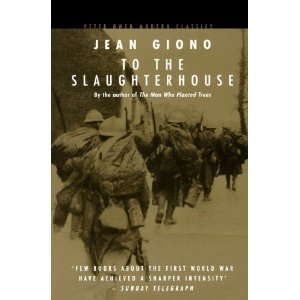
To the Slaughterhouse by Jean Giono

The other books that I will read for the challenge only are

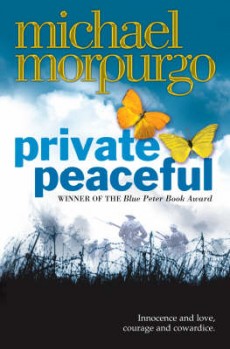
Private Peaceful by Michael Morpurgo. It’s a children’s book and I’m very interested to see how someone writes about war for children.

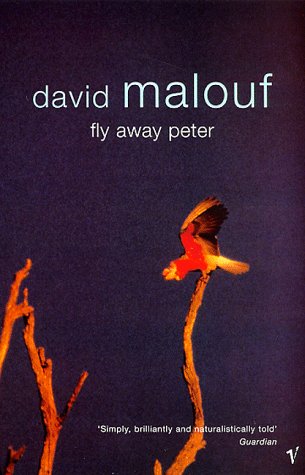
Fly Away Peter by David Malouf. This is a suggestion from Kevin (The War Movie Buff). It’s a very short novel by an Australian author which seems interesting. I’ve watched a lot of Australian WWI movies, it’s about time to read an Australian WWI book.

Here are a few additional suggestions as my favourite war novels are all WWI novels:

Remarque’s All Quiet on the Western Fornt. Probably the most famous one.

Pat Barker’s Regeneration TrilogyRegeneration –  The Eye in the DoorThe Ghost Road.

Jane Urquhart’s The Stone Carvers

Sebastian Faulk’s Birdsong 

Jennifer Johnston’s How Many Miles to Babylon? (here is my review).

If you would like to sign up, more details on the challenge can be found here.

Literature and War Readalong April Wrap up: The Winter of the World

As usual this is the time to thank those who read along and/or showed an interest in this monthly activity.

From the comments I can deduce that we all thought pretty much the same about this book. It was a mixed bag or, to quote litlove, “a curate’s egg”. True. There was much to like in this novel but also many things that didn’t work. The descriptions of the battle scenes were graphic but well-rendered, the close look at facial wounds and the reconstruction that followed were detailed. We get a feeling for how harrowing these were but also a lot of admiration for those who tried to help, the nurses and doctors alike.

Equally well done was everything that was tied to the grave/burial of the unknown warrior or soldier. (I don’t know if anyone was thinking of this book when watching the Royal Wedding that took place in Westminster Abbey were the soldier is buried).

What we all had our problems with was the story itself. At the center of this novel is a passionate love story that leaves behind considerations of friendship and decency. If you were among the readers who have difficulties to imagine such a strong passionate love at first sight story, the novel was pretty much doomed. But also if you could accept this as a premise, like I could, you had to be able to “feel” this passion. While I got a feeling for Alex, Clare left me completely unfazed. She is a great nurse and, in this function, an admirable character but the abuse story and her feelings for Alex weren’t well rendered. At one moment I was suspecting Carol Ann Lee to want to tell us that Clare acted the way she did, because she had been abused, that ultimately she was devoid of real feelings. That’s a type of explanation I do not like at all.

I also think, as did the others, that some episodes and narrative devices should have been left out.

I still have a few novels of WWI on my TBR pile but I’m glad that we move on anyway.

Looking back, the novel of the four I liked the most was Jennifer Johnston’s How Many Miles to Babylon. However if I had to recommend one to someone who has no idea about WWI, I think I would recommend Strange Meeting.

Which was your favourite? Which one would you recommend?

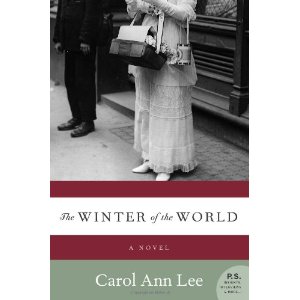
Carol Ann Lee: The Winter of the World (2007) Literature and War Readalong April

Journalist Alex Dyer made his name covering the bloody horrors of the European trenches. Yet even after the Great War is over, he cannot shake the guilt he feels for not serving on the front lines like his dearest childhood friend, Ted Eden. Worse still, Alex cannot put to rest the emotions that gnaw at him from the inside: his feelings for Clare, Ted’s wife—a woman they both have loved more than life itself. 

Carol Ann Lee’s The Winter of the World is the last novel on WWI in this read along. For the next one we will be moving on to WWII.

This wasn’t the easiest review to write as I am in two minds about this novel. There are parts in it that are so haunting and powerful but then again there were others were I was just rolling my eyes thinking “get on with it”.  Still it would be unfair to write a totally negative review because the good parts are among the best on WWI I’ve ever read.

Alex and Ted are childhood friends. They are close and attached to each other until the day Ted introduces Alex to his soon-to-be wife Clare. Very unfortunately this is a love at first sight moment for Alex and Clare. They try to fight it but, as we will see soon enough, the more the story advances, the less likely it is that they will succeed.

The marriage takes place just when the war breaks out. Ted will enlist, Alex will participate as a war correspondent and Clare will be one of the nurses in France.

The novel moves back and forth between Alex’s and Clare’s point of view. Alex sees a lot of atrocities and the descriptions are very graphic and extremely impressive without falling into the trap of being too clichéd. But since Alex isn’t fighting, it stays an outsider’s perspective. Clare’s point of view was captivating for totally different reasons. As a war nurse she has to deal with indescribable wounds and suffering. The abundance of facial wounds seems to be a trait of WWI and these parts reminded me of one of the best WWI movies I have ever seen, La chambre des officiers aka The officer’s chamber based on the eponymous novel by Marc Dugain. We seem to get an insider’s view of this truly harrowing aspect of the “Great war”. I can hardly imagine what it must have been like to have been the victim of this kind of facial mutilation and to be rejected by those you loved and who once loved you. The reactions of the relatives and fiancées were often brutal. Through Clare’s eyes we also get an equally close look at what mustard gas did to those who became its victims and how they suffocated or drowned slowly.

The only men more popular than I was were the ones in wheelchairs, or those with empty sleeves pinned against their chest. Everyone wanted to talk to them, to do something for them. Children presented them with flags and in the railway stations they got free tea or coffee. It was different for the ones whose faces had been destroyed. People averted their eyes quickly, the blood flooding their skin. No one wanted to make eye contact with a disfigured soldier; they were modern-day lepers.

While the war moves on – not stopping at Christmas, as was expected – the love affair develops as well. Clare and Alex meet secretly but are finally driven apart by conflicting emotions and wishes. Alex feels he needs to tell Ted everything, while Clare wants to protect him and keep the affair secret.

Through Alex’ voice we hear what it must have been like to cover this war as a correspondent. The journalists were not allowed to tell the truth. The numbers of casualties were not mentioned nor were the biggest defeats spoken of. While Clare’s parts rather focus on individuals, Alex’ parts illustrate the enormity of the losses. He evokes the incredible amount of wounded, disfigured and killed soldiers. At moments I had the feeling of seeing all these dead men standing in one huge row before my inner eye. When we visit those cemeteries we get a feeling for those massive losses.

He imagined a thin line linking the cemeteries along the old Western Front, from the smallest graveyards hidden away within woods to those huge, silent cities on the plains where the most ferocious battles had been fought. Some bore the names given to them by the soldiers themselves – Owl Trench, Caterpillar Valley, Crucifix Corner – while others were named after the battalion who had buried their own men there. He imagined how tha line would look from the air; so thick in parts that it resembled a child’s scribble, for they were everywhere these Gardens of Stone.

The novel slowly moves towards the culminating point which is the burial of the “unknown warrior”. The name is chose deliberately as “warrior” sounded more inclusive than “soldier”. The grave which is really located in Westminster Abbey was meant to commemorate all the dead fighters of this war, not only the infantry men. The burial is one of the best and most powerful parts in this novel.

Despite all these impressive elements, I had my problems, as I said. The biggest part of the story is told by Alex. He tells Lombardi, a guy he meets in Flanders after the war, why he is so tormented, why he cannot get over the war. I didn’t get this narrative device at all.  I would have preferred a more straightforward story, not this artificial telling of what happened to someone who has nothing to do with it. This was a common technique in 19th century novels but I think it doesn’t add anything to a modern novel at all. The next biggest negative aspect was the coincidence. I found it highly unlikely that Alex would meet Ted at the end. The third thing that I didn’t think well-done is the love-triangle. I think it was unnecessary that Alex and Clare had an affair. The descriptions of Alex’ feelings worked very well for me but not those of Clare. And the guilt-theme was just an element too much. Last but not least I missed Ted’s point of view.

I have a lot of questions at the end of this novel and would be curious to know what others thought.

Was this really the tone of a WWI novel? Especially the love-affair seemed very WWII to me but maybe that impression stems from the similarity to Pearl Harbor.

What about the facial wounds, does anyone know whether this was a consequence of the trenches? In The officer’s chambers, the young officer loses half of his face on the battle field, but I have really never heard so much about this type of injury from any other war.

Why do you think Carol Ann Lee left out Ted’s point of view? I think she might have risked to fall into the trap of cliché but I am not sure that’s why she chose to leave it out.

I’m really curious to read your thoughts.

Here are other reviews

Anna (Diary of an Eccentric)

Danielle (A Work in Progress)

*******

The Winter of the World was the fourth book in the Literature and War Readalong. The next one will be Shusaku Endo’s The Sea and Poison aka Umi to dokuyaku. Discussion starts on Friday May 27, 2011 .

Literature and War Readalong April 29 2011: The Winter of the World by Carol Ann Lee

Carol Ann Lee’s novel The Winter of the World that has the same title as a collection of WWI poems, is the last novel in the readalong to be dedicated to WWI. I discovered the novel on Danielle’s blog and thought it would be a good addition to the 11 I had already chosen.

Carol Ann Lee has written mostly nonfiction books before. The Winter of the World is her second novel. This is what can be found on her amazon page.

Carol has written two novels: ‘Come Back To Me’ which is semi-autobiographical, and ‘The Winter of the World’ – about the Unknown Warrior – which received rave reviews when it was published in France last year. Le Monde ended their review: ‘Finally, here is a writer who understands the subtleties of the soul.’ The book was nominated for two major awards in France, but has yet to find a UK publisher (one commented that it was a beautiful story and compared her writing to Ian McEwan, but said it was simply ‘too patriotic’) although it has been published in America by Harper Collins.

Sounds intriguing. The French title is La rafale des tambours.

Among her nonfiction books are One of our Own: The Life and Death of Myra Hindley, Anne Frank’s Story, The Hidden Life of Otto Frank and Witness: The Story of David Smith Chief Prosecution Witness in the Moors Murders Case.

Should you want to read along you might want to get started a little earlier as the novel has a bit over 300 pages, however the discussion will start late in the month, on Friday 29.

Literature and War Readalong March Wrap up: The Return of the Soldier

For one reason or the other I had a feeling I knew exactly what this novel was going to be about but I was very wrong. I think that with the exception of Danielle who read The Return of the Soldier for the second time we were all more or less surprised by the book.

When you expect to read a novel about a shell-shocked soldier you don’t necessarily expect to see Freudian theories at work and much less you expect this book to be about a choice, a decision that will change all the lives involved considerably.

What did strike me most in this readalong are the differences between the reviews that have been written which underlines what I wrote in my post where I said this book could be read in many different ways. While I concentrated on summarizing the plot and comparing the symbolical meaning of the three women, trying to link them to Freudian theories, Bookaroundthecorner and Danielle focused on a core theme of the book which is the choice. In her post Bookaroundthecorner points out the following:

The ending is what we call in French a “choix cornélien”, a “Cornelian choice”. The term comes from the French playwright Corneille (17th C). In his plays, the characters must always make a choice between passion and duty, between happiness and what is right. Here, Margaret and Jenny face a Cornelian choice: to cure or not to cure Chris. To cure him is to allow him to be a soldier and be sent to the trenches again, to lead him to a highly probable death.

Anna (Diary of an Eccentric) pointed out that what she liked the most about the book was the fact how it didn’t just give easy answers but encouraged you to think about the characters and their motivations. She also mentioned how life changing the death of Chris’ father was, a fact I must have overlooked completely. Anna also wrote that she felt we never really get to know Kitty and Margaret due to the first person narrative and that she would have liked to hear more about Chris, about what happened to him in the trenches. Although I did appreciate the book’s subtle use of war scenes through the means of Jenny’s nightmares, I expected it to be more from Chris’ point of view as well.

Danielle made an interesting comparison to Tess of the d’Urbervilles

Much like the letter that was shoved under the carpet rather than just under the door in Tess of the D’Urbervilles, letters that should have found their recipient but did not meant an entirely different ending for the two lovers until this unusual meeting.

Danielle also mentions that in the introduction West was quoted saying that a novel should have no empty sentences. This struck me as well, when I read it and I think I can agree with Danielle on the fact that this novel really is a fine example of this.

In all the posts and discussions, the treatment of the classes was mentioned. Apart from Kevin, no one really felt like understanding Kitty. I must admit, I felt an intense dislike and think the others shared this more or less. Of course, Kevin is right in pointing out that she is a product of her upbringing and the society she lives in.

What struck me as very interesting is that Kevin perceived the book as non-feminist. I think I disagree but understand very well how one could come to this conclusion. I believe she deliberately created a weak and vain character like Kitty to criticize the passivity of certain women, especially those who had everything, money, looks, status.

I found the treatment of the war very interesting although it was extremely toned down or rather, because it was so toned down and blended into the story. As a final word I’d like to quote Verlyn Klinkenborg.

It is certainly necessary to read The Return of the Soldier as a way of analyzing the experience of war from the civilian side. But it is also imperative to read this novel as West’s means of analyzing the experience of being female. At the age of twenty-four, West is holding up disparate versions of a woman’s experience and waiting to see which one crashes to the floor. (From the Introduction to The Modern Library Edition, p.xx )

I don’t know if you have noticed the different book covers. I think this is the one I like the most.