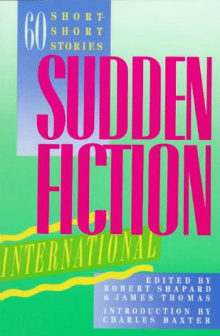
Sudden Fiction International – 60 Short Short Stories

Sudden-Fiction-International

I have always liked short stories but even more than that I like very short stories, tales that are barely one to five pages long. The success of their first edition of Sudden Fiction led the editors to the idea to do the same for international fiction that they had previously done for American Fiction. The collection Sudden Fiction International presents 60 very short stories from authors from all over the world. I’ve started to read the collection over the last few weeks and I’m amazed. It’s a fantastic collection. Not only is each and every story wonderful, it also introduces the reader to authors from many different countries. The result is rich, varied and vibrant. Reading and discovering these tales feels like it would have felt to be offered a huge collection of marbles as a child. Each of them is round and perfect but they all have another pattern, another colour, a different transparency.

In addition to the stories there is some background information on the authors provided at the end of the book. Most of the times the information is given by the respective translators.

I know that many people are reluctant to pick up short stories. They don’t know how to read them, feel they cannot immerse themselves as much as they want. I believe that the very short story could be helpful because it can be read and re-read in one sitting without too much effort.

I have read quite a few of the stories already and with the exception of Cortázar’s story, I liked them all. The two which did stand out the most so far were Buzzati’s The Falling Girl and Kawabata’s The Grasshopper and the Bell Cricket. The first is the story of a young girl which jumps from a skyscraper but falls very slowly and has enough time to talk to the people she passes by. It’s a sociological look at contemporary Italy. Kawabata’s story is a thing of rare beauty. A man sees children at night, each of them carrying a lantern in another colour. The children are looking for insects and one of them finds a grasshopper. The story offers a nostalgic look at childhood and the way time passes so quickly and dreams die too soon.

For those interested I noted a few of the authors, stories and countries they represent. Although this is the second tome, there are still quite a lot of American stories in this one and many from other English-speaking countries too.

Dino Buzzati – The Falling Girl – Italy

Yasunary Kawabata – The Grasshopper and the Bell Cricket – Japan

Colette – The Other Wife – France

Rodrigo Rey Rosa – The Book – Guatemala

Bessie Head – Looking for the Rain God – Botswana

Jamaica Kincaid – Girl– Antigua

Joyce Carol Oates – The Boy – US

Sergei Dovlatov – Katya – Russia

Feng Jica – The Street Sweeping Show – China

Arthur Schnitzler: Short Fiction – Lieutenant Gustl (1900) and Fräulein Else (1924)

Austrian writer Arthur Schnitzler was one of those whose books were burned in Nazi Germany. Hitler considered him to be a typical example of what he called ‘Jewish filth’. What infuriated the Führer and created a lot of controversy among other readers of the time was, among other things, how outspoken Schnitzler wrote about sexuality, notably in his most famous play Round Danca aka La Ronde (Der Reigen). La Ronde is easily one of the best plays to convert people who don’t read plays,  as it’s such a stunning piece. It’s a play about promiscuous and venal love in which we always see one of the two characters from the preceding scene in the next one too.

Schnitzler was highly influenced by Freud, a fact that is most apparent in Dream Story aka Dream Novella (Traumnovelle) on which Stanley Kubrick’s last movie The Eyes Wide Shut. While I liked the movie a great deal, I was pleased to find out the novella is even better.

I have read both The Dream Novella and La Ronde some years ago and wanted something else and finally decided to re-read Lieutnant Gustl and (after Tony’s suggestion) added Fräulein Else. Both are available in the collection Short Fiction.

They are both written entirely as interior monologues, a technique which was very new at the time and also influenced by Freud’s theories. At 35 pages, Lieutenant Gustl is the shorter of the two, Fräulein Else is twice that size.

Both monologues show young people in distress. Both are victims of their society. The effect of listening to their hidden fears and desires, their hopes and wishes, their silliness and despair, is spellbinding.

Lieutenant Gustl takes place in Vienna during one night. Gustl is a young officer and has a history of duels to show for. When we are introduced to him during a Oratorioum which bores him to death, we also learn that this is the evening before another duel with a doctor will take place. Gustl is all about honour and reputation. All that is on his mind are girls and the hope people will respect him. When on the way out of the theater, a master baker insults him, he feels there is only one way to save face – he has to kill himself. As the man is below him, he couldn’t ask for satisfaction in a duel. He spends the whole night debating, looking at pros and cons of his decision, imagining the reaction of the people he knows when they will find out about his death, remembers similar cases like his. At the same time he displays how much he loves life.

Fräulein Else’s story is similar but far more tragic. Else is a young girl from a rich family whose father, a gambler, again and again maneuvers the family into impossible situations. While she stays in Italy at a hotel with her aunt, her cousin and a few other people she knows, her father has lost a lot of money, some of which belongs to his charges. Because he has lost such a lot of money before, he owes most of his family and acquaintances already a fortune and there is nobody left he could ask this time. Else’s mother decides to write to her and begs her daughter to save her father. There is a rich man, Dorsday, staying at the hotel with her, someone who fancies her and the mother thinks if Else asks him, he will lend her the money. This puts Else in a very delicate situation. Not only is she deeply ashamed, she also senses that asking a man like Dorsday for money will lead to complications and most certainly he will want something in exchange. The story is quite upsetting as we get the feeling the parents know very well that this request is as if they were asking her daughter to prostitute herself. Else, like Gustl, contemplates suicide, sees herself dead, imagines escape routes and hopes for help.

What finally becomes of Else and of Lieutnant Gustl is for you to find out. I would really encourage you to read these stories, if you haven’t done so already. I liked them a great deal and think Schnitzler may be one of my favourite authors. What impressed me a lot as well was how fresh the stories and the language are. The society has changed but the things that are at stake are still the same: love, death, money. And the style is precise and emotional without ever being sappy or sentimental.

German Literature Recommendations II – 89 Novella and Short Story Writers You Should Read

First of all, welcome to German Literature Month. I’m sure it will be an exciting journey for all of us. If you participate, please leave comments so that we can visit your blogs and add your posts to a final list. We will most probably not do as many wrap up posts this year but the occasional update will surely appear on the one or the other blog.

Last year I published a post called German Literature Recommendations – 20 German Novels You Should Read. It was based on Marcel Reich-Ranicki’s famous “Der Kanon der deutschen Literatur”. There were many questions about missing authors in the comment sections. Many famous and outstanding writers were not on that list which made it look like an omission but in many cases they were not on that list because Reich-Ranicki considered them better at writing novellas and short stories.

In order to fill the gap left by last year’s post, I have decided to post his list on novellas and short stories. I indicate the authors (over 80 names) and some of their best stories with their German titles. For those who are famous it’s easy to find the English equivalent as it will be in collections, for others it’s more difficult. If you have a particular interest in an author or a story but difficulties to find it in English – or French… Don’t hesitate to send me an e-mail. If it’s available, I’m sure I can find it for you.

The first week of this year’s German Literature Month is dedicated to novellas and short stories, if you still don’t know what to read, I’m sure you will find suggestions on the list.

I’ve already read two, one of them is on the list below, it’s Schnitzler’s Leutnant Gustl, which is available under the same title in English.

For more details on the different weeks, please visit the German Literature Month Announcement.

  • Johann Wolfgang Goethe: Die Sängerin Antonelli; Die wunderlichen Nachbarskinder; Der Mann von funfzig Jahren
  • Friedrich Schiller: Der Verbrecher aus verlorener Ehre
  • Johann Peter Hebel: Der kluge Richter; Eine merkwürdige Abbitte; Kannitverstan; Drei Wünsche; Moses Mendelssohn; Ein teurer Kopf und ein wohlfeiler; Unverhofftes Wiedersehen; Drei Worte; Glimpf geht über Schimpf
  • Jean Paul: Des Feldpredigers Schmelzle Reise nach Flätz
  • Ludwig Tieck: Des Lebens Überfluss
  • E. T. A. Hoffmann: Ritter Gluck; Der Sandmann; Das Fräulein von Scuderi
  • Heinrich von Kleist: Das Erdbeben in Chili; Die Marquise von O…; Michael Kohlhaas; Die Verlobung in St. Domingo; Der Zweikampf; Anekdote aus dem letzten preußischen Krieg
  • Clemens Brentano: Die Schachtel mit der Friedenspuppe; Geschichte vom braven Kasperl und dem schönen Annerl
  • Adelbert von Chamisso: Peter Schlemihl’s wundersame Geschichte
  • Jacob und Wilhelm Grimm: Hänsel und Gretel; Aschenputtel; Rotkäppchen; Die Bremer Stadtmusikanten; Der Gevatter Tod; Dornröschen; Schneewittchen; Rumpelstilzchen
  • Joseph von Eichendorff:
    Das Marmorbild; Aus dem Leben eines Taugenichts; Das Schloss Dürande
  • Franz Grillparzer: Der arme Spielmann
  • Annette von Droste-Hülshoff: Die Judenbuche
  • Jeremias Gotthelf: Die schwarze Spinne
  • Heinrich Heine: Aus den Memoiren des Herren von Schnabelewopski; Florentinische Nächte; Der Rabbi von Bacherach
  • Wilhelm Hauff: Die Geschichte von Kalif Storch; Der Zwerg Nase
  • Eduard Mörike: Das Stuttgarter Hutzelmännlein; Mozart auf der Reise nach Prag
  • Adalbert Stifter: Turmalin
  • Georg Büchner: Lenz
  • Theodor Storm:
    Immensee; Die Söhne des Senators; Hans und Heinz Kirch; Der Schimmelreiter
  • Gottfried Keller: Romeo und Julia auf dem Dorfe; Die drei gerechten Kammacher; Kleider machen Leute; Der Landvogt von Greifensee
  • Theodor Fontane: Schach von Wuthenow; Stine
  • Conrad Ferdinand Meyer: Der Schuss von der Kanzel; Gustav Adolfs Page
  • Marie von Ebner-Eschenbach: Krambambuli
  • Ferdinand von Saar: Schloss Kostenitz
  • Eduard von Keyserling: Die Soldaten-Kersta
  • Arthur Schnitzler: Sterben; Der Ehrentag; Leutnant Gustl; Der Tod des Junggesellen;Fräulein Else; Spiel im Morgengrauen
  • Gerhart Hauptmann: Bahnwärter Thiel
  • Frank Wedekind: Die Schutzimpfung
  • Heinrich Mann: Gretchen
  • Jakob Wassermann: Der Stationschef
  • Hugo von Hofmannsthal: Das Märchen der 672. Nacht
  • Thomas Mann: Der kleine Herr Friedemann; Tristan; Tonio Kröger; Schwere Stunde;Wälsungenblut; Der Tod in Venedig; Unordnung und frühes Leid; Mario und der Zauberer
  • Rainer Maria Rilke: Die Turnstunde
  • Hermann Hesse: Knulp; Klein und Wagner
  • Martin Buber: Abraham und Lot
  • Robert Walser: Sebastian; Ein unartiger Brief
  • Alfred Döblin: Die Ermordung einer Butterblume
  • Robert Musil: Das verzauberte Haus; Tonka
  • Stefan Zweig: Die Weltminute von Waterloo; Schachnovelle
  • Ernst Weiß: Franta Zlin; Die Herznaht
  • Franz Kafka: Das Urteil; Die Verwandlung; Vor dem Gesetz; Ein Bericht für eine Akademie; Ein Landarzt; In der Strafkolonie; Ein Hungerkünstler
  • Lion Feuchtwanger: Höhenflugrekord
  • Egon Erwin Kisch:
    Wie ich erfuhr, daß Redl ein Spion war; Die Himmelfahrt der Galgentoni
  • Ernst Bloch: Fall ins Jetzt
  • Gustav Sack: Im Heu
  • Gottfried Benn: Gehirne
  • Georg Heym: Jonathan
  • Kurt Tucholsky: Rheinsberg
  • Franz Werfel: Der Tod des Kleinbürgers
  • Joseph Roth: April; Stationschef Fallmerayer; Die Legende vom heiligen Trinker
  • Heimito von Doderer: Acht Wutanfälle
  • Carl Zuckmayer: Geschichte von einer Geburt
  • Bertolt Brecht: Der Augsburger Kreidekreis; Der verwundete Sokrates;
    Die unwürdige Greisin
  • Elisabeth Langgässer: Saisonbeginn
  • Anna Seghers: Der Ausflug der toten Mädchen; Post ins Gelobte Land;
    Bauern von Hruschowo
  • Hans Erich Nossack: Der Untergang
  • Marie Luise Kaschnitz: Der Strohhalm; Lange Schatten; April
  • Marieluise Fleißer: Avantgarde
  • Elias Canetti: Die Verleumdung; Die Lust des Esels
  • Wolfgang Koeppen: Schön gekämmte, frisierte Gedanken;
    Ein Kaffeehaus; Jugend
  • Max Frisch:
    Der andorranische Jude; Skizze eines Unglücks; Glück
  • Arno Schmidt: Seelandschaft mit Pocahontas; Die Umsiedler
  • Peter Weiss: Der Schatten des Körpers des Kutschers
  • Wolfgang Hildesheimer: Ich schreibe kein Buch über Kafka;
    Das Ende einer Welt
  • Heinrich Böll: Der Mann mit den Messern; Wiedersehen in der Allee; Wanderer, kommst du nach Spa …; Doktor Murkes gesammeltes Schweigen
  • Wolfdietrich Schnurre: Das Manöver
  • Friedrich Dürrenmatt: Die Panne
  • Wolfgang Borchert: Das Brot
  • Ilse Aichinger: Spiegelgeschichte
  • Franz Fühmann: Das Judenauto; König Ödipus
  • Siegfried Lenz: Der Verzicht; Ein Kriegsende; Ein geretteter Abend
  • Martin Walser: Ein fliehendes Pferd; Selbstporträt als Kriminalroman
  • Günter Grass: Katz und Maus
  • Günter Kunert: Alltägliche Geschichte einer Berliner Straße; Die Waage
  • Christa Wolf: Kein Ort. Nirgends
  • Thomas Bernhard: Die Mütze; Wittgensteins Neffe
  • Gabriele Wohmann: Wiedersehen in Venedig; Sonntag bei den Kreisands
  • Adolf Muschg: Der Ring; Der Zusenn oder das Heimat
  • Uwe Johnson: Jonas zum Beispiel
  • Ulrich Plenzdorf: kein runter kein fern
  • Peter Bichsel: Die Männer; Sein Abend; Der Mann mit dem Gedächtnis
  • Hans Joachim Schädlich:
    Besuch des Kaisers von Russland bei dem Kaiser von Deutschland
  • Jurek Becker: Die beliebteste Familiengeschichte
  • Hermann Burger: Der Orchesterdiener
  • Peter Handke:
    Das Umfallen der Kegel von einer bäuerlichen Kegelbahn
  • Christoph Hein: Der neuere (glücklichere) Kohlhaas
  • Botho Strauß: Die Widmung
  • Christoph Ransmayr: Przemysl

Antonio Tabucchi Week – Wrap Up

Tabucchi Week is already over and I wanted to thank all of you who joined, read along, wrote reviews, commented and read other’s posts. I’m really happy that it was quite interactive and people visited each other’s blogs. There were quite a few very interesting discussions. I’m also happy that those who joined who didn’t know Tabucchi found an author whose work they want to continue exploring and those who knew him felt like returning to an old friend. I enjoyed the two books I chose a great deal and I’m also glad that I have discovered a few new blogs.

What I also loved was that many of the posts showed how wide Tabucchi’s range is and that everyone can find something else in his books. Quite a few people have read Pereira Maintains but every single post was completely different and highlighted other things, something I’ve rarely noticed when many people read the same novel.

Once more – Thank you so much for participating.

Below are all the participant reviews again (they are also in the intro post). In a few days I’ll set up a page which will allow to find the posts more easily. I’m pretty sure this isn’t the last author week I’ve hosted and knowing that I like a bit of a theme the next week will most probably also be dedicated to an Italian writer. No worries, though, not before next year.

It’s Getting Later All the Time – Brian (Babbling Books)

On Dreams of Dreams – Tom (Wuthering Expectations)

Pereira Declares – Judith (Reader in the Wilderness)

Pereira Maintains – TBM (50 Year Project)

Pereira Maintains – Vishy (Vishy’s Blog)

Pereira Maintains – Bettina (Liburuak)

Pereira Maintains – Andrew Blackman

Piazza d’Italia – Scott (seraillon)

Requiem – Caroline (Beauty is a Sleeping Cat)

The Edge of the Horizon – Caroline (Beauty is a Sleeping Cat)

The Flying Creatures of Fra Angelico – Stu (Winstons Dad’s Blog)

The Last Three Days of Fernando Pessoa with Bonus Lobster Recipe – Tom (Wuthering Expectations)

The Missing Head of Damasceno Monteiro – Richard (Caravana de Recuerdos)

Vanishing Point -1streading

Pereira Maintains (Book and Movie) and Requiem – Scribacchina (Parole/Words)

Antonio Tabucchi Week

Antonio Tabucchi Week is finally approaching. It’s starting tomorrow and this is really just a very quick introduction to the week and some info for those who participate. I’m going to post two reviews, one on Tuesday and one either Friday or Saturday and will wrap up on Monday in a week.

I spent the last week reading Tabucchi and was quite captivated by my choices. I wanted to read Pereira Maintains but then I dipped into another two of his books and one of them hooked me right away.

Tabucchi has written quite a few very short books, so if you haven’t started yet, there is still time until Sunday.

If you are participating and have reviewed something, please, leave a link in the comment section of this post.  I’ll add it to this post. Once the week is over you can still access the links either via this post or via the page I will set up.

Participant reviews

It’s Getting Later All the Time – Brian (Babbling Books)

On Dreams of Dreams – Tom (Wuthering Expectations)

Pereira Declares – Judith (Reader in the Wilderness)

Pereira Maintains – TBM (50 Year Project)

Pereira Maintains – Vishy (Vishy’s Blog)

Pereira Maintains – Bettina (Liburuak)

Pereira Maintains – Andrew Blackman

Piazza d’Italia – Scott (seraillon)

Requiem – Caroline (Beauty is a Sleeping Cat)

The Edge of the Horizon – Caroline (Beauty is a Sleeping Cat)

The Flying Creatures of Fra Angelico – Stu (Winstons Dad’s Blog)

The Last Three Days of Fernando Pessoa with Bonus Lobster Recipe – Tom (Wuthering Expectations)

The Missing Head of Damasceno Monteiro – Richard (Caravana de Recuerdos)

Vanishing Point -1streading

Pereira Maintains (Book and Movie) and Requiem – Scribacchina (Parole/Words)

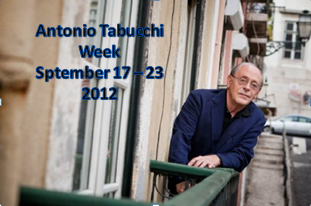
Antonio Tabucchi Week September 17 – 23 2012 and Giveaway

Ever since Stu’s Henry Green Week I wanted to host something similar for an Italian author and my first choice was always Antonio Tabucchi. He is one of the finest Italian writers and one I admire a lot.

Sadly what should have been a tribute to a living author has now turned into a commemoration as Tabucchi died earlier this year.

Tabucchi was a novelist, short story writer and academic. One striking feature was his love for Portugal, the Portuguese language and Fernando Pessoa. He didn’t only teach Portuguese literature at the university but he lived in Portugal (as a reaction among other things to Italian politics), wrote a novel in Portuguese and translated Pessoa.

He is one of the rare authors not writing in English who has been extensively translated. While I will read him in Italian, all those who would like to join can choose from a variety of other languages. He is available in English, French and German and most probably also in Spanish and Portuguese.

Tabucchi’s Indian Nocturne is one of my all-time favourite books. It has been made into a movie. I just read and reviewed Sogni di Sogni – Dreams of Dreams – a collection of imagined dreams attributed to famous writers, musicians and artists. But there are others that I want to re-read or discover for the first time like Tristano muore. Una vita.

If you have never read anything by this author I would suggest you start with one of his more famous novels like Pereira Maintains (Sostiene Pereira) or Indian Nocturne (Notturno Indiano). If you like short stories you may enjoy the beautiful collection of fictitious letters It’s Getting Later All the Time. If you go for quirky and inspiring, Dreams of Dreams may be the thing. But there are more.

Requiem: A Hallucination

Little Misunderstandings of No Importance

The Missing Head of Damasceno Monteiro

And in Italian (and other translations) only

Tristano muore. Una vita

Il tempo invecchia infretta

Il filo dell’orizzonte

In order to motivate you to join I’m giving away one copy of one of his most famous novels which has also been made into a movie with Marcello Mastroianni.

Pereira Maintains

In the sweltering summer of 1938 in Portugal, a country under the fascist shadow of Spain, a mysterious young man arrives at the doorstep of Dr Pereira. So begins an unlikely alliance that will result in a devastating act of rebellion. This is Pereira’s testimony.

The giveaway is open internationally. If you would like to win this book, just leave a comment. The only condition is that you take part in Tabucchi Week. What you will read is up to you, it doesn’t have to be the book you won.

The winner will be announced on Friday August 17 2012.

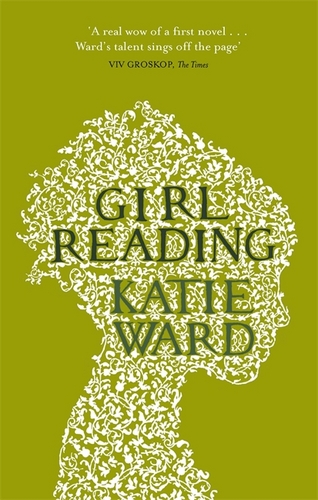
Katie Ward: Girl Reading (2011)

Katie Ward’s Girl Reading is called a novel which is slightly misleading as what it really is, is a collection of seven episodes with a similar theme which are tied together by the last one. Each of the episodes or scenes is set in another time and place, 1333, 1668, 1775, 1864, 1916, 2008, 2060. The way it is tied together, with a final scene set in 2060, gives the whole book a futuristic finish. I knew all this before I started the book but what surprised me was the writing which is quite dense, elaborate and heavily influenced by other books and tales, and, of course, paintings as the linking idea are portraits of reading women or girls seen through the ages.

Most of these “stories” are mysterious, that’s why I chose to call them episodes. They are like small windows that open up on scenes set in the past. We hardly ever get all the background information and often don’t know what will happen to the characters later.

Each of the scenes describes the challenges of women in their respective time and the girl or woman chosen for the portrait is mostly not exactly in line with what is expected of a woman at the time. The fact that the challenges and problems women face stay so similar from the 14th to the 21st century is somewhat unsettling.

Of the 7 stories or episodes I really liked four a lot. The first one, set in Siena, and the second, set in the Netherlands, were not so much to my liking nor was the last set in the future. In the case of story 1 and 2 I had a feeling I have read the exact same stories before, especially the second which was very similar to Girl with a Pearl Earring. Too similar.

I thoroughly enjoyed story 3, set in 1775 in which a female painter comes to the estate of a noble woman to finish the portrait of her lover. The lover, a woman as well, has left and the abandoned one is depressed and morose.

Story 4, set in Victorian England, was another favourite despite the fact that it resembled Audrey Niffenegger’s Her Fearful Symmetry. It’s a tale of two psychic twins. One becomes a photographer, while the other tours the world as a famous medium. It’s a wonderful story and the decor, clothes, atmosphere, are lush and evocative.

Story 5 is another wonderful story. The girl in the center will be a painter in the future but at this point in time she is a slightly silly young girl, infatuated with a painter. What is wonderful is the intensity with which she experiences life. Everything she does – smoking, drinking, falling in love – she does for the first time and savours every minute. Even being heartbroken as it seems.

While I liked some of the stories, I think story 6, set in a Shoreditch bar in 2008, was the most original and rounded of the stories. We get to know much more about the character in this story than about any other of the characters. She is a young black Tory who wants to become member of the Parliament. At the same time she has to decide whether she should get married or not. I liked the way she was described and how descriptions of the most mundane struggles, like wearing shoes which were new but painful, were interwoven with heavy decisions.

I enjoyed some of the stories a lot but as a novel Girl Reading didn’t work for me at all. While the last story, set in the future, gave it an interesting twist, it didn’t manage to really tie them all together. As a whole I found the book a bit artificial which is certainly due to the elaborate and somewhat forced writing. On top of that a few of the stories were too similar to other books I’ve read to be entirely satisfactory.

I’ve read the book along with Rikki and am looking forward to hear what they thought.

Rikki (Rikki’s Teleidoscope) First impressions, Stories 3 and 4, Stories 5-7

If anyone else has read this I would like to know which of the stories you liked best and whether this worked as a novel for you or not. Looking back, I think that story 6 was my favourite because it was the only one that didn’t feel like a pastiche.

If you’d like to see the paintings the stories are based on here is the link to Katie Ward’s site where you find the links.