
For one reason or the other I had a feeling I knew exactly what this novel was going to be about but I was very wrong. I think that with the exception of Danielle who read The Return of the Soldier for the second time we were all more or less surprised by the book.
When you expect to read a novel about a shell-shocked soldier you don’t necessarily expect to see Freudian theories at work and much less you expect this book to be about a choice, a decision that will change all the lives involved considerably.
What did strike me most in this readalong are the differences between the reviews that have been written which underlines what I wrote in my post where I said this book could be read in many different ways. While I concentrated on summarizing the plot and comparing the symbolical meaning of the three women, trying to link them to Freudian theories, Bookaroundthecorner and Danielle focused on a core theme of the book which is the choice. In her post Bookaroundthecorner points out the following:
The ending is what we call in French a “choix cornélien”, a “Cornelian choice”. The term comes from the French playwright Corneille (17th C). In his plays, the characters must always make a choice between passion and duty, between happiness and what is right. Here, Margaret and Jenny face a Cornelian choice: to cure or not to cure Chris. To cure him is to allow him to be a soldier and be sent to the trenches again, to lead him to a highly probable death.
Anna (Diary of an Eccentric) pointed out that what she liked the most about the book was the fact how it didn’t just give easy answers but encouraged you to think about the characters and their motivations. She also mentioned how life changing the death of Chris’ father was, a fact I must have overlooked completely. Anna also wrote that she felt we never really get to know Kitty and Margaret due to the first person narrative and that she would have liked to hear more about Chris, about what happened to him in the trenches. Although I did appreciate the book’s subtle use of war scenes through the means of Jenny’s nightmares, I expected it to be more from Chris’ point of view as well.
Danielle made an interesting comparison to Tess of the d’Urbervilles
Much like the letter that was shoved under the carpet rather than just under the door in Tess of the D’Urbervilles, letters that should have found their recipient but did not meant an entirely different ending for the two lovers until this unusual meeting.
Danielle also mentions that in the introduction West was quoted saying that a novel should have no empty sentences. This struck me as well, when I read it and I think I can agree with Danielle on the fact that this novel really is a fine example of this.
In all the posts and discussions, the treatment of the classes was mentioned. Apart from Kevin, no one really felt like understanding Kitty. I must admit, I felt an intense dislike and think the others shared this more or less. Of course, Kevin is right in pointing out that she is a product of her upbringing and the society she lives in.
What struck me as very interesting is that Kevin perceived the book as non-feminist. I think I disagree but understand very well how one could come to this conclusion. I believe she deliberately created a weak and vain character like Kitty to criticize the passivity of certain women, especially those who had everything, money, looks, status.
I found the treatment of the war very interesting although it was extremely toned down or rather, because it was so toned down and blended into the story. As a final word I’d like to quote Verlyn Klinkenborg.
It is certainly necessary to read The Return of the Soldier as a way of analyzing the experience of war from the civilian side. But it is also imperative to read this novel as West’s means of analyzing the experience of being female. At the age of twenty-four, West is holding up disparate versions of a woman’s experience and waiting to see which one crashes to the floor. (From the Introduction to The Modern Library Edition, p.xx )
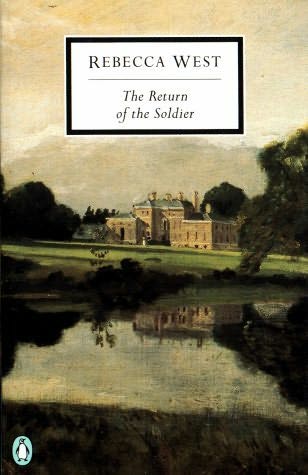
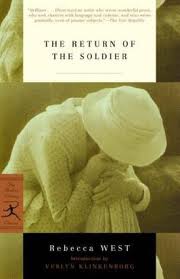
I don’t know if you have noticed the different book covers. I think this is the one I like the most.
 Beauty is a Sleeping Cat