Literature and War Readalong July 30 2012: Black Rain – Kuroi Ame by Masuji Ibuse

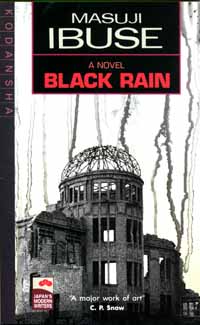
When I saw Black Rain mentioned by Gary (The Parrish Lantern) on Rise’s blog (in lieu of a field guide) last year, I knew I wanted to include this book in this year’s readalong. Last year we read Marguerite Duras’ Hiroshima Mon Amour and I’m really curious to find out how this horrible event will be treated by a Japanese author. John Hersey’s Hiroshima and Ibuse’s Black Rain are said to be the most important novels on the horror of Hiroshima.

Here are the first sentences

For several years past, Shigematsu Shizuma, of the village of Kobatake, had been aware of his niece Yasuko as a weight on his mind. What was worse, he had a presentiment that the weight was going to remain with him, unspeakably oppressive, for still more years to come.

*******

The discussion starts on Monday, 30 July 2012.

Further information on the Literature and War Readalong 2012, including all the book blurbs, can be found here.

Len Deighton: Bomber (1970) Literature and War Readalong June 2012

It is very rare that I abandon a book. Often I regret this persistence when I finish it anyway and have to find out that it simply isn’t good. Sometimes I’m incredibly glad I went on. Len Deighton’s Bomber was one of those. I struggled badly for 150 pages and the idea to have to go on for another 400 seemed daunting. But it was worth the effort, it really was and looking back, I have to say, how lucky this was part of my readalong or I would have given up and missed out greatly. Bomber is amazing. It’s maybe not refined and highly literary but it’s a huge achievement. Not only because it is extremely accurate and detailed but also because it’s very engaging and admirably well constructed.

Bomber is an epic. A book with a huge cast and numerous different settings and story lines. Deighton really needed 150 pages to set the scene and introduce everyone, including the different aircraft. That part was really challenging to read as there were so many names and one had to try to constantly picture a map to see where they were located. Once the set up was done, the story moved on nicely, all the different story lines were tied together, the characters had become more than just names but people with a story.

Bomber tells the story of a bombing raid that takes place on June 31st 1943. Deigthon deliberately chose a date that doesn’t exist, knowing well that his book felt so realistic and authentic that people would always end up assuming it was non-fiction.

The 31st is a full moon night and all the crews get ready for a night of bombing and fighting. The target is the city of Krefeld in Germany. The planes take off from Warley Fen, head towards Krefeld and have to try to not get shot down before they have dropped the bomb. But before they can drop a bomb

First the PFF Mosquito aircraft will mark the target with red markers. Their gear is much more accurate than anything we have, so their reds are what the Finders must look for. The Finders will put long sticks of flares over the reds. Mixed in with the Finder aircraft there are Supporters – and these are mostly crews on their first couple of trips – who are carrying only high-explosive bombs. That’s because incendiaries could be mistaken for red markers.

What you just read is part of the instruction the pilots receive before flying off. But this part is more than that, it points towards the core of the book because the tragedy of the story has it’s source in the fact that, due to many unlucky circumstances, the markers were dropped on the wrong targets and what was bombed was the small city of Altgarten. No factories, no strategic points, just civilian buildings.

The first third of the book, sets the scene, the next third describes a lot of action and how the mistake happened and the last third is describing the drama in the air and on the ground in a very graphic way. I had to swallow hard a lot of times.

What I liked is that Deighton described a wide range of German characters, from the fanatic Nazi to the likable soldier. The portraits are nuanced and we get a feel for the diversity of the people.

The British crews are equally diverse but for other reasons. There are also Canadians and Australians, upper class and lower class men, married guys and womanizers, men who just do their duty, cowards and heroes.

In the death scenes Deighton’s sympathies clearly lie with the German civilians and the British bomber crews. Each part has one or two main characters and a lot of secondary characters and the fate of the main characters is equally sad in all the parts. I cannot go into too much detail, if you want to read it, you want to find out for yourself who will survive and who will die.

I’ve read a few harrowing accounts in the past and the one or the other book has depressed me incredibly. Bomber didn’t depress me but it brought a few tears to my eyes, a thing that rarely if ever happens to me unless something sad happens to an animal.

Bomber offers an interesting mix of emotional story telling, accuracy and numbers. We are informed of everything. How many people were involved, how many died, how many were injured, how many bombs hit target, how many were jettisoned, how many missed or didn’t go off and so on and so forth. At the end of the book were also informed about each and every surviving character’s future. It’s as if Deighton wanted to answer each and every question someone reading his novel might have.

If you ever wondered what it is like to be in a city which is bombed, this book will bring you close to this experience. If you ever wondered what it is like to be in plane on a bombing raid, this book will allow you to experience this as well.  In any case, if you are interested in WWII and how it was fought in the air, this is the book you should read.

If you’d like to find out a few things about Deigthon and his other books don’t miss visiting the Deighton Dossier. It is a site dedicated to Deigthon’s work and it is done with a lot of passion.

Other reviews (I’m somewhat doubtful that there will be any)

*******

Bomber was the sixth book in the Literature and War Readalong 2012. The next one will be Masuji Ibuse’s Black Rain. Discussion starts on Monday July 30, 2012.

Katie Ward: Girl Reading (2011)

Katie Ward’s Girl Reading is called a novel which is slightly misleading as what it really is, is a collection of seven episodes with a similar theme which are tied together by the last one. Each of the episodes or scenes is set in another time and place, 1333, 1668, 1775, 1864, 1916, 2008, 2060. The way it is tied together, with a final scene set in 2060, gives the whole book a futuristic finish. I knew all this before I started the book but what surprised me was the writing which is quite dense, elaborate and heavily influenced by other books and tales, and, of course, paintings as the linking idea are portraits of reading women or girls seen through the ages.

Most of these “stories” are mysterious, that’s why I chose to call them episodes. They are like small windows that open up on scenes set in the past. We hardly ever get all the background information and often don’t know what will happen to the characters later.

Each of the scenes describes the challenges of women in their respective time and the girl or woman chosen for the portrait is mostly not exactly in line with what is expected of a woman at the time. The fact that the challenges and problems women face stay so similar from the 14th to the 21st century is somewhat unsettling.

Of the 7 stories or episodes I really liked four a lot. The first one, set in Siena, and the second, set in the Netherlands, were not so much to my liking nor was the last set in the future. In the case of story 1 and 2 I had a feeling I have read the exact same stories before, especially the second which was very similar to Girl with a Pearl Earring. Too similar.

I thoroughly enjoyed story 3, set in 1775 in which a female painter comes to the estate of a noble woman to finish the portrait of her lover. The lover, a woman as well, has left and the abandoned one is depressed and morose.

Story 4, set in Victorian England, was another favourite despite the fact that it resembled Audrey Niffenegger’s Her Fearful Symmetry. It’s a tale of two psychic twins. One becomes a photographer, while the other tours the world as a famous medium. It’s a wonderful story and the decor, clothes, atmosphere, are lush and evocative.

Story 5 is another wonderful story. The girl in the center will be a painter in the future but at this point in time she is a slightly silly young girl, infatuated with a painter. What is wonderful is the intensity with which she experiences life. Everything she does – smoking, drinking, falling in love – she does for the first time and savours every minute. Even being heartbroken as it seems.

While I liked some of the stories, I think story 6, set in a Shoreditch bar in 2008, was the most original and rounded of the stories. We get to know much more about the character in this story than about any other of the characters. She is a young black Tory who wants to become member of the Parliament. At the same time she has to decide whether she should get married or not. I liked the way she was described and how descriptions of the most mundane struggles, like wearing shoes which were new but painful, were interwoven with heavy decisions.

I enjoyed some of the stories a lot but as a novel Girl Reading didn’t work for me at all. While the last story, set in the future, gave it an interesting twist, it didn’t manage to really tie them all together. As a whole I found the book a bit artificial which is certainly due to the elaborate and somewhat forced writing. On top of that a few of the stories were too similar to other books I’ve read to be entirely satisfactory.

I’ve read the book along with Rikki and am looking forward to hear what they thought.

Rikki (Rikki’s Teleidoscope) First impressions, Stories 3 and 4, Stories 5-7

If anyone else has read this I would like to know which of the stories you liked best and whether this worked as a novel for you or not. Looking back, I think that story 6 was my favourite because it was the only one that didn’t feel like a pastiche.

If you’d like to see the paintings the stories are based on here is the link to Katie Ward’s site where you find the links.

Japanese Literature Challenge

Every year the Japanese novels I read are among my favourites. While I missed Bellezza’s Japanese Literature Challenge last year, I’m very keen on participating this year. It is a 7 month long challenge which has started this month and runs until January 30 2013.

I’m not going to share a proper list at this point although I have a pile with interesting books. Mostly in French or German translations which makes it tricky to find the English titles and, as so often, they do not even exist in an English translation.

A few of the translated choices are

Ueda Akinari’s Tales of Moonlight and Rain.

Soseki Natsume’s Kokoro

Lady Sarashina As I Crossed A Bridge of Dreams: Recollections of a Woman in 11th Century Japan.

I already know that one of my first contributions will be the July title of my Literature and War Readalong.

Masuji Ibuse’s Black Rain is said to be one of the most important novels which have been written on Hiroshima.

If you participate in the Japanese Literature Challenge you might consider joining us in reading this novel.

The discussion is due on Monday, July 30 2012. An introduction post to this novel will follow shortly.

Literature and War Readalong June 29 2012: Bomber by Len Deighton

The last two titles in the readalong were both about the Blitz and the bombings of the British cities seen from the perspective of civilians. Bomber shows another point of view. Set in summer 1943 it tells the story of an Allied air raid from the point of view of all of the participants, in the air and on the ground, covering 24 hours. It has been praised for its detailed descriptions and documentary style and from what I read so far, it seems very well done. I have to thank Kevin (The War Movie Buff) for pointing it out.

Here are the first sentences

It was a bomber’s sky: dry air, wind enough to clear the smoke, cloud broken enough to recognize a few stars. The bedroom was so dark that it took Ruth Lambert a moment or so to see her husband standing at the window. “Are you alright, Sam?”

“Praying to Mother Moon.”

She laughed sleepily. “What are you talking about?”

“Don’t you think I need all the witchcraft I can get?”

“Oh, Sam. How can you say that when you…” She stopped.

“He supplied the words: “Have come back safe from forty-five raids?”

Should you want to join you will have to start early. With 527 pages it is by far the longest book of this readalong.

*******

The discussion starts on Friday, 29 June 2012.

Further information on the Literature and War Readalong 2012, including all the book blurbs, can be found here.

Some Thoughts on Alice Walker’s The Color Purple (1983)

To be frank, this is a difficult post as I really struggled to finish this book. A few years ago I have read some books by Alice Walker. One of them was Possessing the Secret of Joy. The book tells Tashi’s story. Tashi is an Olinka woman – a people invented by Alice Walker – who has to undergo circumcision. I remember that I thought it was well done and a very important book. I didn’t know that Tashi already plays a role in The Color Purple. I think The Color Purple also contains a lot of topics that are still important today but it is a book I should have read as a teenager. Uncle Tom’s Cabin was one of the first books my mother read to me when I was a child, it made a big impression. If there wasn’t such a lot of violence and some explicit sex in The Color Purple it would be great for children as well. I’m too familiar with the topics by now to care much for the educational intention behind the story and the narrative voice – a childlike voice narrating the story in form of letters addressed to God and later letters addressed to a distant sister – annoyed me a lot. After a hundred pages I could hardly bear to go on reading. Still, as I said, the topics are important and some elements were interesting.

The most important topics are sexism and racism. Cultural heritage and religion. Slavery and freedom. Self-esteem and lack of confidence. Each character embodies one or more topics but with the exception of one of the central characters Shug Avery, the Blues singer and lover of Celie and Celie’s husband, all the characters undergo a journey from a fractured self to a complete self. Only Shug is fully herself from the beginning of the novel until the end and as such functions like a catalyst. She is also the only one who has the “true religion” or rather spirituality. A religion free of false patriarchal images, a religion which celebrates life and God in everything and everyone. This aspect of the novel is interesting and was glad to finally find out what the title of the novel means.

Listen, God love everything you love – and a mess of stuff you don’t. But more than anything else, God love admiration.

You sayin God vain? I ast.

Naw, she say. Not vain, just wanting to share a good thing. I think it pisses God off if you walk by the color purple in a field somewhere and don’t notice it.

Well, us talk and talk bout God, but I’m still adrift. Trying to chase that old white man out of my head. I been so busy thinking bout him I never truly notice nothing God make. Not a blade of corn (how it do that?) not the color purple (where it come from) Not the little wildflowers. Nothing.

Towards the middle of the novel, Celie discovers that her long-lost sister Nettie has been writing to her ever since she left. Her letters form an important part and if they hadn’t been so wordy they would have been a relief as they are not written in spoken language. Nettie’s letters give another dimension and add the topic of Africa to the novel. I’m surprised that there haven’t been a lot of critical voices mentioning the depiction of Africa in the book. Nettie goes to Africa as a missionary and describes in great detail the poverty and illnesses, the illiteracy, the patriarchal society which forces girls to undergo the painful and dangerous circumcision. What I found amazing is that Nettie sees a direct link between the fact that many African people have sold other Africans to whites as slaves and their poverty and illnesses.

Although Africans once had a better civilization than the European (though of course even the English do not say this: I get this from reading a man named J. A. Rogers) for several centuries they have fallen on hard times. “Hard times “is a phrase the English love to use, when speaking of Africa. And it is easy to forget that Africa’s “hard times” were made harder by them. Millions and millions of Africans were captured or sold into slavery- you and me, Celie! And whole cities were destroyed by slave catching wars. Today the people of Africa-having murdered or sold into slavery their strongest folks-are riddled by disease and sunk in spiritual and physical confusion. They believe in the devil and worship the dead. Nor can they read or write.

I can’t help it but this passage shocks me. Africa has no homogenous population. It hasn’t and has never had. Africa has always consisted of extremely diverse peoples, with different cultural backgrounds, social systems, governments, religions, etc. From the highly elaborate kingdoms to the hunter gatherer societies there was everything before the white people even arrived. The way this is treated in the book or in this passage makes it sound as if there was such a thing as THE African while there were and are so many different people. While, yes, certain African people were actively selling other Africans – mostly the coastal people sold those from inside the country, the lesser developed people – and without the assistance of Africans slavery wouldn’t have been possible, not everyone has partaken in this. This is simplifying and distorting history. The end of the big cities was brought upon them by the whites. As developed as Africa was, in art and culture, they had no pistols or guns or any such weapons and were brought down relatively easily by a small number of white traders and explorers.

All in all, as I mentioned before, the narrative voice annoyed me. It was very repetitive. I also thought there was much too much in this book. Celie’s and Shug’s story would have been sufficient. There was no need to add a sister who travels to Africa as a missionary. It’s as if she had wanted to touch upon each and every subject related to or important in the life and history of Afro-American women. It may be mean to say so but I don’t think this would received a Pulitzer if it had been published now and not 30 years ago.

As I wanted to read more African – American authors this year, I’m glad I’ve read it but I’m sure, I’ll pick Zora Neale Hurston or one of the novels by Toni Morrison I haven’t read yet, next.

I have read The Color Purple for the readalong hosted by Bettina (Liburuak). If you’d like to read other’s impressions here are the links.

Let me end this post on a provocative note and add a question for the readalong participants or anyone who has read the book.

After having read The Color Purple, do you really consider this to be a classic or is it not rather just a very famous book?

Katie Ward’s Girl Reading Readalong June 25 2012

A while back Rikki (Rikki’s Teleidoscope) and I have decided to read Katie Ward’s Girl Reading together. I discovered the book on Danielle’s blog. It was one of those posts that made me want to get the book and read it immediately. I added the blurb but Danielle’s wonderful review (here) will give you a much better idea.

A real wow of a first novel. The premise is alarmingly simple and yet somehow stunning: seven portraits, seven artists, seven girls and women reading . . . A wonderful, imaginative evocation of seven different worlds . . . It’s very rare for a novel to have a real freshness and originality but at the same time to evoke echoes of other literary memories. This feels incredibly clever. It’s a book packed full of adventures and stories and you completely lose yourself in them . . . This book’s great strength: the perfect, separate, involving worlds it creates. Like Mitchell, Ward is equally adept at shifting between completely different registers and voices . . .

What the blurb doesn’t say is that each episode captures another era and according to Danielle’s review some of them are done remarkably well.

If you have enjoyed Susan Vreeland’s Girl in Hyacinth Blue, you might like this as well.

It would be great if you would consider joining us in reading this novel.

We will discuss the book on Monday June 25 2012. Links to other participant’s posts will be added to our respective reviews.