Bookish Christmas Memory: Mrs Dalloway

This post is my contribution to the Virtual Advent Tour. A big “Thank you” to Kailana from The Written World and Marg from Adventures of an Intrepid Reader for organising it. It is already day 22 and many interesting, touching and informative posts have been written so far. Mostly family memories, but also a few of another kind.

Christmas has always been a special and a very quiet holiday  for me. When I was very little, we spent the Christmas season in Paris, with my father’s family. My mother’s side is dispersed all over Europe, there was never a possibility or a will for a big gathering. Later, when I grew older, and family politics made it impossible to have one joint meeting, we mostly stayed at home. Due to these circumstances Christmas was always a time of intensified reading and watching of old movies on TV.

Books that I have read during a certain season, on a holiday, somewhere abroad, a special period of my life, have always seemed to stay more intensely in my mind than others. I have a mental treasure trunk full of cherished book memories of this kind.

The last Christmas I spent with my parents, when still living with them, at age 19, is, in retrospect, one of the most enchanted ones. I already studied at the university but had no worries, lived in great comfort and was looked after. No illness, no precarious financial situation, no major burn-out, nothing of the kind, that all happened later. All I had to do, is come out of my room and join my parents for lunch and dinner. With hindsight, that Christmas seems like frozen in time, like a scenery in a snow globe and when I look at it, I see a young girl, curled up in an old wicker chair, holding a book with a greenish cover and reading it with utter enchantment.

That year, someone had offered me my first Virginia Woolf novel. It was Mrs. Dalloway. I will never forget that novel and especially not my favourite scene in it. This scene comes to my mind the very instant when I think of Christmas. Invariably since that time my mind wanders spontaneously along the following trail: Christmas, Mrs. Dalloway and off into a string of associations that are all tied to one particular episode in the book: Mrs Dalloway buying flowers at a flower shop. My memory of this scene is intense and sensual. I remember Mrs Dalloway entering a cool shop, an intense green scent of freshly cut flowers pervades the air and the odor of some sweet smelling blossoms seems to linger all over the place. I cannot remember what flowers she bought, I remember semi-darkness and this almost sparkling scent.

I often remember one particular scene from the novels I liked best. Everything else slowly sinks into oblivion but that one scene, with all the associations and meanings it represents to me, stays ingrained in my mind. I don’t know if others feel like this about books.

I have never read Mrs Dalloway again, I am afraid of what I might find. Maybe my memory has adorned it over the years with elements entirely my own. I fear disenchantment. I have read Michael Cunningham’s The Hours, the novel that is dedicated entirely to Virginia Woolf and Mrs Dalloway, and have seen the movie that is based on it. The novel is wonderful and the movie is one of the best I know, especially because of Philip Glass’ music. It has acoustic qualities that are corresponding to the flower shop scene’s visual ones; they are light, fresh and green.

It may be odd to tie Christmas to one distant reading experience but I love the memory.

I haven’t made many Christmas plans for this year apart from dinner with friends. I was toying with the idea to read Elizabeth Gaskell’ s Cranford or maybe Michael Chabon’s Wonder Boys. I have seen the movie during another Christmas season and found it wonderful. I like books and movies about writers and it is the only movie in which I liked Michael Douglas.

Does anyone else have any speacial Christmas reading memories or plans?

Don’t forget to visit the other stops today.


Niccolò Ammaniti: I am not scared (2004) aka Io non ho paura (2001) An Italian Novel of Crime, Adventure and Coming of Age

One relentlessly hot summer, six children explore the scorched wheat-fields that enclose their tiny Italian village. When the gang find a dilapidated farmhouse, nine-year-old Michele Amitrano makes a discovery so momentous he dare not tell a soul. It is a secret that will force Michele to question everything and everyone around him.

Someone has offered me a gift and this person is called Niccolò Ammaniti. The gift consists of a trip to the distant land of childhood memories, of hot summers long gone. No words will be able to convey how much I liked this novel, however I am conscious that it is also a very personal experience. It has a lot to do with my cultural background (my mother was Italian) and similar childhood experiences (apart from the crime element). This novel is pure magic. A magic that I have only encountered in Italian novels so far. It’s a magic that comes from the almost cinematographic power of descriptions. This is a novel I didn’t read, I saw and experienced it. It is sensuous and descriptive like not many. And gripping. Imagine what a combination. And touching as well. (I really have to hold myself back or I will get this year’s prize for cheesiest book review.) And did I mention melancholic? Italian novels tend to be very melancholic, with bitter-sweet undertones, there is always a mix of tears and laughter. I laughed quite a few times when reading Io non ho paura.

I am not scared evokes a scorching hot summer, in the little Italian village of Aqua Traverse. The heat is suffocating, the air has acquired a density that feels like cotton, the heat feels dangerous and relentless. All around the village oceans of yellow wheat extend and in the far distance are rolling hills and little mountains. Michele, his little sister and their friends play outside all day long, they venture into places that are yet unknown, populated by ghosts and ogres, witches and demons, all fruit of their imagination. Childhood politics, with their petty punishment and ostracizing of the weakest are rendered masterly. One day the children explore an abandoned ruinous house and Michele discovers a little boy in a dug out. He won’t tell anyone what he has found, keeps it to himself. Michele learns later that the child is held hostage until his mother will comply and pay a huge ransom. Things are not exactly what they seem in peaceful Aqua Traverse and more than one illusion will be lost at the end of this summer.

Michele, the narrator, is a boy of 9, or rather, the grown up Michele, looking back on his childhood self, is the narrator. This is one of the most beautiful narrative voices I have come upon in a long time. Naïve, perceptive, and precocious at the same time.

The descriptions of an typical Italian village, Italian family life in the 70ies is spot on.

Some of the most wonderful passages are descriptions of moments Michele spends in utter solitude. At night he cannot sleep, the heat is too intense, he stands at the open window, looks out into the full moon night. Everybody is asleep, he seems to be the only one on earth, he hears the sound of little owls and crickets in the windless night…

There is another wonderful instance in which he imagines himself dead and how he would enjoy to attend his own funeral. I always used to think such thoughts as a child and these solitary moments are also very familiar. Enchanting moments of blissful loneliness.

Michele is a highly imaginative child, everything around him is full of mysteries but there are also discoveries that are sobering like when they climb a mountain that they had suspected to be full of magic and it is quite ordinary close-by.

Ammaniti, an author of the so-called letteratura pulp movement, influenced by Tarantion’s Pulp Fiction, is an astonishingly original writer. He mixes genres like the adventure and horror story with crime and elements of the coming of age story. He combines all sorts of elements from popular and sophisticated culture alike. He mentions an Italian pop song like Parole at the same time as La Traviata.

What I liked best are the masterful descriptions of the landscape and the weather.

I haven’t read anything in Italian lately, another reason why  this was a particular pleasure for me. I think it is one of the most melodious languages and being my mother’s native language it brings back childhood memories…

Other Italian authors I love are Bassani, Tabucchi and Pavese. Which are the ones you would recommend?

Io Non Ho Paura (Stile Libero)

Jennie Walker: 24 for 3 (2008) A Novel by Poet Charles Boyle

24 for 3

Friday: as a Test match between England and India begins, a woman’s attention is torn between her husband’s insistence on explaining the rules of cricket, her lover’s preference for mystery, and the worrying disappearance of her sixteen-year-old stepson. By Tuesday night the outcome of the match will become clear – but whatever happens, the lives of the players will be changed forever. 24 for 3 is a funny and moving story about love, family, and whether or not one should always play by the rules.

24 for 3 is the first novel by poet Charles Boyle, written under the pen-name Jennie Walker. It is a very short novel, rather a novella. Crispy, clean prose, undoubtedly the work of a poet. Wonderful language. It’s a tricky little book as well. Tricky in many ways. Tricky because it didn’t find a publisher at first and Boyle published it himself and founded at the same time his own publishing house CB Editions. After he published it, he got a contract from Bloomsbury that’s why we can now read it in a brand-new outfit.

But it is tricky in many other ways. And quirky. You think it is a very small little book and that you can just gulp it down but you are wrong. This little treasure forces you to slow down and pay attention. Once it has made sure that you are focused it will enchant you completely. On barely more than 130 pages we get to read a linear novel, that can be read as such but, when paying really close attention, we realize what an ingenious composition it has. It consists of paragraphs which, in a lot of cases, can be read individually and work as poems, hint fiction and observations. Marvellous. Cricket serves as the backdrop on which a family history unfolds, a very rich tapestry of unusual relationships and non-traditional family life. And adultery. The narrator lives together with her husband, Alan, her step-son Selwyn and the former au-pair Agnieszka who has been staying with them for almost ten years. The woman who tells the story is drawn between her husband and her lover, a loss-adjuster. Surprsingly as this may seem, they are not at the heart of her emotional life. This place is occupied by her love for her step-son who disappears during the beginning of the five-day cricket test match. He ran off to stay with her lover.

The story is profound but I particularly apprecaited the style and would like to give you a few examples:

His face is lined; he looks older than Alan although in fact is younger. He has lived in cities and survived on little sleep. (s. 73)

Or this one that reads like a poem:

“What are you thinking about?”

“Love”

“In general, or in particular?”

“In particular. You?”

“Ants. Oh, and hanging, shooting, poison.”

“Are you asking me to choose?” (s. 49)

Towards the end there are two pages which consist of 8 paragraphs that all begin with the words “We used to play…” and are allusions to lost joy, childhood, change, futility and memories.

And here is the narrator thinking about her two men and the choice she will be forced to make:

Me, I am married to a caring, conscientious man who rearranges cookery books by the light of the moon, and I rush away into the arms of a man who wears yellow Wellington boots and whose job – and possibly whose life too, if  I cared to investigate further – reeks of doom, disaster, things gone awry.

Since this is a multilayered novel, allusions abound. I am sure many readers will understand these:

“Is that okay?”

It appears to be so. Indeed, Selwyn is safe, Agnieszka has not been raped, no rash crime of passion has been committed, no one has thrown him- or herself under the train. But it is not okay. (s.105)

There are many more great passages and sentences, as a matter of fact, one is tempted to quote the whole book. And then there is cricket. For those who like the game this will add additional charm, for those who don’t care about it, it’s another symbolical subtext to explore.

Apart from being a poet, an editor and a novelist Charles Boyle is also blogging at Son of a Book.

I came across 24 for 3 while browsing the site of the Swiss editor Unionsverlag who is dedicated to publish a very exquisite choice of translated books. I had to order the English original right away.

What English (or other) editors, apart from Peirene Press, do you know who publish only translated books?

Fünf Tage. Ein Spiel is the German title, its literal translation would be “Five days. One game”.

Fünf Tage. Ein Spiel

Elizabeth Taylor: Mrs Palfrey at the Claremont (1971)

On a rainy Sunday in January, the recently widowed Mrs Palfrey arrives at the Claremont Hotel where she will spend her remaining days. Her fellow residents are magnificently eccentric and endlessly curious, living off crumbs of affection and snippets of gossip. Together, upper lips stiffened, they fight off their twin enemies: boredom and the Grim Reaper. Then one day Mrs Palfrey strikes up an unexpected friendship with Ludo, a handsome young writer, and learns that even the old can fall in love …

I am not that easily moved but Mrs Palfrey at the Claremont moved me a lot. What a touching story. Elizabeth Taylor is really a wonderful writer. Her style is so exquisite. I am really annoyed with myself as I read it much too fast. This should be savoured sentence by sentence. I think I will have to re-read it. I loved the style of Blaming too but I didn’t care for the characters. I found them so unkind. This is quite different. Mrs Palfrey is really a darling. But the other characters, even the embittered ones, are still endearing. They are all very eccentric and put up a front. They know exactly that the Claremont, that has seen better days, much like they have, will be their last chance at a little bit of freedom. After the Claremont comes the hospital and ultimately death. Their boredom and the way they try to grasp every little bit of excitement is described so well.

I don’t think hotels like this still exist and if so the people who live there must maybe even be richer than those described. The elderly women and the only old man at the Claremont are very well off. And lonely. No one visits them, they have become a burden to their families.

When Mrs Palfrey falls in the streets and handsome Ludo, an aspiring writer, kindly comes to her rescue she takes the opportunity and asks him to be a  stand-in for her own grandson who doesn’t visit her.

The other people at the hotel envy her immediately and she becomes quite a success thanks to Ludo. Their relationship is very special and Mrs Palfrey even develops a little crush. Ludo uses her as the model for his novel that he calls after something Mrs Palfrey said: “We aren’t allowed to die here”. He does have a bit of a bad conscience to exploit her like this but he does like her too and enjoys spending time with her. She is nothing like his own mother who couldn’t care less about him.

The novel is full of bon mots that are like little pearls on a necklace. Some are used by the narrator, some by the protagonists. Some are pretty, many are funny, like this one, uttered by Ludo during his first dinner with Mrs Palfrey: “I have never enjoyed myself more with my clothes on”. Here is what the narrator says about Mrs Palfrey: “She would have made a distinguished-looking man, sometimes, wearing evening dress, looked like some famous general in drag.” This may sound unkind but Elizabeth Taylor isn’t unkind, she really likes her characters, their crankiness and eccentricities.

I truly enjoyed this novel, it’s sad, funny, bitter-sweet and beautiful. And thought-provoking. After all, none of us is spared old age, let alone the grim reaper. And some of us may have old parents or grandparents. Maybe we really should visit more often.

I would like to watch the movie and attached the trailer for you.

Has anyone seen it? Joan Plowright is a wonderful actress and seems perfect in this role.

Arnaldur Indriðason: Silence of the Grave (Reykjavík Murder Mysteries 2) aka Grafarþögn (2001) An Icelandic Mystery

Silence Of The Grave (Reykjavik Murder Mysteries 2)

Building work in an expanding Reykjavík uncovers a shallow grave. Years before, this part of the city was all open hills, and Erlendur and his team hope this is a typical Icelandic missing person scenario; perhaps someone once lost in the snow, who has lain peacefully buried for decades. Things are never that simple. Whilst Erlendur struggles to hold together the crumbling fragments of his own family, his case unearths many other tales of family pain. The hills have more than one tragic story to tell: tales of failed relationships and heartbreak; of anger, domestic violence and fear; of family loyalty and family shame. Few people are still alive who can tell the story, but even secrets taken to the grave cannot remain hidden forever.

Silence of the Grave is the second of Indriðason’s successful mysteries. When reviewing Sjón the other day I had forgotten that I had the German edition (Todeshauch) of this book somewhere. Very much in the mood to read more Icelandic literature I picked it up and was hooked right away. I wouldn’t compare it to Mankell though (as it is usually done in Germany), they don’t have a lot in common apart from two disillusioned inspectors and being disillusioned is all the two inspectors have in common. Mankell’s books are much more psychological. Indriðason is bleaker, drearier. You’d better put a coat on should you read this as it is chilly, very chilly. Picture one of the Absolute Vodka adds. Right, that’s how cold it is. In every sense. We tend to forget that Iceland is not only about beautiful landscapes but there is the city of Reykjavík in which the people have pretty much the same problems as anywhere else. Delinquency, drugs, child abuse, domestic violence. And all this in a climatically challenged setting of excessively long winter nights and never ending summer days.

The novel starts in April and already it is getting dark after 9 p.m. and the days start in the wee hours of the morning.

Inspector Erlendur is divorced. He has two children he rarely sees. One is a junky, lying in a coma all through the novel,  the other is completely estranged from him. His ex-wife hates him. This is important as his personal story gets as much attention as the crime that is to be solved. Both stories are interwoven with a third story line that takes place during WWII. This third story is one of the worst stories of domestic violence I have ever read.  We know that this is somehow tied to the crime that has to be solved. It is also interesting to read about Iceland during WWII.

In the beginning of the novel it is not a 100% clear if there really has been a crime. Children find some human bones on a construction site. Archeologists have to dig them out with painstaking slowness. It takes the whole book until we know who is buried. What is discovered is very surprising. There are as many differnet possibilities with regard to the victims as with regard to the murderers.

I am not always happy when authors jump back and forth in time and mix many story lines but Indriðason did a good job. He also did a good job at describing Iceland and its harsh winters. The moment you leave Reykjavík you are at the mercy of nature. Many people get lost in winter during storms and die a white death. A handy cover-up for many a crime, as we are told.

Silence of the Grave was very different from any other crime novel I have read so far. No comparing it to Mankell (more psychlogical), Larsson (more elaborate) or Nesbø (bad!), please. I liked reading it, kept on guessing and wondering who, where, why, when but I am not sure I am sufficiently interested in Erlendur and his life to read another one in this series soon.

I am always fascinated how different covers look in other countries. The one I have is the blue hardback one. I think it does the book more justice than the English and the German paperbacks.

Sjón: The Blue Fox (2008) aka Skugga-Baldur (2004) An Icelandic Novel

The year is 1883. The stark Icelandic winter landscape is the backdrop. We follow the priest, Skugga-Baldur, on his hunt for the enigmatic blue fox. From there we’re then transported to the world of the naturalist Friðrik B. Friðriksson and his charge, Abba, who suffers from Down’s syndrome, and who came to his rescue when he was on the verge of disaster. Then to a shipwreck off the Icelandic coast in the spring of 1868.

The fates of Friðrik, Abba and Baldur are intrinsically bound and unravelled in this spellbinding book that is part thriller, part fairy tale.

Winner of the Nordic Literary Prize and nominated for the Icelandic Literature Prize

Different. Very different. Mysterious. I don’t always feel like finding out more about a book but this time I did. The Blue Fox is a haunting story full of ice and snow and darkness. Historical fiction and fairytale. It takes place at the time when Iceland has finally gained independence from Denmark. Fridrik, one of the protagonists, studied in Copenhagen. He is a naturalist and a herbalist. He returns to Iceland to burn down his late parents farm and erase all of his old life. But then he finds Abba, a young woman with Down’s Syndrome, who is kept in captivity. He decides to stay for her sake until the day she dies an early death. The book tells also the story of the priest Baldur Skuggason and the little blue vixen he is hunting. This is a very short novel but it is rich and multi-layered. Compellingly atmospherical and descriptive. What we don’t know unless we do a little bit of research is the fact that Skugga-Baldur, the Icelandic title, refers to a ghost being, part fox, part cat. A mysterious mythological creature. The English translator decided to name one of the forms of Skugga-Baldur. The German opted for the title Schattenfuchs, meaning shadow fox. Even though it has fairytale elements The Blue Fox is also very realistic. The writing is sparse, the information is well-chosen, we get a good impression of life in Iceland at the end of the 19th century. One thing that I found very interesting is the fact that Down’s Syndrome never existed in Iceland. Sjón deliberately chose to write about it as he was shocked when he found out that children showing signs of it in the womb are immediately aborted.

Sjón writes the lyrics for  Björk and also wrote the lyrics for the movie Dancer in the Dark. He is a well-known Icelandic poet. His affinity to poetry is very obvious.

I don’t think that I have read a lot of Icelandic literature so far apart from bits from the Edda and I have books by Halldor Laxness on my TBR pile.

Does anyone have recommendations? Any Icelandic writers you like or know of?

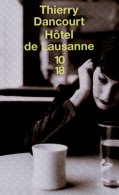
Thierry Dancourt: Hôtel de Lausanne (2008) French Prize For First Novel

Au cimetière du Trocadéro, un homme et une femme s’assoient sur un banc. Le vent souffle, elle n’arrive pas à allumer sa cigarette, ils entament la conversation. Elle s’appelle Christine, vit un peu hors du temps, entre un père obsédé par les mappemondes et un fiancé qui semble ne pas beaucoup compter. Lui, Daniel, parcourt le monde à la recherche d’objets anciens. Entre eux se noue une relation à part, clandestine, dans un Paris enneigé et brumeux. Du XVIe arrondissement à Casablanca, une galerie de portraits se dessine, mais une figure domine, entre ombre et lumière, celle, singulière et attachante, de Christine Stretter.

A man and a woman meet at the cemetery du Trocadéro in Paris. She tries to light a cigarette but the wind and the rain are too strong. They start to talk as if they had known each other forever. Christine lives outside of our daily world between a father obsessed with maps and  a fiancé who is never there. Daniel is an antiquarian and travels the world. They will start to meet in hotels all over Paris and in the province.

Dancourt won the French prize for first novel and I am pretty sure he will be translated. This little book is far too wonderful and will be highly appreciated by people everywhere as it is also an homage to the city of Paris. Without knowing it ( I looked it up later) I knew that Dancourt is not a Parisian. Parisians do not render their city so lovingly. Only people from abroad and the homesick ones who live in other countries would describe it with such great detail.

Reading this filled me with a terrible longing. Missing a city is not much better than missing a person. On the other hand, the Paris of this book has an otherworldly quality and charm that the struggle of daily life, commuting etc. destroys sooner or later. This is the Paris we love to dream about, the town we would love to live in if we did not have to go to work every day.

Hôtel de Lausanne tells also a very lovely story in the typical French manner of not revealing too much. The people in this novel keep their mystery until the very end. We can only assume why they do this or that, it is never explained or analyzed.

Christine is engaged when she meets Daniel and even though their relationship is very profound and magical she still gets married to her fiancé as she always wanted to get married very young (she is only 21). The funny thing, even though this feels wrong on a logical level, it feels right emotionally. One has never the feeling of reading a book about an adulterous woman. And one never questions her choice. I never even wondered why she wasn’t getting married to Daniel if they were so close.

I liked this aura of mystery that encloses the people and the many descriptions of Paris, its little cafés and bars. Those typical little cafés no tourist would ever go to but where the people living close by, the so-called  “habitués” will come every day, drink and eat and chat. Village-like coziness of big cities where you end up staying in your quartier unless you go to work. Christine and Daniel have their favourite places, where people know them and treat them like a couple and where they occasionally also meet someone who knew Christine’s mother. A haunting figure of whom we try to catch a glimpse as hard as Christine tries herself.

Hôtel de Lausanne is a very enchanting novel and I will certainly read more of Dancourt (his second novel Jardin d’hiver has just been published). As stated before I am pretty confident this will be translated. It simply has to.