Literature and War Readalong February 25 2011: How Many Miles to Babylon? by Jennifer Johnston

This is just a quick note to remind you to make sure to get your copy of Jennifer Johnston’s WWI novel How Many Miles to Babylon? in time, should you want to read along this month. This is the second novel in the Literature and War Readalong. It is, like Strange Meeting, a very short novel, only 160 pages. The story adds another twist as the protagonists are Irish. Jennifer Johnston has been quoted saying that she had a passion for WWI but that it was also a substitute for her. What she really wanted to write about were the Troubles.

I found these interesting quotes on contemporarywriters

Prohibited friendship is also at the heart of How Many Miles to Babylon? The first-person narrator is Alec Moore, an only child and heir to the Big House; his ‘private and secret friend’ is Jerry Crowe, a village boy he has known since childhood. In 1914, fighting together near the Belgian border, the friends’ loyalty is tested by a brutal enforcement of class divisions and a code that brooks no sentiment or mercy. Johnston is adept at suggesting her characters’ interior lives through image and symbol, and invites her readers to join the dots between what is said and felt, as in this incident, related by Alec, at his parents’ dinner table: ‘[My mother] looked at [my father] with contempt and said nothing. I blushed and looked down, away from them, at the smooth glowing silver neatly ordered around my plate. A griffin raised its talon in an angry gesture on the handle of each spoon and fork.’

The First World War is a ‘passion’ for Johnston, one she initially used as a metaphor. ‘When I started writing prose, I had it very seriously in my mind that I wanted to write about the Troubles … yet I couldn’t face taking them head-on. So I started to write about the First World War…  how people try to keep their lives normal, their feet on the ground, even though terrible things are going on’ (The Irish World, 24 October 2007).

I hope many will feel tempted to join me in reading and discussing Jennifer Johnston. Should you not have read anything by this wonderful Irish writer, this is a good opportunity.

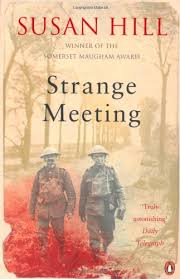
Susan Hill: Strange Meeting (1971) Literature and War Readalong January


John Hilliard, a young subaltern returning to the Western Front after a brief period of sick leave back in England, finds his battalion tragically altered. His commanding officer finds escape in alcohol, there is a new adjutant and even Hilliard’s batman has been killed. But there is David Barton. As yet untouched and unsullied by war, radiating charm and common sense, forever writing long letters to his family. Theirs is a strange meeting and a strange relationship: the coming together of opposites in the summer lull before the inevitable storm.

Strange Meeting, is set in the English countryside and the trenches in France, at the beginning of WWI. The book is divided into three parts. The first is written from John Hilliard’s point of view, the second mostly from David Barton’s and the third could be called the combined one. At the heart of the story is the juxtaposition of two very different themes; the intense and emotionally intimate friendship between John Hilliard and David Barton on the one hand, and the horrors of WWI on the other. The following quotes taken from page 158 illustrate this perfectly well:

“But they (the Germans) must know we are up to something.”

“Oh yes, though that fact is never obvious to High Command, whose faith in the Element of Surprise in the attack is really very touching and quite unshakeable.”

And a few lines later:

“Has it always been like that? Has it always been so easy for you to love people? To get on with them, to bring them out, say the right things at the right time? Have you always made friends as you’ve done out here?”

Whoever is familiar with novels or movies on wars knows that one of these two will die. It is the aim of books and movies on war to show an individual, to pick one person out of an anonymous number and to tell his story. As horrible as it is for us to know that in some offensives – especially in the early WWI ones – far over 100 000 young men were killed in less than an afternoon and millions died senselessly during the course of this war, we still need to be told an individual’s story and not only a huge number, to be touched emotionally. From the beginning of the novel until its end, the shadow of death hangs over these two young people and this is what makes it so touching. We know, one of them is doomed. It’s like a Greek tragedy.

Hilliard and Barton meet in France, during the first summer of WWI, in a bombed out village, away from the trenches and the front line. Hillard has just returned from a short sick leave to England. He is shocked to find his company reduced to a fraction. His commanding officer is drinking and seems to have lost his faith completely.

We lost three quarters of the Battalion in a day and a half. Getting on for two dozen officers. Mayor Gadney, young Parkinson, Ward – all the best. Half of them went because we didn’t get an order telling us the second push was cancelled. They just went on. You were well out of it. I’m glad you were out of it.

But Hilliard’s stay in England was horrible too. He couldn’t sleep, had no one to talk too. He showed signs of  shell-shock, only not enough to not return. The mindless cheerfulness of the people around him who had no idea what it was like to be in the trenches was unbearable. They did neither realize how useless the losses were, nor how futile the missions. The newspapers only gave a purified version and people everywhere were convinced, the war would be over by Christmas. Hilliard was suffering from this feeling of isolation and haunted by the images and smells that were stuck in his mind. He found the smell of roses revolting, the sweetness reminded him of the smell of dead bodies. He would have liked to talk to his sister, the only person from his family he felt close to, but finds her estranged. She is about to get married and he doesn’t approve of her choice until he realizes, there is really no one else left, most other young men are dying in France.

When he returns to France and finds out that most of the men of his company are dead, he also hears that there is a new guy that he will share his quarters with.  They don’t meet directly at first, instead we follow Hilliard into the room that they will share and discover Barton through his things.

The lettering (on the valise) was upright and plain and clear, done in black ink. The leather of the valise still shone, the buckles were not yet tarnished. There was a tortoise-shell backed hairbrush and comb and a slab of chocolat Meunier. A copy of The Turn of the Screw and of the complete works by Thomas Browne, and one of the Psalms, bound in navy morocco. Hilliard reached out a hand towards it, hesitated, drew his hands back.

This passage tells us such a lot in a few words. The new guy is still untarnished, naive, it seems he has prepared himself for a summer camp. Hilliard resents this at first but when he finally meets Barton and gets to know him, he understands that Barton would always have packed the same things, no matter where he would have gone. His belongings mirror his being and how he always tries to see the sunny side of things and make the best of it. Hilliard has never met anyone like Barton. He is cheerful, easygoing, open, direct and very communicative. Even though he is reluctant at first, Hilliard is swiped away by Barton’s exuberance. For the first time in his life he starts to open up to another person and speaks about himself and his feelings.

Part II is mostly told from Barton’s point of view and consists in large parts of letters home to his family. Barton writers the longest letters Hilliard has ever seen. This strikes him as his family sends expensive parcels but short, polite and distant notes.

The two friends are not at the front yet, Barton will still have to find out what life in the trenches is like but he already sees someone killed and feels responsible for the man’s death.

There is something all the men hate about this place. Now, I can sense it myself. Something old and bad and dead, a smell a feeling you get as you walk across the street. It is not simply the bodies lying all about us, and the fact that the guns are firing, it is something else, something…

Part III is set in the trenches and we see a considerably changed and disillusioned Barton who has been sent on a reconnaissance mission on which he has seen people get killed. They know by now that High Command prepares for a big offensive. Since most of these are high in losses their morale is low. Being the new guy,  Barton is sent on several reconnaissance missions without Hilliard who goes almost crazy when he imagines Barton might get hurt or killed. When the offensive finally begins the two friends are separated in the chaos and one of them dies.

Strange Meeting does an incredible job at rendering what it was like to be in France in the summer of 1914. It captures the difference between the relative luxury encountered by the companies who wait off the front line and the ugliness and ordeal of the trenches. Susan Hill describes all the details that we can also find in history books, memoirs and letters. She describes various elements that were typical for WWI, the futility and high losses of the offensives, the chaotic and bad planning, the underestimation of the situation and possible duration of the war. The trenches are rendered accurately. Once they are there we read about the constant shelling, the noise, the rats, the mud, the dirt, the stink, the wetness and the cold.

As accurately as she renders the dreary trenches and the sadness and futility of it all, it is not surprising to read the following in her afterword:

Yet I have not told the whole truth, for although I have accounted for my obsession with the First World War, I am still sometimes troubled by thoughts of those two young men of whom I became so very fond while I was writing about them and who stand for thousands upon thousands of others, so full of youth, strength and bright promise, who were slaughtered in a war perhaps more futile and meaningless than any other in history. I wrote the novel in memory of them and in tribute to them. But I hope it is not thought of only as a novel whose “subject is the war and the pity of war”, for, more than anything else it is about human love.

Srange Meeting is indeed a novel about friendship, much more than about the war. The war serves as a backdrop and an explanation for this very intimate exchange. In civilian life, men were not this close, opening up would have taken much longer. Strange Meeting excels in rendering the intensity of the feelings of two people for one another and the tragedy of their fate. As strange as this may seem, although the description of their feelings for each other can only be called love and Barton does also tell Hilliard that he loves him, I never had the feeling they were gay. Apparently Susan Hill has been asked if Hilliard and Barton did have a physical relationship and she denied this. As said this never occurred to me either. It is really about emotional love. It is sad that we immediately have to think that there must be some sexual attraction involved as soon as two people have very strong feelings for each other.

I read somewhere that it wasn’t possible to say if Strange Meeting had been written by a man or a woman. I would contradict this. I think we can feel that it was  written by a woman. This is mostly due to Barton’s narrative voice and the nature of their conversations. They constantly ask each other how they feel, speak out everything, clarify, share their emotions.

I think Strange Meeting is  a beautiful novel about a unique and fateful meeting that took place during one of the darkest moments of European history.

What did you think?

Other reviews:

Anna (Diary of an Eccentric)

Danielle (A Work in Progress)

*****

Strange Meeting was the first book in the Literature and War Readalong. The next one will be Jennifer Johnston’s How Many Miles to Babylon. Discussion starts on Friday February 25, 2011 .

John Marsden: Tomorrow, When the War Began (1993) An Australian Page-turner

When Ellie and her friends go camping, they have no idea they’re leaving their old lives behind forever. Despite a less-than-tragic food shortage and a secret crush or two, everything goes as planned. But a week later, they return home to find their houses empty and their pets starving. Something has gone wrong–horribly wrong. Before long, they realize the country has been invaded, and the entire town has been captured–including their families and all their friends. Ellie and the other survivors face an impossible decision: They can flee for the mountains or surrender. Or they can fight.

Sometimes you want to read for pure entertainment, something that is fast-paced, action-packed but still interesting. Tomorrow, When the War Began is exactly like that, a real page-turner. I discovered the book on Jenclair’s blog last year and am really glad I read it. I am not too much into  series but this start into the Tomorrow Series was really gripping. Too bad that it isn’t an independent book. It’s rather a series in the spirit of the TV series Lost. It always ends when it’s most supenseful, when something big happens. You really have to go on reading if you want to know what’s going to happen next. Jenclair has read all the books meanwhile. You can find her second review here.

Ellie and her friends go camping instead of participating in a cattle show that takes place during Commemoration Day. They make a trip into the Australian mountains and discover a place that very possibly no one has ever seen before. Or only one person, a hermit, who is said to have lived there. The hermit is a man who has been accused of the murder of his wife and baby and escaped into the mountains.

The place they discover is enchanted. It seems to belong to another world, untouched by civilization. They enjoy their stay a lot and leave only reluctantly. When they arrive at their homes, the coming back is a brutal one. Their houses and farms have been abandoned, their animals are dead or dying. Bit by bit they discover that Australia has been invaded and all the people are captives.

The adventures that follow are numerous and dangerous. They first need to find out what happened, then they need to make decisions. How are they going to live and where? How will they hide, what will they eat? It seems natural that they return to the hidden place in the mountains. The country is swarming with foreign soldiers and every expedition is a trial.

We never hear who has invaded the country but we learn why. People in neighbouring poor countries couldn’t accept that a lot belongs to a few rich people and they came to redistribute what is here.

What I liked particularly is the setting. I have never been to Australia but I have seen movies and it is a country whose landscape fascinates me. The setting is rendered very well, in a very descriptive manner. I liked the exploration of topics like war, murder, social justice and injustice. I was just wondering for a moment if it is ethical, to base a book on the idea that poor people or a poor country could act in such an aggressive way. I think what Marsden had in mind, was raising the awareness that there are people less well off than those in the Western hemisphere. Another question that arose was whether they would have the military power to invade.

The characters are not all equally well drawn, two stay a bit schematic but that may change in the future books, maybe they will be more developed.

If you want to read something that is really absorbing, this is a good choice.

Did I mention it is a YA novel? I often enjoy the topics they explore and this is no different. Part one of the series has been made into a film. I haven’t seen it, no idea if it is any good.

Do you like series and if so which ones?

Jenn Ashworth: A Kind of Intimacy (2009) A Very Noir Character Study

Annie is morbidly obese, lonely and hopeful. She narrates her own increasingly bizarre attempts to ingratiate herself with her new neighbours, learn from past mistakes and achieve a “”certain kind of intimacy”” with the boy next door. Though Annie struggles to repress a murky history of violence, secrets and sexual mishaps her past is never too far behind her, finally shattering her denial in a compelling and bloody climax. A quirky and darkly comic debut – giving readers a glimpse of a clumsy young woman who has too much in common with the rest of us to be written off as a monster.

I discovered A Kind of Intimacy thanks to a review on Danielle’s blog. It was also among her top 12 of 2010 and it was also one of the favourite reads of Guy Savage who also reviewed it.

I already jokingly “said” to Danielle in a comment that her top 2010 might become my top 2011 and,  yes, this book is certainly a candidate as it is astonishingly good. Very dark, absolutely fascinating, engrossing, and very well executed. While starting it I had forgotten Jenn Ashworth was compared to Ruth Rendell but the association immediately occurred to me as well.

A Kind of Intimacy is told by the main protagonist, obese, deluded Annie herself. She is what you call an unreliable narrator. The reader feels that something is wrong from the beginning, too many hints and little details tear apart the picture of perfection that Annie wants to draw for our and her own sake. These interfering details, as I would call them, make this a creepy read. Uncanny and creepy. It is not so much that we judge Annie as that we wish to never meet someone like her as she seems capable of doing really harmful things.

At the beginning of the novel Annie moves into a new neighbourhood. One of the first people she meets is Neil who has a natural capacity for being kind, which proves to be fatal in this relationship, as Annie doesn’t see things the way they are but the way she wants them to be. Unknown of Neil or anyone else, she is convinced, he is her soul-mate and the only thing that needs doing is getting rid of Lucy, his skinny and pretty girlfriend.

What starts like a comedy soon develops into something much darker. Bits and pieces of Annie’s past are revealed slowly. A miserable childhood, an odd marriage, a baby girl who seems to have disappeared and some really dodgy things Annie does to try to get “A Kind of Intimacy” despite her being revoltingly obese. The further you read the more you will hope to never meet anyone like Annie.

As deluded and extreme as she may seem, Annie is a character I am all too familiar with which added another dimension to my reading. However odd this may seem, I have met more than one Annie in my life. They were not always as dangerous and they were always male… Call me Neil… It’s really scary what some people can interpret into your tiniest actions.

I read somewhere that Jenn Ashworth was criticized for chosing an obese woman as her protagonist… I see Annie as a distortion, a caricature and as such the obesity did work for me. Unlike one critic I read, I did feel sorry for Annie. All through the web of lies and deceptions we catch glimpses of a very lonely and hurt soul.

Jenn Ashworth is a gifted writer. If you have ever tried to write yourself you will know that voice and point of view are always very challenging. Annie’s voice does sound so right. There is not one wrong note in this symphony of lies and self-deception. A Kind of Intimacy is one of the best character studies I have ever read. Fascinating, creepy and compulsively readable. I am sure this book will appeal to readers of crime and general fiction alike.

Just one aside, Jenn Ashworth won a prize for Best Blog Content in 2008. Here is the link to her site.

Urs Widmer: My Mother’s Lover (2011) aka Der Geliebte der Mutter (2000) One of the Finest Swiss Authors Finally Translated

It’s Switzerland in the 1920s when the two lovers first meet. She is young, beautiful, and rich. In contrast, he can barely support himself and is interested only in music. By the end of their lives, he is a famous conductor and the richest man in the country, but she is penniless. And most important of all, no one knows of her love for him; it is a secret he took to his grave. Here begins Urs Widmer’s novel “My Mother’s Lover”. Based on a real-life affair, “My Mother’s Lover” is the story of a lifelong and unspoken love for a man – recorded by the woman’s son, who begins this novel on the day his mother’s lover dies. Set against the backdrop of the Depression and World War II, it is a story of sacrifice and betrayal, passionate devotion and inevitable suffering. Yet in Widmer’s hands, it is always entertaining and surprisingly comic – a unique kind of fairy tale.

Urs Widmer is one of the finest Swiss authors of German language. He has been compared to Frisch and Dürrenmatt but that isn’t doing him any justice. I personally like him more. His novellas and novels are always very nostalgic, melancholic and bitter-sweet. There is beauty and sadness in equal doses. Recently I looked which of his works has been translated and couldn’t believe that until now there wasn’t any English translation available. Seems as if his novel Der Geliebte der Mutter aka My Mother’s Lover is the first of his books that has been translated into English. It will be out in June. That is incredibly good news. This really is an author to discover and My Mother’s Lover is a good starting point as it is one of the best novels of German language of the last decade. It is rich, it is dense, it is colourful and as powerful as a slap in the face.

My Mother’s Lover is told in first person peripheral, a point of view I like a lot. Some of the best works of literature have made use of it (Le Grand Meaulnes, The Great Gatsby… ). It is a very poetical point of view. In this novel, it is the son who tells his mother’s story. A story that spans over eighty years and begins just before the Black Thursday 1929, when Clara, the mother, is some 20 years old. Widmer tells the story of a life and a century with all the joy, sadness, madness and tragedy there was in both.

Clara is the daughter of an Italian whose great grand-father was of African descent. Her father left his Northern Italian hometown to live in Switzerland, Zürich, where Clara is born. The mother died young and Clara grew up with her father enjoying a life of ease and wealth. They loved going to concerts and that is how she met Edwin, the man who should become the love of her life and one of the most famous conductors of all time.

The Black Thursday 1929 kills her father and ruins her. She starts to work for Edwin and his orchestra and leads a life of joyful bohemianism. Together with Edwin and the orchestra they travel to Paris, sit in restaurants and bars and discuss all night long. She becomes Edwin’s lover.

The descriptions of the cities in the novel are among the best parts. Clara travels to pre-war Frankfurt that was a city full of charm and narrow medieval streets. Clara also travels to Italy where her relatives life on a vineyard, producing some of the best Italian wine. She even sees Mussolini.

Clara gets pregnant and contrary to what she expects Edwin wants her to get rid of the child. She doesn’t realize that this is the end of the affair. Edwin marries the rich daughter of an industrialist and – we never really understand why – Clara gets married to the narrator’s father who stays somewhat non existent throughout the book.

The first part of the book spans maybe 5 years, the second part almost sixty. What is told from now on is the descent of a fragile woman with a great appetite for life and a passionate love for music. She is robbed of the life she loves and the man she desires. The juxtaposition of Clara’s life and the outbreak of the second world war is incredibly masterful. We see Clara like a figure on a stage and the history of the second world war like a moving canvas in the back. Clara plants vegetables, Hitler invades Poland, Clara cooks marmalade, Hitler drives the British into the sea at Dunkirk… It is breathtaking. And so is Clara’s story. After leading a normal life at first and having a child, the narrator, all of a sudden, she slowly goes mad. She who always fantasized a lot invents a dozen ways of killing herself. Of course she thinks of taking the child with her. After a breakdown, she ends in the asylum where she stays for a long time. Although she leaves the asylum again, she returns to it all through her life until her violent death.

Apart from being the story of a life, a century, it is also an homage to classical music and art in general. You will discover many names of musicians you know and maybe a few new ones.

Widmer takes barely 140 condensed pages to tell this century long story. It has a staccato rhythm. Phrases vary considerably in length. Fragments alternate with parataxis and longer phrases with subordinate clauses. That doesn’t make for smooth reading. At least not in German. Another writer would have told this story in 300-500 pages but he would never have made you feel as if you had jumped from a cliff at the end of it. And still, and this is Widmer’s most prominent feature as a storyteller, you know you have witnessed beauty. There is always something tragic about beauty… It doesn’t last, does it? Beauty has to be captured in art. And that’s what Widmer excels at.

John O’Hara: Appointment in Samarra (1933) The Social and Psychological Downfall of an Alcoholic

Appointment in Samarra is a fast-paced, blackly comic depiction of the rapid decline and fall of Julian English. English is part of the social elite of his 1930s American hometown but from the moment he impetuously throws a cocktail in the face of one of his powerful business associates his life begins to spiral out of control – taking his loving but troubled marriage with it.
“For all its excellence as a social panorama and a sketch of a marriage, it is as a picture of a man destroyed by drink and pride that Appointment in Samarra lives frighteningly in the mind” John Updike

Isn’t it wonderful when you read a book at the exact right time? I started Appointment in Samarra on Christmas Eve, not knowing that the novel started on Christmas Eve or rather, during the early morning hours of Christmas and tells a story, with a few flashbacks, that lasts exactly three days. Three days in which a man starts his descent. The man is Julian English and the reason for his downfall seems to be his throwing a glass of drink, including ice cubes, into the face of a much despised but universally feared man. Of course this is not the real reason for Julian’s fall into the social and psychological abyss, it is just the tipping point, the one crucial moment that pushes him over the edge. The real reason is his heavy drinking and, due to this, the end of his marriage to Caroline, a woman he still loves and desires as much as when he met her. On an even deeper level, there is also something happening that the French writer Cocteau termed “La machine infernale”. And exactly this is what the title alludes to. Appointment in Samarra refers to a short piece taken from Somerset Maugham titled Death speaks that opens the novel. Death speaks alludes to the inevitability of destiny. Once the machine is set in motion, there is no stopping it. Once your fate has been decided you cannot change it.

Apart from following Julian’s descent Appointment in Samarra offers an incredibly interesting analysis of a highly ritualized society during the Great Depression and Prohibition era. Julian and Caroline English are part of the high-society of the small town, Gibbsville. They follow the rules of club life and parties very closely until Julian throws his drink into Harry’s face. From this moment on, he is an outcast. But what is so terrible in what he did? It seems to lay bare the undercurrent of hate and contempt beyond this façade of politeness and good manners. And what’s worst, he doesn’t really give a damn. Breaching the rules of society sets something free in Julian as well. He doesn’t keep up a front anymore. He had problems with alcohol before but now they get unbridled. He drinks and drinks and drinks, hurts people’s feelings and still doesn’t care until he cannot stop anymore.

Appointment in Samarra was criticized when it came out as it is a very outspoken novel. Sexuality is a central theme and even women show interest in it. At the same time it illustrates what society expects from its members, especially its female members. Virginity is an important topic and the fact whether or not a girl is a virgin is of greatest importance. There are two flashback parts in the novel. One shows Caroline just before she gets married to Julian and is an interesting and careful analysis of women’s role in this society. The second flashback focuses on Julian’s childhood and his complicated relationship with his father a very incapable surgeon. It also mentions Julian’s grandfather who committed suicide and was, as Julian’s father states, a liar like Julian himself.

One of the most impressive features of this book is how O’Hara handles point of view. It is very diverse and original but not experimental. The second thing that struck me is his use of dialogue. Some of the dialogues are among the best I have ever read. These people sound like real people, also the drunken Julian is incredibly well rendered.

Apparently O’Hara has in parts told his own story. He just got divorced, pretty much for the same reasons as Julian. He drank too much. However some of the traits are inverted. O’Hara was an Irish Catholic but in the book Harry, the guy he throws the drink at, is an Irish Catholic. O’Hara’s own father was a doctor and the relationship must have been a conflicting one.

Appointment in Samarra is also a very American novel, one of the most American novels I have ever read and this is not only based on the fact that the Depression and Prohibition are mentioned but in how prominent the role of cars is in this novel. Cadillacs to be precise. Apart from being status symbols, they are treated like rooms. You drive in them, talk in them, quarrel and make love in them. You sit in your car to drink or smoke or just think. And you can end your life in a car as well.

According to John Updike who wrote the foreword to my edition, this seems to have been O’Hara’s first and most accomplished novel. Apparently he wrote some 400 short stories.

I always wanted to read the novel since I saw it mentioned by one of the soldiers in the movie Redacted (which I never finished watching btw.  There are a lot of allusions to the Great War, which would probably also be worth analyzing) and lately saw O’Hara mentioned on Danielle’s blog.

This is definitely a book to reread. I don’t really know if I liked it but I found it fascinating and enjoyed the style a great deal. This is like reading F. Scott Fitzgerald without the varnish. A novel with the feel of a roman noir and the bleakest of endings.

Meg Rosoff: What I Was (2007) A Very Poetical Novel

The narrator of Carnegie Medal winner Rosoff’s latest and perhaps most perfect novel is a 16-year-old boy who has been expelled from two boarding schools and finds himself dumped in a third, near the Suffolk coast. The school is all arbitrary rules, pretentious tradition and routine bullying. But on the beach nearby the boy finds a fisherman’s hut occupied by beautiful, competent Finn, who is everything he wishes he could be himself: athletic, self-sufficient, able, free. The relationship that follows becomes an escape and an obsession, pure and transporting, and a turning point in a life remembered by the narrator at the age of 100. It makes us fall in love not only with Finn but also with the Suffolk coast, the land, the sky and the sea passionately described in airy and crystalline prose. It’s already a classic.

I wasn’t aware that I was reading a YA novel when I started Meg Rosoff’s hauntingly beautiful novel What I Was. It tells the story of a teenage boy but apart from that I don’t see why it is classified as YA. It is very lyrical, poetical and even mysterious. Rosoff creates a wonderful world, her descriptions are very atmospheric.

The novel takes place in 1962. Hilary is an old man now and looks back on his time at St. Oswalds boarding school.  It is the third school in a very short time. He doesn’t really fit in, he hates the place, he doesn’t like the people. The description  of the place had an almost gothic feel.

When Hilary meets Finn, his life changes. What follows is one of the most subtle descriptions and meditations on falling in love. Rosoff manages to show the complexity of the feeling in a masterful way. Don’t we always wish to a certain extent to be like the one we fall in love with? Isn’t the one we love not often an idealized version of our selves, a better part of ourself?

Finn lives all alone in a little fisherman’s hut, near the sea. His sole companion is his little grey cat. Finn is independent, strong, adept at many things. He is everything that Hilary is not. And very beautiful. Hilary is touched by Finn’s beauty in a very profound and even painful way. He compares himself and thinks that this is how he would like to look, how he would like to be. There is also a great transformative power in this kind of love. Through his feelings Hilary becomes every day a little more like Finn.

The fisherman’s hut is located in a very precarious position, threatened to be flooded at all times. Storms are a great danger to it. But it is also a very cozy little hut. Finn has a fire going all the time, he makes tea for them, cooks dinner. Finn likes to read and is interested in history. Through him Hilary discovers a lot he didn’t know.

The description of the landscape and the weather has also a very gothic feel. The sea is wild and seems to devour the land, the winds are howling, the storm is raging. At times I felt reminded of Jonathan Coe’s The House of Sleep, one of my all-time favourites. And once you know the story has a twist, even more so. I wasn’t surprised by the twist, I thought it was pretty obvious from the start but that didn’t dampen the reading experience. I truly liked this book and might very well pick up another one of her novels soon.

Has anyone read this one or another one of her books?

Should anyone want to know more about Meg Rosoff here is her website and blog.