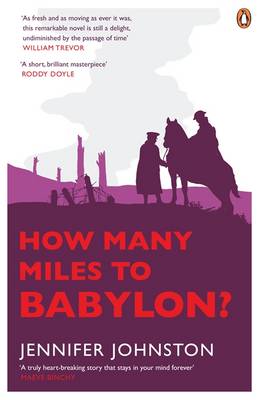
Literature and War Readalong February Wrap up: How Many Miles to Babylon?

I wanted to thank all of you who have participated this month. I loved the book and enjoyed the discussions.

Even though there is also a friendship at the heart of How Many Miles to Babylon? this book is totally different from Susan Hill’s novel Strange Meeting which we read in January. As you can easily see my review doesn’t emphasize the role of the friendship between Alec and Jerry as much as Anna’s or Danielle’s (and here as well) does.

I realized when reading the other posts and a few of the comments that some had a bit of a problem with this novel. There were different reasons for this. For one Alec doesn’t appear to be a very likable character, he was even called a coward by some. For several reasons I never thought of him like that and was wondering why. I realized that from the start, I was totally fixed on his going to be executed. I saw him like some Breaker Morant character (which he isn’t) and thinking he did something that would have this consequence set the tone for me from the beginning. Another point of criticism which, with hindsight, seems fair, is the fact that the WWI elements are toned down. WWI seems to serve more as a pretext for the tragic story and to write about Irish history. WWI itself is rather just a backdrop. I did not mind this at all but can understand that this can bee seen differently.

I think we all equally agreed that the mother in this book was an extremely negative figure, the whole family situation, as Kevin pointed out, is highly dysfunctional.

What I couldn’t really solve was the question about the title. Why did she choose this nursery rhyme as the title for her novel? In an article on the net I found one tiny hint, saying that it did underline the relationship between the soldier and his superior.

On Wikipedia I found this list which enumerates how many times the rhyme has been used in popular culture

In popular culture

In literature

In film

In popular music

  • It is parodied as “How many miles to Babyland?” on Lenny and the Squigtones– a comedy album by the characters Lenny and Squiggy from the 1970s sitcom “Laverne & Shirley”.

This is quite a considerable list. It eludes me why this rhyme is so popular with writers and I am still open for any interpretation why Jennifer Johnston chose it as her title.

Jennifer Johnston: How Many Miles to Babylon? (1974) Literature and War Readalong February

Alec and Jerry shouldn’t have been friends: Alec’s life was one of privilege, while Jerry’s was one of toil. But this hardly mattered to two young men whose shared love of horses brought them together and whose whole lives lay ahead of them. When war breaks out in 1914, both Jerry and Alec sign up – yet for quite different reasons. On the fields of Flanders they find themselves standing together, but once again divided: as officer and enlisted man. And it is there, surrounded by mud and chaos and death, that one of them makes a fateful decision whose consequences will test their friendship and loyalty to breaking point.

We know from the beginning of this novel that it is not going to end well. Alec is held in detention and knows that he will die. Because he is an officer and a gentleman, as he states, they have given him his notebooks, pen and ink and he writes down the story of his life. The story spans from his lonely isolated childhood in rural Ireland to the war-torn trenches in France. The tone of the novel is melancholic, full of nostalgia for a world that has been lost and is at the same time infused with the profound love of a country.

By now the attack must be on. A hundred yards of mournful earth, a hill topped with a circle of trees, that at home would have belonged exclusively to the fairies, a farm, some roofless cottages, quiet unimportant places, now the centre of the world for tens of thousands of men. The end of the world for many, the heroes and the cowards, the masters and the slaves.

Alec’s childhood was a lonely one. Caught between two parents who hated each other and who kept a polite and icy distance, he was the pawn with which his mother played. He didn’t like his mother, a haughty, cruel but beautiful woman whose strict rules and relentless following of etiquette ruined every childhood joy. What his parents do not know for a long time is that Alec has a secret friend. Alec and Jerry have a lot in common. Their love of horses, their sense of humour, they share so much, unfortunately not the social class. Alec is an only child of a wealthy Anglo-Irish couple whereas Jerry is part of the Catholic underclass. When their friendship is found out, Alec’s mother freaks out and decides to go on a 4 month trip to Europe with Alec.

When Alec comes back he doesn’t see Jerry anymore. Jerry is working while Alec is still studying. And then the war breaks out. At first there seems to be only a rumour of war. Jerry knows it long before Alec hears it and most people think it isn’t really true.

We paid very little attention to the war when it happened first. Belgium and Flanders seemed so far away from us. Our fields were gold and firm under our feet. Autumn began to stroke the evening air with frost. Smoke from bonfires was the only smoke to sting our eyes. Cubbing began in the early morning, the earth temporarily white with mist and dew. A few familiar faces disappeared. War was on the front pages of the newspapers daily brought from Dublin on the train.

Many do not feel that this is their war or that they should assist the British. Tensions inside of Ireland start to be palpable, tensions that bear the foreboding of the things that will come, the striving towards independence. However people who feel loyal towards Britain send their sons. Alec’s father considers it to be foolish to go to a war when you are not forced to go but his mother, out of spite and vengeance against his father, drives Alec away.

Meanwhile Jerry had already enlisted and the two young men meet in the training camp near Belfast in which they stay for six weeks until they get shipped to France. Their superiors do not like to see an officer talk to an enlisted man. Alec, due to his social class, has become an officer immediately.

When they finally arrive in France they stay separated. Alec shares quarters with a British officer, Bennett, a guy with a lot of humour, while Jerry sleeps with the other enlisted men. Still the three of them meet occasionally and ride about the country together.

They hardly see any action for a long time and stay far off the trenches for a while. When they are finally sent to the front line they will spend a lot of their time cleaning and reconstructing the badly damaged trenches.

We spent three more days in the front trenches, mainly shoveling and making props. It rained a considerable amount of the time. Sometimes sleet cut into the men’s bare hands, and at night there was sharp frost that covered the bottom of the trenches with a thin film of ice. We extended the line to our left. It was hard work moving the earth, heavy with water, always crouching till ones back and shoulders ached pitifully. The men hated it and worked slowly, grumbling most of the time. For most of the day there was concentrated shelling of the German lines by our artillery. The shells screeched over our heads sometimes for hours at a time. After a while I became so used to the noise that I felt strangely unprotected when it stopped, then slowly the process of thinking had to begin again.

The cold is unbearable and Alec suffers a lot from it. They constantly drink rum as it is the only way to warm up. Here again Alec and Jerry are caught talking together and the superior officer forbids it. But that is not the only trouble they are in. The Irish are not appreciated at all. On top of that there are rumors of a movement that wants to fight for the independence of Ireland. Jerry is suspected to be part of that movement and one day he confides in Alec.

“I don’t know how you can contemplate ever fighting again.”

“It won’t be like this. There’ll be no trenches, no front lines. No waiting. Every town, every village will be the front line. Hill, rock, tree. They won’t know which way to look. Even the children, for God’s sake, will fight them. It won’t be like this, I promise you that. Oh, Alec, it’s some thought.”

When Jerry receives a letter from his mother in which she informs him that his father has gone missing, he runs off to look for him and the tragedy unfolds.

I loved How Many Miles to Babylon? I think it is a beautiful book. It doesn’t teach you as much about WWI as Strange Meeting (see post 1) but it says a lot about Irish history. I found this look at the first World War from an Irish perspective extremely fascinating.

As Jennifer Johnston said, she wanted to write about the Troubles but didn’t feel ready yet. This is the prehistory of the Troubles. The Irish War of Independence started right after WWI in 1919 and was closely followed by the Irish Civil War. This succession of wars was the reason why Ireland stayed neutral during WWII. They simply couldn’t afford to be in another war in such short time.

How Many Miles to Babylon? hints at all this. But it is not only a very Irish novel because of the historical elements but also for its imagery, the symbolism and the many references to Irish mythology and culture.

The motif of the swans is a recurring element. There are swans on the lake on the property of Alec’s parents, they see swans in France, some soldiers shoot a swan which does upset Alec terribly. Since Alec reads W.B. Yates at the beginning of the book I think the swans are an allusion to Yates’ famous poem The Wild Swans at Coole which seems to mourn a time long gone.

In contrast to the gratuitous killing of the swans stand the mercy killings. Wounded horses are killed, a wounded man is killed…

I really liked this enchanting novel. I loved the poetical prose, the melancholic tone and the feeling of nostalgia that pervaded it.

What did you think of the novel in general and its treatment of WWI?

Other reviews:

Anna (Diary of an Eccentric)

Danielle (A Work in Progress) and here as well

Fence (Susan Hated Literature)

*****

How Many Miles to Babylon? was the second book in the Literature and War Readalong. The next one will be Rebecca West’s The Return of the Soldier. Discussion starts on Friday March 25, 2011 .

Daniel Glattauer: Every Seventh Wave (2011) aka Alle sieben Wellen (2009) The Sequel of Love Virtually

Every Seventh Wave

A while back I wrote about Daniel Glattauer’s Love Virtually which has been released meanwhile. I just saw that the sequel, Every Seventh Wave,  will be published this year as well. Usually I include the amazon blurb at the beginning of my posts but this one  contains too many spoilers of the first book.

Like its predecessor, I have read Alle sieben Wellen when it came out in Germany. For all those who like Love Virtually, they can look forward to a sequel that is very close to the first book. The story of Leo and Emmi, their e-mail exchange goes on. More passionate and more intense than before. And still they ask the same questions. Should they meet or should they not? To the somewhat playful tone of the first book Glattauer adds a bit of a darker undertone. I cannot say too much or it would be a spoiler.

Even though I didn’t like the idea of a sequel at all and if I had had something to say, it wouldn’t have been written but since it was and I liked the tone of the first book, I had to read this one as well. And it isn’t disappointing. It is as witty, charming, thought-provoking and enjoyable as the first.

All those who thought that Emmi and Leo’s story shouldn’t finish like it did in Love Virtually will enjoy this book. All those who loved the style of Glattauer the first time, will enjoy this as well. Although Love Virtually can be read on its own, this one can not. If you want to read Glattauer, you should start with the first one.

I have no problem with the translation of the title this time, it is pretty literal but I still like the German cover better.

The Austrian author Daniel Glattauer has written quite a few books that have been successful in Germany and other German speaking countries. Like so very often none of them has been translated. Should you read German you can find more information on his website.

Ruth Rendell: The Tree of Hands (1984)

Once, when Benet was about fourteen, she and her mother had been alone in a train carriage and Mopsa had tried to stab her with a carving knife. It was some time since Benet had seen her mad mother. So when Mopsa arrived at the airport, looking drab and colourless in a dowdy grey suit, Benet tried not to hate her. But the tragic death of a child begins a chain of deception, kidnap and murder. Domestic dramas exploding into deaths and murders …threads are drawn tightly together in a lethal last pattern.

I read and reviewed A Judgment in Stone last year and have mentioned how much I liked it. It was one of my favourite reads of 2010. On one of the comment thread’s Guy Savage suggested another book by Ruth Rendell, The Tree of Hands, and that is how I discovered this novel.

I have to emphasize once more what a great writer Ruth Rendell is. This book is different from A Judgment in Stone but also very engrossing. After having read The Tree of Hands I can also see why A Kind of Intimacy was compared to Rendell’s books. The description of the streets and their inhabitants shows a lot of parallels plus the people are equally deranged.

In the Tree of Hands the stories of at least 6 people are interwoven but it is skillfully done and they are all linked together in a logical way. The novel works like those rows of domino stones that have been set up in order to see them fall one by one. The falling down of the first stone makes the others follow. One action in the novel triggers another action and they are all equally fatal and catastrophic.

I was a bit wary at the beginning as Mopsa, Benet’s mother, is said to have a mental illness. Using mental illness as an explanation for a crime is often insufferable to me. But fortunately Mopsa is just the first domino stone. Being totally irresponsible she steals a child without ever thinking of the consequences but then she leaves and lets all the other people deal with the aftermath of his kidnapping.

The book really has a chain reaction at its core and one bad decision leads to another. And it also describes quite a lot of negative, selfish and frankly bad people. What struck me, even though Mopsa is mentally ill and on top of that clearly not a good person, she is by far less deranged than some of the other nasty characters in this book.

One of the main stories is the story of Benet, a young mother and extremely successful writer who lives in a beautiful house in Hampstead. At the beginning of the book her mentally ill and very unstable mother, Mopsa, comes to visit her and her little boy, James. Benet is a very loving mother and James is the most important person in her live.

The second main story revolves around another young mother, Carol, her son Jason and her young boyfriend Barry. Carol is a superficial and unrestrained woman with a flaming temper. At the age of 28 she is already a widow and has three children from different men. Two have been taken away, only the smallest, Jason, is living with her and Barry.

At first the two strands of the story run in parallel until a tragedy happens and Mopsa steals Jason.

I am tempted to write a lot more as there are a few aspects that I find interesting but unfortunately it isn’t possible, it would spoil too much. I can however say that the novel also explores the concept of parenthood and if someone who loves a child dearly might not be a better parent than a biological parent.

Something that struck me in this book is the overuse of the sedative Valium. This dates the book. Surely nowadays people in novels don’t pop pills like sweets and they might not use benzodiazepines as often anymore. This constant use of downers and alcohol is of course symbolical and just underlines that the people in the novel do not want to face any problems or consequences of their actions.

Ruth Rendell’s writing is suspenseful, her characterizations are psychologically plausible and the descriptions of different social milieus spot-on. Do I have to mention that I will certainly read another Ruth Rendell or Barbara Vine very soon?

Erica Bauermeister: The School of Essential Ingredients (2009) Dreams, Friendship and Slow Food

In this remarkable debut, Bauermeister creates a captivating world where the pleasures and particulars of sophisticated food come to mean much more than simple epicurean indulgence. Respected chef and restaurateur Lillian has spent much of her 30-something years in the kitchen, looking for meaning and satisfaction in evocative, delicious combinations of ingredients. Endeavoring to instill that love and know-how in others, Lillian holds a season of Monday evening cooking classes in her restaurant. The novel takes up the story of each of her students, navigating readers through the personal dramas, memories and musings stirred up as the characters handle, slice, chop, blend, smell and taste. Each student’s affecting story—painful transitions, difficult choices—is rendered in vivid prose and woven together with confidence.

I like books about book groups, writing classes, language lessons or knitting clubs as they are essentially books about friendships focusing additionally on a certain topic. They resemble cozy mysteries in which an amateur sleuth, besides solving a crime, introduces us to his craft, hobby or profession. Most of the books of this book club/lesson/school subgroup are not up to my expectations and still, whenever I see one, I have to read it sooner or later. When I read about The School Of Essential Ingredients I was curious and thought it might be uplifting to read a novel that takes you into the realm of food, cooking, spices and aromas during the bleak month of February. And for a change I was not disappointed. It is entertaining, charming and provides intelligent reflections on food and food preparation.

From the reviews I read, I know that some people had a problem with the form of this novel as each chapter is dedicated to another character. We only catch glimpses of their lives. Unlike in The Fiction Class that I enjoyed so much last year, there is no main character in this novel.

Lillian is a chef and owns an expensive and very exclusive restaurant. She organizes monthly cooking classes in which she teaches a very special form of cooking that is meant to inspire and transform. The beginning of every new class is exciting as people come for so many various reasons. Of course they want to learn to cook but they also want to make friends. Some only come because they were offered a voucher. Each person has their own dreams and sorrows that they carry with them.

Lillian is far more than just a simple cook. Already as a child she has learned that you can affect people if you serve them the right food. She did this when she managed to guide her own mother back into life. After having been left by Lillian’s father, her mother shied away from the world and withdrew into books. By cooking the right meal, choosing the right ingredients, Lillian achieved to pull her back into life, to make her notice the world around her and to participate again.

This is what she also does in her cooking classes. She has a good eye for people and studies her pupils closely. Through choosing the right menu, she manages to trigger something in them.

Each month is dedicated to another meal and another person. While they cook and discover new tastes and new aromas, the students are touched in a profound way, remember something of their past or discover new joys in the present.

There is Claire a young mother who rediscovers herself outside of her role as mother and wife and finds back to a more authentic, less limited perception of herself. Her dish is a meal of crabs and preparing it reveals to her an inner strenghth she didn’t know she had (It was a bit hard to read this chapter as the process of killing the crabs is described. Admittedly in a thoughtful and thought-provoking way.).

There is Helen, an elderly woman fighting the early signs of dementia or Alzheimer’s. During “her” evening they cook fondue. There are many others. Tom, a young man who is mourning his wife who was a chef herself, Antonia, an Italian interior designer and the elderly couple Helen and Carl.

At the end of the novel, the little group has become a group of friends who will probably go on seeing each other. Only Lillian hasn’t become a part of it a fact which fills her with an unfullfilled longing.

Susan Breen’s The Fiction Class, that I mentioned before, was completely focusing on the teacher. She was the central character who tied the stories together. This isn’t the case here. Although Lillian is a force, she stays in the background. She is like one of those ingredients in a dish that you only notice when they are absent. Maybe like salt.

I know that this approach didn’t work for every reader but I liked the stories and the descriptions of the aromas, ingredients and the setting and found the book to be positively enchanting. You can feel Erica Bauermeister’s inspiring love of food and especially Slow Food that she discovered during her stay in Italy.

Erica Bauermeister is the editor of 500 Great Books by Women and Let’s hear it for the Girls.  The School Of Essential ingredients is her first novel.

She has her own website on which you can find recipes and guest posts she has written for other bloggers.

Erri de Luca: Tre cavalli aka Three Horses (1999) The Scent of Earth, Sage and Flowers Pervading a Story of Love, Pain and War

Three Horses

From Argentina to Italy, the intense, metaphysical and poetic story of a gardener in love, by Italy’s most prominent writer. “A MAN’S LIFE LASTS AS LONG AS THREE HORSES. YOU HAVE already buried the first.” Somewhere along the coastline of Italy, a man passes his days in solitude and silence, tending a garden and reading books of travel and adventure. Through these simple routines he seeks to quiet the painful memories of the past: a life on the run from Argentina’s Dirty War; a young bride “disappeared” by the military; a terrifying escape through the wilds of Patagonia. Yet everywhere he turns, new life is pulsing, ready to awaken his senses, like the force that drives his fruit trees into bloom. People and events from the past and present migrate into patterns assigned by a metaphysical geometry. A woman of the world reintroduces him to love. An African day laborer teaches him the meaning of gratitude. In this intense narrative, every acute observation, every nuance, becomes a means of salvation. Using a language that is both gripping and contemplative, Three Horses is an unforgettable tale.

Imagine the smell of warm earth, the scent of sage, the intense aroma of mimosas. These are evoked like musical themes in this beautifully sensuous novel that reads like a hymn to beauty and pain. But Three Horses is about much more than this. It introduces us to one of the most endearing narrators. A while back Litlove had a post on favourite male characters. If I had read Erri de Luca’s  Tre cavalli at the time, I would have mentioned the narrator as one of the most appealing characters of all time.

I only read second-hand books. I lean them against the bread basket, I turn the page and it stays like this. This is how I chew and read. (…) Like this, at lunch time, I sit in the bistro, always on the same chair, I order soup and wine and I read.

I liked him from the start, this taciturn, profound reader, quietly eating, turning the pages but still open to everything around him. Open to life, and every little sign of it, even open to love, despite what he has been through. A man like a tree, deeply rooted in earth, poetical and down-to-earth at the same time. Through him, we catch glimpses of a painful past, a lover killed by the military junta in Argentina, thrown from a helicopter into the sea. Is this why he only reads novels with a watery theme?

You are also drawn into a war because you are ashamed of staying out of it. And then grief snatches you and keeps you there as a soldier of rage.

The narrator is back in Italy. He is a gardener and to touch the earth, to smell the richness of the herbs, sage, thyme, rosemary keeps him alive.

The sauce and a handful of oregano already announce the summer. I take a pinch and inhale it to awaken my senses.

This novel is so beautiful it is hard to describe. The narrator meets Làila and falls deeply in love. He meets Selim, a man from an unnamed African country who tells him to read the future in the ashes of burned laurel leaves. Everything is connected. Selim sells the mimosas that the narrator offers him, he sells the thyme and the rosemary. He pays back in kindness and friendship and even more if needed.

The gentleness and the tenderness of the narrator is overwhelming. He is a good man, a man who is trustworthy. A man who has the gift of being able to be a true friend. A reader who believes humans are changed through books much more than through the things they experience. A listener who lives life with all of his senses.

The days go by like this. In the evening, at home, I crush raw tomatoes and oregano over drained pasta and I nibble cloves of garlic in front of a Russian book.

Despite this gentleness he is capable of violence, he was a soldier, he killed people. He would even be able to commit a murder. Would he kill for the woman he loves? Or would someone else kill for him? Would that make him less of a murderer?

I’m often drawn to slim novels, novels that have been written by writers who are also poets. This is one of the most intense I have read in a long time. It has a floating quality, still it is very effortless to read, you could read it in one sitting but that would be a shame. It is too beautiful to rush through.

I was many times reminded of the poems of Octavio Paz.

Làila listens to me and she is so close to my ear that she manges to breathe islands into it.

De Luca writes about the relationship of Italy and Argentina in his foreword. Until 1939 Argentina let 7 million immigrants enter the country. Over half of that number came from Italy. You can easily hear the Italian influence on the Argentinian Spanish. It’s much softer and closer to Italian than any other variety.

De Luca is one of the very great Italian storytellers. His books are translated in many languages but only a very few are available in English.

The quotes are translated from the French as I read the novel in its French translation Trois chevaux.

For those of you who understand Italian I attached this homage. Those who don’t understand it can still try to feel the rhythm of his language. This is pretty much the rhythm of the novel.

Anne Tyler: Back When We Were Grownups (2001)

The first sentence of Anne Tyler’s 15th novel, Back When We Were Grown Ups, sounds like something out of a fairy tale: “Once upon a time, there was a woman who discovered she had turned into the wrong person.” Alas, this discovery has less to do with magic than with a late-middle-age crisis, which is visited upon Rebecca Davitch in the opening pages of the book. At 53, this perpetually agreeable widow is “wide and soft and dimpled, with two short wings of dry, fair hair flaring almost horizontally from a centre part”. Given her role as the matriarch of a large family–and the proprietress of a party-and-catering concern, The Open Arms–Rebecca is both personally and professionally inclined towards jollity. But at an engagement bash for one of her multiple stepdaughters, she finds herself questioning everything about her life: “How on earth did I get like this? How? How did I ever become this person who’s not really me?”

Did you ever have the feeling you are living the wrong life? You should be somewhere else and someone else? I think this did happen to me in the past a few times and this may be one of the reasons why I could relate so well to Rebecca, the main character of this novel. This was my first Anne Tyler novel and I liked it a great deal. It’s a marvelous novel. Warm, rich, touching. It’s not a novel in which there is a lot of action, not at all, there are a few intense scenes the rest are flashbacks, thoughts, feelings. Back When We Were Grownups explores if there are signs that we live the right life, if there are signs that we could read before things happen, “Prophetic Moments”, as Rebecca calls them.

Or is it just like Poppy, her late husband’s great-uncle states:

“And that’s where he and I differed,”  Poppy said. “Because I was always telling him, ‘Look,’ I said. ‘Face it,’ I said. ‘There is no true life. Your true life is the one you end up with, whatever it may be. You just do the best you can with what you’ve got,’ I said.”

During a picnic with her family Rebecca all of a sudden has this strong feeling of being at the wrong place. She is a fifty something widow, mother and grandmother and professional hostess. The house she has inherited from her husband, a grand old mansion, is used as a place where people can celebrate parties, weddings, birthdays. One of her daughters is a chef and does the cooking.

Rebecca looks back on her life and the turning point, the one moment that made her embark on this life that she has suddenly become so unsure of. When she was still a young woman, studying for a degree, dating a fellow student, Will, she was invited to a party at the mansion she is now living in and meets the older son of the family. He sees her and chooses her immediately, as his companion and as the mother for his three little daughters. His wife abandoned him for a dubious career as a singer and the poor man struggles to keep his girls happy. When he sees Rebecca she strikes him as someone very cheerful, which she wasn’t, as she thinks looking back. Two weeks later they are married. She has left her highschool sweetheart and moves in with this older man and the three little girls. They have a daughter of their own and organize parties at their house. Six years later he dies suddenly.

Rebecca wonders if she shouldn’t have stayed with Will, pursued her studies. At present she lives with her husbands 99-year-old great-uncle. The old man is somewhat demented but still appears very intelligent and articulate, just very forgetful. His wish is a birthday party for his hundredth birthday. Rebecca is afraid of all the effort this will require and doubts he will even remember it the next day but someone says that he will still enjoy it while it lasts and so she gives in.

The birthday party is really the culmination point of the novel. It’s a wonderful final scene, very rich and full of life. The old man enjoys every moment of it and describes to those gathered around him with great minutiae every instant of this memorable day.

He must be nearing the finishing line now; he was dressing for the party (“…the crackly  feel of starched shirtsleeves when yu slither your arms inside them…”) And anyhow Rebecca was enjoying this. It was sort of like a report on what it was like to be alive., she decided. let’s say you had to report back to heaven at the end of your time on earth, tell them what your personal allotment of experience had been: wouldn’t is sound like Poppy’s speech? The smell of radiator dust on a winter morning, the taste of hot maple syrup…

This is one of the best and most touching scenes in a novel that is full of wonderful moments.

But before we arrive at Poppy’s birthday, we follow Rebecca as she tests the possibilities she might have missed. She contacts Will after all these years, gets some books from the university.

This is a novel about possibilities, lost dreams, second chances, family and love and ultimately about chosing the right path and belonging. I really loved this book. I liked Rebecca and many of the other characters, especially Poppy, the great-uncle. I liked how it shows that choosing a partner also means choosing a life and that maybe sometimes when we feel we are just drifting we are actually just sliding along because we are on the right path. Back When we Were Grownups also takes a very close look at parenting and step parenting. Rebecca never makes a difference between any of her girls.

I always like novels that explore alternative life styles or unusual families and big old houses. Rebecca lives with her late husbands great-uncle, every Thursday the whole family gathers at her place, every evening she is on the phone with her best friend, her brother-in-law. She is surrounded by people and life, still there are these moments for which I loved the book even more:

And anyone would agree that “Stardust” was a melancholy song. So that was probably why, in the middle of “How Old Are You?” she felt an ache of homesickness in her own house.

Did you read any novels by Anne Tyler? I got Dinner at the Homesick Restaurant (said to be her best) and The Amateur Marriage that I would like to read next.

If I had to compare her, there are some recent authors who came to my mind, Rachel Cusk and Ayelet Waldman and maybe Rebecca Miller.