Nicci French: Tuesday’s Gone (2012)

Psychotherapist Frieda Klein thought she was done with the police. But once more DCI Karlsson is knocking at her door.

A man’s decomposed body has been found in the flat of Michelle Doyce, a woman trapped in a world of strange mental disorder. The police don’t know who it is, how he got there or what happened – and Michelle can’t tell them. But Karlsson hopes Frieda can get access to the truths buried beneath her confusion.

A few months ago I read and reviewed Blue Monday, the first in the new series written by writer duo Nicci French. I thoroughly enjoyed it as you can read here and was looking forward to the sequel. Tuesday’s Gone is the second novel in the series with psychotherapist Frieda Klein and DCI Karlsson. I didn’t expect it but I’m glad to say that this book was even far better than the last. The characters are more rounded, the story is much more suspenseful and some loose strands of the first book are nicely tied together. The only bad news is, you should read Blue Monday first as the sequel contains numerous spoilers, even mentioning the solution to part one.

Who is this man the police find in Michelle Doyce’s apartment, sitting on a sofa, naked and decomposed? The autopsy shows the man was murdered and since Michelle is a woman with a rare mental disorder it seems likely she killed him. Or at least the police would hope so as that would cut a lengthy investigation short and save a lot of tax money.

For some reason DCI Karlsson isn’t happy with this interpretation and asks psychotherapist Frieda Klein to talk to Michelle. Frieda is no expert in this type of disorder and consults with a specialist. As hard as it is to talk to Michelle, they find a way to communicate and it seems highly unlikely she committed the crime.

Frieda thinks it’s far more crucial to find out who the man was. It takes a while and they discover that his name is Robert Poole but when they inform his brother that they found his body they are in for a surprise. Robert Poole died six years ago. It looks as if the dead man on the sofa used a fake identity, had a lot of money transferred to a bank account in Poole’s name and withdrew it again on the day of his murder.

While the police are willing to pay Frieda for her work, like in the first book she does a lot of research on her own account. One cannot shake the feeling that a lot of what she does has something to do with personal atonement.

Once they find out that the victim was a con man and they start interrogating some of his victims, the book gets really interesting. There are many loose ends but they are all tied together in the end. Some elements of part two are still important in this part and will also play a role in the next.

We get to know Frieda much better in this book, some of her family history is revealed, her love life gets a new twist. DCI Karlsson and some other secondary characters are further developed. And once more the location, the city of London, plays an important part and we learn a few interesting historical facts while following Frieda on her nightly walks through her beloved town. While the book has a satisfying ending, there are clearly indications that there will be a third part soon.

I really enjoyed Tuesday’s Gone and could hardly put it down. While the first in the series had some minor flaws Tuesday’s Gone is as good as Nicci French’s standalones. This has turned into a really gripping series with complex, flawed but likable main characters.

On Juan Carlos Onetti’s A Brief Life – La vida breve (1950)

Picture a lazy summer afternoon. The heat is unbearable. You’re in a room with the blinds half down, lying on a bed listening to the voices of complete strangers in the apartment next door. You’re in a languid dreamy mood. Your imagination starts to invent a story based on the snippets of the conversation you hear.  After a while the lives next door seem more real than your own.

Many of the chapters in Juan Carlos Onetti’s famous novel A Brief Life capture this type of mood, describe inertia paired with a vividly active imagination. I liked this, because I like those motionless summer afternoons spend lazily doing nothing else but day-dreaming. I liked the languid and languorous feeling those chapters conveyed. Seeing the narrator Juan María Brausen captivated by his imagination was appealing but the narrator was not. I hated him big time. I rarely if ever use the word “misogynist” but I felt the narrator was exactly that. His wife has just undergone a mastectomy and the way he thinks about her, her pain, her mutilated body, is unfeeling, self-centered and lacking any kind of empathy. It just annoyed me so much that after 150 pages I stopped reading. Because life is indeed very brief, I decided to abandon this novel.

The novel is well written and parts of it had an atmosphere and a mood I liked a lot but it was also confusing at times. It constantly switches from the narrator’s real life to the invented story about a doctor living in the fictional city Santa María. From there it switches to a third narrative strand showing the narrator inventing himself a double life and visiting the woman, a prostitute, who lives next door.

I suppose if the narrator hadn’t annoyed me so much – and not only because he is misogynistic – I would have finished the book as I found the narrative technique interesting.

I was curious to see whether other people had felt the same and googled “Onetti and misogynist”. I’m not sure why I didn’t trust my own impression but I was relieved to see that it was something critics and readers had commented on very often.

Onetti was a Uruguayan writer. He is famous for his novels and his short stories. I’ve read the collection Tan triste como ella a few years back and liked the melancholic tone. Onetti fled to Spain after having spent 6 months incarcerated in a mental hospital by the military government. Onetti was married 4 times (why did that not surprise me?).

I’ve read Onetti’s novel for Spanish Literature Month hosted by Richard (Caravana de recuerdos) and Stu (Winstonsdad’s Blog). It’s part of a readalong. It will be interesting to see what others thought, if they finished it and how they liked it.

Tatiana de Rosnay: The House I Loved (2012)

Her newest novel, Rose, is already an early spring hit in France. Again written initially in English, this historical work evokes Paris under the Second Empire and the grand urban redesign ordered by Baron Haussmann: Rose, an aging widow living in her family home in a small street near the church of Saint Germain des Prés, receives a letter announcing that her home is slated for destruction to make way for the new Boulevard Saint Germain.

I haven’t read any of Tatiana de Rosnay’s novels before. Knowing she is one of the most successful French writers made me a bit suspicious but when I saw a copy of Rose in our local bookshop I felt drawn to it immediately as the novel is about Paris. It’s only after browsing the book that I found out, the original, The House I Loved, was written in English and Rose is a translation. I wasn’t even aware that Tatiana de Rosnay has written most of her latest novels in English and – less surprisingly – that this contributed to her international success.

The House I Loved is written in  the form of a long letter from Rose to her deceased husband. She tells him that she has, after all, been informed that she has to move. Her house is among those which will be destroyed to make way for the large boulevards which are part of the redesign of Paris ordered by the Prefect, Baron Haussman. The idea to lose the house breaks Rose’s heart. She loves this house, loves it for its history and because it is the family home of her husband. For her, whose mother was cold and distant, the house has become her home just like his family has become her family.

In this long letter she looks back on her past, how she grew up, how they met, speaks to him about her children, their life together, the sadness about the death of her son, about her husband’s illness, his confusion and his death. The memories and remembrances are often interrupted by the present. The people who will tear down the house will arrive soon but she has still not left. She speaks of the destruction, how the city changes.

I had a bit of a problem with the way this was told. The tone is very sentimental, at times corny, the voice too modern for the time depicted. I think it would have been much better as a third or a simple first person narrative instead of this epistolary confession. Still I’m very glad I have read this. It captured a particular moment in the history of the city of Paris very well. I love Paris for its big Boulevards and Avenues, the Paris of the Baron Haussmann. They represent Paris for me. When those big Boulevards were designed, the old medieval streets had to go, the houses were torn down. I tend to forget at what cost the remodeling of the city was achieved. It is so hard to imagine what it would have meant to own a family house, full of memories and histories and to be informed that it will be torn down and destroyed for the sake of modernisation and sanitation. Tatiana de Rosnay captures the enormity of such a loss very well.

In oder to achieve authenticity, Tatiana de Rosnay said in an interview, she wrote most of the novel with a pen, by candlelight. “I had the idea for this novel 15 years ago, after seeing pictures of streets now forgotten,” she explains. “It contains my two obsessions: memories embedded in the walls and family secrets.”

If anything The House I Loved made me want to pick up a few non-fiction books on this topic or Zola’s novel La CuréeThe Kill, which Emma reviewed recently here.

If you don’t mind a sentimental tone and are fond of historical novels and books set in Paris you might enjoy this entertaining novel.

I have attached a video about an exhibition of photos taken during the time. Although it is in French, you see many amazing photos. The person interviewed speaks about the numbers – how many houses were destroyed and why and about the photographer and why there were no people on the photos (at that time they couldn’t capture movement – so the streets had to be empty).

This review is a contribution to Karen’s and Tamaras‘s event Paris in July

On Jacques-Pierre Amette’s Le Lac d’Or, Léo Malet’s New Mysteries of Paris and Eugène Sue’s Mysteries of Paris

Unfortunately there is no English translation of Amette’s excellent crime novel Le Lac d’Or whose title is the name of a Chinese restaurant that is an important refuge for the main character in this book and aptly indicates the setting, Chinatown in Paris. Only one of Amette’s numerous books – the Goncourt Prize winning  Brecht’s Lover  or La Maîtresse de Brecht – has been translated so far.

It’s a pity as Le Lac d’Or (2008) is a great read and it’s no wonder he has been compared to Léo Malet and Georges Simenon. Like Malet’s Fog on the Tolbiac BridgeBrouillard au Pont de Tolbiac, Amette’s novel is deeply rooted in the 13th Arrondissment. Place d’Italy, Pont de Tolbiac, Chinatown. It’s not one of my favourite arrondissements but it’s a part of Paris nonetheless. In any case, the 13th is one of those arrondissements that hasn’t any tourist appeal. It is an area with many atypically high buildings, concrete passageways, bridges and as said before, Paris’ Chinatown. But not even Chinatown is very picturesque.

At the heart of the novel is police inspector Barbey who has to investigate the murder of a prostitute. Chloë wasn’t a simple prostitute, she was a police informant and his ex lover. Why they split is not clear as they seem to have been made for each other, what is clear however is that the separation still hurts him, even some years later.

At the time of her murder Chloë was informing on a group of gangsters who regularly rented a few rooms in a hotel in the 13th. They have plenty of reasons why they would want Chloë dead. Reasons and opportunity.

The ending is not what one would expect but it isn’t completely surprising either. Amette’s strength is the description of a lesser known Paris and his likable but sad and exhausted inspector. There were a few interesting bits on the murder of a prostitute and that people think far less in terms of victim when the person who has been murdered was a prostitute. The most important aspect however is that this book is rooted in a tradition that started with Eugène Sue’s Mysteries of Paris.

The book put me in the mood to read some of the Léo Malet titles I haven’t read yet, one of which the afore-mentioned Brouillard sur le Pont de Tolbiac – Fog on the Tolbiac Bridge. Or Eugène Sue. Malet followed Eugène Sue’s famous Les mystère de ParisMysteries of Paris, calling his series the “new mysteries of Paris”. Each of his short and taut books is dedicated to another Parisian arrondissement.  I liked all of those I read. He captures the places well, the stories are interesting, the tone is unique.

If you look for a Paris-set series in English, then I’ve heard that Cara Black is quite good but I haven’t tried her yet. I think she also changes arrondissements from one book to the other.

Have you read Léo Malet or Eugène Sue? Or Amette’s Brecht’s Lover?

This post is my first contribution to Karen’s and Tamaras‘s event Paris in July.

Len Deighton: Bomber (1970) Literature and War Readalong June 2012

It is very rare that I abandon a book. Often I regret this persistence when I finish it anyway and have to find out that it simply isn’t good. Sometimes I’m incredibly glad I went on. Len Deighton’s Bomber was one of those. I struggled badly for 150 pages and the idea to have to go on for another 400 seemed daunting. But it was worth the effort, it really was and looking back, I have to say, how lucky this was part of my readalong or I would have given up and missed out greatly. Bomber is amazing. It’s maybe not refined and highly literary but it’s a huge achievement. Not only because it is extremely accurate and detailed but also because it’s very engaging and admirably well constructed.

Bomber is an epic. A book with a huge cast and numerous different settings and story lines. Deighton really needed 150 pages to set the scene and introduce everyone, including the different aircraft. That part was really challenging to read as there were so many names and one had to try to constantly picture a map to see where they were located. Once the set up was done, the story moved on nicely, all the different story lines were tied together, the characters had become more than just names but people with a story.

Bomber tells the story of a bombing raid that takes place on June 31st 1943. Deigthon deliberately chose a date that doesn’t exist, knowing well that his book felt so realistic and authentic that people would always end up assuming it was non-fiction.

The 31st is a full moon night and all the crews get ready for a night of bombing and fighting. The target is the city of Krefeld in Germany. The planes take off from Warley Fen, head towards Krefeld and have to try to not get shot down before they have dropped the bomb. But before they can drop a bomb

First the PFF Mosquito aircraft will mark the target with red markers. Their gear is much more accurate than anything we have, so their reds are what the Finders must look for. The Finders will put long sticks of flares over the reds. Mixed in with the Finder aircraft there are Supporters – and these are mostly crews on their first couple of trips – who are carrying only high-explosive bombs. That’s because incendiaries could be mistaken for red markers.

What you just read is part of the instruction the pilots receive before flying off. But this part is more than that, it points towards the core of the book because the tragedy of the story has it’s source in the fact that, due to many unlucky circumstances, the markers were dropped on the wrong targets and what was bombed was the small city of Altgarten. No factories, no strategic points, just civilian buildings.

The first third of the book, sets the scene, the next third describes a lot of action and how the mistake happened and the last third is describing the drama in the air and on the ground in a very graphic way. I had to swallow hard a lot of times.

What I liked is that Deighton described a wide range of German characters, from the fanatic Nazi to the likable soldier. The portraits are nuanced and we get a feel for the diversity of the people.

The British crews are equally diverse but for other reasons. There are also Canadians and Australians, upper class and lower class men, married guys and womanizers, men who just do their duty, cowards and heroes.

In the death scenes Deighton’s sympathies clearly lie with the German civilians and the British bomber crews. Each part has one or two main characters and a lot of secondary characters and the fate of the main characters is equally sad in all the parts. I cannot go into too much detail, if you want to read it, you want to find out for yourself who will survive and who will die.

I’ve read a few harrowing accounts in the past and the one or the other book has depressed me incredibly. Bomber didn’t depress me but it brought a few tears to my eyes, a thing that rarely if ever happens to me unless something sad happens to an animal.

Bomber offers an interesting mix of emotional story telling, accuracy and numbers. We are informed of everything. How many people were involved, how many died, how many were injured, how many bombs hit target, how many were jettisoned, how many missed or didn’t go off and so on and so forth. At the end of the book were also informed about each and every surviving character’s future. It’s as if Deighton wanted to answer each and every question someone reading his novel might have.

If you ever wondered what it is like to be in a city which is bombed, this book will bring you close to this experience. If you ever wondered what it is like to be in plane on a bombing raid, this book will allow you to experience this as well.  In any case, if you are interested in WWII and how it was fought in the air, this is the book you should read.

If you’d like to find out a few things about Deigthon and his other books don’t miss visiting the Deighton Dossier. It is a site dedicated to Deigthon’s work and it is done with a lot of passion.

Other reviews (I’m somewhat doubtful that there will be any)

*******

Bomber was the sixth book in the Literature and War Readalong 2012. The next one will be Masuji Ibuse’s Black Rain. Discussion starts on Monday July 30, 2012.

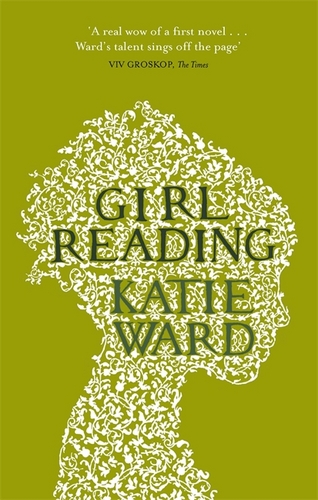
Katie Ward: Girl Reading (2011)

Katie Ward’s Girl Reading is called a novel which is slightly misleading as what it really is, is a collection of seven episodes with a similar theme which are tied together by the last one. Each of the episodes or scenes is set in another time and place, 1333, 1668, 1775, 1864, 1916, 2008, 2060. The way it is tied together, with a final scene set in 2060, gives the whole book a futuristic finish. I knew all this before I started the book but what surprised me was the writing which is quite dense, elaborate and heavily influenced by other books and tales, and, of course, paintings as the linking idea are portraits of reading women or girls seen through the ages.

Most of these “stories” are mysterious, that’s why I chose to call them episodes. They are like small windows that open up on scenes set in the past. We hardly ever get all the background information and often don’t know what will happen to the characters later.

Each of the scenes describes the challenges of women in their respective time and the girl or woman chosen for the portrait is mostly not exactly in line with what is expected of a woman at the time. The fact that the challenges and problems women face stay so similar from the 14th to the 21st century is somewhat unsettling.

Of the 7 stories or episodes I really liked four a lot. The first one, set in Siena, and the second, set in the Netherlands, were not so much to my liking nor was the last set in the future. In the case of story 1 and 2 I had a feeling I have read the exact same stories before, especially the second which was very similar to Girl with a Pearl Earring. Too similar.

I thoroughly enjoyed story 3, set in 1775 in which a female painter comes to the estate of a noble woman to finish the portrait of her lover. The lover, a woman as well, has left and the abandoned one is depressed and morose.

Story 4, set in Victorian England, was another favourite despite the fact that it resembled Audrey Niffenegger’s Her Fearful Symmetry. It’s a tale of two psychic twins. One becomes a photographer, while the other tours the world as a famous medium. It’s a wonderful story and the decor, clothes, atmosphere, are lush and evocative.

Story 5 is another wonderful story. The girl in the center will be a painter in the future but at this point in time she is a slightly silly young girl, infatuated with a painter. What is wonderful is the intensity with which she experiences life. Everything she does – smoking, drinking, falling in love – she does for the first time and savours every minute. Even being heartbroken as it seems.

While I liked some of the stories, I think story 6, set in a Shoreditch bar in 2008, was the most original and rounded of the stories. We get to know much more about the character in this story than about any other of the characters. She is a young black Tory who wants to become member of the Parliament. At the same time she has to decide whether she should get married or not. I liked the way she was described and how descriptions of the most mundane struggles, like wearing shoes which were new but painful, were interwoven with heavy decisions.

I enjoyed some of the stories a lot but as a novel Girl Reading didn’t work for me at all. While the last story, set in the future, gave it an interesting twist, it didn’t manage to really tie them all together. As a whole I found the book a bit artificial which is certainly due to the elaborate and somewhat forced writing. On top of that a few of the stories were too similar to other books I’ve read to be entirely satisfactory.

I’ve read the book along with Rikki and am looking forward to hear what they thought.

Rikki (Rikki’s Teleidoscope) First impressions, Stories 3 and 4, Stories 5-7

If anyone else has read this I would like to know which of the stories you liked best and whether this worked as a novel for you or not. Looking back, I think that story 6 was my favourite because it was the only one that didn’t feel like a pastiche.

If you’d like to see the paintings the stories are based on here is the link to Katie Ward’s site where you find the links.

Harry Mulisch: The Assault – De Aanslag (1982)

The execution of a collaborator and Nazi retaliation on the family of twelve-year-old Anton Steenwijk have lasting repercussions in Anton’s life as he learns, through chance encounters, the truth of one harrowing night. 

Harry Mulisch is an author I have wanted to read for a long time. I know he is said to be one of the most important Dutch writers.  The Assault – De Aanslag is one of his most acclaimed novels and since it isn’t as long as The Discovery of Heaven, which I’d like to read sooner or later as well, I thought it’s a good starting point.

The book is told in a prologue and 5 sequences, each set in another year, 1945, 1952, 1956, 1966, 1981.

During the course of one single night, in the famine winter 45, just before the end of the war, the life of Anton Steenwijk, a twelve year-old boy, is changed forever.

The prologue describes the location. We get to know that the Steenwijk’s live in Haarlem, in a detached house, part of a housing project with three other houses. They are small but stately houses. At the beginning of sequence one, the family sits together in the darkened dining room, the only room they still inhabit in the icy cold apartment. Anton is reading, his older brother Peter is doing his home work, the mother spools wool and the father is trying to instruct them. A peaceful moment and despite the hunger Anton is enjoying it.

When they hear shots outside in the street, the peaceful moment is interrupted brutally. Looking out of the window they see that someone has been shot down in front of a neighbour’s house and immediately after this the neighbours come out and drag the man to the front of  Steenwijk’s house. Peter is the only one to react. He runs out and discovers that the man is a well-known police inspector and Nazi collaborator. He tries to drag the man away but before he gets very far, a group of Nazis approaches.

We learn later, that in those days, whenever a Nazi or a collaborateur was shot dead, the Nazis would severely punish those living in the houses close by.

This is exactly what happens. At the end of the night Anton’s parents and brother are shot and the house is destroyed. Anton is brought to his aunt and uncle who live in Amsterdam.

How do you go on living after something like this? How do you cope?

Each of the subsequent scenes shows us Anton at another point in his life. There is no conscious coping at first. It is as if he was numb and had forgotten everything right after it happened. His feeling for time is distorted. Whenever he thinks of that night he doesn’t feel much and thinks it’s much longer ago than it really is. Still the event seems to be guiding him in all of his choices and it is impossible to leave it behind for good. It is as if a secret force was at work and pushing him towards people who will help him uncover what happened really.

Survivor’s guilt may be an important theme but morality and fate or destiny are even much more important. While it was a pure coincidence that the dead man was shot in front of Korteweg’s house, Korteweg’s chose to drag him and leave him in front of Steenwijk’s house. Why? And if those who committed the assault had known that almost a whole family would be erased, would they still have done what they did? All these questions that Anton will start to ask many years later will be answered in the novel.

The book explores the question whether it is morally acceptable to commit a crime which will have severe consequences for others, in order to prevent bigger crimes and it explores also how people live with a trauma and repression. It shows in a very subtle way that although you may not be conscious of it, the trauma still lingers and wants to be acknowledged and express itself. It will find ways to make you pay attention. Pretty much like the elements in a dream which will return as long as you have not resolved some interior conflicts. The trauma can even make you choose a profession and it expresses itself in illness and accidents.

The way Mulisch shows the complexity and symbolism in which our subconscious tries to get our attention is amazing. What is equally wonderful is how evocative and expressive his descriptions are. When we open that book, we sit there with the family in the darkened room. We see the flickering lamp, feel the rough wool of an old pullover on our skin, the hunger churning in our bellies.

I didn’t like all of the parts equally well but one thing is for sure, part I 1945, is an amazing piece of literature and as a whole it is well worth reading.

I have read Harry Mulisch for Iris Dutch Literature Month. If you’d like to discover more Dutch books, make sure to visit her blog.

Has anyone read this or another of Mulisch’s book?