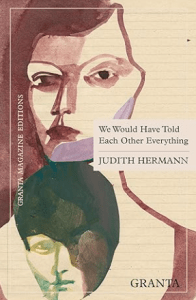
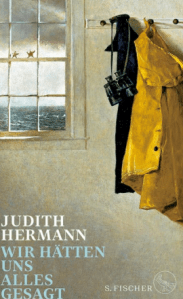
Judith Hermann – We Would Have Told Each Other Everything (Wir hätten uns alles gesagt)

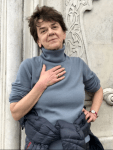
We all have authors whose every book we read. For me, Judith Hermann is one of those authors. She’s best known for her short stories but has also written novels and now, finally, her long awaited first memoir. Or rather a series of lectures on life and writing that reads like a memoir. We Would Have Told Each Other Everything will be published in English next April. Two of her short story collections, Summer House, Later and Nothing but Ghosts are available in English. Her third short story collection Lettipark, a book of five connected stories, Alice, and her two novels Aller Liebe Anfang (Tony just let me know this and Letti Park were translated) and Daheim don’t seem to have been published in English.

Hermann is a bit of a phenomenon. Her first short story collection, Summer House, Later, which came out in 1998, was published to high acclaim. Critics and readers adored it. Nobody had written quite like her before. She seemed to capture the lifestyle and mood of a whole generation – the generation of those who were in their twenties in the late 90s. She wrote about things other people didn’t write about. Young people hanging out, travelling, doing nothing, just living their life. Most of the stories are set in Berlin, Judith Hermann’s hometown. I loved that book so much, found myself in so many of the stories and have been a loyal reader ever since. Sadly, even though I liked almost everything she has written, I found, like many of her critics and readers, that she was never able to achieve again what she had achieved in her first book. Some critics were already harsh when the first book came out. Over the years the criticism got worse. I never really understood why the reviews were at times so harsh, even cruel. When her first novel came out, one critic wrote she couldn’t write and had nothing to tell. In the memoir Judith Hermann addresses this review and what she has to say is very interesting. In many ways, her response to this reproach lies at the heart of these lectures.

Judith Hermann has never spoken much about her life, her childhood, or where her inspiration came from. Her answers to certain questions were always evasive. The book explores in detail why this was the case and it also investigates what is autobiographical and how she transforms what she has experienced and turns it into literature. At the beginning of the book, she describes how she ran into her psychoanalyst, late one night in Berlin. She discovered this psychoanalyst through a friend who went to see him and then spontaneously decided to go to see him as well. It seems the friend’s therapy was already over when she began to see the therapist, nonetheless, she never told her friend, Ada, that she went to see him too. We learn that this was rather typical of her. She hardly ever spoke to people or told them anything about herself or her childhood. The more we read about her past, the better we understand why she was silent. The trauma of two world wars, mental illness, emotional abuse, were all part of her difficult childhood.

All her stories are inspired by her life, but nothing is recognizable as such. That is because of her writing technique. She writes draft, after draft, after draft, erasing every time what is closest to what happened to get to a deeper meaning and truth. Very similarly, her psychoanalyst taught her to write down a dream and then write it down again the next day and once more on day three. The thing that would be missing, would be the most essential element of the dream, the element because of which the dream was dreamt, so to speak. Talking about her writing she says that in the end she sometimes no longer knows what really happened and what didn’t.

When she read the criticism I mentioned before, she agreed with the critic. Yes, she really didn’t have anything to tell because she couldn’t really tell what was important.

A large part of the book is dedicated to her friendship with Ada and the group of friends that surrounded Ada. Many of these scenes reminded me of some of her stories. She spent a lot of time with these friends. They spent whole summers together in the house near the sea that belongs to Judith Hermann’s family. These scenes are so wonderfully evocative. The friendships she has with these people, particularly with Ada, are very intense. They experience so much together yet they don’t really talk. This chosen family, she says, showed a very familiar lack of words and speechlessness to her own.

The last part of the book is set during Corona and the early lockdowns. During that time, she moved to the countryside and made a new friend, Jon. They spent a lot of time together but this time, her silences aren’t easily accepted, almost cost her this new friendship. And that’s where the title comes from. There’s a moment during which she would have told Jon everything about her life. It doesn’t happen but she will tell him later why she is so evasive.

Many of the things she describes in this book are relatable to anyone who has suffered (childhood) trauma. So often, one can’t find a way out of silence. It’s often the whole purpose of a therapy to be able to finally tell someone everything.

I’m not entirely sure I managed to capture how much I loved this book. But I did. It will make my end of year best of. It was one of those books I didn’t want to end. She achieves something quite magical – she lets us know a lot about herself and her writing process, but she also allows us to discover ourselves more deeply. Just like she does in her best stories.

The German title of this book is interesting. During these lectures she mostly uses the word “erzählen” – “to tell a story”. For the title, however, she uses “sagen” – “to tell”. This shows, in my opinion, that she’s come full circle. She used to tell stories but left out most of what really happened in her life. Through the new friendship with Jon, and in writing these lectures, she breaks the silence and speaks about the things behind the stories. I wonder if there will be another novel or book of stories from her. In some ways it would make sense if this was her last book. I hope not though.

For those who don’t want to wait for the publication of the English book there is either a part or even the whole translation by Katy Derbyshire on the Granta website here.
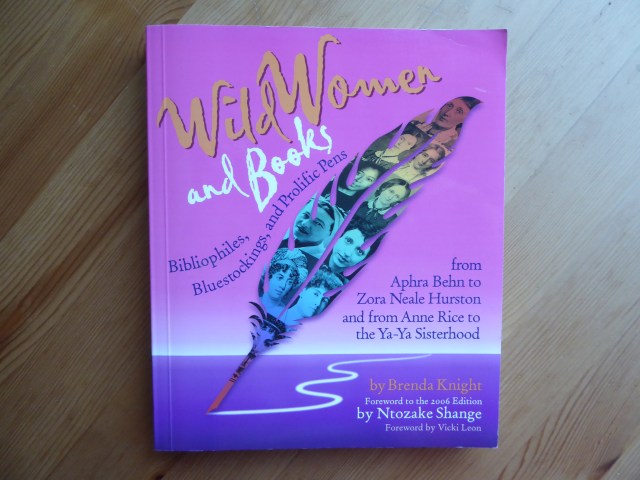
Wild Women and Books by Brenda Knight – Bibliophiles, Bluestockings, and Prolific Pens – A Post a Day in May

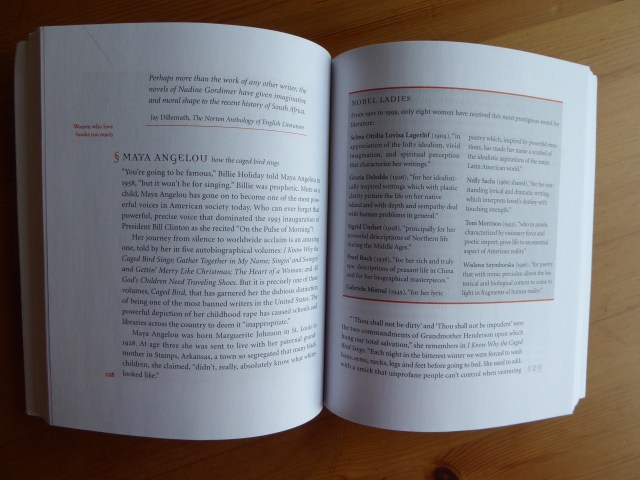
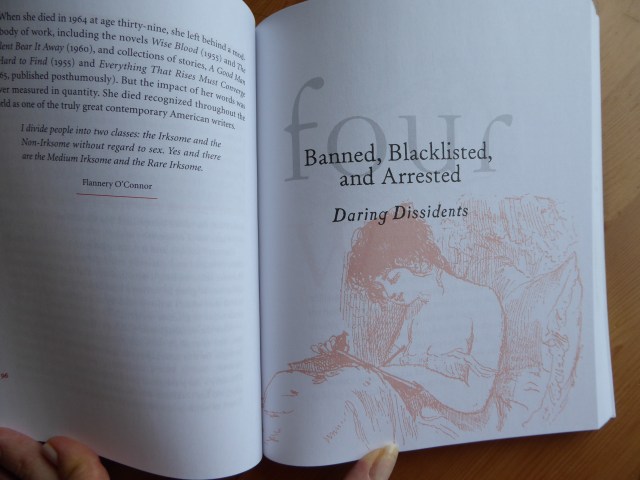
I kept this one for last as it’s hands down one of my favourite books. Wild Women and Books – Bibliophiles, Bluestockings, and Prolific Pens contains entries that span from Aphra Ben to Zora Neale Hurston. Now this may sound like it’s similar to Literary Witches but it’s quite different. It’s a much bigger book and while it contains photos, illustrations, and pictures of artwork, there is a lot of text in each chapter and on each writer. Additionally, to the chapter texts, it has boxes that give information on where to find the authors online and themed lists.

There is a total of seven chapters.

Chapter 1 – First Ladies of Literature is on the precursors and pioneers like Anne Bradstreet, Aphra Behn, Harriet Beecher Stowe, Lorraine Hansbury.

Chapter 2 – Ink in their Veins focusses on women who come from writing dynasties, like the Brontës or Mary Shelley.

Chapter 3 – Mystics and Madwomen explores authors like Hildegard von Bingen and Teresa of Avila.

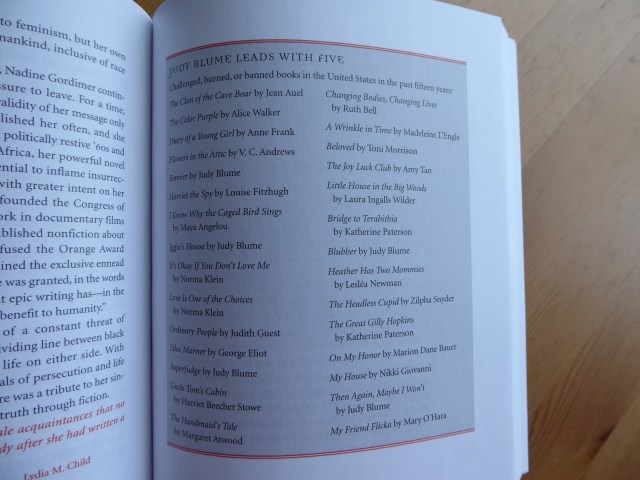
Chapter 4 – Banned, Blacklisted and Arrested is particularly fascinating. Why do women get blacklisted and who are they? I’ve always been baffled when I saw these lists of books that have been banned in the US. You can find many of them above. There are a lot of children’s authors like Judy Blume on that list.

Chapter 5 – Prolific Pens explores those women who seem to be publishing nonstop or have published a lot like Margaret Mead, Joyce Carol Oates, and also Margaret Atwood, Edith Wharton, Danielle Steel, and Barbara Cartland.

Chapter 6 – Salonists and Culture Makers looks at authors like Dorothy Parker, Simone de Beauvoir, Virginia Woolf, Getrude Stein, Djuna Barnes and many more.

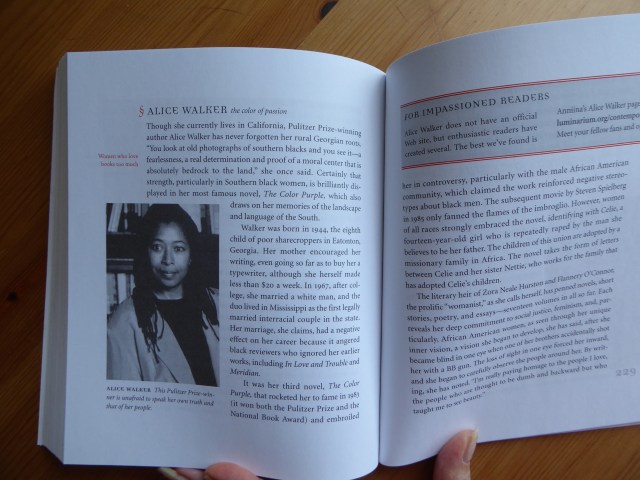
Cahpter 7 – Women Whose Books are Loved too Much is interesting and diverse. These are the authors who have a large fanbase, fervent followers and admirers. Some of them are Agatha Christie, Alice Walker, Anne Rice, and Margaret Mitchell.

I’m sure it’s easy to see why this is such an appealing book. Anyone will stumble upon authors they hadn’t heard of before as it is so diverse. The high and the low and those in the middle, they are all there. The book has a handy index at the back, lists with online book groups and further reading on women and books. Wild Women was initially published in 2000 and then reissued and updated in 2006. The only bad thing – it looks like it’s currently out of stock but second hand copies are cheap and easily available and there’s a kindle version too.

Night Walks by Charles Dickens – London by Night – A Post a Day in May

Today’s post is very short. We have the most delicious reading weather and I want to make the most of it. Yesterday the thermometer on my shady balcony showed 30°. It was hot and humid, so, as was to be expected, we have rain today. Not just a drizzle, a downpour. The back garden is full of very old trees with dense foliage that is now dripping with rain. It’s wonderful. The best reading weather ever.

Night Walks, one of the titles from the Penguin Great Ideas series, contains several journalistic texts Charles Dickens wrote between 1850 – 1870. I’ve only read the first short piece so far, the one that has given the book it’s title – Night Walks.

During a certain period of his life, Dickens suffered from insomnia. It was due to a “distressing impression” and led to his wandering the streets of London all night during a series of several nights. He never says what distressing impression caused his insomnia, only speaks about the cure. Since he couldn’t sleep, he decided, it would be best to go for long walks. He must have left the house around midnight and only returned after sunrise to, finally, fall into an exhausted sleep.

This is a very short piece but it’s immensely enjoyable. Dickens describes his nightly London so well, creates such an uncanny atmosphere, touches on so many themes like homelessness, social injustice, poverty, mental health, in a mere 15 pages.

But the river had an awful look, the buildings on the bans were muffled in black shrouds, and the reflected lights seemed to originate deep in the water, as if the spectres of suicides were holding them to show where they went down. The wild moon and clouds were as restless as an evil conscience in a tumbled bed, and the very shadow of the immensity of London seemed to lie oppressively upon the river

He starts his walk close to Waterloo Bridge, at the time, a toll bridge, and walks on in the direction of London Bridge, Westminster, and ends at Covent Garden. He passes prisons, asylums, and theatres. After two in the morning, when the last pub closes, it gets very quiet. Only very few people are out and about and he cherishes what little contact he has, with the man on the toll bridge for example. His favourite parts seem to be having a light breakfast at Covent Garden or watching the mail come in at a railway terminus.

I tried to find out what caused Dickens’ insomnia and came across this interesting blog post

That Doesn’t Mean What You Think it Means by Kathryn Petras and Ross Petras- Misused Words and Their Tangled History – A Post a Day in May

Are you fond of words and their etymology, their meaning, their use? Do you chuckle when someone misuses a word and the sense of the sentence is totally not what the speaker/writer intended? I’m one of those people. Endlessly fascinated by words and their meaning. Easily amused by their misuse.

If you’re like me, then That Doesn’t Mean What You Think It Means is the perfect book for you. The authors have compiled 150 entries in which, starting from a quote in which a word is misused, they explain the history, the various changes in the meaning of certain words and their correct use. Some words are on their own like scarify or refute, others paired with a word that either sounds similar or has a similar meaning like ingenious/ingenuous, hurdle/hurtle. There are also expressions like begs the question. The entries are in alphabetical order starting with a priori and ending with wet your appetite/whet your appetite.

Many of the quotes made me chuckle, but so did the entries. They are not only informative but often very funny.

Here’s the beginning of the entry for preternatural

“Whole Foods . . . is the largest supermarket in Manhattan. Milling about its preternaturally clean aisles and sculptured displays of produce, shoppers move pastorally slowly by New York standards.” – From Greening the red, white, and blue: The bomb, big business, and consumer resistance in post-war America

Unless you think finding grass-fed beef steaks for 6.99$ a pound is a paranormal event, going to Whole Food isn’t a supernatural experience. It seems kind of ordinary to us.

The authors then go on to explain the Latin source of the word, compare it to the word supernatural, which is close, mention where it’s been used and how and then end with the definition.

I was surprised that I don’t mix up many of these words, even though English isn’t my native language, but that is certainly because many of the words are Latin or Greek based and can also be found in French and German. Plus I had eight years of Latin at school.

But there were word pairings like nauseous and nauseated that I also misuse. I didn’t know that you shouldn’t say you feel nauseous about something but nauseated. The thing that makes you feel nauseated is nauseous.

Even though I was familiar with many of the words, I didn’t always know where exactly they came from or how they were used formerly. Nauseous, for example, really did once mean nauseated in the US.

Here are a few more of the pairings that are often misused or mixed up:

all together/altogether, loath/loathe, tortuous/torturous, economic/economical.

Nobody is likely to misuse the words of this entry any day soon:

Pandemic/Epidemic/Endemic

“In 2016, the board clashed with directors of the film Udta Punjab, a film depicting the drug pandemic in the west Indian state of Punjab, when it asked for multiple cuts.” CNN

They obviously mixed up pandemic and epidemic.

I bought this book when it came out in 2018 and since then it has become a favourite to which I return again and again. I always discover something, always learn something. How to really use some words or about the original and former use. It’s a book that would appeal as much to those who love grammar as to those who are interested in the origin of words.


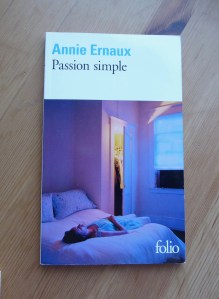
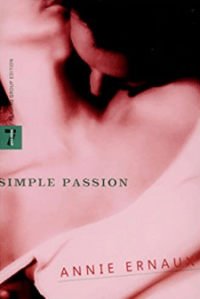
Simple Passion by Annie Ernaux – French Life Writing – A Post a Day in May

I own everything Annie Ernaux has written up to The Years but have only read a few of her books. Since her books are so short, she seemed an excellent choice for my May project.

Annie Ernaux is divisive. Some people adore what she does, others are put off. Those who love her, praise her honesty, those who don’t, find her indecent. I go back and forth between these two reactions. Sometimes I find it a bit too much, as well. At other times, I’m just so fascinated.

What helped me get along with her better, was to see her oeuvre as a whole. Sure, you can read single books, but you will get so much more out of reading her, when you read more or all of her. It’s never just about the story or the topics of a book with her, it’s always about the process of writing and giving meaning. Writing about a woman’s life, her body, and often, her sexuality.

Several books have been rewritten Simple Passion, her account of her love affair with a Russian diplomat, is one of those. She wrote another book about her affair many years later – Se perdre (To lose oneself – not translated, I think). Aa a reader, you often wonder – Why does she write about this? Why does she have to reveal herself like this and so does she. You’re always part of the writing process as well, part of the thought processes behind the writing.

In Simple Passion (Passion Simple), Annie Ernaux analyses a love affair she had with a married man, the previous year. The affair lasted over a year and was all-consuming. She couldn’t think of anything else but him. Couldn’t find interest in anything else or anyone else, unless they somehow reminded her of him or had something in common with him. She sat whole days next to the telephone, waiting for his call. Spent whole afternoons preparing for his arrival; shopping new clothes, painting her nails, applying new make-up.

The absence of a call is agony. A call is bliss. She’s completely dependent on this man and doesn’t exist outside of their meetings. It’s never as apparent as when she goes on a holiday to Florence. She doesn’t even want to look at anything. Just wants to think of him, imagine how he would see the place.

The book describes everything. Her weakness, her dependence, her desire, her obsession. It’s like reading the account of a drug addict. She’s aware of that herself but there isn’t anything she can do. She wonders sometimes, if he feels the same, but she has no idea. Conversation isn’t exactly part of the whole affair. Sex is important, everything else, not so much. But that is also because of the language barrier. It’s not said in this book that he’s Russian, but in a later book it is revealed. She doesn’t speak Russian, and his French, while good, is not always accurate. He has difficulties to translate deeper meaning.

Since he’s a diplomat, it’s always clear, the affair will end. When it does, she’s shattered. And she takes note of the world around her again. And writes about her affair. It takes her five months during which the Berlin wall falls and the Ceaușescus are executed.

After having finished to write about her affair, she suddenly feels shame. A shame she never felt during the affair, a shame that comes from the idea to publish.

I found the way she described this affair interesting. Most of it rang so true. Haven’t we all waited next to a phone before? Spent afternoons getting ready or endlessly talking and thinking about our love interest? I never found it problematic, that she’s honest. I found it problematic that she never questions having an affair with a married man. Not once. It’s all about her and her feelings. He’s only interesting as far as he’s the object of her desire. And the other woman? It’s as if she doesn’t exist. Obviously, this shows how honest she is, as it doesn’t really make her look good.

People were shocked when this came out in the 90s. Also, because it was a departure from her earlier work and because it’s so explicit about female desire and sexuality. It was certainly courageous to write and publish this at the time. Nowadays, I find it a bit sordid. Not because of the descriptions – it’s never very explicit anyway – but, as I mentioned, because there’s another woman. If it’s a feminist act to live our passions, isn’t it also a feminist act to think of the other woman? I’m not judging that it happened, that would be naive, these things do happen, but that she’s never thinking or writing about it.

After the translation of The Years, Annie Ernaux received a lot of attention outside of France. She’s interesting, well worth exploring, but I’d say, this isn’t the best entry point to her work.

If you’d like to read another review – here’s on I wrote on A Woman’s Life. I liked that one a great deal.

Best Books I Read in 2019

There hasn’t been a year since I started blogging in which I reviewed as little as in 2019. I also read less, or rather, I finished less books. I have two huge stacks of almost finished and half-finished books next to my bed. I’ve never done this before, given up on a book twenty to thirty pages before its ending but I did this year. Some of them will still be finished someday but many, I guess, won’t. Not sure why this happened. Did I make bad choices? Was I in a reading slump? A bit of both, I suppose.

That said, I have read some wonderful books this year.

And here they are, in no particular order.

Fiction

William Maxwell – They Came Like Swallows

Tragic and beautiful, Maxwell’s book is one of the few I reviewed. Here’s what I said:

I’m full of admiration for the craft and looking forward to reading The Château next. And I think it’s an outstanding portrayal of grief and the awkward ways people treat the bereaved. It also shows very well how devastating the influenza pandemic was.

Philippe Delerm Sundborn ou les jours de lumière

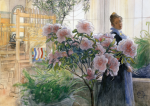
Anglophone readers might not be familiar with Philippe Delerm, but let me just tell you – it’s an absolute shame. He’s one of my favourite French writers. After having read Autumn, his book on the Pre-Raphaelites, I chose to read Sundborn last year. Sundborn focusses on the Scandinavian artists surrounding Swedish painter Carl Larsson. Delerm is outstanding at capturing colours, landscapes moods, and this book is no exception. Anyone who loves Carl Larsson or Soren Kroyer would love this book. It needs to be translated.

Carl Larsson

Soren Kroyer

Barbara Pym – Excellent Women and Some Tame Gazelle

No need to introduce Barbara Pym to the readers of this blog. She’s a favourite of many. These were two excellent, witty, sharp, and at times amusing books. I couldn’t say which one l liked better. Possibly, Some Tame Gazelle, as it is a bit gentler. I’m a bit mad at myself for not reviewing them but when I read them, I was still in too much back pain to sit at my desk.

E.F. Benson Mapp and Lucia

While I didn’t review Barbara Pym, I did write a post on E. F. Benson’s famous Mapp and Lucia. What a delightful book. One that left me with a serious “book hangover”. It took weeks until I was able to move on and properly enjoy something else.

Here’s a bit from the review:

And there’s life at Tilling. A carefree life that’s so different from most of our lives nowadays. Not only because it’s set before WWII, but because it’s set among the British upper middleclass. Nobody works in this book. All the main characters own beautiful houses. All they think about is where they will dine next, who gives the best tea party. Gossip and petty quarrels aside, it’s a peaceful world. The conflicts are entirely the character’s own making. Nothing dramatic ever comes from outside. At least not until the end. After a while, I found spending time in this world very comforting. And funny. It’s a terrific social comedy. Lucia’s pretence to know Italian is hilarious and so is the way they constantly try to outsmart each other.

Joseph Roth Der Radetzkymarsch

Death, dying, and the end of an era are all themes in this marvellous novel. Sometimes you wonder why a book is a classic. Not in this case.

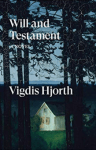
Vigdis Hjorth Will and Testament

This novel by Norwegian writer Vigdis Hjorth was so good and I did review it.  Here’s a bit from the review:

Will and Testament was a huge success in Norway, and I can see why. It’s highly literary but nonetheless as captivating as a thriller. The plot is moving back and forth in time, slowly revealing the dark secrets at the heart of the dysfunctional family depicted in the novel.

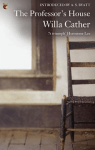
Willa Cather – The Professor’s House

Since I’ve started blogging, almost tens year go, I came across so many raving reviews of Willa Cather’s work. Every year I said the same – I need to read her but then I didn’t. Last year, finally, I read my first Willa Cather and the only thing I regret is that I didn’t review it. What a wonderful book. One could say it’s almost two books in one, something I’m usually not keen on but it really worked. First we have the more interior parts, told from the point of view of Professor St. Peter. Anyone who has ever tried to carve out some time for her/himself, will know how hard it can be to work either creatively or do research when there are many demands from friends, family,  . . . Professor St. Peter tries very hard and succeeds and the time he spends on his own turns into a trip down memory lane. He thinks about his former student and friend, Tom Outland, who died in the Great war. His death brought great wealth to St. Peter’s family but also complexity and animosity. The second book inside of the book is Tom Outland’s story. And in that part we see what Willa Cather was so famous for – her landscape descriptions. It’s quite magical.

Crime

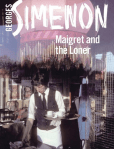
Simenon – Maigret et l’Homme tout seul – Maigret and the Loner

It’s been a while since I’ve last read a Maigret. They are a bit hit or miss, but this one was fabulous. A homeless man has been killed and it seems so absurd. He kept to himself, had no possessions. What could anyone gain from killing him? Maigret’s in the dark for a long time. The end is surprising.

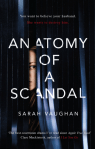
Sarah Vaughan Anatomy of a Scandal

This is embarrassing. I read this last January, didn’t review it and have practically forgotten everything about it. I just remember I LOVED it.

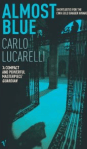
Carlo Lucarelli Almost Blue

I love a good noir. The mood, the atmosphere. This has all that and more. It’s a rare beast as it’s a genre blend. A serial killer noir. Don’t let that put you off. It really is good.

Nonfiction

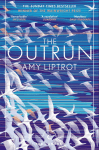
Amy Liptrot – The Outrun

Another one of the very few I’ve reviewed. Such an amazing memoir about the way nature can help us heal.

Here’s a bit from the review:

I can’t recommend this highly enough. It’s an amazing insight into someone’s addiction and recovery and a fabulous account of life on Orkney. I could see the many migratory birds, feel the icy cold of the water, the force of the gales, and the beauty of the constellations in the night sky.

In defiance of this dissatisfaction, I’m conducting my own form of therapy through long walks, cold swims and methodically reading old journals. I’m learning to identify and savour freedom: freedom of place, freedom of damaging compulsion. I’m filling the void with new knowledge and moments of beauty. (p.180)

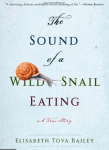
Elizabeth Tova Bailey – The Sound of a Wild Snail Eating

If I had to pick one favourite of all the books I’ve read, I’d say it was this one. It’s beautiful and fascinating. Elizabeth Tova Bailey contracts a mysterious viral or bacterial infection that leaves her tied to her bed for years. During an especially bad phase, a friend gifts her a terrarium with a tiny forest snail in it. This tiny being becomes her companion. She’s so fascinated by it that she begins to read up on gastropods. The world she discovers is amazing. (Did you know snails have between 1’000 and 12’000 teeth?). The result of her research is an absolute gift to the reader. But the tiny snail does more than fascinate. It gives her comfort and solace.

Angelika Overath – All the Colors of Snow – Sent Diary – Alle Farben des Schnees

Have you ever dreamt of moving to the place where you spend your holidays? That’s exactly what German journalist and writer Angelika Overath did in 2007. She, her husband, and their youngest child moved to Sent, a small village in the Engadine region of Switzerland. Before that, they lived in Tübingen, Germany, where her husband was a professor at the university. Her two older children stayed in Tübingen.

Shortly after they moved, Overath was asked whether she wanted to write something for a local newspaper about moving to her holiday home. That article was the starting point to this book— a diary of a little more than a year in her new home Sent.

I read a few of the diary entries in an anthology and liked them so much that I wanted to read her whole book. As a child, we used to spend many holidays in the Engadine region. My mother had a Swiss friend whose family owned a holiday home there. The scenery is spectacular and I was always fascinated to see how differently the seasons changed in the mountains. I never spent a Christmas there, only New Year, but it must be lovely as the parts I read in the anthology, and now reread, take place during Christmas and Overath describes so many wonderful things and interesting customs.

The descriptions of the changing seasons are some of the best parts in Overath’s “diary”. That and her joy to be somewhere she loves as much as she loves the Engadine. She describes what it takes to change status, to move away from being a tourist and become a local. In her case, it’s not that easy because, as you may know, the Engadine region is the Swiss region, where the fourth Swiss language – Romansh (Rätoromanisch) is spoken. People speak some German and Swiss but they distinctly prefer to speak their own language and in order to get fully accepted it’s better to learn to speak the local language.

While her son, who is only seven when they move, picks up Romansh easily at school, and her husband has a greater facility to learn Romansh, it’s not that easy for Angelika Overath to learn the language. But since she’s so enthusiastic, she uses a special way for herself, which I found quite ingenious and well-worth copying. In order to familiarize herself with the language, especially the nuances of the vocabulary – many words sound similar but have  a completely different meaning – she began to write poetry in Romansh. The result is quirky and playful. It’s a brilliant way to learn a new language.

I enjoyed this book a lot because of the beautiful descriptions of the landscape, and the many interesting people that populate these pages. The Overaths have a rich social life and meet many fascinating people. Sent seems to be a place that attracts a lot of foreigners, artist, writers. It’s also a place people seem to return to after having stayed abroad for a while.

My only small reservation concerns the term “diary”. In my opinion, this is rather a notebook than a diary. Angelika Overath herself, her interior life is almost completely absent from these pages. One can sense it was meant for an audience and not as personal as diaries normally are. But that’s a tiny reservation. It’s such a rich and diverse book that has a lot to say about moving to another country, learning a new language, new ways of living. It also describes beautifully the charm of living in a small community. And her love for the mountains, the short but intense summers, and the long, cold, snowy winters, can be felt on every page.

Sadly, so far, none of the books by Angelika Overath have been translated into English. This book would be interesting for American readers as there are several entries set in the US, during the summer, when both she and her husband teach at a college in Vermont. Since I liked the way she wrote, I might try one of her novels next.

Did you ever want to move to a place where you spent your holidays? I know I did. I often dream of moving to the South of France. It wouldn’t be a challenge language-wise, so, maybe, that doesn’t count.