Nora Murphy: Knitting the Threads of Time Casting Back to the Heart of our Craft (2009) A Memoir

You don’t need to be a knitter to enjoy this book. I am not. Still I liked this book for many reasons. It is a memoir in which Nora Murphy takes us on a personal journey on which she starts and finishes a difficult sweater for her son and explores the manifold meanings of knitting, yarn and clothes.  Now is the perfect time to read it as the memoir starts in October and ends three months after All Soul’s Day. Her style is very evocative.

A woman sits in her comfy chair. Two needles and a ball of yarn keep her company. She is knitting away at something. Maybe a scarf? Socks? She enjoys the sound of her needles beating like a soft drum. She inhales the smell of the waxy yarn. She exhales the satisfaction of watching a single strand transform into an object of beauty. She is perfectly present, in perfect bliss. (Epilogue, Darkness Falls p. 3)

And another teaser:

October is a bit like the last dance in Minnesota. We know it’s the first month of darkness, but we don’t want to acknowledge it. We’d prefer to keep our attention on the sunlight dancing off the red and orange and yellow and gold and brown mosaic in the trees overhead. But we know better – a long winter awaits us. (Leaves p. 13)

Nora introduces us to herself, her family and her friends and the people she meets on her journey. She opens up her house and her heart for us. We are allowed to catch a glimpse of her cozy little home and the life she lives with her two sons and Diego her friend and lover. Through her we meet a woman who owns a yarn shop, an owner of a sheep farm and all of her animals, and many other people. We get to know Minnesota through several seasons. And we learn a lot about yarn. Nora Murphy combines history and cultural anthrolpogy. I did not know, for example, that King George’s Wool Act of 1699 might have been responsible for the American Revolution. England felt its wool industry was threatened by the colonies and forbid to export sheep to America. But some animals had been smuggled in and where already quite numerous by 1665. At some time, anyone found guilty of trading in wool faced severe punishment. The cutting-off of hands is mentioned. However, unlike Ireland, America was too far away from England to be threatened for long and the way to independence could not be blocked forever.

Nora’s book is also a lesson in values. Cherish the moment. Learn from the past. Try something new. Remember the simple things. In a world that spins in confusion she tries to build stability and conveys this to those around her and her readers. I felt very comforted, enchanted and energized by this book.
Nora Murphy’s Homepage

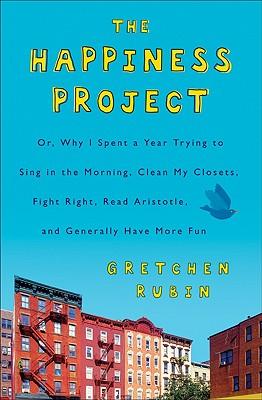
Gretchen Rubin: The Happiness Project: Or, Why I spent a Year Trying to Sing in the Morning, Clean my Closets, Fight Right, Read Aristotle and Generally Have More Fun (2009)

This is not going to be one of my better reviews as I am highly annoyed by this book and the live style it propagates. So instead of a review this is rather a rant. I do however still like Rubin’s blog as it is very colorful and many people tell little stories of their lives.

A word of caution at the beginning seems appropriate:  The Happiness Project is not about happiness, it is about having fun. And if you want to have fun the way Gretchen Rubin teaches it you will need money.

I felt a bit uneasy with her book early on. It is well written and entertaining to read but did not feel right. When I finally came to her view on Buddhism I realised what had bothered me subconsciously right away. There is a big difference between attachment and non-attachment. If you are influenced or attracted by Hinduism and Buddhism then this book will be a great disappointment  to you since it does equal  happiness to materialistic well-being. This is frankly infuriating. It takes a certain arrogance to show means how to improve your life through things and activities that will cost money. Gretchen Rubin’s way to happiness is not for free.

Just read the following quote taken from the chapter “Mindfulness” and you will see, what I mean regarding attachment/detachment:

I’d always been intrigued by Buddhism, so I was eager to learn more about both the religion and the life of the Buddha. But although I admired many of its teachings, I didn’t feel much deep connection to Buddhism, which at its heart, urges detachment as a way to alleviate suffering. Although there is a place for love and commitment, these bonds are considered fetters that bind us to lives of sorrow – which of course they do. Instead, I’m an adherent of the Western tradition of cultivating deep passions and profound attachments; I didn’t want to detach, I wanted to embrace; I didn’t want to loosen, I wanted to deepen. Also, the Western tradition emphasizes the expression and perfection of each unique, individual soul; not so in the Eastern tradition.”   (p. 235/236)

I think this about sums it up.

If however you want to improve your daily life, de-clutter your apartment, hear how to better your relationships with your husband, children, family and friends, then you might enjoy this book. It will show you how to spend and buy things, how to hoard your memories and so on and so fort.

I admit that if I had read the subtitle more carefully I wold have known what to expect. Still, leaving aside the detachment/attachment dichotomy, I believe there is no happiness without creativity and this is an aspect that is not covered at all. Apart from a little paragraph on scrapbooking there is no exploring creativity.

Apples for Jam: A Colorful Cookbook by Tessa Kiros (2007)

A cookbook needs to fulfill much more than just provide us with recipes. Ideally it appeals to us visually as well as content wise. I have come to think of cookbooks as the grown-up’s counterpart of illustrated children’s books. We do not just use them, we enter another world by means of opening them. Enchantment is what we are looking for. And advice. Most cookbooks, unless they are of the „How to“ and „Basic cooking“ kind, are conceptual, either dedicated to the cuisine of a country or region or to a specific food group. Many are written by famous chefs.

Tessa Kiros’ Apples for Jam: A Colorful Cookbook is unique in its kind. It artfully blends memoir and cookbook and takes us on a voyage back to our own childhood. Apples for Jam consists of  a collection of easily followed recipes interwoven with wonderfully colorful photos and prettily designed pages.

The recipes we find stem from the realm of family cooking. Recipes handed down from one generation to the next. Meals and food that is and was meant to nourish, comfort and console. The type of food mama used to cook when we came home from school worn out or downright crying. You will also find a lot of favourite children’s food that seems to have  stayed remarkably the same over the decades. Children’s palates do not crave for the all too sophisticated fancy cuisine of five-star chefs. And maybe we have gotten tired of it as well. We want the simple things again. Homemade meals with only a few ingredients that are all the more flavourful for being recognizable. You will find recipes for salads and main courses like “Chicken cutlets with parsley and capers”, alcohol free drinks such as “Cranberry syrup” and a wide range of deserts among which there are ice creams, cookies and cakes. No fancy hors d’oeuvre or starter courses.

It is a book that will especially appeal to color sensitive types as it is organised by colors, starting with orange, yellow, pink and green, heading on towards, gold, white and brown and ending with color themes “monochrome”, “stripes” and “multicolor”. Recipes and ingredients  echo and play along the lines of those colors.

But what is maybe the nicest about this book is its capacity to enchant. If you do not feel like cooking you can still enjoy the artwork, relish in the photos and read the little stories and Tessa’s childhood memories and let her take you back on a trip to your own cherished past.

Apples for Jam: A colorful cookbook by Tessa Kiros (2007), Andrews McMeel Publishing, Kansas City