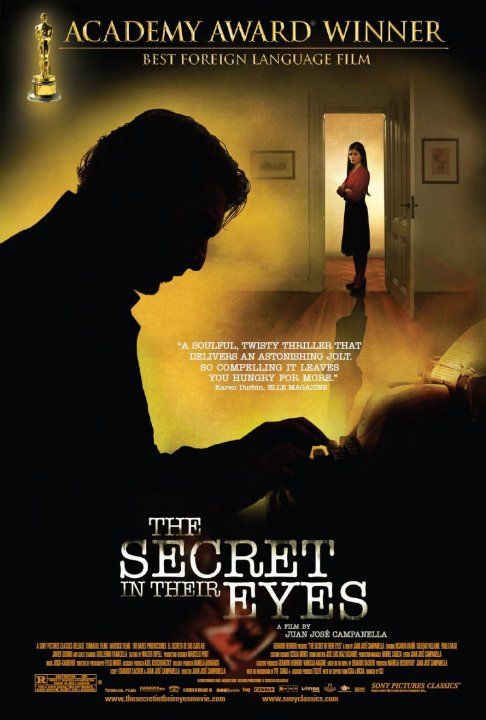
Juan José Campanella’s El Secreto de Sus Ojos / The Secret in Their Eyes (2009) An Argentinian/Spanish Thriller

Juan José Campanella’s movie El Secreto de Sus Ojos aka The Secret in Their Eyes is an unusual thriller. It’s a Argentinian/Spanish co production, based on Eduardo Sacheri’s novel El Secreto de Sus Ojos.

The story is told in an unusual way, takes many twists and turns and offers an astonishing and thought-provoking ending.

Benjamín Espósito is a retired Argentinian federal agent. He has started to write a novel about a case that happened many years ago and that took an unsatisfactory turn. Liliana Coloto, a beautiful young woman, was brutally raped and murdered in her own apartment. Although Espósito and his colleague probably found the killer, the man was let go.

Espósito writes his novel for many reasons, one of which is giving an ending to something that didn’t have one. In order to achieve this, he revisits the case and the people who were involved.

Espósito pays a visit to the former chief of the department, Irene Menéndez-Hastings and tells her about his plans to write a novel about the case. She isn’t very keen on the idea. The case and its outcome were too upsetting. And there may be other reasons why she doesn’t want to remember what happened so many years ago.

The story of the case is told in flash backs and bit by bit we see what happened, how the people involved in the investigation lived, how they got emotionally involved in the case. Espósito cares a lot about Liliana’s husband. The man is devastated by the loss and the brutality of the crime and tries to find the murderer on his own.

In a conversation between Liliana’s husband and Espósito, Liliana’s husband says that he wouldn’t want the man to be executed. Capital punishment would be much too merciful.

I liked this movie a lot, it’s very melancholic, manages to interweave different story lines and offers a few interesting themes like writing as a means to find closure,  second chances, capital punishment and justice. The characters are very complex and interesting.

The movie is mysterious for a long time but I can assure you that everything is resolved in the end, all the loose ends will be tied together.

I’m not always tempted to read a novel after having watched a movie but it in this case I’m really curious. Has any one read the Spanish original? The English translation The Secret in Their Eyes will be out soon as well.
.

12 Recent German Movies on German History

I have said it repeatedly elsewhere, I think that Germany produces some of the best movies and especially when dealing with German history they have shown great talent. Many movies that have stayed with me far longer than the 1.5 – 2hrs it took to watch them were German. Here are some of the best of the last decade. They are all focusing on history, sometimes local (Requiem, Sass), mostly on a larger scale. All of them are good or very good or at least (Dresden) they manage to show something that hasn’t been shown like this before.

Sass (2001) Sass tells the incredible true story of the brothers Sass. After getting into huge financial problems they become the most famous bank robbers in Berlin in 1924. They were so cheeky and cunning that they became heroes. The police just couldn’t get them. It’s a wonderful period piece that reawakens the Berlin of the 20s with its salons and smoky dance halls. Ben Becker and Jürgen Vogel are two of my favourite German actors and they are great as the brothers Sass. Rola wanted to make a “Larger than Life ” movie and did well.

Herr Lehmann aka Berlin Blues (2003) Based on Sven Regener’s outstanding first novel, Herr Lehmann tells the story of a barkeeper in West Berlin’s Kreuzberg just before the wall falls down. It’s not as good as the book but still worth watching as it captures the “alternative scene” of the 80s very well.

Goodbye Lenin (2003) This is the funniest movie and maybe one of the best German movies ever. It’s simply brilliant. It portrays the former DDR in a humorous way but manages to really show what it must have been like to live behind the wall. It is also able to show what people who grew up in the DDR miss about it. Alex’ mother is in a coma when the wall is removed. She awakes and because the doctor says she shouldn’t be stressed or she might die of a heart attack, Alex tries to keep the DDR alive for her. This is extremely difficult. The trailer gives you an idea of the problems they face. It’s hilarious.

NaPoLa aka Before the Fall (2004) NaPoLa shows the machinery of the so-called National Socialist Elite Schools. It shows how the black pedagogy led to total subordination albeit costing the souls of those who were not totally accepting. It’s a shocking and tragic movie. It conveys how the Nazi regime already got hold of the very young and through ritual and discipline achieved to turn the young people into mindless machines.

Der Untergang aka The Downfall (2004) The last weeks of Hitler showing an outstanding Bruno Ganz. Der Untergang captures Hitler’s madness and the madness of those around him. It’s very chilling and a must-see.

Sophie Scholl – Die letzten Tage aka Sophie Scholl – The Final Days (2005) Sophie Scholl is very moving film that tells the last days of the Geschwister Scholl or Weisse Rose, as they were called. It shows what people are capable of. It makes you want to become a better person and to put yourself behind an ideal. Sophie is such an admirable young woman and it’s hard to believe that someone so good existed, someone so unflinching and strong. Very sad and touching. She was one of the heroes of WWII Germany.

Das Leben der Anderen aka The Lives of Others (2006) Another look at life in the former DDR. What was it like to be under suspicion in the DDR? What was it like to work for the Stasi (Staatssicherheit/secret police)? The terror and horror of the life under a totalitarian regime.

Requiem (2006) Based on a true story this movie tells about a shocking event that took place in the 70s in Germany. The young student Michaela who suffers of epilepsy leaves her home in which she suffocates. Her parents are ardent Catholics and didn’t leave her any freedom. In the city she enjoys life until she starts to have psychotic episodes. Believing she is possessed by the devil, she seeks help from a priest who will try to exorcise the demon. This is not a horror movie, mind you, but it is no less shocking. Superstition and fanaticism will cost the young woman her life.

Dresden (2006) Dresden is a TV production and a bit corny. I wouldn’t recommend it here if it wasn’t the best movie on the bombing of Dresden that I have ever seen. If found it very well done (apart from the tacky love story). It gives you an idea of the atrocity of the burning city and is very thought-provoking. Were the Allies really justified to erase a whole city like Dresden, a city of culture and art? Was the bombing of Dresden a war crime?

Die Fälscher aka The Counterfeiters (2007) Germany WWII. Crooks, thieves, communists and Jews all land together in the Concentration Camp in Sachsenhausen where they will help the Nazis to forge the money of the Allies. Helping the Nazis, is helping them to win the war. Opposing them could cost you your life. It’s based on a true story and explores the question whether you are allowed to think of yourself while the whole world is at war.

Der Baader Meinhof Komplex (2008) In the 70s things were not as they should have been in Germany. Many of the former National Socialist party, ex-Nazis,  were still in important positions. The US had their bases in Germany. The Vietnam war was raging. A couple of students didn’t want to take it any longer. They protested and then terrorized the country systematically. The famous heads were Andreas Baader, Gudrun Ensslin and Ulrike Meinhof. This is their story. Extremely worth watching. You cannot deny that they were right, only the means to achieve justice were not well chosen. And they paid for it. Each and every one of them. But what is the most amazing, is the fact that they were willing to go the whole way. You cannot be more radical than this.

Anonyma – Eine Frau in Berlin aka Anonyma –  A Woman in Berlin (2008) Berlin at the end of WWII. If you ever wondered what happened to the women in Berlin when the Russians arrived… This excellent movie will tell you. It is based on the diary of a German woman who lived in Berlin at the time. It’s a tale of rape and ruins. And despite all this, quite a beautiful love story.

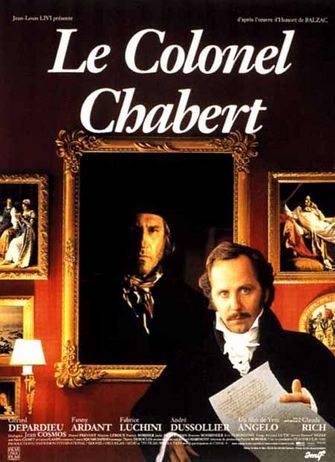
Yves Angelo’s Le Colonel Chabert (1994)

I am really glad I have watched this movie. I liked every minute of it. It’s beautifully filmed, the interiors are wonderful, the actors are extremely good.

One of the problems I usually have when a movie is based on a book is that so much I liked has been left out. Le Colonel Chabert is an example of the opposite. Where the book gives us just a few details, the movie elaborates them. The character portraits are much more interesting; the Countess Ferraud and the lawyer Derville, have more depth and complexity and also the Count Ferraud, who is more or less just a distant presence in the book, becomes a real person.

I will not summarize the plot, I have already done this in the review of the novel, I will rather point out a few differences and how the film director managed to put into pictures what has before been put into words.

The movie starts with a view of the battlefield. This isn’t easy to watch. I mentioned somewhere else the problems I had with the movie Waterloo because of the dead horses. The amount of wasted horses is heartbreaking. The scene is very graphic; bodies of men and horses are piled up high and disposed of, just like garbage. There are three instances like this in the movie. They are falshbacks and represent what the Colonel Chabert remembers from the battle of Eylau where he was so severely wounded that he was reported dead.

While the book is rightly called Le Colonel Chabert, the movie could also have been called The Countess Ferraud. There is much more emphasis on her and the role and fate of women in the French society in the 19th century. She is not only greedy and ambitious like the Countess in the novel but she is also a woman who fights for her survival in the society. The movie shows that they are just pawns in a game and that “love” mostly equals lust and where that ends, “love” stops. A woman must constantly fear to be replaced by another one that is either more attractive or more likely to bring a man the social status or wealth he craves or the son he needs. I am not a fan of Fanny Ardant but she is excellent in this movie.

Derville’s role is also much more substantial. I like the way he speaks about his profession and how it made him unvover the ugliest in human society. The avarice, the greed, the fighting over money. Derville is truly a good person. He has seen so many vile acts that it seems to have transformed him into a better human being. There is not much to gain for him, in helping the Colonel, yet he does it anyway. Fabrice Luchini plays this incredibly well. The scene in which he visits the Colonel in his filthy abode is priceless.

Le Colonel Chabert is beautifully filmed. The decor, interiors and costumes are really worth watching. I particularly liked how the lawyer’s chambers were shown and the filthy backyard in which the Colonel lives.

Gerard Depardieu will always be one of my favourite actors no matter how often he parodies himself. I love his voice and he is often great. He is great in period drama but he excels in modern movies. The final scene of  Le Colonel Chabert shows him at his very best. This alone would have made this movie worth watching for me. On the other hand I have to point out that whoever is familiar with French cinema of the 80s and 90s knows that there is one thing to deplore. Whenever there was a big budget movie, it was more than likely he was casted. This makes it occasionally difficult to see the character and not the actor and his former roles. When I saw Chabert I also saw Rodin, the Count of Monte Christo, Cyrano de Bergerac, Vidocq, Vatel, Valjean, Columbus, Maheu, Jean de Florette and Balzac.

Unfortunately I couldn’t find a trailer. I attached a few film stills instead.

Dashiell Hammett: The Glass Key (1931) and Heisler’s The Glass Key (1942)

Ned Beaumont is a tall, thin, moustache-wearing, TB-ridden, drinking, gambling, hanger-on to the political boss of a corrupt Eastern city. Nevertheless, like every Hammett hero (and like Hammett himself), he has an unbreakable, if idiosyncratic moral code. Ned’s boss wants to better himself with a thoroughbred senator’s daughter; but does he want it badly enough to commit murder? If he’s innocent, who wants him in the frame? Beaumont must find out.

I have read everything Raymond Chandler has written. He used to be one my favourite authors. This might be the reason why I neglected Hammett for so long. Maybe I thought he would be too similar and that this would influence my reading.

The Glass Key was my introduction to Dashiell Hammett and although it did remind me a bit of Chandler, they are still quite different. Hammett is at the same time sparser and coarser.

At the heart of The Glass Key lies the question “Who has killed Taylor Henry?”. Taylor Henry is the son of the influential politician Ralph Henry. In an attempt to appear cleaner than he is, the corrupt politician Paul Madvig tries to associate himself with Henry. And he is in love with Henry’s daughter Janet. When Taylor is found dead, rumors start to circulate that he might have been killed by Paul. None of these people are really main characters, the central figure and exemplary tough-guy, is Ned Beaumont. He is a sort of assistant to Paul Madvig and tries, like a PI, to investigate the murder. He visits bars and clubs and people. Gets beaten up and is held captive. Women literally throw themselves at him. This all leaves him quite unfazed. No matter how much you beat that guy up, how often you threaten him, how many times you flatter him or try to seduce him, you will not get much of a reaction but a very short reply. This is as tough as tough-guys go.

The interest, at least for me, did not lie in the solving of the murder. I couldn’t care less. The appeal of this book, is the character of Ned Beaumont, this monosyllabic guy who doesn’t even flinch when he is beaten to a pulp. The other appeal is the world and the atmosphere this novel depicts.

The world of The Glass Key is a world of corruption, prohibition, easy women, hard men, bars and secret joints, bribery and violence.

And of course one has to mention the dialogue. You couldn’t find any more sparse and caustic dialogue in any novel.

Ned Beaumont advanced into the room where Lee and the Kid were.

The Kid asked: “How’s the belly?”

Ned Beaumont did not say anything.

Bernie Despain exclaimed: “Jesus! For a guy that says he came up here to talk you’ve done less of it than anybody I’ve ever heard of.”

“I want to talk to you,” Ned Beaumont said. “Do we have to have all these people around?”

“I do,” Despain replied. “You don’t. You can get away from them just by walking out and going about your own business.”

“I’ve got business here. “

After having finished the book I realized that I had the movie. It is part of a collection of Film noir movies that I had ordered before Christmas. I immediately watched it and liked it a lot.

The story is told differently. More chronological and Janet Henry’s (Veronica Lake) role is much more important. A few names have been changed. There is a club owner who is Irish in the book. He is Italian in the movie which was probably more in line with the depiction of wise guys as they populated the film noir. What I truly liked about the movie is Veronica Lake. Since I have seen L.A. Confidential (one of my favourite movies) in which Kim Basinger is compared to Veronica Lake I always wanted to see the real one. I think she is really special.

Don’t ask me whether I prefer the novel or the movie. I enjoyed reading and watching at the almost same time. It was as if the characters had stepped out of the pages at the end of the book and come alive.

I am really pleased I found the trailer which is not usual for every old movie.

Historical Novels

100 Must-Read Historical Novels (Bloomsbury Good Reading Guides)

I always thought that I didn’t like historical novels or that it was at least a genre that I hardly ever read. Still, when I came upon this little book (it’s a very small size) on amazon I was curious and as it was one that you can open and browse (as you can when clicking on the picture) I had a look and was astonished how many of them I had read or knew. I found Pat Barker’s Regeneration in it as well as Kate Grenville’s The Secret River and Penelope Fitzgerald’s The Blue Flower. Willa Cather is mentioned alongside with Umberto Eco’s The Name of the Rose and Giuseppe Tomasi di Lampedusa’s The Leopard. I was so curious that I finally had to order it and I am glad I did. It’s a great little book.

100 Must-read Historical Novels describes 100 books in detail, with a brief introduction to the author and  a summary of the book. Other books of the author are mentioned as well as books that are similar and movies based on the book.

In between the entries on the authors are book lists with themes. You can find a list of books on World War I and its aftermath, a list with books on the American West, a list with historical novels on Asia, a list with historical fiction for children, novels on ancient Greece and Egypt, The Renaissance, The Middle Ages and so on and so forth.

I picked two lists as examples and reproduced them for you:

Black History Fiction

David Dabydeen, A Harlot’s Progress

Barbara Hambly, A Free Man of Colour

Lawrence Hill, The Book of Negroes

Toni Morrison, A Mercy

Walter Mosley, Devil in a Blue Dress

Caryl Philipps, Cambridge

William Styron, The Confession of Nat Turner

Margaret Walker, Jubilee

Writers’ Lives

Andrew Taylor, The American Boy (Edgar Alan Poe)

Julian Barnes, Arthur & George (Sir Arthur Conan Doyle)

Anthony Burgess, Nothing Like the Sun (William Shakespeare)

Frederick Busch, The Night Inspector (Herman Melville)

Tracy Chevalier, Burning Bright (William Blake)

J.M. Coetze, The Master of Petersburg (Fyodor Dostojevsky)

Michael Didbin, A Rich Full Death (Robert Browning)

Helen Dunmore, Counting the Stars (Catullus)

Carlos Fuentes, The Old Gringo (Ambrose Bierce)

Tom Holand, The Vampyre (Lord Byron as one uf the undead)

Michèle Roberts, Fair Exchange (William Wordsworth)

Steven Saylor, A Twist at the End (O.Henry)

C.K. Stead, Mansfield (Katherine Mansfield)

Colm Toibin, The Master (Henry James)

Of those mentioned here I have Colm Toibin’s The Master and A Mercy on my TBR pile. I did start The American Boy but never really got into it but Devil in a Blue Dress is a favourite.

I realize that my understanding of historical novels was slightly narrower than what is shown in this book and maybe that was based on a misconception. A historical novel had to be set before the 20th century. That’s why I wouldn’t have considered Pat Barker to be a writer of historical novels. According to Nick Rennison, the author of the book guide, he applied the same rule that Sir Walter Scott once applied. In order for a novel to be called historical, the events that are described must have taken place at least 60 years prior to the year in which the writer lives.

My favourite three historical novels (in a narrow sense) are: Françoise Chandernagors L’allée du roi aka The King’s Way, Margaret Mitchell’s Gone with the Wind and Tracy Chevalier’s Girl with a Pearl Earring.

I know that many of you love historical novels. Which would be your top three?