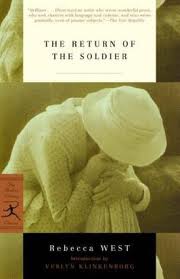
Rebecca West: The Return of the Soldier (1918) Literature and War Readalong March

The soldier returns from the front to the three women who love him. His wife, Kitty, with her cold, moonlight beauty, and his devoted cousin Jenny wait in their exquisite home on the crest of the Harrow-weald. Margaret Allington, his first and long-forgotten love, is nearby in the dreary suburb of Wealdstone. But the soldier is shell-shocked and can only remember the Margaret he loved fifteen years before, when he was a young man and she an inn-keeper’s daughter. His cousin he remembers only as a childhood playmate; his wife he remembers not at all. The women have a choice – to leave him where he wishes to be, or to ‘cure’ him. It is Margaret who reveals a love so great that she can make the final sacrifice.

The Return of the Soldier is unusual because it has been written by a woman and during the war. But it is also unusual in its treatment of the war. Although a tale that takes place on the home-front, the horrors of the war in the trenches shine through constantly.

The novel is a first person narrative,  told by Jenny, Chris’s cousin. It opens on a domestic scene showing Kitty, Chris’ wife and Jenny together in the nursery. We learn immediately that the child who lived there is dead and we also learn a lot about the very different characters of these two women. Kitty is not easily alarmed even though they haven’t heard from Chris for weeks. The very first paragraph shows that she treats the war lightly, does maybe not take it very seriously at all, rather like some adventure, while Jenny is aware of the dangers.

“Ah, don’t begin to fuss!” wailed Kitty. “If a woman began to worry in these days because her husband hadn’t written to her for a fortnight—! Besides, if he’d been anywhere interesting, anywhere where the fighting was really hot, he’d have found some way of telling me instead f just leaving it as “Somewhere in France. He’ll be alright.”

Jenny will tell us later what a very shallow woman Kitty is. Appearances is all that is important to her.

Now, why did Kitty, who was the falsest thing on earth, who was in tune with every kind of falsity, by merely suffering somehow remind us pf reality?

The initial scene is almost idyllic as the house and its surroundings are so lovely and Jenny cannot help but think of how much Chris must miss his life there. Rebecca West is excellent when she describes the surroundings. She chooses words like a painter who tries to get every little shade of what he paints right. Her writing is nuanced and poetical.

The house lies on the crest of Harrowweald, and from its windows the eye drops to miles of emerald pastureland lying wet and brilliant under a westward line of sleek hills blue with distance and distant woods, while nearer it ranges the suave decorum of the lawn and the Lebanon cedar whose branches are like darkness made palpable, and the minatory gauntness of the topmost pines in the wood that breaks downward, its bare boughs a close texture of browns and purples, from the pond on the hill’s edge.

Of the two women, Jenny is the one that brings the war into the novel through her worrying. It is deeply rooted in her consciousness as well as in her subconscious. Her feelings for her cousin are so intense, the identification is total at times and she seems to be the one experiencing the battlefield. Through Jenny we get a clear picture of how much was known on the home-front. In the movie theaters they were shown black and white footage of the front line. To be like Kitty, unaware of the real dangers, you had to be really determined to keep them away from you.

Of late I had had had dreams about him. By night I saw Chris running across the brown rottenness of No Man’s Land, starting back here because he rod upon a hand, not even looking there because of the awfulness of an unburied head, and not till my dream was packed full of horror did I see him pitch forward on his knees as he reached safety—it was that. For on the war-films I have seen men slip down as softly from the trench parapet, and none but the grimmer philosopher would say that they reached safety by their fall.

Into the initial idyll breaks a shabby and elderly looking woman. She is badly dressed and seems of the lowest social class. Both women feel revolted and when they hear why she has come they are quite shocked. Margaret has come to inform them that Chris has been is in a hospital in France and suffers from severe shell-shock. He is amnesic and has eradicated the last 15 years of his memory, believing to still have a relationship with Margaret. The reactions of the two women towards this member of the lower classes is quite disturbing. They almost react as if she was contaminating the house.

Soon after this conversation, Chris is brought back and has indeed lost every memory of his wife and barely recognizes his cousin who is now fifteen years older.

In what follows we see how each of the three women reacts so differently, how each wishes and longs for other things. We learn also about the relationship Chris had with Margaret and why he broke it off and what happened to her after he left her. Despite all this there is no sign of his recovering his memory and finally a doctor is called. At first he isn’t successful but he points out that there may have been a reason why Chris repressed the memory of his marriage. It is only after Margaret suggests to show Chris something that will trigger a strong emotion – in this case things that belonged to the dead child – that he will be able to regain his memory. I the moments before he is shown the baby’s things Jenny is suddenly painfully aware of what a recovery truly means. Should he recover, he will have to go back to the front. In sharp contrast to this, Kitty doesn’t care. She wants her husband to recognize her again, that’s all she cares about. Once the recovery has happened, it’s Jenny again who states clearly what will be.

He walked not loose limbed like a boy, as he had done that very afternoon, but with the soldier’s thread upon the heel. It recalled to me that, bad as we were, we were yet not the worst circumstance of his return. When he dad lifted the yoke of our embraces from his shoulders he would go back to that flooded trench in Flanders under that sky more full of flying death than clouds, to that No Man’s Land where bullets fall like rain on the rotting faces of the dead.

I found it very interesting that The Return of the Soldier can be read in many different ways. Considering the theme of the readalong, I focused on the way she treated WWI but that is not the only topic in this novel. One could also explore the psychological theories or the sociological dimension.

I think The Return of the Soldier is an incredibly subtle and artful novel. The war and it’s horrors are like threads that are woven into the fabric of the story. As a journalist Rebecca West was interested and did report on the war but she was also very interested in Freud’s theories, some of which she has applied in the novel. I think to make of Chris a shell-shocked soldier suffering from amnesia which was not realistic, shows us that she wanted this to be taken symbolically. The psychologist Glen Clifford kindly and eloquently pointed out in a comment on my introductory post that PTSD is characterized by the incapability to forget and amnesia is a very unlikely occurrence.

The three women all symbolize something else and represent different levels of consciousness. Kitty, the wife he has forgotten is the symbol of all the forces that contribute and maintain the class system and the war. She is a typical representative of the British upper class, of those who decide to send  thousands of young men to a certain death. Those who don’t care what is going on “over there”. She symbolizes the unconscious. Margaret on the other hand stands for the working classes, simplicity, those who have to endure what others force upon them. That seems to be pretty much how Chris feels as well. She may be read as the subconscious. Jenny is by far the most intriguing. She moves back and forth between the different levels of consciousness with a capability of seeing things clearly. She is his cousin but thinks and feels rather like a lover. She seems the most authentic, the most emotional, the one who feels what either Kitty or Chris should feel, namely the horror and despair caused by this horrible war and the sadness about the loss of the little boy. It may very well be that the death of the child drove the spouses apart.

I would like to say thanks to Ann Norton from the International Rebecca West Society, for pointing me towards a new critical edition by Bernard Schweizer and Charles Thorne. It contains invaluable material and background information to the book. If you want to have a look at the content here’s the link to the broadview press.

Ann Norton wrote the introduction to the Barnes and Noble Library of Essential Reading Edition.

I am really curious to read what others have to say about this complex novel, be it in a review or in comments.

Other reviews:

Anna (Diary of an Eccentric)

Bookaroundthecorner

Danielle (A Work in Progress)

*****

The Return of the Soldier was the third book in the Literature and War Readalong. The next one will be Carol Ann Lee’s The Winter of the World. Discussion starts on Friday April 29, 2011 .

Halldór Laxness: The Fish Can Sing aka Brekkukotsannáll (1957) An Icelandic Coming-of-Age Tale

Abandoned as a baby, Alfgrimur is content to spend his days as a fisherman living in the turf cottage outside Reykjavik with the elderly couple he calls grandmother and grandfather. There he shares the mid-loft with a motley bunch of eccentrics and philosophers who find refuge in the simple respect for their fellow men that is the ethos at Brekkukot. But the narrow horizons of  Alfgrímur’s idyllic childhood are challenged when he starts school and meets Iceland’s most famous singer, the mysterious Gardar Holm. Gardar encourages him to aim for the “one true note”, but how can he attain it without leaving behind the world that he loves?

Have you ever read a book and caught yourself smiling almost all the time? The Fish Can Sing is so charming I couldn’t help doing it. It’s also quite funny at times and certainly very intriguing. I’m afraid I can’t really put into words how different it is. As a matter of fact, Halldór Laxness’ book is so unusual and special that I have to invent a new genre for it. This is officially the first time that I have read something that I would call mythical realism. It is very realistic but at the same time it is full of exaggerations like we find them in myths. This is due to some extent to the narrator, Alfgrimur, who takes everything he hears literally. Very probably it also has its roots in Icelandic storytelling.

I really owe thanks to Professor Batty of Flippism is the Key. If it hadn’t been for him I wouldn’t have embarked on my Halldór Laxness journey starting with The Fish Can Sing. The late Icelandic Noble Laureate has written some 60 books. Some haven’t been translated into English but almost all of them are available in German. As he told me, The Fish Can Sing is by far more accessible than any of his other books and certainly much easier than Under the Glacier which I had planned on reading first. I went through a bit of a Susan Sontag phase two years ago and stumbled upon her essay on Under the Glacier. Many of the Noble Laureates aren’t the most easy reads and I can imagine how challenging some of Laxness’ other books must be as The Fish Can Sing, as charming and enchanting as it is, isn’t very easy either.

To give you an impression of how different it is, let me just quote the first sentence:

A wise man once said that next to losing its mother, there is nothing more healthy for a child than to lose the father.

This sets the tone nicely. This novel is full of unusual statements and observations. If you want to walk the trodden path when reading a book, chose another one. This is a wild landscape you are entering. A landscape of harsh beauty that – as I can only assume – must mirror the beauty of Iceland itself.

The Fish Can Sing is the story of little Alfgrimur whose mother gave birth just before emigrating to the US and left the baby behind at Brekkukot where he is adopted by the man and the woman he will call grandparents. His mother stayed, like so many others, for some time at the turf-cottage of Björn of Brekkukot. What a world this Brekkukot is. Dominated by the grandfather whose love for people, authenticity and truthfulness are the guiding light towards which so many are directed. The grandfather is the most important person in Alfgrimur’s life. He is the personification of absolute love and security.

But whether I was playing in the vegetable garden, or out on the paving, or down by the path, my grandfather was always somewhere at hand, silent and omniscient.There was always some door standing wide open or ajar, the the door of the cottage or the fish-shed or the net-hut or the byre, and he would be inside there, pottering away.

His constant silent presence was in every cranny and corner of Brekkukot – it was like lying snugly at anchor, one’s soul could find in him whatever security it sought. To this very day I still have the feeling from time to time that a door is standing ajar somewhere to one side of or behind me, or even right in front of me, and that my grandfather is inside there pottering away.

The grandfather is a real original. He follows his own rules and is not impressed by status or education. Alfgrimur feels that he is profoundly loved. The grandfather reminded me in some ways of Atticus Finch. Another culture, another society but the same aim for truthfulness and tolerance. Only a touch more eccentric. This novel is full of eccentric characters and unusual descriptions like those of the turf-cottage. The grandfather and his hospitality are so famous that people come from all over Iceland to sleep at the cottage. Some stay there always, some are on their way to the States, some are ill and look for a cure, others come to die there.

It would drive one mad to try to tell about all the visitors who ever came to Brekukkot, and indeed such a book would burst all the printing-presses in Iceland.

A dilapidated, creaking stair with seven steps connected the passage with the mid-loft in our house. It was here that  and my fellow-residents lived. This mid-loft was the centre-space of the upper storey, partitioned off from the rooms on either side; we were in effect a sort of vestibule for those who lived in the east and west ends of the loft as well as for anyone who went up  or down the stair. When my grandfather did not give up his bed to a visitor, he slept in the part of the loft that faced south, but which was actually called the west end; otherwise he would lie on a pile of nets out in the store-shed, and would think nothing of it. Often our living-room was full, and people were tightly packed in at both ends of the loft; there were sleepers in the passage and sleepers in the doorway, and sometimes during the autumn trips, when we had the largest crowds, they would bed themselves down i the store-shed and the hayloft as well.

The book is told in a sequence of short chapters that could almost be read independently like short stories but it is still a novel. Some of the characters and stories that are told are quite funny.

It is a small and protected world in which Alfgrimur grows up and the outside world and foreign countries are only brought to his world through the figure of the somewhat mysterious Gardar Holm, a world-famous Icelandic singer who mostly lives abroad. There is a special connection between Alfgrimur and the singer and it is through him that he discovers his own voice and will choose to follow the same path.

The first real pain in Alfgrimur’s life comes from the need to go to school. To leave the safe haven of Brekkukot is terrible for him. All he had been deaming of was staying there forever and becoming a fisherman. This can of course not be and the end part of the novel is therefore almost melancholic.

All in all this was a great discovery. I really liked it a lot and think Laxness has a wonderful imagination. Professor Batty has dedicated his blog almost entirely to Iceland. If you are interested in Halldór Laxness or other Icelandic authors, also crime authors, you will find a lot of information and reviews there. He has reviewed many of Laxness’ novels and done several posts on the translations that are available.

Here is his Top Ten Laxness in translation review.

Sarah Blake: The Postmistress (2010)

The wireless crackles with news of blitzed-out London and of the war that courses through Europe, leaving destruction in its wake. Listening intently on the other side of the Atlantic, newly-wed Emma considers the fragility of her peaceful married life as America edges closer to the brink of war. As the reporter’s distant voice fills the room, she sits convincing herself that the sleepy town of Franklin must be far beyond the war’s reach. But the life of American journalist Frankie, whose voice seems so remote, will soon be deeply entangled with her own. With the delivery of a letter into the hands of postmistress Iris, the fates of these three women become irrevocably linked. But while it remains unopened, can Iris keep its truth at bay?

I wanted to like The Postmistress and for 200 pages I really did. It has a cinematic quality to it, the descriptions are so perfect, you think you are watching a movie. A movie like Pearl Harbor, not The Draughtsman’s Contract, that’s for sure, but still, it’s an achievement. Also the story is really interesting for far more than two thirds of the book and then it sadly collapses. What starts out as an entertaining and very well-researched read becomes slightly insipid.

The Postmistress interweaves the lives of three very different American women. Frankie Bard, a war reporter, Emma Fitch, the young wife of a doctor and Iris James, the postmaster (she insists on calling herself “postmaster” and I never really got the title).

The story that is told in the book takes place in 1941. During the first two thirds of the book, Frankie is in war-torn Europe, reporting live on the radio, during the Blitz and later from different cities in France. Emma and Iris live both, in the fictional small town Franklin in Massachusetts and hear Frankie’s broadcasts that brings the war into their living rooms. They feel Frankie’s engagement, they live the tragedy with her. They are so far away if it wasn’t for Frankie the war would seem almost unreal.  Apart from Harry Vale, Iris’ fiancé, no one in Franklin, Massachusetts thinks that America will ever go to war, even though the draft has started.

The plot starts to get silly when Emma’s husband decides to go and help in London. He seeks atonement for a “medical accident” for which he feels responsible.

The second third of the book shows Frankie travelling with various trains from Germany to Portugal to interview refugees on the trains. She collects the stories on disks and those voices will later be listened to – thanks to a huge story-twist – in Franklin.

The central story is the one part of the book that I didn’t like and this is unlucky because it ties the three parts together. The idea was to tell the story of a letter that is not delivered because the postmistress decides to hold it back.

Something else that didn’t quite work for me is due to the handling of the characters. Although all three women get their equal share at the beginning, it becomes ultimately Frankie’s story. The other two seem to be mere vehicles to make the plot work.

Sarah Blake writes in her after-word that Frankie couldn’t have had access to a portable disk recorder at that time. What she uses came into usage in 1944 and enabled live-recording from the battlefields.

I took liberty with the date because World War II was the first war that was brought into people’s living rooms by radio, and I wanted to highlight the power of the voice to convey the untellable, the refugees speaking into an air into which they will vanish.

Sarah Blake studied a lot of books on female war reporters, Martha Gellhorn and many other books on WWII. The themes are decidedly interesting and it is no wonder the book has A Reader’s Guide and Discussion Questions. An ideal choice for a book club I presume. Occasionally I wonder if these Reader Guides are not meant to justify the book and ultimately to sell it. It strikes me that I see this more in more in books, even in so-called American literary fiction.

The history of female war reporters and the evolution of reporting is interesting. I think the book also captures very well how far away the war seemed to the Americans. It looks at the way people go on about their lives while in another part of the world people go through terrible things. This seemed very timely and I was reminded of the situation in Japan. We are here and safe while people in another country fight for their survival. How do we go on living as if nothing was happening?

If you are still curious, here is The book’s homepage where you can read the first chapter.

On the History of Stefan Zweig’s Balzac


About a year ago I inherited my mother and my grandmother’s books. They fill up more than one cellar. We are talking about thousands of hardbacks as both never bought paperbacks. They didn’t think they were looking good on the wood shelves. And they removed all the dust jackets which is not helpful as there are so many that may or may not be good but I have no clue what they are about.

To cut a long story short there are also innumerable classics and collected works of many an author. You can find the whole works of Goethe, Schiller, Romain Rolland, Upton Sinclair, John Galsworthy…

I remembered that I had seen a 50s edition of Stefan Zweig’s Balzac somewhere and – oh wondrous moment – found it within a minute. Dusty and with a somewhat musty smell but nicely intact. What surprised me more than the speedy recovery of the book was the afterword and I realized I had had no idea how the book came to be, let alone that Stefan Zweig meant this to be his magnum opus, his most important work. Considering that literary biographies were something he excelled at we can easily deduce how important his Balzac must have been for him.

The afterword in my Balzac edition has been written by Richard Friedenthal, Stefan Zweig’s friend who got to be the literary executor of the manuscripts that had remained in Europe after Zweig fled to Petrópolis where, in 1942,  he ended his life together with his wife.

It took Stefan Zweig over ten years of working, compiling, taking notes and rewriting but when he died, Balzac was still not finalized, or so he said. He managed to finish Die Schachnovelle or Chess in Petrópolis and his autobiography. However he had wished to finish the Balzac as well and had asked Friedenthal to send the manuscript to Petrópolis, which he did, but the papers never reached Zweig. By the time it arrived in Brazil, Zweig had already ended his life. The mansucript was sent back to Friedenthal who then sorted and edited what was, according to him, almost finished anyway.

Zweig had written the last draft of the Balzac in Bath, where he had stayed before emigrating to the US and from there to Brazil.

Zweig’s book Drei Meister or Masterbuilders of the Spirit already contains an essay on Balzac, together with essays on Dickens and Dostojewski. But that was just like warming up. Clearly the topic of Balzac was far too important to him to be left in the form of an essay only.

As Friedenthal points out, Balzac was of supreme importance for Austrian literature. It was the reception of authors like Hugo von Hofmannsthal who contributed to a large extent to Balzac’s fame during his lifetime.

Hofmannsthal said about him that he was “the biggest substantial imagination since Shakespeare”. The Austrian authors thought of him as the incarnation of literary potential. Zweig thought pretty much the same and despaired many times during the composition of the book, it seemed almost too enormous an undertaking.

When Friedenthal, who lived in London during the Second World War, looked at the manuscript, after Zweig’s death, he saw that it didn’t need a lot of changes and undertook to edit what he got. Reading what he writes about it makes you think that it is a miracle this book was ever published. Friedenthal describes how it was literally ripped out of his hands twice when, during the Blitz,  the house he lived in was bombed. Apparently one can still see bits of plaster and little splinters of glass in the original manuscript. On the papers are numerous notes and remarks of Stefan Zweig’s wife who helped him correct and edit his works. Zweig had already written “For the editor” on the front page which led to Friedenthal’s assumption that Zweig himself considered it to be fairly finished.

I am not sure when I will start to read Zweig’s Balzac, but I  know I will. These two authors seem such opposites. I know I’m simplifying things but it seems as if one of the two was so avid for life that it killed him and the other one so tired of it that he ended it.

Balzac: Le Colonel Chabert aka Colonel Chabert (1832/1844)

Balzac’s radiant story recounts the history of Colonel Chabert, a disenfranchised hero of the Napoleonic wars. Left for dead on the battlefield of Eylau, Chabert has spent years as an amnesiac in an asylum. The novel begins with his return to the life he left behind: only to discover that in his absence, his entire life – family, society, identity – has changed. With Napoleon deposed, France’s aristocracy has returned to power ‘as if the Revolution never occurred’. With Chabert supposedly dead, his wife is now married to a Count. Sickened by his wife’s pretence not to recognise him, and the titled society which spurns his former meritorious deeds, Chabert vows to recover his money, his reputation and his name.

A few years back I went through an intense Balzac phase reading one of his novels after the other. Still there are so many left I haven’t read and one of them was Le Colonel Chabert (or Colonel Chabert in English). I always thought it was much longer, probably because the edition I have contains other books as well. Or because of its notoriety. I think it is one of the most famous of his works.

Le Colonel Chabert is one of the books from the Scènes de la vie privée. Those who are familiar with Balzac know that the vast canvas of his work which he called La Comédie Humaine is organized in groups depending on the setting or themes.

Balzac has written an impressive amount of books. Some were serialized and written for the newspaper, like Splendeurs et misères des courtisanes, and the writing is not subtle at all. As wonderful as his plots, characters and topics usually are, his style is occasionally lacking. I was pleased to see that Le Colonel Chabert is, from a purely literary point of view, one of his best. It was published twice, first in 1832 under the name La transaction and then again in 1844.

Colonel Chabert is one of Balzac’s most tragic figures, a man who had everything and lost it all. To a certain extent the figure of Colonel Chabert whose fate is tied to that of Napoléon, also mirrors the emperor’s fate. Like Napoléon himself, he knew fame and glory and lost it all.

The novel opens on a scene of lively banter among several clerks who work for a young and promising lawyer. This scene is Balzac at his very best. With a few words he captures mediocrity. Into this setting enters a man who looks like a ghost. An old and broken man, poorly dressed, weak and ailing. When he asks to see Derville, the young lawyer, they make fun of him. And even more so when he tells them that he is the Colonel Chabert. Everybody knows that this cannot be as the Colonel has died in the battle of Eylau. His much deplored death has even been confirmed by Napoléon himself. His wife has remarried and born two children to a new husband. His fortune has been divided. The man standing in front of them cannot be the dashing looking colonel. This is an old man who seems to have seen nothing but poverty and misery.

The clerks who do not believe the old man send him away and tell him to return at one in the morning, the only hour during which the lawyer receives his clients.

When Chabert returns Derville is gruff at first but he is not only an ambitious young man, he is also very intelligent and kind-hearted. He pities the poor man and allows him to tell his story.

The Colonel who has shown Derville the deep scar on his skull, tells him how he was mortally wounded by a sabre, who almost split his skull in two. Buried under his horse who had been killed, he wasn’t trampled by the fleeing army but left unconscious. When they finally discovered him, they declared him dead and buried him. He regained consciousness later in the grave and managed to dig himself out from underneath corpses, earth and snow. This is a truly creepy scene that reminded me of an Edgar Allan Poe story.

Illustration de Le Colonel Chabert

(La bataille d’Eylau by Antoine-Jean Gros)

Ten years have passed since that episode. Ten years of suffering and erring during which the Colonel wrote to his wife a few times. Hoping to make a better marriage she pretends not to believe that he is alive. Chabert finally decides to ask for help and wants the young lawyer’s assistance in claiming back his wife and his considerable fortune.

His former wife, now the Countess Ferraud, is one of the ugliest characters of Balzac whose novels are full of greedy, vile people.

I will stop my summary here and just tell you that the outcome isn’t exactly what we expect.

I am not sure if it would be ideal to start reading Balzac with Le Colonel Chabert. I usually recommend Le père Goriot or La cousine Bette. Once you are more familiar with Balzac’s themes and characters you will realize how unique this book is. It is very short but extremely complex and a lot of allusions to French history are almost crammed into it. To fully comprehend the story it is good to know something about French history.

I’m looking forward to watch the movie one of these days as it seems to be very good as Guy Savage writes in his review of the book.

My favourite Balzac is Les illusions perdues aka Lost illusions, followed by La cousine Bette aka Cousin Bette. Which one do you like?

Colonel Chabert (Hesperus Classics)

Literature and War Readalong March 25 2011: The Return of the Soldier by Rebecca West

There is still plenty of time for anyone who wants to join the Literature and War Redalong this month to get a copy of Rebecca West’s The Return of the Soldier. It is only 90 pages long which makes it all the more feasible. If all those of you who expressed an interest in this book will read along we might be quite a crowd. We will see. There are at least two different paperback editions available. I got the one from The Modern Library with an introduction by Verly Klinkenborg. The other one is a Virago edition with an afterword by Sadie Jones.

Rebecca West’s book is unique as it was published in 1918, before the war had ended. She tells the story of a returning soldier who suffers from shell-shock. I am particularly interested in this topic and curious to compare her handling of it with Pat Barker’s Regeneration trilogy which is for me still one of the greatest books on WWI, shell-shock and the development of the new medical discipline, psychiatry.

I was very surprised to find out that The Return of the Soldier that seems so well-known in the English-speaking world has not been translated into German. The only two of her books that made it into German are Black Lamb and Grey Falcon and The Fountain Overflows.

Rebecca West was only 24 when she wrote this novel but already an acclaimed journalist and women’s rights activist. This isn’t an account of the front line but purely a story that takes place on the home front.

Shell-shock is extremely typical for most WWI accounts. It seems as if there had never been so many cases of shell-shock in any war as in WWI. Psychologists state that one of the reasons for this lies in the trench warfare. Being in the trenches for such a long time infused the soldiers with a deep feeling of helplessness that makes shell-shock much more probable than any othe type of warfare. The moment the soldiers were allowed to leave the trenches and move about shell-shock was far less frequent.

Here is the link to the Rebecca West Society if you want to find out more about the author, upcoming conferences and events.

The Return of the Soldier has also been made into a movie.

Joseph Roth: Hotel Savoy (1924)

Hotel Savoy

Written in 1924, Hotel Savoy is a dark, witty parable of Europe on the verge of fascism and war.

I read Joseph Roth’s The Radetzky March years ago in school and had sworn at the time that I will re-read it and read as much as I can of this incredible author. A while back I stumbled upon a really nice discovery in a local bookshop, a little slipcase containing seven of Joseph Roth’s novels. It consists of Hotel Savoy (Hotel Savoy) (1924) Hiob (Job) (1930) Radetzkymarsch (The Radetzky March) (1932) Beichte eines Mörders (Confession of a Murderer) (1936) Das falsche Gewicht (Weights and Measures) (1937) Die Kapuzinergruft (The Emperor’s Tomb) (1938) and Die Geschichte von der 1002. Nacht (The String of Pearls) (1939).

Roth is one of three Austrian authors (the other two being Robert Musil and Heimito von Doderer) who wrote about the end of the Danube Monarchy. The end of an era, the changing of the times, is often central in his books.

I decided to read Roth’s books chronologically and started with Hotel Savoy.

What an absolutely wonderful novel this is. Beautifully written, astonishingly varied in style, themes and characters. How can you capture so much in under 120 pages? The style is very different from Radetzkymarsch but not less enchanting. His sentences are very special, often composed of a list of nouns which might have been a challenge for a translator.

I am happy, once more, to shed an old live, like I did so often these past years. I see the soldier, the murderer, the man who was almost murdered, the resurrected man, the captive, the wanderer.

Or this powerful sentence:

I enjoy the floating feeling, calculate how many wearisome steps I would have had to climb if I wasn’t sitting in this luxurious lift, and I throw down bitterness, poverty, homelessness, migration, hunger,  the past of the beggar, throw them deep into the shaft, from where they cannot reach me, the hovering one, ever again.

Hotel Savoy is a “Heimkehrer Roman”, the story of the former soldier Gabriel Dan who after WWI and several years of having been a prisoner of war in a Siberian camp returns to Poland. He is a descendant of Russian Jews and one of his uncles lives in the city in which he stops. He wants to travel westwards to Paris or any of the other big Western cities. As far away as he can get from Russia and a painful past full of deprivations, it seems.

He moves into a room on one of the upper floors of the grand and glamorous looking Hotel Savoy. As pompous as it may seem from the outside, the interior is rundown.

The first three lower floors are reserved to rich people, bankers, aristocrats, factory owners and patrons. The upper floors belong to the poor who cannot pay their rent. After a few weeks their suitcases and luggage is confiscated and they are left completely destitute.

What a colorful group of people they are in those upper floors. Dancers and clowns and people who return from the war or people who have lost everything in one foolhardy transaction. They are eccentrics and lunatics and more than one of them is terminally ill. There is singing and dancing and cheerfulness and a lot of dying going on.

Gabriel hopes to be able to extract some money of his rich uncle, Phöbus Böhlaug, but to no avail. His uncle’s avarice is frightening.

There is nothing else to do for Gabriel than stand at the train station daily and hoping for work. Every other week the train station is flooded by prisoners returning from the camps. One day he meets one of his old comrades the peasant Zwonimir.

What a character, this Zwonimir. Full of life, exuberant, funny and droll. He makes friends easily has a funny sense of humour and detects everything phony in the rich and pompous people around him.

They work hard and enjoy themselves in the evening, drinking copiously, going to cabarets and the vaudeville, walking through the city, exploring the quarters where only Jews live.

I always enjoy novels set in hotels. They are full of interesting characters from the most diverse social backgrounds. In this inter-war period hotels were often the only place where people could stay. It took those who returned from the war an awfully long time to get back to their homes and they had to stay somewhere on the way. Others had lost their houses or just fled the countryside.

It is a fascinating microcosm this Hotel Savoy. The very poor and the very rich rub shoulders.

One of the central episodes is the arrival of Henry Bloomfield an incredibly rich banker who left Europe for America but returns once a year to his hometown. No one really knows why he chooses to come back to this little town when he could stay in Berlin.

While he resides at the Savoy, people cue up to talk to him and present their business ideas hoping he might finance them. Gabriel is lucky and is chosen by Bloomfield as temporary assistant. He will listen to all the stories and sort the valuable ideas out.

This novel has really everything. It is funny, sad, picturesque, touching and bitter-sweet and the ending is perfection. Roth describes people, the hotel and the little town with great detail. And every second sentence bears an explosive in the form of a word that shatters any illusion of an idyllic life. Roth served in WWI and never for once allows us to forget that the horror of one war and subsequent imprisonment have only just been left behind  while the next one is announcing itself already.

I was reminded of other novels set in hotels, pensions or clubs like Muriel Spark’s The Girls of Slender Means, Vicki Baum’s Menschen im Hotel (Grand Hôtel), Elizabeth Taylor’s Mrs Palfrey at the Claremont, Assouline’s Lutetia, Thomas Mann’s Felix Krull and Anita Brookner’s Hotel du Lac.

I am sure there are many more. Do you know any others?

I translated the quotes from the original German. Any mistakes are entirely my own.