Molly Keane: Two Days in Aragon (1941)

Grania and Sylvia Fox live in the Georgian house of Aragon, with their mother, their Aunt Pidgie and Nan O’Neill, the family nurse. Attending Aragon’s strawberry teas, the British Army Officers can almost forget the reason for their presence in Ireland. But the days of dignified calm at Aragon are numbered.

I first read about Molly Keane’s Two Days in Aragon on Danielle’s blog. Molly Keane or M.J. Farrell, the pseudonym under which she published her books,  is one of Danielle’s reading projects and after having read Two Days in Aragon I can understand why. I’m trying to put into words what type of book this was but nothing I come up with seems to do it justice. Molly Keane captured beautifully the end of an area, portrayed a social system, drew complex character portraits and incorporated such a wide variety of topics that I’m full of admiration.

I love descriptions of big old houses. They seem to have a life of their own and their majestic presence can be felt so strongly, they are almost characters in their own right. Aragon is exactly such a house. The family home of the Fox’s is grand, old and full of history. There are hidden rooms and the ghosts of the ancestors seem to be hovering around. But Aragon is also a symbol. A symbol for a way of life about to end. Aragon also symbolizes oppression as it is the house of an Anglo-Irish family and as such represents everything that the Irish have come to hate and against which they are fighting in 1920, the year in which the novel takes place.

The end of an era can be brought by many things but war, rebellion, change of government are among the most frequent. All over the world when the colonized stand up against the colonists this signifies the end of a life in beauty and ease for the formerly advantaged. Molly Keane knew very well what she wrote about as she came from such a rich Anglo-Irish family who lived in privilege and never had to work. They loved their horses and hunting and eating well. All this was incorporated into the novel. The descriptions of these two days make one long to have been there, to have experienced the rituals, seen the beauty.

Molly Keane offers more than the description of a house and a way of life about to end. One thing I liked a lot in the novel were the characters. None of them likable, maybe with one exception (Sylvia), but all of them are drawn so vividly and in all their complexity that I was glued to the page.

Grania and Sylvia Fox live in the grand old house together with their mother and Aunt Pidgie. Their father has died after a hunting accident. Grania and Sylvia are very different which is also shown in their choice of men. Grania has an affair with Foley O’Neill, a socially unacceptable choice, while Sylvia is secretly in love with a British officer. One girl is described as a slutty, fat, blond and the other as a neat, groomed and very poised young lady. The mother has a bit of both of them but seems to like her passionate, wilder and slutty daughter far more.

Aunt Pidgie and Nan O’Neill, the house nurse, form a duo. Aunt Pidgie is an unwelcome elderly relative that is kept, far away, in the nursery. This reminded me of the first Mrs Rochester in Jane Eyre. The unwanted, especially women, were often locked away. Aunt Pidgie is a bit crazy but inoffensive. In the beginning we know nothing of her sufferings but when we learn more about Nan O’Neill and her well-hidden side of aggression and cruelty we start to pity this poor bird-like little woman. Nan O’Neill is the most complex and fascinating character. She loves Aragon and everything in it with a fierceness and as if it did belong to her. This has a reason. She is an impressive woman, commanding, extremely good-looking and adept at everything. She is especially good at hiding her true nature. Disappointment and lack of love have made her cruel and pitiless. In her role as nurse she is one of the most powerful characters in the novel. She knows about unwanted pregnancies and how to end them, about subtle ways how to torture someone in keeping them alive but constantly uncomfortable. A very chilling character.

I have read a lot of novels about the end of an era, many have houses in their center. I loved Waugh’s Brideshead Revisited as much as E.M.Forster’s Howard’s End and of course,  Bassani’s The Garden of the Finzi Contini. They are often nostalgic and melancholic books. This isn’t the case here, Two Days in Aragon is completely different in tone and although tragedy strikes all of them I wasn’t sad after reading it but rather full of admiration for Molly Keane and her very unique voice and fascinating approach to tell her story.  And I felt exhausted. She is such a vivid storyteller, I lived in those pages, I almost felt as if I had experienced two very intense days.
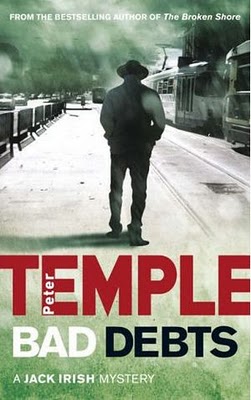
Peter Temple: Bad Debts (1996) A Jack Irish Mystery

Meet Jack Irish: some-time lawyer, part-time private eye, spare-time cabinet maker and full-time lover of strong coffee, swift horses and spirited women.

Bad Debts is the first in Australian crime writer Peter Temple’s Jack Irish series. Temple has won a lot of Australian prizes for his crime and thriller writing. I think it is the first time I read an Australian crime writer. I was very curious and looking forward to the novel and for a total of 50 pages I really enjoyed it.

It’s starts off well enough, quite sarcastic and humorous. Jack Irish seems a typical hardboiled private eye and debt collector. He used to be a lawyer but when his wife is killed he starts drinking and spends a year in total limbo. Sometime during that year he has to defend Danny McKillop, a drunk-driver, who killed a woman. The woman he killed, Anne Jeppeson, was an activist and pain in the neck for many people. The driver had no memory of either driving a car or hitting someone.

Ten years have gone by and all of a sudden Danny McKillop leaves messages on Jack’s answering machine. By the time Jack hears them McKillop has been shot by the police. Jack feels guilty. It seems to him as if he had let down McKillop a second time and he starts to investigate not only his death but also Anne Jeppeson’s death.

After interviewing a few people he finds out that there were and are a lot of strange things going on. People in high places are doing things they don’t want anyone to find out about. His investigation leads Jack deep into corruption and conspiracy and the farther he gets into these things, the more he endangers himself. The last third of the novel is very action-packed.

The beginning of the novel was humorous and I thought it might be one of the series I would like to explore further but after 20-50 pages, there were far too many things I didn’t like. Jack isn’t a lawyer anymore, he tries to make a living collecting debts, betting on horses and doing cabinets. All these different occupations take up time and pages which is very disruptive. On top of that I hate horse-racing stories. Not only do I despise horse-racing I also find it outrageously boring to read about it.

Another problem I had was the language. A large part of the novel consists of dialogue. Australian spoken language seems much closer to British English than to American English. I certainly didn’t mind that. But I did mind that most of the dialogue was composed of swearing and foul language. It was somewhat tiring after a while. And there is the love story. Maybe Jack has been mourning for ten years, but for us, who just got to know him, it’s odd to see him mourn on one page and jump at full speed into a love affair on the next one. And how do I have to picture a woman who is not good-looking but handsome?

I realized that I have a few first and occasionally second books in series at hand and decided to start to read my way through them. Peter Temple’s book was one of them. I’m sure the Jack Irish series has its merits, only I couldn’t find them.

Does anyone know the series? Or any other Australian crime novels/series?

Elsa Morante: La Storia – History (1974) Literature and War Readalong August 2011

History was written nearly 3 decades after Morante spent a year hiding from the Germans in remote farming villages in the mountains south of Rome. There she witnessed the full impact of the war and first formed the ambition to write an account of what history does when it reaches the realm of ordinary people struggling for life and bread.

La Storia aka History is the last WWII centered book of this readalong. It’s also the most ambitious, starting before the war and ending just a few years after. It describes in minute details how the schoolteacher Ida Mancuso, her two sons and the people to whom they are connected are affected by the war. La Storia looks in great detail into the impact of war on civilians. In telling this ordinary woman’s daily life we see how precariously civilians live during a war. The constant bombing, the fear, the loss of the houses or apartments, of friends and the jobs, the lack of food and clothes, rape and brutality, fear of being transpotred to a camp, all this together is part of everyday life. What civilians endure is no less harrowing than what happens on the battlefields.

Summarizing this vast canvas of a novel that is driven forward by ebullient storytelling would be quite a challenge, that is why I decided to highlight a few points.

History starts in 19** and ends …. 19**, but the core chapters focus on the years from 1941 to 1947. Before each chapter we find detailed accounts of all the important historical facts of those years. Reading this overpowered me and that was probably the aim. One horrible event follows after another and each and every single country participated in one awful event or the other. It’s a mad circle, a maelstrom that sweeps along everything and everyone and whose impact shapes, distorts and changes the life of normal people who are unable to escape this crazy frenzy.

Following the accounts of History’s furious rage, we read about the simple, childlike Ida, whose mother was Jewish. This fact fills her with constant anxiety all through the novel and even pushes her to do crazy and dangerous things. Ida is a widowed schoolteacher, the older of her boys, Nino, is a foolhardy opportunist, while the other one, Useppe, is the child she conceived when she was raped by a German soldier at the beginning of the war. In the early chapters of the novel Ida lives in modest circumstances but she has an apartment and enough food. When the war breaks out and finally comes to Rome, their house is bombed and she must flee to the countryside where she and Useppe, the little one, live in one room together with numerous other people.

Ida’s older son Nino first joins the fascist forces, later changes over to the partisans and finally becomes a criminal after the war. His “career” seems somewhat typical and I found that in creating a character like this Morante managed to capture a lot that is wrong in Italy. Opportunism and corruption are everywhere.

Focusing on Ida, we witness the ordeal of the “ordinary people”, how much they had to endure. The hunger is unspeakable. What they have to eat is hardly imaginable. Grass, cats, rats, anything. Being homeless and having no clothes is horrible. Having to fight or steal for just a little bit of bread is hard to imagine. It’s a truly harrowing account.

One of the most interesting details is the narrator. Who tells this story? To whom belongs this voice that is audible at any time, that speaks to us directly and from the heart of this novel?  Is it History speaking to us? It seems to be, as the way Morante describes people, animals and things seems to signify that everything is animated. So why not History itself? History is such a force, it seems as if it has become a being driven to destroy.

What I loved about this novel is that everyone has a voice. Useppe is as much a person as are his dogs Blitz or Bella. Their thoughts and feelings are rendered in great detail. I think in doing so she manages to emphasize that in a war everyone is equal, everyone is threatened. I also liked the detailed in the descriptions, the exuberant storytelling.

Despite all the positive aspects I also had a few problems with the novel, especially at the beginning. I didn’t like Ida. I know, it will sound mean, but she was too simple for me. She isn’t very introspective, she is almost a simpleton, still she is touching and the tragedies she endures moved me. I understand Morante’s choice for a character like this but I didn’t always enjoy it.

While reading this novel I found myself smiling a lot. Useppe’s and his dog’s thoughts are so charming in their naivety. The end of this novel moved me a lot. Without giving away too much, I can tell that it showed that there are far more victims in wars than winners, that wars still impact people long after they have ended and that history doesn’t spare anyone. There is no escaping this force that wreaks havoc in human lives.

Before closing I would like to ask a question of anyone who might have read this novel, now or at another point in time: Isn’t it dangerous to treat History like a being? Isn’t this blurring the fact that History isn’t an undefined, independent force but, in the end, it is people who harm other people?

Other reviews:

*****

History was the eight book in the Literature and War Readalong. The next one will be Tim O’Brien’s The Things They Carried. Discussion starts on Friday September 30, 2011 .

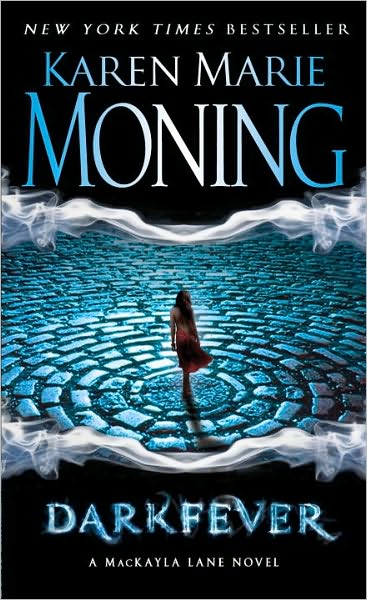
Karen Marie Moning: Darkfever ( 2006) Fever Series I

My philosophy is pretty simple: any day nobody’s trying to kill me is a good day in my book. I haven’t had many good days lately.’ When her sister is murdered, leaving a single clue to her death – a cryptic message on Mac’s cell phone – Mac journeys to Ireland in search of answers. 

What a romp. This was so much fun. If anyone has been looking for a Dark Fantasy version of Janet Evanovich’s Stephanie Plum series, there is good news, Darkfever is exactly what you have been looking for. This is the first in the series of this urban fantasy goes crime of Karen Marie Moning who is better known as a romance writer. Don’t get alarmed, this is not a romance novel although there is a certain undercurrent in it, no, this is a real whodunit, spiced up by some nasty supernatural happenings. There are also some explicit sex scenes and judging from Book Rain’s review, the series is getting steamier from book to book. I’m grateful I read her review because now I know that not only the series ends, but that it is rather like a whole novel in five parts. Although part one has some sort of denouement, the end is a cliffhanger.

Mac (short for Mackayla) is a very naive character. She is also clumsy which is a common cliché in paranormal crime. And she was definitely into the Disney Princesses as a child and still loves pink more than anything else. But having a character like that encounter dark and malevolent beings makes for slapsticky fun.

Trying to overcome the grief over her sister’s murder and in attempt to urge the police to solve the crime, Mac decides to take things into her own hands and flies from the US to Dublin where her sister studied. Before her sister died she left a cryptic message on Mac’s cell phone saying that she had been wrong about someone and something needed to be found. All this is very strange and as soon as Mac arrives in Dublin things get even more mysterious. Despite an intense aversion she befriends Barrons, the handsome but moody owner of a book shop.He agrees to help her find the murderer of her sister but only because Mac can help him find an old and very dangerous book.

Mac, as she soon finds out, is what is called a Sidhe-Seer, someone who can see faeries and other supernatural creatures. This helps her to avoid that some encounters end deadly but it also exposes her. The moment faeries know she can see them she is a threat to them and they hunt her. Additionally she can spot magic objects and since absolutely everyone in this novel seems to hunt for the same magical book Barrons is after, they are all threats to her.

This is a fast-paced novel in which a lot of the action takes place in unlit streets roamed by dark creatures. It’s a decent crime story too and there are a lot of other riddles to be solved and characters who have a hidden side which makes it well worth reading.

In any case, this was a true guilty pleasure and I will definitely read the next in the series.

Atiq Rahimi: Earth and Ashes – Chakestar o Chak (2000)

Novel, short story, fable? – who cares. Here is a text with a sadness that tears at your heart, a visual beauty shot through with the horror of war, where every tear shed, every move made, every word counts.

Set during the Russian occupation of Afghanistan Earth and Ashes tells the story of an old man who has survived the bombing of his village. All the other members of the family are dead with the exception of Yassin, his little grandson and Murad, Yassin’s father, who works at the coal mines.

The old man has undertaken the exhausting journey to go and tell his son about the death of all of their loved ones  and that the little boy has lost his hearing in the bombing.

At the beginning of the slim novel the old man is sitting on the road with his grandson. It’s hot and dusty. They are hungry and thirsty and waiting for a truck to get a ride to the mines. These are dreadful moments in which the old man is torn by memories and fears. The memory of the bombing and the fear of the reaction of his son. How much should he tell him? Should he tell him how he saw his wife die?

With your back to the autumn sun, you are squatting against the iron railings of the bridge that links the two banks of the dry riverbed north of Pul-i-Khumri. The road connecting Northern Afghanistan to Kabul passes over this very bridge. If you turn left on the far side of the bridge, on to the dirt track that winds between the scrub-covered hills, you arrive at the Karkar coal mine.

This is the first book of Rahimi, an Afghani writer, that I have read but it will not be the last. This is beautiful prose, a second person narrative which is very appealing and something you don’t find very often in Western literature.

An army truck, a red star on its doors, passes the bridge. It disturbs the stony sleep of the dry earth. The dust rises. It engulfs the bridge thensettles. Silently it covers everything, dusting the apples, your turban, your eyelids. You put your hand over Yassin’s apple to shield it.

The dryness and harsh beauty of this country is rendered very well and what we read about the interactions with other men the grandfather meets, before arriving at the mines, is touching. The old man, as well as Mirsa Qadir, a shop owner, are moving characters. Qadir is a reader and a writer who had to flee Kabul and found refuge in this forlorn backcountry. In Kabul he used to assemble people and told them stories all night long.

One of the biggest achievements however is that with a few sentences and sparse but eloquent prose, Rahimi tells us a lot about his country. The old man learns that his son is found to be very promising when his superior tells him, that his son, although a grown up man, will be sent to school and learn to read and write. Allusions like these and the portrait of the storyteller Qadir show us a world in which literacy isn’t the norm.

Atiq Rahimi’s book is one of the most important discoveries of my reading this year. Not only is it well-written, it brought back memories of a trip to Morocco and the amazing encounters with kindness I had in that country. But far beyond reminding me of personal experiences it is also a plea to consider what horrors war means for civilians, what tragedies bombs trigger.

Earth and Ashes is a heartbreaking story of a war-torn country that reads as if we were looking into the soul of a man broken by tragedy.

The Patience Stone is the next of Rahimi’s novels I am planning on reading. Have you read any of his books or any other Afghan writers?

Vanessa Diffenbaugh: The Language of Flowers (2011)

The Victorian language of flowers was used to express emotions: honeysuckle for devotion, azaleas for passion, and red roses for love. But for Victoria Jones, it has been more useful in communicating feelings like grief, mistrust and solitude. After a childhood spent in the foster care system, she is unable to get close to anybody, and her only connection to the world is through flowers and their meanings.

I saw The Language of Flowers at a bookshop, spontaneously bought and read it right away. After all the books I read during the last weeks (Sebald, Josipovici and Morante – all upcoming reviews) I felt like reading something “heartbreaking and redemptive” as the book cover states.

Victoria is 18 years old and finally relieved from the foster-care system she has been living in since she was born. Her only chance at adoption went by when she was 10 years old, after that she spent most of her life in homes. She is aggressive and shy, wounded and mistrusting. With nowhere to go she decides to sleep in a public park in San Francisco. Flowers are her only passion, growing them, taking care of them as well as their meaning. She learned all about flowers from Elizabeth.

In chapters that alternate between then and now, we find out who this mysterious Elizabeth was. Elizabeth was the owner of a vineyard. She knew everything about the language of flowers as it was used by the Victorians. I don’t want to spoil this novel, and will only tell you that Elizabeth was Victoria’s only hope to be adopted but a tragic event prevented it.

The Victoria of today soon discovers that even though she can live in the open, she still needs money for food. She is lucky and can convince the local florist of her talent with flowers. Renata hires her, amazed that this wild-looking, unkempt girl has such a talent. While buying flowers at the flower market they meet Grant. Victoria has never been in love and doesn’t want anyone to come close. He is clearly interested but she fights off his advances at first. His knowledge about flowers and, surprisingly, also about their language, helps Victoria to open up. It is a coincidence, but not a too far-fetched one, that Grant turns out to be Elizabeth’s nephew.

As I said, this book has a redemptive ending but the road that leads there is more than bumpy. It’s not a romance but love plays an important role. It’s more the story of a young woman who has been too deeply wounded to trust, a novel about mothers and motherhood and of course about flowers. There was one part in it, involving birth and nursing that is very powerful, to say the least.

Victoria’s gift is so considerable that she will start her own business. Not only does she know about the meaning of flowers, she is capable of arranging them in a way that they affect someone’s life. A person looking for a relationship will find a partner thanks to Victoria’s flowers.

Vanessa Diffenbaugh created a flower dictionary and included it at the end of the book. She went trough many Victorian books, comparing the meanings. Often there was more than one meaning for a flower, occasionally they were even contradicting. She decided what she thought works best. She also added flowers that are more common nowadays and left out those that cannot be found anymore.

The Language of Flowers reminded me a bit of The Mistress of Spices but it is far better. It has been compared to White Oleander which I loved but I didn’t think they had anything in common.

I must admit I wasn’t exactly the right reader for this. It’s hard to describe what problem I had with it. There were moments when I really liked it and others where I was thinking it felt artificial.

One thing  is for sure, the right reader will absolutely adore this book. The combination of the meaning of flowers, a wounded woman who struggles to find happiness and extremely graphic descriptions of giving birth and nursing is quite different.

Peggy Orenstein: Cinderella Ate My Daughter (2011)

An intelligent, candid, and often personal work, Cinderella Ate My Daughter offers an important exploration of the burgeoning girlie-girl culture and what it could mean for our daughters’ identities and their futures.

What happens when a feminist who knows exactly how things should be, gets pregnant and the child is – horror on horror – a girl? This is pretty much how Peggy Orenstein opens her entertaining, thought-provoking and occasionally quite shocking account about what she sub-titles “Dispatches from the front-lines of the new girlie-girl culture”.

In Cinderella Ate my Daughter she explores the world of toys, kid’s beauty pageants, the color pink, superhero figures, fairy tales, the internet and so on and so forth. It is at the same time a cultural exploration as a reflection on how to bring up a daughter. How much can you allow, how well can you shield her from the influences around her and what if you succeed and she will forever be a boyish girl, the odd one out?

A lot of what Peggy Orenstein describes is certainly very American. I have seen items of the Disney Princesses’ brand but never to the extent she describes. The Disney Princesses are a marketing strategy that exploited little girls’ wish to look and dress up like a princess. The main problem, so Orenstein, is the focus on cuteness and looks only. What is also problematic is the fact that, although there are several princesses, they are never found to interact and on pictures showing them together, they all look into different directions.

Orenstein finally had to give in and let her daughter dress up as a princess but she stayed firm when it came to sexualized toys like the Bratz doll. She also explores at length how  even little girls are dressed in more and more sexy ways. Once more it is all about looks and not about feeling. The girls should look sexy but not feel it (of course not, they are only little girls), only if this is a behaviour they learn at a young age, how will they un-learn it?

The chapter on beauty pageants is one of the most controversial. Orenstein showed how confusing it was to speak with the families, to see how much the girls enjoyed it and she wondered finally if it was really all that damaging.

The chapter on pink was an interesting one and I liked how she described that this is rather a new phenomenon. Only a couple of decades back, pink wasn’t so important. Once more there is a marketing strategy behind it. If boys and girls are the same, you sell far less toys. Just imagine, a family has a boy and a girl, they wouldn’t need to buy special boy and girl toys, if there were no differences. Of course, it is more complicated than that, I simplify.

I never expected, when I had a daughter, that one of my most important jobs would be to protect her childhood for becoming a marketers’ land grab.

The chapter Wholesome to Whoresome was another fascinating part. Reading about the case of Miley Cyrus and other girl stars who seem to cross the border from cute child to slut in an instance and how this not only damages their self-esteem but confuses the fans is enlightening. Those girls have to be cute and sexy at a young age but as soon as they become teenagers the problems starts. They should be virginal but they can’t. Britney Spears is another sad example.

I found one of the last chapters on social media and virtual friendships called Just Between You and Me and My 662 BFFs extremely worrying. The umber of so-called friends on Facebook and the like indicates the popularity of a girl. At the same time, all their fears and weaknesses are exposed to the whole world at an age when they can hardly handle it.

The self, Manago (a researcher at the Children’s Digital Media Center in LA) said, becomes a brand, something to be marketed to others rather than developed from within. Instead of intimates with whom you interact for the sake of exchange, friends become your consumers, an audience for whom you perform.

According to Orenstein, recent research has shown, that there is an alarming rise in narcissistic tendencies among young adults as social media encourages self-promotion over self-awareness.

What I liked a lot is how honest Orenstein is about finding out how nice things are in theory and how super difficult and different things get when you face them in real life. Still, she concludes, it is vital, not to let go, to talk to the girls, ask them questions, guide them and to look for role models they can identify with and that will help them develop a strong sense of their self as beings and not as products.

I won’t lie: it takes work to find other options, and if you are anything like me, your life is already brimful with demands.

It is amazing that in all her sorting out of children’s books, cartoons for girls, fairy tales and movies there was only one director in whose films  there are female protagonists who are

refreshingly free of agenda, neither hyperfeminine nor drearily feminist. They simply happen to be girls, as organically as, in other director’s films, they happen to be boys.

The man she is speaking of is Japanese animation director Hayao Miyazaki who signed such fantastic movies as Laputa: The Castle in the Sky or Kiki’s Delivery Service.

I discovered the book on Fence’s blog. Here is her review.

If you want to know more about Peggy Orenstein and her books you should visit her website Peggy Orenstein.