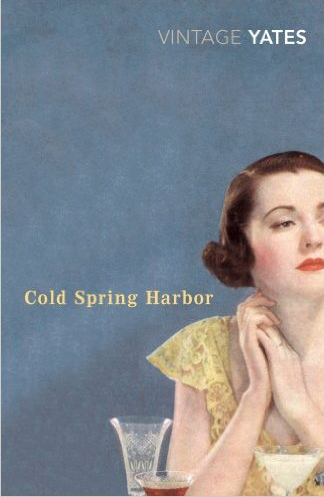
On Richard Yates’ The Easter Parade (1976) and Cold Spring Harbor (1986)

Easter ParadeCold Spring Harbor

I had almost forgotten how fascinating it is to read several books of the same author, one after the other. You see patterns emerge, recurring motifs, similar themes. Maybe not every author’s work is as homogenous as Yates’ is. In his case, the books are variations on the same themes. Some readers might find it repetitive to read so many of his novels, but I liked to see the patterns and differences emerge. Comparing The Easter Parade with Cold Spring Harbor was particularly rewarding. Most of Yates’ main themes are already present in Revolutionary Road but The Easter Parade and Cold Spring Harbor take them one step further.

The similarities of The Easter Parade and Cold Spring Harbor are striking. In both books we have excentric, almost laughable, mothers who are prone to drinking. We have struggling daughters and/or sons, who desperately try to live a better life but fail hopelessly. We watch those daughters and sons have kids and already know they will pass on the “loser gene”. Divorce is as much a recurring theme as alcoholism, lack of ambition, self-deception, and a failure to stand up for oneself.

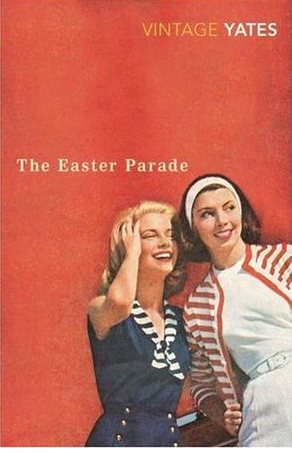
The Easter Parade tells the story of a mother, Pookie, and her two daughters, Sarah and Emily. From the frist sentence on we know the story will not be a happy one.

Neither of the Grimes sisters would have a happy life, and looking back it always seemed the trouble began with their parents’ divorce.

If ever a sentence summed up the books of an author, then this is it. Not only does it tell us that his characters will not be happy, but it places them firmly in a family tradition, which predestines them for unhappiness. This is an extremely pessimistic view of families. While I agree, it’s very difficult to free yourself from the influence of a dysfunctional family, I’m not as pessimistic as Richard Yates. I do believe it’s possible.

The two daughters in The Easter Parade live very different lives. While Sarah gets married early and has kids, Emily is a free spirit, who strives for a career and has many lovers. She does get married but the marriage doesn’t last. We can judge how pessimistic Yates was, when we follow Emily’s life. The only reasons, for me, why she couldn’t be happy was that her family prevented her. The strings that attached her were too tight, even after she left and went to live far away from them.

Cold Spring Harbor tells the story of different people. Evan Shepard comes from a broken home, although his parents aren’t divorced. His father could never live the life he wanted to live and his mother is a severely depressed alcoholic. Evan marries too early, gets a divorce, and then meets his second wife, Rachel and her family. Rachel’s mother resembles Pookie. She too has two kids, a daughter and a son, she is divorced, has illusions of grandeur and drinks too much. About halfway into the novel, we know that Rachel will follow in her footsteps and possibly pass her unhappiness on to her child. We do have hope for the son though.

Failed marriages and divorce are recurring themes but, unfortunately, Yates’ characters experience other forms of misery. They are either not ambitious and therefore never achieve any type of professional fulfillment, or they are ambitious but not good enough at what they are doing and will never know success.

Both novels are sad and tragic but, strangely enough, they didn’t depress me. Yates’s outlook is pessimistic but when you look at his characters closely, you see that the misfortune is the result of their own doing. You don’t need to let your parents unhappy lives/marriages drag you down. Just because your parents drink, that doesn’t mean you have to start drinking as well. Maybe it’s odd, but in a way I found the books almost comforting because, maybe unbeknownst to Richard Yates himself, they seemed to be telling— this only happened to these people because they didn’t free themselves.

And then, like in Revolutionary Road – there’s the writing which is simply amazing. He’s got a knack for describing people like not many other authors. Actually, this aspect of his writing, reminded me a lot of Jane Austen. I already felt that when reading Revolutionary Road but after these two books, even more. Like Jane Austen, he can see right through people and phrase this in a witty way. The biggest difference is the fate he’s got in store for them. Not one of them is allowed a Happy Ending à la Austen. That said, his observations and descriptions are so masterful that they always cheer me up.

I’m not sure which of the three novels I’ve read so far I liked best. Possibly The Easter Parade. Cold Spring Harbor is like another version of that book; a slightly less perfect one.

Here’s my review of Revolutionary Road.
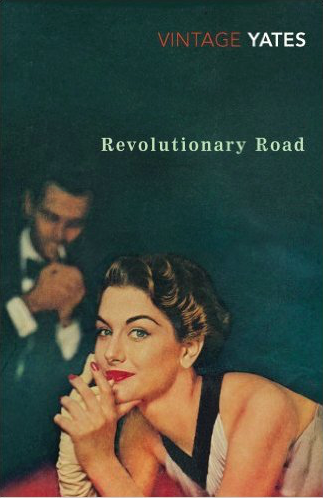
Richard Yates: Revolutionary Road (1961) or Why is Richard Yates a Writer’s Writer?

Revolutionary Road

The first time I came across the name Richard Yates was in 2006 when his short story collection Eleven Kinds of Loneliness was translated into German. All the big newspapers reviewed and praised it. I think that must have been about the same time, he was rediscovered in the US, which then led to the translations. I’m not sure why it took me another nine years to finally pick up one of his books. Be it as it may, I’m so glad I finally did. After finishing Revolutionary Road, I started to read up on him and that’s when I came across this very long, very insightful article by Stewart O’Nan: The Lost World of Richard Yates. It was written in 1999 – before the rediscovery. It’s interesting because O’Nan not only tries to capture why he thinks Yates is an amazing author but also goes into lengthy musings on why he was never successful. For me, it wasn’t surprising that it took so long to discover him in Germany, but that he wasn’t successful in the US or other English-speaking countries did come as a surprise. Stewart O’Nan’s central thesis is that Yates is a writer’s writer. Not a typical one, though. I’ll get to that again, after the review of Revolutionary Road.

Revolutionary Road tells the story of Frank and April Wheeler, a young couple who’s living in the suburbs of New York. The book opens with an amateur play in which April has the main role. At first it looks like it could be a success. Initially, April’s performance is good enough to make her husband fantasize what her success will mean for them. He imagines how April will be admired and how it will ultimately make him a center of admiration too and how he will pretend to be all modest about it. But then the play goes wrong and turns into a farce, exposing all the actors, including April to ridicule. It’s a devastating moment. Not so much because the play goes wrong but because the Wheeler’s dreams are shattered. April, who studied acting once, isn’t a good actress after all. And Frank, who imagined his wife’s stellar performance would reflect on him as well, feels just as ashamed as she does, maybe even more so.

This scene is a perfect introduction to the novel and the couple April and Frank Wheeler. While the outcome is dramatic for them, it’s not as such tragic but it contains all the elements of the future tragedy.

Yates introduces us here to a couple who lives a somewhat mediocre life. He’s working for a company he doesn’t appreciate, doing a job that bores him to death. She’s a housewife and stay-at-home-mom, the last thing she ever wanted to be. This as such is sad but what makes it sadder is the fact that they still think they are special and different from anybody else. But every time they want to prove themselves that they are more cultivated, wittier, unconventional, their unrealistic dreams crash against reality and leave them bitter, disillusioned, and filled with an anger they take out on each other.

I must admit, it took me over a hundred pages until I started to appreciate what Yates was doing. I hated and despised these two characters so much. Their aspirations and pretences showed us that they were anything but special but mediocre and petty. Since one of Yates’s admittedly brilliant techniques is to show us Frank’s interior monologue, we’re constantly in the head of a real douchebag. As I said, I was so distracted by the story and found the characters so off-putting, that I almost missed to pay attention to Yates’s narrative techniques. Not only is it brilliant to let Frank’s interior monologue clash with reality, it’s also quite funny.

At the heart of the story is April’s dream to leave and start a new life in Paris. The interesting thing about it is that while it may seem wild, it’s a totally feasible plan, yet they are bound to fail. Why and how they fail is shown in a masterful way.

The most tragic and paradoxical thing about April and Frank Wheeler isn’t that they never live their dream but that they try, if only for a very brief moment, to live it.

I said at the beginning of this post that Yates was, for a long time, considered to be a writer’s writer. This was surprising to me at first because usually writer’s writers are stylists, often using lyrical prose. Yates does write well but his writing is accessible, smooth, simple, almost free of figures of speech. He’s not strong on descriptions, hardly uses atmosphere or mood. So what is it then? It’s amazing how brilliantly he describes people and their interactions. His dialogue and interior monologue is sharp and witty. But more than that, his choices of scenes and structure are admirable. I wondered constantly – how will he capture this or that? Whose point of view will he choose next? And, most importantly – how will he end this novel? I wasn’t interest in the ending from a plot perspective but from a perspective of author’s choice. I felt that there had to be a major “bang”. What would it be?

These are reasons why I agree with O’Nan— he is a writer’s writer. After having found O’Nan’s essay,  I came across John Mullan’s four part piece on Revolutionary Road in The Guardian – you can find it here Part I Imaginary Dialogue, Part II The Epigraph, Part II Comic Dialogue, Part IV The Ending. Reading it confirmed my impressions. Yates is a highly conscious writer. His style may be effortless, his structure and narrative choices are not. One just has to think of the title. Revolutionary Road is the street on which the Wheelers live. It’s close to a suburban nightmare called “Revolutionary Hill”, where all the houses are candy-colored, cute abominations. Not so the Wheeler’s street and house. Nonetheless, it’s suburbia and even in a part that’s not as affluent. Knowing that they read signs and interpret them in a spirit of self-aggrandisement, the name of the road becomes ironic. The Wheeler’s are a lot of things but they are not revolutionary nor rebellious. If anything they are self-deluded and narcissistic.

Revolutionary Road was my first Richard Yates but it won’t be the last. I’m already halfway through Easter Parade and want to read Cold Spring Harbor and Eleven Kinds of Loneliness after that.

I had to watch the movie after finishing the book. Of course, it’s not as good but what bothered me the most was that the Frank Wheeler in the movie was almost likable.

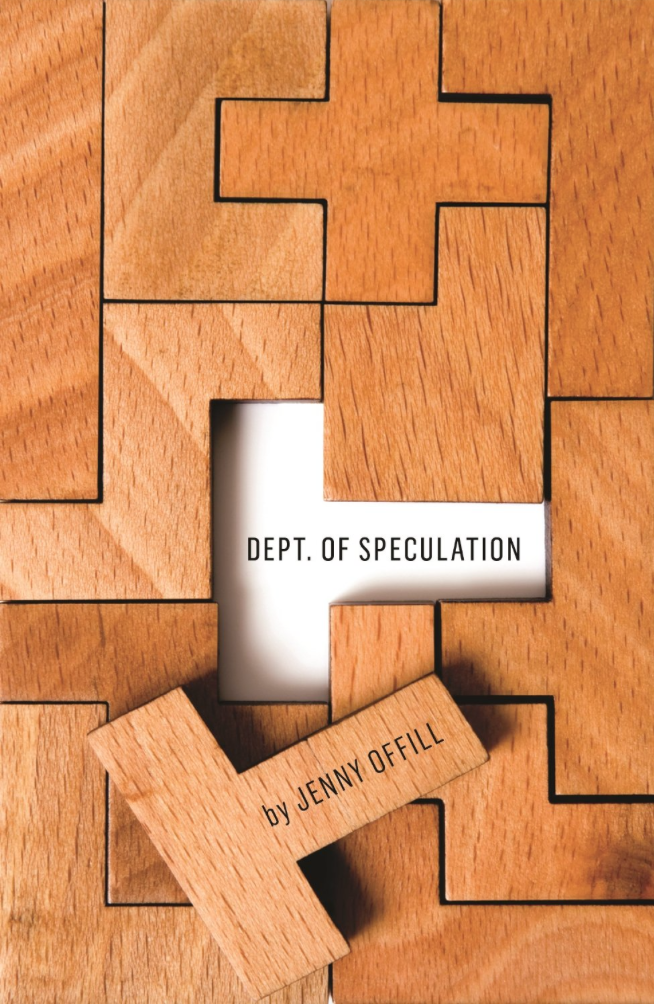
Jenny Offill: Dept. of Speculation (2014)

Dept. of Speculation

Are there any stories more hackneyed than stories of adultery? Possibly not. So, let’s imagine you’re a writer and you want to write a novel about adultery. How would you do it? You could hunt for a really sordid story. Or you could infuse your story with a heavy dose of original writing and, at the same time, make writing about adultery your topic. If you went down that road you might end up with something like Jenny Offill’s Dept. of Speculation. We’ve read the story she tells so many times before, but we never read it told the way she chose to tell it.

The plot is summarized quickly. A woman and a man meet, fall in love, get married, have a child, are happy. Then he cheats. She’s devastated. They fight and grieve and get back together. Jenny Offill could have told this many different ways, but she chose a fragmented approach. Maybe I’ve read too much flash fiction and prose poetry recently, but to me, that’s exactly what Dept. of Speculation is— a novel in flash fiction form. Like flash fiction, it’s highly condensed, pared down, stripped of anything superfluous. It uses formatting as a means of expression, short paragraphs that are arranged like verses in poems. It’s episodic, uses defamiliarization and counterpoint. Reverses expectations, wants to surprise. All characteristics of the condensed art of flash fiction. And it works. Almost every element, each paragraph that has been set apart, can be read individually, like a mini-story. They all offer something and, just like the wheels of a clock, are perfect in themselves.

There’s an interesting use of POV. Before the adultery there’s a first person narrator, after the adultery the POV changes to third. Instead of the pronouns You and I Offill uses “the wife” and “the husband”.  Only in the very last chapter she slowly moves back to first person, almost imperceptibly. Maybe it was the only way to write about the sorrow, pain and grief and avoid cliché and bathos. The result was that I felt kept at arm’s length by the book as a whole, but the individual parts moved me often.

The narrator is a teacher of creative writing. She writes about her student’s stories but, also about her own and how it should have been written differently. I liked those metafictional parts the most.

Of course we wonder how autobiographical it is. At times I felt like reading a personal essay.

There’s a lot to love in this book. Many sentences and passages I admired. Telling such an age-old banal story but infuse it with so much originality – form and thoughts – deserves high praise. And it goes beyond adultery. There are passages in which Offill captures bliss and joy without being corny. Passages in which she praises the wonder of creation and the vastness of the universe. Domestic bliss meets transcendent happiness.

Nonetheless, I couldn’t enjoy it unreservedly because it was too much. For a novel it was almost too rich and for a short story collection it lacked variety in tone, atmosphere, and mood. It’s a hybrid form, and, as such, needs a specific kind of reading.

To give you an impression here are a few quotes:

One night we let her sleep in our room because the air conditioner is better. We all pile into the big bed. There is a musty animal smell to her casts now. She brings in the nightlight that makes fake stars and places it on the bedside table. Soon everyone is asleep but me. I lie in our bed and listen to the hum of the air conditioner and the soft sound of their breathing. Amazing. Out of dark waters, this.


How has she become one of those people who wears yoga pants all day? She used to make fun of those people. With their happiness maps and their gratitude journals and their bags made out of recycled tire treads. But now it seems possible that the truth about getting older is that there are fewer and fewer things to make fun of until finally there is nothing you are sure will be never.


She would not have let one of her students write the scene this way. Not with the pouring rain and the wife’s broken umbrella and the girl in her long black coat. To begin with, she’d suggest taking out the first scene on the subway, the boring one, where the wife pretends to be a Buddhist. (I am a person, she is a person, I am a person, she is a person, etc. etc.) Needed? Can this be shown through gesture?


She has wanted to sleep with other people, of course. One or two in particular. But the truth is she has good impulse control. That is why she isn’t dead. Also why she became a writer instead of a heroin addict. She thinks before she acts. Or more properly, she thinks instead of acts. A character flaw. Not a virtue.

If you’d like to read another review. Max has reviewed here.

This is the third book of my 20 under 200 project.

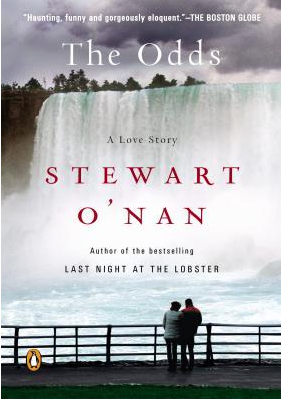
Stewart O’Nan: The Odds (2012)

The Odds

Stewart O’Nan’s novel The Odds is the second novel of my 20 Under 200 project. It’s the third of O’Nan’s novels I’ve read so far and while Last Night at the Lobster is still my favourite, I thought this was very well done.

The Odds tells the story of a middle-aged couple, who spends Valentines Weekend at an expensive hotel in Niagara Falls. They are broke, about to lose their beloved house, and ready to file for bankruptcy. Their marriage has been crumbling for years and after this weekend they will get a divorce. Basically, because they hope to hide assets. The interesting element, the element that generates tension in this novel, is that the reader knows from the beginning this weekend means different things for the characters. Marion considers this a weekend of goodbye. The divorce will bring her freedom. Art, on the other hand, considers this to be a new beginning. He’ll ask his wife to marry him again. Unsurprisingly, the book is full of double entendre and subtext. Watching the protagonists circle each other, trying to find out if they made the right move – Marion hopes having sex isn’t giving the impression, she’s still in for a new beginning, while Art hopes the flashy diamond ring does really express love and is not just seen as a reckless token – is enthralling.

While these dynamics would be interesting enough to follow, there’s something else ging on here. Niagara Falls was where they spent their honeymoon but it’s also a place where you can gamble. This might have been the most interesting part of the book and it shattered a few of my illusions. How naïve was I to believe that Niagara Falls offered nothing but a spectacular view of one of nature’s most amazing offerings. I’ve been taught, Niagara Falls is a garish, small version of Las Vegas. Flashing lights and casinos included. I honestly don’t get it. Do people really enjoy illuminated sights? In garish colors at that? I remember when I saw the Eiffel Tower for the first time in its all-year-round Christmassy illumination – I was disgusted. But this seems even more sacrilegious.

The trip to the casino makes a lot of sense because Art thinks he has figured out how to win big time at the roulette wheel, using the Martingale system. He’s certain that working with the odds will save them.

I found it amusing that Stewart O’Nan used different statistics as titles for his chapters. Odds of a couple making love on Valentine’s Day 1 in 14 – Odds of a U.S. citizen filing for bankruptcy: 1 in 17 – Odds of a married couple reaching their 25th anniversary: 1 in 6 – Odds of surviving going over the Falls without a barrel: 1 in 1,5000,000. Of course, all these are relevant to the story and made me think of those long chapter titles we find in many 19th century novels that give a flavour of what follows.

While they spend their days queuing for hours to see the many tourist attractions, at night they hit the casinos. If you want to find out whether the odds are against them – you’ll have to read the book.

I found this very well written, very realistic. I particularly liked the way he showed the absurdity of a tourist business that transforms a natural phenomenon into a tawdry theme park. Pretty sad, to be honest. It was equally excellent how he described how two people can have very different feelings about the same thing and that even in a marriage you may very well live with a stranger.

What kept me from loving this was that the people described are very realistic, but not exactly interesting. Since this is the second novel about middle-aged people, written by a man, I wonder whether men’s view of middle age in our society isn’t more negative than women’s view. Often, in novels written by women, the middle-aged protagonist starts a new, freer life. This is to some extent reflected in the attitude of the two protagonist. While Art thinks it would be a catastrophe if they spilt, it means freedom for Marion.

After finishing this book I’ve asked myself two questions:

What are the odds that I’ll visit Niagara Falls: 1 in 10,000

What are the odds I’ll pick up another Stewart O’Nan novel? 1:1

Maybe The Odds isn’t Stewart O’Nan’s best novel but it’s still well worth reading.

I first read about The Odds on Guy’s blog here.

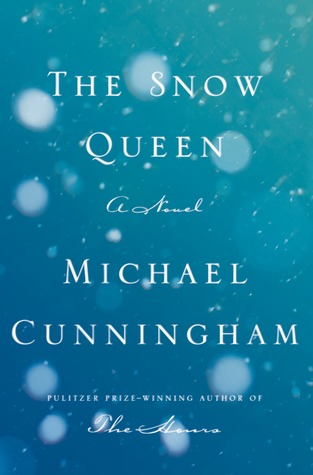
Michael Cunningham: The Snow Queen (2014)

The Snow Queen

Michael Cunningham’s luminous, compassionate new novel begins with a vision.

It’s November 2004. Barrett Meeks, having lost love yet again, is walking through Central Park when he is suddenly and inexplicably inspired to look up at the sky, where he sees a pale, translucent light that seems to regard him in a distinctly godlike way. Although Barrett doesn’t believe in visions – or in god, for that matter – he can’t deny what he’s seen.

At the same time, in the not-quite-gentrified Bushwick neighborhood of Brooklyn, Beth, who’s engaged to Barrett’s older brother ,Tyler, is dying of colon cancer. Beth, Tyler, and Barrett have cobbled together a more or less happy home. Tyler, a struggling musician with a drug problem, is trying and failing to write a wedding song for his wife-to-be – something that will be not merely a sentimental ballad but an enduring expression of eternal love.

Barrett, haunted by the light, turns unexpectedly to religion. Tyler grows increasingly convinced that only drugs can release his deepest creative powers. Beth tries to face mortality with as much courage and stoicism as she can summon.

One night, after having been dumped by his boyfriend via text message, Barrett is walking through Central Park when he sees a light. He’s pretty sure it’s of divine origin and looking down on him. He’s not the only one in his entourage who would benefit from divine intervention. He shares an apartment with his older bother Tyler, an unsuccessful musician with a drug problem, and his soon-to-be sister-in law Beth who has colon cancer. Both could do with some divine assistance.

The Snow Queen starts shortly before Christmas. It snows constantly and the images Cunningham creates are lovely and haunting. Tyler standing at the open window, while the snow swirls into the room full of old broken objects. Beth who wears only white and goes for a solitary walk. Liz and Andrew who do drugs until the early morning and stand on the top of the roof talking.

Barrett was once a wunderkind, someone who promised to be great one day. A scholar, a writer, someone who would leave a mark. Nowadays he’s happy to be a shop assistant in Beth’s and Liz’s vintage clothes shop. He doesn’t see himself as a failure when it comes to his career but he definitely sees himself as failure when it comes to love.

Tyler, the addict, struggles hard to write the perfect song for his wedding. He’s sure that a small bit of cocaine occasionally will help him. But occasionally is just an addict’s way of saying “I’ll stop soon”. And he always stops – until the next time, which comes invariably.

Liz is the oldest of the group of friends. She’s over fifty and still dating young men in their twenties. When they leave her for younger women she doesn’t care. It’s part of the plan, part of never settling.

We follow the four characters over the course of four years and see each of them come to terms with their life choices. They are drifters who have to learn that what they wanted in life might not have been the thing that would really make them happy.

I’m not sure what to think of this novel. I’ve read it in one sitting and some of the images are still vivid but it was also quite lame. I’ve read two of Cunningham’s novels A Home at the End of the World and The Hours. I loved both but this one left me puzzled. The writing is airy and precise, the images he creates are haunting but overall it’s so fluffy. And most of the time I felt like I’ve read something similar somewhere before. I even had a shock moment while working out, watching TV, and an episode of Sex and the City came on. A lot in this episode resembled The Snow Queen. I must say I like him better when he recycles Virginia Woolf. I also have no idea why he chose the title. Tyler get’s a snow splinter in his eye at the beginning but apart from that and the snow-heavy first chapters, there’s no link. Another possible inspiration might have been Jonathan Lethem’s Fortress of Solitude, with which it has more than one element in common.

With the exception of one critic most were raving about this book. I agree that the writing is lovely and the descriptions of addiction are extremely well done. Nonetheless, I need a bit more than a person seeing a light which is never explained and a couple of drifters accepting that life isn’t as grand as they thought it would be. Read it if you want to read an ode to resignation in a snowy setting.

Edith Wharton: The House of Mirth (1905)

The House of Mirth

It took me far over two months to decide whether I wanted to review The House of Mirth or not. For some reasons, I found this book profoundly disturbing.

While reading  The House of Mirth I felt like I was watching a fly getting trapped in a spider’s web. At first, when they notice that they are trapped, they wiggle frantically, hoping to be able to free themselves but, in doing so, entangle themselves even more. Comparing the stunningly beautiful Lily Bart to a fly isn’t doing her any justice, but the way she’s trapped by the society she lives in, and the way in which she tries to free herself, is not much different from the poor fly. I’m still a bit shocked. I knew nothing about The House of Mirth and to find that Lili Bart is just as tragic – maybe even more so – as Effi Briest or Mme Bovary (only without the adultery), came as a huge surprise.

Lily Bart comes from a formerly rich family who has lost everything, Her parents are dead and Lily depends on a rich aunt and her friends. She spends a lot of time at her aunt’s New York home or at the country houses of her friends, on the Hudson. Lily is lucky; she’s stunningly beautiful and people like to adorn their parties and evenings with her. She is also a great conversationalist. Everyone is sure she is going to marry rich but the years go by, Lily is already 29, and she still hasn’t settled.

At the beginning of the novel, she meets the lawyer Lawrence Selden. Lily clearly fancies him but since he’s not rich, she doesn’t think of getting married to him. Accidentally meeting at the train station is surprising for both of them and it triggers something reckless in Lily. She spontaneously decides to follow him home for a cup of tea. Something that would be of no consequences nowadays sets in motion Lily’s downfall and shows how much it costs her at all times to play by the rules. The visit is harmless enough. Lily and Selden chat and speak about mutual acquaintances. The tragedy is set in motion because Lily bumps into someone on her way out and abashedly lies about where she’s been. What follows is a series of bad decisions (on Lily’s side) and shameless exploitation, petty jealousy and revenge (on the society’s side). The story has a lot in common with a Greek tragedy in which the heroes fail inevitably.

As much as some elements of the plot shocked me, I loved this book. The prose is luminous, the descriptions are masterful. I went over many passages repeatedly, before moving forward. The book is written from different points of view, each adding another element, another voice. Selden’s passages are analytical, while Lily’s are far more descriptive and atmospheric.

I found Lily Bart one of the most interesting fictional characters because she’s such a bundle of contradictions and – in many ways – her own worst enemy. At least in the beginning. From a 21st Century perspective one is tempted to condemn her at first. But her upbringing really didn’t equip her for an independent life. She has examples of people around her who are independent, but they are outside of the society whose member Lily wishes to stay. Still, they could inspire her and they do eventually, only by then it’s too late then. What makes Lily endearing, is the way she self-sabotages herself constantly, because these acts of sabotage show that she’s not that corrupted, that she actually despises the society she lives in.

The biggest shock is to see how especially women contribute to Lily’s undoing and how much they relish watching her going down. The House of Mirth is an illustration that – I hate to say this – as long as women actively contribute to undermine, discredit and harm other women – out of jealousy or envy – there will never be true gender equality.

I’ve read The Age of Innocence, Ethan Frome and Mme de Treymes, three very different books, which are all great, but none of them quite equals The House of Mirth. I’m pretty sure, I will re-read it. Now that I know the story, I’ll be enjoying the writing even more.

Susan Minot: Evening (1998)

Evening

With two novels and one short story collection published to overwhelming critical acclaim, Susan Minot has emerged as one of the most gifted writers in America, praised for her ability to strike at powerful emotional truths in language that is sensual and commanding, mesmerizing in its vitality and intelligence. Now, with Evening, she gives us her most ambitious novel, a work of surpassing beauty. During a summer weekend on the coast of Maine, at the wedding of her best friend, Ann Grant fell in love. She was twenty-five. Forty years later–after three marriages and five children–Ann Lord finds herself in the dim claustrophobia of illness, careening between lucidity and delirium and only vaguely conscious of the friends and family parading by her bedside, when the memory of that weekend returns to her with the clarity and intensity of a fever-dream. 

It’s not easy to capture the beauty of Susan Minot’s gorgeous and ambitious novel Evening. If Virginia Woolf or Proust had written page-turners, that’s what it could look like.

In beautiful prose which explores how memory and consciousness work Evening captures the story of Ann Grant’s life. It is 1994 and Ann is terminally ill; she’s lying in her bed, drifting in and out of consciousness. Scent transports her back in time. The morphine induces hallucinations, which are rendered in brilliant stream of consciousness paragraphs. These chapters and paragraphs, are very short, fragments only; the main story however simply moves back and forth between 1994 and 1954, the summer in which she met Harris Arden.

She smelled the cushion and smelled the balsam and what happened to her then was a kind of wild tumult. The air seemed to fracture into screens which all fell crashing in on one another in a sort of timed ballet with spears of light shooting through and something erupted in her chest with a gush and in her mind’s eye she saw her hands forty years younger and heard the clink of rocks on a beach and the sound of a motorboat and rising behind that came a black night and a band playing in the trees and the smell of water in the pipes of a summer cottage and she raised her hand to keep the cushion there and breathed in and heard an old suitcase snap open.

While Ann is remembering four days in 1954, when she met Harris, her grown-up children, her friends and nurses flutter like moths in the periphery of her bed. Ann is given morphine and more often than not, she’s not lucid but hallucinating. One moment she remembers something that happened in 1954 and the next moment a noise in her bedroom changes everything, makes her imagine something; another moment later, she’s back with her visitors.

Her children hear her talk to an invisible stranger, Harris, but when they ask her about him, Ann denies knowing a person with that name.

The story is divided into several recurring elements. There is the story of the four days in summer 1954, the stream of consciousness elements in which Ann sees her whole life pass, the passages in which we hear her children talk, and very short passages in which Ann seems to be talking to Harris who has come to visit her. His visits take place in her imagination but for her this seems more real than anything else.

Evening questions what is left of a life when it comes to its end. Memories, dreams, illusions, are all the same, when you look back. Ann has been married three times. Some marriages were good, others were bad, but now that she is dying, Harris, the unlived possibility, is the strongest memory she has.

Evening explores the way memory works

First she was Ann Grant, then Phil Katz’s wife then Mrs Ted Stackpole then Ann Lord. Bits of things swam up to her, but what made them come. Why for instance did she remember the terrace at Versailles where she’d visited only once, or a pair of green and checkered gloves,  photograph of city trees in the rain?It only demonstrated to her all she would forget. And if she did not remember these things who would? After she was gone there would be no one who knew the whole of her life. She did not even know the whole of it.

Although the narrative is fragmented and modernist in places, the book has the qualities of a page-turner. At the beginning we only know that Ann Grant met Harris in 1954 and that they both fell in love. It will take the whole book to reveal what has happened and why, after all these years, she still remembers him as if it had been yesterday but never told anybody about him.

Underlying this remembrance of things past, lies a very crucial topic: pain medication in palliative care. It’s briefly mentioned in the book that Ann Lord decided to be medicated although she knew she would probably spend her final weeks, days and hours not being lucid. Some cancer patients prefer lucidity and live their final moments with as much pain as they can possibly endure. Not Ann.

It’s a beautiful book and strangely uplifting. Possibly because it testifies how intense an interior life can be and that nothing is really lost. Everything we’ve ever experienced, imagined or dreamed is still somewhere. In its best moments Evening reminded me of Virgina Woolf’s The Voyage Out, in which we often see people or houses from outside. They are motionless or sleeping, but we catch a glimpse of their inner lives, which are rich and deep and passionate.

Evening has been made into a movie with Claire Danes, Vanessa Redgrave, Glen Close, Toni Colette, Natasha Richardson and Meryl Streep. It doesn’t capture what made the book so wonderful but it’s still a beautiful movie.