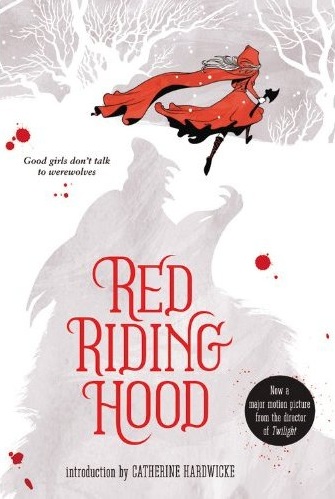
Sarah Blakley-Cartwright: Red Riding Hood (2011) The Book Based on the Movie

Valerie’s sister was beautiful, kind, and sweet. Now she is dead. Henri, the handsome son of the blacksmith, tries to console Valerie, but her wild heart beats fast for another: the outcast woodcutter, Peter, who offers Valerie another life far from home.
After her sister’s violent death, Valerie’s world begins to spiral out of control. For generations, the werewolf has been kept at bay with a monthly sacrifice. But no one is safe. When an expert wolf hunter arrives, the villagers learn that the creature lives among them – it could be anyone in town.
It soon becomes clear that Valerie is the only one who can hear the voice of creature. The Wolf says she must surrender herself before the Blood Moon wanes . . . or everyone she loves will die..

A few months ago I was browsing the Internet looking for the website of Fever Ray and that’s how I found the trailer of the movie Red Riding Hood for which Fever Ray has done the soundtrack.

There are hundreds of fairytale retellings out there. The range is incredible. From literary fiction to pulpy trash you find everything.

Ever since I have read Angela Carter’s Fairytale retellings and watched the movie The Company of Wolves I had a particular liking for the Little Red Riding Hood retellings. It has a few powerful elements that not all other fairy tales have, first of all the wolf and the red cloak. When it comes to the original fairytale it is far from being one of my favourites but what it inspires newer authors to do is often interesting.

For these reasons there was no way around the book Red Riding Hood as soon as I discovered it. The book is actually based on the movie, which makes the marketing strategy clear. This is even enhanced once you realize that what you hold in your hand isn’t the complete book. The last chapter is missing and can only be read online. This isn’t such a problem by now, as the movie has been released, but when I started reading, the chapter wasn’t accessible yet because the movie wasn’t playing.

The wolf in this version, like in some of the other retellings, is a werewolf. During the Blood Moon he lurks in the darkness and comes out of his hiding to kill the people of Daggorhorn. He hasn’t done so for a long time because he normally gets an offering but different circumstances lead to the killing of Valerie’s sister and from there to the death of other villagers. There is no stopping the wolf anymore.

The book works pretty much like a paranormal thriller. It is suspected that the werewolf must be from the village. Someone among the people they all know is transforming himself during the Blood Moon. Like in a proper thriller, there are many suspects. Red herrings abound and you really have to read until the final (online) chapter to find out who is the killer. Insofar it is quite gripping. I think it is possible to find out who it is but it is still entertaining.

What did not work for me are the characters. With the exception of the grandmother they are quite flat and interchangeable. The grandmother however is interesting, a witch-like, potion-cooking old woman who lives outside of society.

Another thing I didn’t like are the inconsistencies in the story. I had a feeling it was written very fast and there were really tacky moments too.

This probably sounds as if I had regretted to read this book but this is absolutely not the case. The descriptions are what I really liked. The little village, lost in the forest, the narrow medieval streets, the picturesque settings and most of all the house of the grandmother. The description of that house made the whole reading worthwhile. The grandmother lives in a tree house, outside of the fear-ridden village, high above everyone else. The interior of that house, the security it provides, is described very appealingly. I’m not going into details, those who want to read the novel should discover this for themselves.

All in all it was a fast read, a bit boring at times but still enjoyable and worthwhile thanks to the descriptions and settings. I shouldn’t forget to mention that there is also a romance part in the novel that did not work so well, or rather, the conflict keeping the lovers apart didn’t work.

I think you gathered that it is nowhere near as good as other retellings of the fairytale that’s why I decided to dedicate another post to a few of the really stunning examples.

Here is the Book’s Homepage with the final chapter.

I haven’t seen the movie yet but I might watch it since I like Fever Ray and Gary Oldman.

Red Riding Hood is my first contribution to the Once Upon a Time Challenge.

Sarah Blake: The Postmistress (2010)

The wireless crackles with news of blitzed-out London and of the war that courses through Europe, leaving destruction in its wake. Listening intently on the other side of the Atlantic, newly-wed Emma considers the fragility of her peaceful married life as America edges closer to the brink of war. As the reporter’s distant voice fills the room, she sits convincing herself that the sleepy town of Franklin must be far beyond the war’s reach. But the life of American journalist Frankie, whose voice seems so remote, will soon be deeply entangled with her own. With the delivery of a letter into the hands of postmistress Iris, the fates of these three women become irrevocably linked. But while it remains unopened, can Iris keep its truth at bay?

I wanted to like The Postmistress and for 200 pages I really did. It has a cinematic quality to it, the descriptions are so perfect, you think you are watching a movie. A movie like Pearl Harbor, not The Draughtsman’s Contract, that’s for sure, but still, it’s an achievement. Also the story is really interesting for far more than two thirds of the book and then it sadly collapses. What starts out as an entertaining and very well-researched read becomes slightly insipid.

The Postmistress interweaves the lives of three very different American women. Frankie Bard, a war reporter, Emma Fitch, the young wife of a doctor and Iris James, the postmaster (she insists on calling herself “postmaster” and I never really got the title).

The story that is told in the book takes place in 1941. During the first two thirds of the book, Frankie is in war-torn Europe, reporting live on the radio, during the Blitz and later from different cities in France. Emma and Iris live both, in the fictional small town Franklin in Massachusetts and hear Frankie’s broadcasts that brings the war into their living rooms. They feel Frankie’s engagement, they live the tragedy with her. They are so far away if it wasn’t for Frankie the war would seem almost unreal.  Apart from Harry Vale, Iris’ fiancé, no one in Franklin, Massachusetts thinks that America will ever go to war, even though the draft has started.

The plot starts to get silly when Emma’s husband decides to go and help in London. He seeks atonement for a “medical accident” for which he feels responsible.

The second third of the book shows Frankie travelling with various trains from Germany to Portugal to interview refugees on the trains. She collects the stories on disks and those voices will later be listened to – thanks to a huge story-twist – in Franklin.

The central story is the one part of the book that I didn’t like and this is unlucky because it ties the three parts together. The idea was to tell the story of a letter that is not delivered because the postmistress decides to hold it back.

Something else that didn’t quite work for me is due to the handling of the characters. Although all three women get their equal share at the beginning, it becomes ultimately Frankie’s story. The other two seem to be mere vehicles to make the plot work.

Sarah Blake writes in her after-word that Frankie couldn’t have had access to a portable disk recorder at that time. What she uses came into usage in 1944 and enabled live-recording from the battlefields.

I took liberty with the date because World War II was the first war that was brought into people’s living rooms by radio, and I wanted to highlight the power of the voice to convey the untellable, the refugees speaking into an air into which they will vanish.

Sarah Blake studied a lot of books on female war reporters, Martha Gellhorn and many other books on WWII. The themes are decidedly interesting and it is no wonder the book has A Reader’s Guide and Discussion Questions. An ideal choice for a book club I presume. Occasionally I wonder if these Reader Guides are not meant to justify the book and ultimately to sell it. It strikes me that I see this more in more in books, even in so-called American literary fiction.

The history of female war reporters and the evolution of reporting is interesting. I think the book also captures very well how far away the war seemed to the Americans. It looks at the way people go on about their lives while in another part of the world people go through terrible things. This seemed very timely and I was reminded of the situation in Japan. We are here and safe while people in another country fight for their survival. How do we go on living as if nothing was happening?

If you are still curious, here is The book’s homepage where you can read the first chapter.