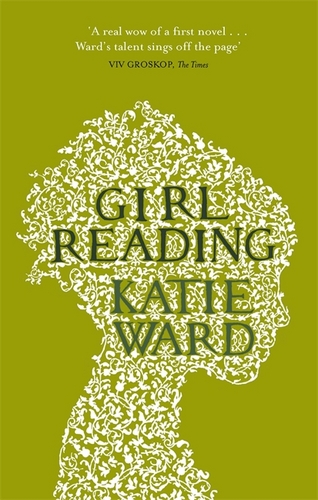
Katie Ward: Girl Reading (2011)

Katie Ward’s Girl Reading is called a novel which is slightly misleading as what it really is, is a collection of seven episodes with a similar theme which are tied together by the last one. Each of the episodes or scenes is set in another time and place, 1333, 1668, 1775, 1864, 1916, 2008, 2060. The way it is tied together, with a final scene set in 2060, gives the whole book a futuristic finish. I knew all this before I started the book but what surprised me was the writing which is quite dense, elaborate and heavily influenced by other books and tales, and, of course, paintings as the linking idea are portraits of reading women or girls seen through the ages.

Most of these “stories” are mysterious, that’s why I chose to call them episodes. They are like small windows that open up on scenes set in the past. We hardly ever get all the background information and often don’t know what will happen to the characters later.

Each of the scenes describes the challenges of women in their respective time and the girl or woman chosen for the portrait is mostly not exactly in line with what is expected of a woman at the time. The fact that the challenges and problems women face stay so similar from the 14th to the 21st century is somewhat unsettling.

Of the 7 stories or episodes I really liked four a lot. The first one, set in Siena, and the second, set in the Netherlands, were not so much to my liking nor was the last set in the future. In the case of story 1 and 2 I had a feeling I have read the exact same stories before, especially the second which was very similar to Girl with a Pearl Earring. Too similar.

I thoroughly enjoyed story 3, set in 1775 in which a female painter comes to the estate of a noble woman to finish the portrait of her lover. The lover, a woman as well, has left and the abandoned one is depressed and morose.

Story 4, set in Victorian England, was another favourite despite the fact that it resembled Audrey Niffenegger’s Her Fearful Symmetry. It’s a tale of two psychic twins. One becomes a photographer, while the other tours the world as a famous medium. It’s a wonderful story and the decor, clothes, atmosphere, are lush and evocative.

Story 5 is another wonderful story. The girl in the center will be a painter in the future but at this point in time she is a slightly silly young girl, infatuated with a painter. What is wonderful is the intensity with which she experiences life. Everything she does – smoking, drinking, falling in love – she does for the first time and savours every minute. Even being heartbroken as it seems.

While I liked some of the stories, I think story 6, set in a Shoreditch bar in 2008, was the most original and rounded of the stories. We get to know much more about the character in this story than about any other of the characters. She is a young black Tory who wants to become member of the Parliament. At the same time she has to decide whether she should get married or not. I liked the way she was described and how descriptions of the most mundane struggles, like wearing shoes which were new but painful, were interwoven with heavy decisions.

I enjoyed some of the stories a lot but as a novel Girl Reading didn’t work for me at all. While the last story, set in the future, gave it an interesting twist, it didn’t manage to really tie them all together. As a whole I found the book a bit artificial which is certainly due to the elaborate and somewhat forced writing. On top of that a few of the stories were too similar to other books I’ve read to be entirely satisfactory.

I’ve read the book along with Rikki and am looking forward to hear what they thought.

Rikki (Rikki’s Teleidoscope) First impressions, Stories 3 and 4, Stories 5-7

If anyone else has read this I would like to know which of the stories you liked best and whether this worked as a novel for you or not. Looking back, I think that story 6 was my favourite because it was the only one that didn’t feel like a pastiche.

If you’d like to see the paintings the stories are based on here is the link to Katie Ward’s site where you find the links.

Alois Hotschnig: Maybe This Time – Die Kinder beruhigte das nicht (2006) Short Stories

I’m glad I discovered this short story collection on Andrew Blackman’s blog thanks to his intriguing review (here is the link). Austrian author Alois Hotschnig is well worth reading. While I don’t see any resemblance with Thomas Bernhardt as some critics did (despite the fact that they are both Austrian), I did find quite a lot of parallels with Kafka, Patricia Highsmith and with one of my favourite authors, Dino Buzzati, another master of the uncanny. Hotschnig describes situations and people who make you feel quite uneasy.

Freud has written an essay called Das Unheimliche which is usually translated by The Uncanny. “Uncanny” does however not capture the full meaning of the word “unheimlich”. Many books, essays and articles have been written about the difficulty to translate the word into other languages. What I’m getting at here is the fact that all of Hotschnig’s stories represent this concept. “Das Unheimliche” as defined by Freud signifies an instance where something can be familiar, yet foreign at the same time, resulting in a feeling of it being uncomfortably strange or uncomfortably familiar. (If you are interested in Freud’s essay here is the English translation).

The collection contains 9 short stories which circle all around people who watch and wait. Just the fact that they don’t do anything but that their presence can be felt at any moment makes them scary. Usually we are afraid of people doing something bad to us but in these stories the fact that the characters are constantly present and stare and watch feels menacing. It gets even more creepy once you realize the narrator is part of this. He is someone who has given up on life and stares and watches. Hotschnig’s stories illustrate incredibly well what passive-aggressive is all about.

The title story of the English edition Maybe This Time captures another uncanny element. In this case it’s the presence of an absence. The parents of the narrator don’t go out anymore as they wait for Walter, the father’s brother, to appear. The children have never seen him. They know he exists but they never meet him. Either he has just gone or he will arrive after they went. Without being there he is omnipresent and the people in the story are like the soldiers in Buzzati’s Deserto dei Tartatri waiting for something that will never happen without realizing that their life will be over without having been lived.

Identity is another element that Hotschnig explores. In his last story called “Du kennst sie nicht, es sind Fremde” (which I would translate a s “You don’t know them, they are strangers”), a man is someone else every time he enters his apartment. The apartment changes as well and so do the people he meets. Depending on whom he faces, he is another person and after a while he chases this experience of seeing himself as someone else through other’s eyes.

I can’t say anything about the translation as I read the German original. They only thing that struck me was the title. Very often the title of a collection of short stories is equal to the title of one of the stories in the book. The German original is called Die Kinder beruhigte das nicht which means “This didn’t calm the children”. There is no story in the book with this title but the title itself has something unsettling, captures the mood of the book. Why the editor of the English translation chose the title  Maybe This Time which is also the  title of one of the stories, eludes me. It’s as if a tiny but significant part had been left out.

As abstract and intellectual as the themes may seem that Hotschnig explores, it’s important to add that his stories are full of vivid descriptions of everyday life. With a few words he evokes the quiet calm of a garden in the early morning which is only disturbed by the distant voices of children. It’s because these stories capture the familiar so well that the unfamiliar strikes us with so much force.

Ladies in Lavender – The Short Story by William J. Locke (1916) and the Movie (2004)

Ever since I have watched the charming Ladies in Lavender I had felt like reading the short story on which it was based. It took a while to find it as I did not know William J. Locke‘s books. I finally discovered that it was in his short story collection Far-Away Stories. Ladies in Lavender is the only one I have read but since I liked it and I bought the book, I will certainly read others sooner or later.

Two elderly sisters (they are 45 and 48 respectively in the book but in their 70s in the movie), both spinsters, live together in a beautiful house on the seaside in Cornwall. They inherited the house from their late father and since his death, some 27 years ago, they have been living in that house alone, sharing a bedroom like a married couple. Theirs is a quiet life, very similar to the life of the ladies in Cranford. A change of weather, something special for lunch, a visitor, are the only distractions they seem to have. They are content and live a certain routine, with the older of the two being in charge.

All this ends when they find a young man on the beach below their window. The sea has washed him ashore. He is unconscious and his ankle is broken. The two ladies cannot help seeing how delicate and beautiful he looks and decide to have him carried to their house and look after him.

What follows is at times quite comedic in the movie. The young man doesn’t speak English, only a little German, but the ladies hardly speak any German at all. It takes a while and some coincidences until they find out that he is a talented Polish violinist.

It is touching how intensely these two old women fall in love with the young man. None of them has ever fallen in love before. They were not married, never had lovers. The adventure with the young man is the most beautiful thing that has ever happened to them, it feels like a fairy tale and they assume he will stay with them forever.

The story of two elderly women falling in love with a very young man could seem somewhat far-fetched but a few years back my mother told me a similar story. She lived in an area of the city that is very green and where a lot of people walk their dogs. My mother was part of a group of 50 and 60+ women going for walks together when suddenly, one day, an extremely good-looking young man appeared with his dog (I wasn’t introduced so can’t tell you how good-looking he was). In any case my mother was quite bewildered as she observed how one of the older women started to fall for the young man. But not only was she in love, she assumed that he had feelings as well as he was very kind and attentive. When he finally showed up after a few months with a young girlfriend, the woman had a major breakdown.

Judi Dench and Maggie Smith play the elderly sisters in the movie and they play them extremely well. They are touching and funny at the same time. The choice for the young man, German actor Daniel Brühl, was less fortunate. I just don’t think he is all that handsome, at least certainly not at handsome as the man described in the book.

In the novel, the story plays clearly before WWI while the movie takes place just before WWII, apart from this and changing the age of the main characters, the movie stays true to the short story but goes into much more detail in the second half.

As nice as the short story is, I preferred the movie. It’s a lovely movie with great actresses, a beautiful setting and a melancholic undertone that depicts very well a certain type of woman that life has passed by.

As I said in the beginning I did not know William J. Locke. It seems he was born in British Guinea in 1863. His novels were five times on the bestseller lists in the US and there are 24 movies based on his work. Amazing.

Indonesian Short Stories

Thanks to Novroz from  Polychrome Interest and Mel U from The Reading Life I discovered Indonesian short stories.

Novroz who is from Indonesia and Mel U who lives in the Philippines are hosting an Indonesian short story month this August and everyone is welcome to join. If you want to know more, check out Novroz’ Introductory Post where you can find suggestions and links to sites where you can read Indonesian short stories online.

I read a few stories but the one I liked the most was by Nenden Lilis A., an author from West Java. I found the story which is called The Rooms Out Back in the issue Tropical Currents of Words Without Borders.

I liked The Rooms Out Back a lot, it opens a door to a world we don’t know, to ways of life we are not familiar with.  There is such a lot in this story, I hardly know where to start.

A young woman, mother of a small child, lives with her husband in a very lively, somewhat chaotic apartment building. Every morning at 7.30 they are woken by the shadow of a cat. Usually they get up at 4.30, do various things, chat with neighbours, pray and nap for a little while until they finally get up for good.

From the first scene we are drawn into this world where a lot happens outside of the apartments and the narrator tells us something about all the inhabitants of the house.

Unlike most of the others she is a happy wife, her husband is kind and gentle and helps a lot while the other husbands tend to drink, have affairs and beat their wives.

What I found extremely fascinating is the narrator’s relationship with Umi, one of the women in the house. Umi has been abandoned by her husband and tries to make a living selling lotions and potions and massaging people.

Reading about this reminded me a lot of my studies of cultural anthropology where I learned how much of the money gained for some households in some countries stems from informal economy. Like housework it is invisible but contributes to a large extent to the family’s survival. These women have to be industrious and ingenious to make a living.

The casualty in their discussions fascinated me, they mention sex naturally and without shame, the body is important and treated as such. Umi offers to massage the narrator because she feels tense. Imagine we would offer that to someone we hardly know?

Just one word on the writing. It isn’t anything special but we have to bear in mind that these stories have been translated from the original language. Maybe the style is more refined in Indonesian.

You can read the story here. I’m interested to read more of her work and to discover other authors.

On Re-Reading Ambrose Bierce

Some classics are part of our childhood reading. There are many different writers that I haven’t re-read since I was quite young. Ambrose Bierce was one of them.

I remember sneaking off with a volume of his short stories and liking them very much when I was little. I knew nothing about the man, only much later when I read a lot of Latin American literature and came across Carlos Fuentes’ Gringo ViejoThe Old Gringo, that was also made into a movie, did I learn something about the man himself. Or rather the mystery of his ending. In 1913, at the age of 71, he rode off to Mexico and was never seen again. Fuentes’ exploration of his vanishing is a great book. I have also seen the movie but can’t remember if I liked it or not. It is believed that Bierce, who also fought in the Civil War, joined the forces of Pancho Villa.

But even without such a mysterious ending, Ambrose Bierce would be an interesting character. He was known for his satirical writings in which he used an acerbic and vitriolic tone. Some of his articles seem to have ruined more than one career of a new writer. He also wrote a lot of short stories and his famous The Devil’s Dictionary.

Since my time is limited these days, I’m much more inclined to read short stories and novellas besides my chunky August Readalong choice (Elsa Morante’s History – one of the great works of Italian literature ! – Yes, you can still join me).

Yesterday I decided to re-read some of Ambrose Bierce’s short stories. I wanted to see how I would like them as a grownup and how the knowledge of his disappearance would influence my reading. I read An Occurrence at Owl Creek Bridge, Beyond the Wall, An Adventure at Brownville, The Damned Thing, One of the Missing and The Stranger. Most of Ambrose Bierce’s short stories can be found online here.

I really loved these stories. Bierce is a fantastic writer. Realistic, yet capable of creating an eerily haunting atmosphere. The Civil War, in which he served, is often a backdrop. The stories are either set in San Francisco or rural California, one takes place in an Arizona desert. The city as well as the country provide material for mysterious descriptions.

In my memory, Bierce’s stories had a certain resemblance with Edgar Allan Poe. It is also said that H.P. Lovecraft was influenced by him. Of the 90something short stories written by Bierce far over 50 have a supernatural, macabre or horror theme. What I had not realized when reading them before is the fact that he has a lot in common with Maupassant. The descriptions more than anything bear a strong resemblance with Maupassant’s short stories. Poe’s descriptions are different.

An Occurrence at Owl Creek Bridge is one of his most famous stories. It is set during the Civil War and tells the story of a man who has been sentenced to be hanged. The story is, like so many others, quite surprising, it is non-linear and offers an unexpected ending. There isn’t anything supernatural in this one, just a touch of it.

Beyond the Wall is a ghost story set in San Francisco during a cold winter night.

The night of my visit to him was stormy. The Californian winter was on, and the incessant rain plashed in the deserted streets, or, lifted by irregular gusts of wind, was hurled against the houses with incredible fury.

An Adventure at Brownville is an atmospherical exploration of the mind’s faculties. It is a beautiful story with great descriptions.

As I leaned wearily against a branch of the gnarled old trunk the twilight deepened in the somber woods and the faint new moon began casting visible shadows and gliding the leaves of the trees with a tender but ghostly light.

The Damned Thing is the story that reminded me the most of Maupassant. It is a very subtle horror story in which two men go hunting.

One of the Missing is the longest story in the collection. It is a tragic story of the Civil War in which a soldier of General Sherman’s army is sent on a dangerous mission.

The Stranger is a ghost story in form of a Western. A party of men camping in the Arizona desert meets a mysterious stranger who tells them an uncanny tale.

If I think of the story of his life and compare its ending to his tales, I think, it is safe to say that Bierce loved mysteries. Maybe he didn’t want to return, maybe he got lost on the way or something occurred that was similar to what happened to the soldier in One of the Missing. One thing is certain, we will never know.

As I said, I enjoyed reading these stories a great deal and since we have autumn-like weather it was quite fitting. I sat on the balcony floor while reading them, it was raining and quite cool. One of the cats was lying on a table, the other one sitting with me under the woolen blanket I had draped around myself. There were a dozen ravens sitting on the huge maples in the back garden flapping their wet wings and cawing.