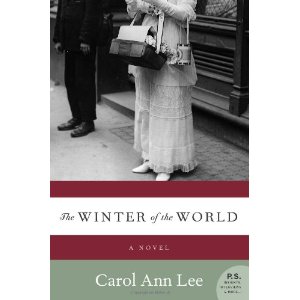
Carol Ann Lee: The Winter of the World (2007) Literature and War Readalong April

Journalist Alex Dyer made his name covering the bloody horrors of the European trenches. Yet even after the Great War is over, he cannot shake the guilt he feels for not serving on the front lines like his dearest childhood friend, Ted Eden. Worse still, Alex cannot put to rest the emotions that gnaw at him from the inside: his feelings for Clare, Ted’s wife—a woman they both have loved more than life itself. 

Carol Ann Lee’s The Winter of the World is the last novel on WWI in this read along. For the next one we will be moving on to WWII.

This wasn’t the easiest review to write as I am in two minds about this novel. There are parts in it that are so haunting and powerful but then again there were others were I was just rolling my eyes thinking “get on with it”.  Still it would be unfair to write a totally negative review because the good parts are among the best on WWI I’ve ever read.

Alex and Ted are childhood friends. They are close and attached to each other until the day Ted introduces Alex to his soon-to-be wife Clare. Very unfortunately this is a love at first sight moment for Alex and Clare. They try to fight it but, as we will see soon enough, the more the story advances, the less likely it is that they will succeed.

The marriage takes place just when the war breaks out. Ted will enlist, Alex will participate as a war correspondent and Clare will be one of the nurses in France.

The novel moves back and forth between Alex’s and Clare’s point of view. Alex sees a lot of atrocities and the descriptions are very graphic and extremely impressive without falling into the trap of being too clichéd. But since Alex isn’t fighting, it stays an outsider’s perspective. Clare’s point of view was captivating for totally different reasons. As a war nurse she has to deal with indescribable wounds and suffering. The abundance of facial wounds seems to be a trait of WWI and these parts reminded me of one of the best WWI movies I have ever seen, La chambre des officiers aka The officer’s chamber based on the eponymous novel by Marc Dugain. We seem to get an insider’s view of this truly harrowing aspect of the “Great war”. I can hardly imagine what it must have been like to have been the victim of this kind of facial mutilation and to be rejected by those you loved and who once loved you. The reactions of the relatives and fiancées were often brutal. Through Clare’s eyes we also get an equally close look at what mustard gas did to those who became its victims and how they suffocated or drowned slowly.

The only men more popular than I was were the ones in wheelchairs, or those with empty sleeves pinned against their chest. Everyone wanted to talk to them, to do something for them. Children presented them with flags and in the railway stations they got free tea or coffee. It was different for the ones whose faces had been destroyed. People averted their eyes quickly, the blood flooding their skin. No one wanted to make eye contact with a disfigured soldier; they were modern-day lepers.

While the war moves on – not stopping at Christmas, as was expected – the love affair develops as well. Clare and Alex meet secretly but are finally driven apart by conflicting emotions and wishes. Alex feels he needs to tell Ted everything, while Clare wants to protect him and keep the affair secret.

Through Alex’ voice we hear what it must have been like to cover this war as a correspondent. The journalists were not allowed to tell the truth. The numbers of casualties were not mentioned nor were the biggest defeats spoken of. While Clare’s parts rather focus on individuals, Alex’ parts illustrate the enormity of the losses. He evokes the incredible amount of wounded, disfigured and killed soldiers. At moments I had the feeling of seeing all these dead men standing in one huge row before my inner eye. When we visit those cemeteries we get a feeling for those massive losses.

He imagined a thin line linking the cemeteries along the old Western Front, from the smallest graveyards hidden away within woods to those huge, silent cities on the plains where the most ferocious battles had been fought. Some bore the names given to them by the soldiers themselves – Owl Trench, Caterpillar Valley, Crucifix Corner – while others were named after the battalion who had buried their own men there. He imagined how tha line would look from the air; so thick in parts that it resembled a child’s scribble, for they were everywhere these Gardens of Stone.

The novel slowly moves towards the culminating point which is the burial of the “unknown warrior”. The name is chose deliberately as “warrior” sounded more inclusive than “soldier”. The grave which is really located in Westminster Abbey was meant to commemorate all the dead fighters of this war, not only the infantry men. The burial is one of the best and most powerful parts in this novel.

Despite all these impressive elements, I had my problems, as I said. The biggest part of the story is told by Alex. He tells Lombardi, a guy he meets in Flanders after the war, why he is so tormented, why he cannot get over the war. I didn’t get this narrative device at all.  I would have preferred a more straightforward story, not this artificial telling of what happened to someone who has nothing to do with it. This was a common technique in 19th century novels but I think it doesn’t add anything to a modern novel at all. The next biggest negative aspect was the coincidence. I found it highly unlikely that Alex would meet Ted at the end. The third thing that I didn’t think well-done is the love-triangle. I think it was unnecessary that Alex and Clare had an affair. The descriptions of Alex’ feelings worked very well for me but not those of Clare. And the guilt-theme was just an element too much. Last but not least I missed Ted’s point of view.

I have a lot of questions at the end of this novel and would be curious to know what others thought.

Was this really the tone of a WWI novel? Especially the love-affair seemed very WWII to me but maybe that impression stems from the similarity to Pearl Harbor.

What about the facial wounds, does anyone know whether this was a consequence of the trenches? In The officer’s chambers, the young officer loses half of his face on the battle field, but I have really never heard so much about this type of injury from any other war.

Why do you think Carol Ann Lee left out Ted’s point of view? I think she might have risked to fall into the trap of cliché but I am not sure that’s why she chose to leave it out.

I’m really curious to read your thoughts.

Here are other reviews

Anna (Diary of an Eccentric)

Danielle (A Work in Progress)

*******

The Winter of the World was the fourth book in the Literature and War Readalong. The next one will be Shusaku Endo’s The Sea and Poison aka Umi to dokuyaku. Discussion starts on Friday May 27, 2011 .

On Philippe Delerm’s Blogger Novel “Quelque chose en lui de Bartleby” (2009)

« http://www.antiaction.com est pris d’assaut. Beaucoup de compliments, qu’Arnold a d’abord trouvés
outranciers, mais on s’habitue vite. Ces enthousiasmes sont souvent signés d’un prénom féminin
accompagné d’une adresse e-mail, mais M Spitzweg s’est promis de ne pas répondre. Certaines
correspondantes comprennent cette attitude : “Ne perdez pas votre temps. Continuez seulement à
cueillir le meilleur des jours.” Cueillir le meilleur des jours pour des Stéphanie, des Valérie, des
Sophie ou des Leila, voilà qui n’est pas sans flatter l’ego d’Arnold, même s’il cueille davantage
encore pour des Huguette ou des Denise ». Arnold Spitzweg crée son blog : l’employé de bureau discret jusqu’à l’effacement cède à la modernité mais sans renier ses principes. Sur la toile, à contre-courant du discours ambiant, il fait l’éloge de la lenteur. Ses écrits intimes séduisent des milliers d’internautes…. Comment vivra-t-il cette subite notoriété ?

I have read a few novels by Philippe Delerm and especially Autumn, his historical novel on the life of the Pre-Raphaelite painter Dante Gabriel Rossetti and his muse Lizzie Siddal, is an absolute favourite of mine. As a matter of fact I liked it so much that I keep his second novel on the life of another famous painter (Carl Larsson), Sundborn, unread on my TBR pile. Unfortunately only one of his books, La première gorgée de bière aka The Small Pleasures of Life has been translated into English. It’s a series of impressions and descriptions of life’s little pleasures. I did like it but not as much as his other books, some of which are novels, others are a combination of little sketches and photos (Paris l’instant).

Quelque chose en lui de Bartleby tells the story of Arnold Spitzweg, an invisible little clerk who is working for La Poste in Paris. Originally from the Alsace region he still loves Paris as much as when he first arrived. He lives an uneventful life, dreams of a unlived love affair, has an occasional lover, but all in all he likes to be left alone and just watch life pass. When someone tells him about a new phenomenon called “blogging” his curiosity is piqued. After a few inquiries he immediately starts his own blog in which he notes in minute details all the little things he observes around him, explains his way of seeing life, of enjoying the simple things and staying outside of it all as a pure observer.

It doesn’t take long and his blog has the first comments. After a while there are more and more until he is a real celebrity, even mentioned on the radio. While at first he wrote exactly what he wanted to write, fame makes him self-conscious and he starts to censor himself. When he realises that he doesn’t write for his pure pleasure anymore, he simply stops blogging.

Quelque chose en lui de Bartleby takes place during one hot summer in Paris. While everyone is gone on holidays, Mr Spitzweg, walks all over Paris, discovers and rediscovers streets, places and little corners and enjoys the city to the fullest. Since I love and miss Paris, I enjoyed all these details. They are well captured. And the parts on blogging are really interesting. From the start Spitzweg doesn’t answer comments or only rarely. He wants to be read but he doesn’t want to get in contact with his readers. I have noticed that there are quite a few bloggers like that out there. I often wonder what is in it for them. The reasons for blogging are probably as numerous as the bloggers who write the blogs. On the other hand I know from my own experience that a blog that gets many comments doesn’t necessarily have many readers, and you may have numerous readers but hardly any comments. I know that I wouldn’t want too many comments as I want to respond to each and every one. The more, the harder. It’s as simple as that. I’m not a crowd person and the people I call “friends” are well-chosen. The same goes for my blog, I suppose. I “know” those who leave comments on my blog. It’s not a crowd of strangers that I cannot place.

I could really understand Mr Spitzweg when he started to feel self-conscious. It did happen to me a few times. Fortunately I got rid of it but occasionally (on my German blog) I have thoughts like “Who is going to want to read this?” or “Oh my, what are they going to think?”.

And what about Bartleby? In the novel Arnold Spitzweg thinks that we are all a little bit like Bartleby and since he emphasized this so much I thought I need to read Melville’s novella. The review will follow tomorrow.

I’m not sure whether what I wrote made it obvious or not but I really liked this little novel. It isn’t one of his best but it contains everything I like in Delerm and I liked his character Spitzweg a lot. He is a very gentle and atypical man who gets picked on quite a lot. Especially by other men. There is also a little bit of gender discussion hidden underneath it all.

Delerm’s novel is not the first blogging novel I saw. I think Joanne Harris has written one and I vaguely remember another one. Has anyone read a novel about blogging?

Louise Welsh: Naming the Bones (2010)

Knee-deep in the mud of an ancient burial ground, a winter storm raging around him, and at least one person intent on his death: how did Murray Watson end up here? His quiet life in university libraries researching the lives of writers seems a world away, and yet it is because of the mysterious writer, Archie Lunan, dead for thirty years, that Murray now finds himself scrabbling in the dirt on the remote island of Lismore. Loaded with Welsh’s trademark wit, insight and gothic charisma, this adventure novel weaves the lives of Murray and Archie together in a tale of literature, obsession and dark magic.

I read a few intriguing reviews of Louise Welsh’s books and Naming the Bones was the one that tempted me the most. Set in Glasgow, Edinburgh and on the Island of Lismore, off the West Coast of Scotland, this is a very atmospherical read. The first 150 pages or so, it did remind me a lot of Kate Atkinson but farther into the novel, this changed considerably. And that is a bit sad. The novel had the potential to be great but the denouement wasn’t to my liking and so I would say, yes, it is a very good novel but not a great one.

Murray Watson, a professor of English literature at the University of Glasgow has a passion that makes him ask for a sabbatical. Since he was a very young guy, he loved the poems of Archie Lunan. Lunan has only had one slim collection published before he died an untimely and mysterious death. Living on the Island of Lismore for a certain time, together with Christie, his girl friend, he took a boat in stormy weather and never returned.

Murray wants to write his biography, do extensive research on the poet, interview people who knew him and secretly wishes to find a few undiscovered poems. Fergus Baine, the head of the department and husband of Murray’s lover Rachel, disadvises this approach. He tells him to concentrate on the poems, not the man.

It is obvious that Naming the Bones is exploring these two approaches to literature; the biographical one and the one leaving out everything related to the life of the author.

Murray is an interesting character. We meet him at a junction in his life. He has just been dumped by Rachel and realizes that Fergus may have known all along that he had an affair with her and that he may not have been the only one whith whom she had affairs. Fergus and Rachel seem to have a very unhealthy relationship.

Murray’s father died of Alzheimer’s and Jack, his brother, who is an artist, made an installation, showing their demented father on film which infuriates Murray.

Murray is a good looking, very attractive man and his charms are the reason why all through the novel women feel attracted to him.

What reads for the first 100 and so pages like a character study and an adventure story circling around the core theme of researching a deceased poet, starts to get dismal once it seems obvious that some of the people in Murray’s life knew Archie and that there may be secrets tied to Archie’s death that are far more disturbing than the possibility that Archie committed suicide.

When the reasearch in Edinburgh and Glasgow is finished, Murray leaves for the Island of Lismore where Christie lives. She doesn’t want to give him an interview or any other information, still Murray wants to see the place where Archie lived and died.

As beautiful as the island may be, it is a lonely and desolate place. Murray’s mood seems to get darker and darker, along with the developments in the novel. It also seems as if other people looking into Archie’s life had met with an untimely death and the further we read into the novel the more uncanny it gets.

I saw the term “gothic” mentioned a few times along with this book and couldn’t understand the use at first. I love gothic books but I do not like the blend of gothic and crime/thriller because that invariably means that  a “satanistic cult” or some such thing serves as part of the background. It’s not as bad as that here but the elements are present. Lucky the outcome isn’t tied to anything supernatural or occult. What we find out at the end just shows some young people’s depravity.

As said in the beginning, this is a very atmospherical novel. I have been to Scotland and know Glasgow and Edinburgh as well as some of the islands off the West Coast and I must say they are very well rendered. It is also an extremely well written novel, the numerous main and secondary characters are without any exception interesting and complex. There is more than one theme explored in this book which gives it additional depth. Welsh tackles topics like old age, research, poetry, alternative life styles, modern relationships, death and suicide with intelligence and a great deal of insight.

All this together makes Naming the Bones a very entertaining read on an autumn or winter afternoon when the world outside is as rainy, stormy and dark as the world in the novel. If you like a gothic atmosphere, you will enjoy this a great deal.

Here’s the island’s website should you plan a trip to Scotland: Island of Lismore.

Anjali Joseph: Saraswati Park (2010)

Famous for its electric chaos, the city of Bombay also accommodates pockets of calm. In one such space works Mohan, a contemplative man who has spent his life observing people from his seat as a letter-writer outside the main post office. But Mohan’s lack of engagement with the world has caused a thawing of his marriage. At this delicate moment Mohan – and his wife, Lakshmi – are joined at their home in Saraswati Park by their nephew, Ashish, a sexually uncertain 19-year-old who has to repeat his final year in college.

The calm, quiet and floating feeling that permeates Saraswati Park makes this one of the most beautiful novels I have read recently. If Anne Tyler had been born in Bombay this could have been a novel she would have written. One of the critics did compare Anjali Joseph to Elizabeth Gaskell and from all the comments I read on my recent post I have a strong feeling Saraswati Park could also be called a modern, Indian set Cranford. In any case it’s a work of perfection. Cosy with a touch of melancholy.

I have always been fascinated by India and visiting Bombay is high on my travelling wish list. Opening a book and feeling as if you were actually already on that trip is a wonderful experience. Saraswati Park is rich in details about the life in Bombay, the climate, the weather, the light, the flowers, plants and birds, yet it never falls into the trap of exotism. Joseph was born in Bombay, she knows the city and, having moved away, misses it. She doesn’t write for foreigners, she writes about her experience and captures facets of Bombay that a foreigner might not expect. We generally associate noise and chaos with Bombay. Who would picture such orderly quiet as it is described in Saraswati Park? But this Bombay, the elegant Bombay of the middle-classes is what Anjali Joseph has experienced.

What I liked best about this novel is the combination of the outside world with all its strangeness and the interior lives of the two main-characters and the blend of the familiar with the foreign.

Mohan belongs to the vanishing profession of letter writers. Sitting day in and out in the middle of the noisy bustling city and writing letters for people who aren’t able to write, he still manages to find peace and quiet in the chaos. He loves the sound of the pigeons running over the roof under which he is sitting, likes to huddle with the other writers around a cup of hot tea during the Monsoon season and enjoys the pouring rains. Books are his passion and he buys as many second-hand books as he can. Preferably those with annotations as this makes him feel as if  he was following in the footsteps of others readers. When the book-sellers are moved one day, it is a huge catastrophe in his life.

At home he sits quietly in a corner, drifting in and out of the novels he is reading and only slightly aware of his surroundings. His wife chooses to watch Indian soap operas instead and they both sort of drift past each other, both lost in their interior worlds.

Still there are so many moments of intense and quiet happiness in Mohan’s life even though he seems to be only a spectator of what is going on in the outside world. Mohan enjoys the early mornings when he is drinking his tea on his own. He loves to watch the birds outside and listen to the rain.

When his nephew Ashish comes to stay with them for one year, things start to shift and move slightly. The death of Laksmi’s brother is the final tipping point. Lakshmi’s sadness and underlying frustrations become apparent when she takes the train and joins her family to help look after an ailing cousin but doesn’t return after one week but stays for over four months. It becomes evident that they are both disappointed by this marriage. Mohan had hoped to find in his wife someone to share his interior worlds with.

But his wife had turned out to be a talker herself. She had her own narration, so confident that he was never sure whether his made any sense to her; then, later, he’d begun to feel that maybe his private thoughts were simply meant to stay that way.

Ashish is a young boy, a quiet student who has to repeat one year. He seems to like being motionless, even enjoys boredom to a certain extent and there is a deep sadness emanating from him. What his uncle doesn’t know is that Ashish is heart-broken. He is about to lose his boyfriend Sunder. Although he finds someone else, his tutor Narayan, this only makes him happy for a little while as this relationship also ends abruptly and the boy is heart-broken again.

The loss of the book sellers, Ashish’s presence and Lakshmi’s absence spur something in Mohan and he starts to write. The first steps are very tentative but through Ashish’s influence he gets more confident and one of his stories is finally published. What he likes best about writing is that he feels

(…) a lovely quiet come off the page. It was rich and held the shards of past experiences.

One of the final scenes shows Ashish taking a last train trip back to the suburb. The scene is such a marvelous scene for anyone who has ever lived far away from home or was going to leave home. It illustrates what I mean when I say, Anjali Joseph knows how to blend the familiar with the – to us – foreign.

From his window seat he looked with hungry eyes at the dirty worlds next to the tracks: the brightly painted shacks, the grubby faced children, the ugly concrete tower blocks, the smells. It was his city, his world; it might be imperfect but it was home. Yet he knew that only his imminent departure nurtured this sudden passion for Bombay, which sometimes was neutral environment in which he existed, and at other moments felt like a trap he’d never escape.

The biggest achievement of this novel is to capture a foreign world and make it sound familiar. To portray the inner lives of people so skilfully that we can identify with each one of them. Saraswati Park is about love and marriage, loss and discoveries but also about the power of imagination and memories, the beauty and danger of reading and ultimately also about writing.

This is certainly one of the most beautiful Anglo-Indian books I have ever read. Do you have any favourite Anglo-Indian writers?

Dutch Literature Recommendations

Lost Paradise

A post on Guy’s blog His Futile Preoccupations, followed by a discussion and comments on Dutch literature inspired me to write a post on maybe not sufficiently known Dutch literature. There is maybe also an upcoming European book tour on Bookaroundthecorner’s Blog.

I did learn Dutch because I wanted to read Dutch books in the original language. It’s a funny language and very close to the Swiss German dialects therefore I can’t say it was difficult to learn for me. The structure of the sentences is very English, the words have either German or English origin. However I read most of the books in the German translation which was mostly OK. Despite having read a fair amount of books I still have a big TBR pile of Dutch books.

I tried to find as many English translations as possible but depending on the author the result is somewhat meager.

The list below consists of literary fiction and a few crime writers. The authors that deserve particular attention are Grünberg, Mulisch, de Winter, Palmen, Hermans and Nooteboom.  I have also read the crime writers. Janwillem van de Wetering’s series is very different, very enjoyable. Saskia Noort seemed rather a bit in the vein of Mary Higgins Clark. Maarten t’Hart writes crime and memoirs and is good at both. Mulisch, Nooteboom and van de Wetering should be easy to find. Many of their books have been translated.

Arnon Grünberg: Phantom Pain

Arnon Grunberg’s masterful first novel is a rare feat: a work that manages to be shocking yet not sensationalist, hip but not trendy, ironic but not cynical. Most of all it is highly affecting. Highly recommended.

Leon de Winter: Hoffman’s Hunger

Felix Hoffman’s hunger is both physical and emotional. A Dutch diplomat with a chequered career behind him, he is now Ambassador in Prague in the late 1980s; his final posting. In Kafka’s haunted city, Hoffman desperately feeds his bulimia and spends his insomniac nights studying Spinoza and revisiting the traumas of his past. A child survivor of the Holocaust, Hoffman married and had beloved twin daughters, but a double tragedy has befallen his family; one daughter died as a young girl of leukaemia, the other, who became a heroin addict, has committed suicide.This has wrecked Hoffman’s marriage and his life; he has not had one decent night’s sleep since the death of his daughter over twenty years ago, and his constant physical hunger reflects his emotional hunger for truth and understanding. When Carla, a Czech double agent, gets into Hoffman’s bed, political and emotional mayhem ensues. Hoffman’s past and his present predicament are inextricably bound up with the tormented history of Europe over the fifty years since the Second World War. Like Europe, he is at a crossroads, and the signs point to an uncertain future.

Willem Frederik Hermans: Beyond Sleep

A gripping tale of a man approaching breaking point set beyond the end of the civilised world: a modern classic of European literature.

Margriet de Moor: The Virtuoso

A novel set in 18th-century Naples. For one entire season, Carlotta sits in her candle-lit box, held in the spell of a world in which knowledge, beauty and love collide: music. She has fallen in love with the male soprano, Gasparo.

Cees Nooteboom: Lost Paradise

Nooteboom brings a subtle, playful brilliance to this exceptional story of escape, loss and identity.

Harry Mulisch: The Discovery of Heaven

On a cold night in Holland, Max Delius – a hedonistic, yet brilliant astronomer who loves fast cars, nice clothes and women – picks up Onno Quist, a cerebral chaotic philologist who cannot bear the banalities of everyday life. They are like fire and water. But when they learn they were conceived on the same day, it is clear that something extraordinary is about to happen. Their worlds become inextricably intertwined, as they embark on a life’s journey destined to change the course of human history. A magnum opus that is also a masterful thriller.

Connie Palmen: The Laws

A debut novel which won the European Novel of the Year Award about unconventional love spanning seven years. A young philosophy student Marie Deniet encounters several men: an astrologer, an epileptic, a philosopher, a priest, a physicist, an artist and a psychiatrist, and attempts to comprehend the laws these loves live by.

and The Friendship

Ara and Kit, two girls in the village school, seem to have nothing in common. Ara, the elder, is large, earthy and illiterate; Kit is lean, brainy and interested in abstractions like philosophy. After they leave school Ara cannot let Kit alone – she is drawn to her as a moth to a candle flame.

Jessica Durlacher. I couldn’t find any of her books in English but she is famous as she writes on the Holocaust and is mentioned in this book: The Holocaust Novel

Dutch crime

Janwillem van de Wetering: Outsider in Amsterdam

Piet Verboom is found dangling from a beam in the Hindist Society he ran as a restaurant-commune in a quiet Amsterdam street. Detective-Adjutant Gripstra and Sergeant de Gier of the Amsterdam police force are sent to investigate what looks like a simple suicide.
Outsider in Amsterdam is the first in the Amsterdam Cops series of internationally renowned mysteries.

Saskia Noort: The Dinner Club

On a cold winter’s night, an elegant villa goes up in flames. Evert Struyck, happily married, father of two and successful business man, dies in the fire. His wife, Babette and the children manage to escape. Babette is part of a group of five women, known as “the dinner club”, who meet regularly and whose husbands do business together. Karen, a dinner club member, takes Babette into her house after the fire, but soon discovers that the friendships in the dinner club are not as unconditional as they seem. It becomes clear that some people have benefited from Evert’s death. Within weeks another member of the club falls from the balcony of a hotel and dies. Karen starts to put the pieces together. White-collar crime, fraud and adultery are the putrefying glue that has kept the dinner club together. Not for much longer. Set in a world of affluent suburbs, flashy 4×4’s and country clubs, familiar to readers in the UK and the US, “The Dinner Club” is a psychological thriller about a group of people desperately hanging on to the outer varnish of their lives. Some of them will defend their material success at any price. Imagine “Desperate Housewives” scripted by Patricia Highsmith. That’s “The Dinner Club”

Maarten t’Hart: The Sundial

The Sundial opens with Leonie Kuyper attending the funeral of her best friend Roos Berczy. She has always felt a little overshadowed by her friend’s glamorous looks and successful career so when she discovers she is the sole heir to Roos’s estate Leonie, an impoverished translator, cannot refuse. Leonie gradually begins to assume Roos’s identity, and as questions arise about her friend’s past, her curiosity becomes piqued. Leonie’s investigations soon unearth certain suspicious circumstances surrounding Roos’s death and the culprit, alarmed by this, springs into action.

I’m planning on reading either Hoffman’s Hunger or Phantom Pain soon.

If you think of reading books in Dutch, it might also be worth trying the literature of Suriname. I have one or two books but they have not been translated.

Does anyone have other suggestions and/or know the books?

If you are interested in a Dutch read along taking place in June, please visit Iris on Books

Phantom Pain

Elizabeth Gaskell: The Moorland Cottage (1850)

Growing up in Yorkshire, the daughter of a deceased clergyman, Maggie Browne is encouraged to devote herself to her brother, Edward, upon whom their widowed mother dotes. Through the example and guidance of her mentor, Mrs Buxton, Maggie learns that self-sacrifice is the key to living a fulfilled life. How much personal happiness will she forgo in the name of duty and devotion to her brother? This novella depicts the struggle of a strong-minded Victorian woman, torn between her dreams and her duty towards her family. Maggie’s love story, Edward’s perfidy and the dramatic conclusion at sea, make The Moorland Cottage a timeless tale.

Elizabeth Gaskell’s novel The Moorland Cottage is said to be the precursor and the template for George Elliot’s The Mill on the Floss as we can read on the inner sleeve of this very nice Hesperus edition. As a matter of fact this and the blurb sounded so interesting and the book looked so appealing that I bought it and only realized later that this was the very same novel I had seen reviewed on Violet’s blog and sworn to stay away from. It wasn’t a positive review at all. I trust Violet’s taste and felt quite silly that I bought it. I must add that the cover of her edition looked very different. Tacky is the word for it. I have never read anything by Elizabeth Gaskell and this was short enough (140 pages) so I thought I give it a try anyway. Halfway into the book I discovered that Katherine from the Gaskell Blog, who is hosting a group read of The Moorland Cottage, dedicated one of the first posts to a stunning photo tour of the first chapter of the book.

The descriptions are easily one of the best things in this novel. For very personal reasons I also liked the character portraits. The mother does, in some instances, sound so much like my own mother used to be that it felt spooky to read how she reprimanded little Maggie the whole time, trying to crush her joy and preferring the brother over the girl for no particular other apparent reason than that he is a boy.

The Moorland Cottage tells Maggie Browne’s story. She is the daughter of a clergy man who has died a few years ago and leaves little Maggie, her brother Edward and a cold-hearted wife, who has adopted a theatrical, ostentatious way of mourning him. In the little cottage also lives a housemaid, Nancy, an old woman who is very fond of little Maggie and loves her dearly. This is lucky as her own mother only cares for the boy who is an obnoxious, selfish and reckless child. He suppresses and exploits his sister whenever he can.

One day the family is invited to the estate of the Buxton family. The Buxton family consists of the invalid Mrs Buxton, Mr Buxton, their son Frank and the niece Erminia. In the Buxton family Maggie encounters acceptance and love. Mrs Buxton as well as the girl Erminia like her a great deal and in the absence of her mother Maggie shows her true nature. She isn’t only a subdued little girl but very intelligent and truly kind.

After the death of Mrs Buxton the novel fastforwards a few years. Maggie and Frank have fallen in love, Edward has become a lawyer and handles some affairs for Mr Buxton The two lovers want to marry but Frank’s father is opposed to the idea. Chapter 7 is by far the most interesting. It displays all the themes that are recurring in Gaskell’s novels, one of them is the situation of the poor.

I found it particularly interesting because Frank asks Maggie to go away with him, to Australia or Canada.

I would go off to Australia at once. Indeed, Maggie, I think it would be the best thing we could do. My heart aches about the mysterious corruptions and evils of an old state of society such as we have in England.

Frank has lost all faith in the European society. He longs for a clean start in an uncorrupted environment. Where would Frank want to go nowadays, I wondered. To the Moon?

Frank has a huge problem with the way the rich treat the poor and the lovers discuss this at length. Maggie says she would be glad if there really was such a thing as “Transmigration”, something she has read about in an Indian tale. She would like to be transmigrated into a slave owner to see his side of things.

I quite enjoyed the first 8 chapters. I have to agree with Violet, the tone of the novel is mawkish throughout and there is a lot of crying but up to chapter 9 I could forgive it. From then on the novel unfortunately takes a turn. Maggie commits a huge act of self-sacrifice and the story’s plausibility is stretched a lot.

Still I enjoyed it overall because I cannot compare it to any of her other novels yet and because I could see what a truly good Elizabeth Gaskell novel would have to offer. Her descriptions are nuanced and beautiful, the changing of the seasons is rendered masterfully. Depending on the season her descriptions are either light and cheerful or dark and gloomy. Some character descriptions are interesting. Mrs Buxton, despite her insufferable moral teachings, is an interesting character. Why is she ailing and why does she love little Maggie so much?  The awareness of social injustices and the social criticism are themes Elizabeth Gaskell is known for and there is already quite a lot of it in this early novel.

Although the end dampened the overall impression, I will always remember the beautiful descriptions of the English countryside and feel like reading either North and South or Cranford very soon.

Do you have any other suggestions? Did someone else read The Moorland Cottage?

Literature and War Readalong April 29 2011: The Winter of the World by Carol Ann Lee

Carol Ann Lee’s novel The Winter of the World that has the same title as a collection of WWI poems, is the last novel in the readalong to be dedicated to WWI. I discovered the novel on Danielle’s blog and thought it would be a good addition to the 11 I had already chosen.

Carol Ann Lee has written mostly nonfiction books before. The Winter of the World is her second novel. This is what can be found on her amazon page.

Carol has written two novels: ‘Come Back To Me’ which is semi-autobiographical, and ‘The Winter of the World’ – about the Unknown Warrior – which received rave reviews when it was published in France last year. Le Monde ended their review: ‘Finally, here is a writer who understands the subtleties of the soul.’ The book was nominated for two major awards in France, but has yet to find a UK publisher (one commented that it was a beautiful story and compared her writing to Ian McEwan, but said it was simply ‘too patriotic’) although it has been published in America by Harper Collins.

Sounds intriguing. The French title is La rafale des tambours.

Among her nonfiction books are One of our Own: The Life and Death of Myra Hindley, Anne Frank’s Story, The Hidden Life of Otto Frank and Witness: The Story of David Smith Chief Prosecution Witness in the Moors Murders Case.

Should you want to read along you might want to get started a little earlier as the novel has a bit over 300 pages, however the discussion will start late in the month, on Friday 29.