
Literature and War Readalong 2014

The Black FlowerThe Killer AngelsMarch

Toby's RoomPrivate PeacefulFear

Undertones of WarMy Dear I Wanted To Tell YouPhoenix and Ashes

The LieFlight Without EndLetters From a Lost Generation

The books for Literature and War Readalong 2011 and 2012 were following the different wars in chronological order. This year, 2013, we focused on different countries and wars we hadn’t covered so far. Next year will be about genre and WWI.

I was afraid a whole year dedicated to WWI books would be too much, especially since a lot of blogs run events for the Centenary, that’s why I decided to start with three novels on the American Civil War, one of which was part of 2011’s readalong, but had to be postponed. After that it’s all about WWI and to make it more interesting, I’ve included different genres: Memoir, letters, historical fiction, literary fiction, a children’s book and one fantasy novel. I hope there will be something for everyone among these titles.

The Black Flower

January, Friday 31 

The Black Flower by Howard Bahr (US 2000), American Civil War, Novel, 272 pages

The Black Flower is the gripping story of a young Confederate rifleman from Mississippi named Bushrod Carter, who serves in General John Bell Hood’s Army of Tennessee during the Civil War battle that takes place in Franklin, Tennessee, in November 1864. Written with reverent attention to historical accuracy, the book vividly documents the fear, suffering, and intense friendships that are all present on the eve of the battle and during its aftermath. When Bushrod is wounded in the Confederate charge, he is taken to a makeshift hospital where he comes under the care of Anna, who has already lost two potential romances to battle. Bushrod and Anna’s poignant attempt to forge a bond of common humanity in the midst of the pathos and horror of battle serves as a powerful reminder that the war that divided America will not vanish quietly into the page of history.

The Killer Angels

February, Friday 28

The Killer Angels by Michael Shaara (US 1974), American Civil War, Novel, 355 pages

The late Shaara’s Pulitzer Prize-winning novel (1974) concerns the battle of Gettysburg and was the basis for the 1993 film Gettysburg. The events immediately before and during the battle are seen through the eyes of Confederate Generals Lee, Longstreet, and Armistead and Federal General Buford, Colonel Joshua L. Chamberlain, and a host of others. The author’s ability to convey the thoughts of men in war as well as their confusion-the so-called “fog of battle”-is outstanding. This unabridged version is read clearly by award-winning actor George Hearn, who gives each character a different voice and effectively conveys their personalities; chapters and beginnings and ends of sides are announced. Music from the movie version adds to the drama. All this comes in a beautiful package with a battle map. Recommended for public libraries not owning previous editions from Recorded Books and Blackstone Audio (Audio Reviews, LJ 2/1/92 and LJ 2/1/93, respectively).

March

March, Monday 31

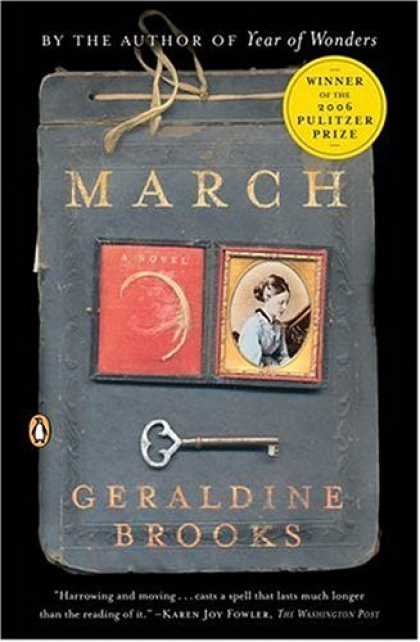
March by Geraldine Brooks (Australia 2005) American Civil War, Novel, 304 pages

Brooks’s luminous second novel, after 2001’s acclaimed Year of Wonders, imagines the Civil War experiences of Mr. March, the absent father in Louisa May Alcott’s Little Women. An idealistic Concord cleric, March becomes a Union chaplain and later finds himself assigned to be a teacher on a cotton plantation that employs freed slaves, or “contraband.” His narrative begins with cheerful letters home, but March gradually reveals to the reader what he does not to his family: the cruelty and racism of Northern and Southern soldiers, the violence and suffering he is powerless to prevent and his reunion with Grace, a beautiful, educated slave whom he met years earlier as a Connecticut peddler to the plantations. In between, we learn of March’s earlier life: his whirlwind courtship of quick-tempered Marmee, his friendship with Emerson and Thoreau and the surprising cause of his family’s genteel poverty. When a Confederate attack on the contraband farm lands March in a Washington hospital, sick with fever and guilt, the first-person narrative switches to Marmee, who describes a different version of the years past and an agonized reaction to the truth she uncovers about her husband’s life. Brooks, who based the character of March on Alcott’s transcendentalist father, Bronson, relies heavily on primary sources for both the Concord and wartime scenes; her characters speak with a convincing 19th-century formality, yet the narrative is always accessible. Through the shattered dreamer March, the passion and rage of Marmee and a host of achingly human minor characters, Brooks’s affecting, beautifully written novel drives home the intimate horrors and ironies of the Civil War and the difficulty of living honestly with the knowledge of human suffering.

Toby's Room

April, Monday 28

Toby’s Room by Pat Barker (UK 2013), WWI, Novel, 272 pages

Pat Barker returns to the First World War in Toby’s Room, a dark, compelling novel of human desire, wartime horror and the power of friendship.

When Toby is reported ‘Missing, Believed Killed’, another secret casts a lengthening shadow over Elinor’s world: how exactly did Toby die – and why? Elinor determines to uncover the truth. Only then can she finally close the door to Toby’s room. Moving from the Slade School of Art to Queen Mary’s Hospital, where surgery and art intersect in the rebuilding of the shattered faces of the wounded, Toby’s Room is a riveting drama of identity, damage, intimacy and loss. Toby’s Room is Pat Barker’s most powerful novel yet.

Private Peaceful

May, Friday 30

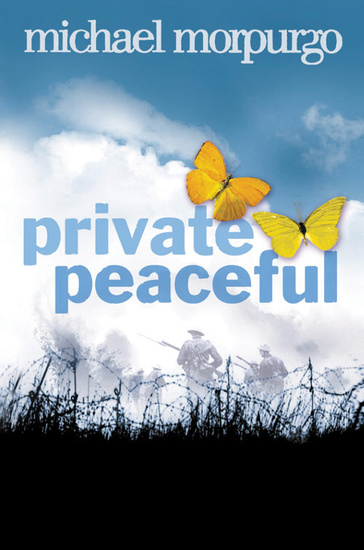
Private Peaceful by Michael Morpurgo (UK 2003)  WWI, Children’s Book, 192 pages

Heroism or cowardice? A stunning story of the First World War from a master storyteller.

Told in the voice of a young soldier, the story follows 24 hours in his life at the front during WW1, and captures his memories as he looks back over his life. Full of stunningly researched detail and engrossing atmosphere, the book leads to a dramatic and moving conclusion.

Both a love story and a deeply moving account of the horrors of the First World War, this book will reach everyone from 9 to 90.

Fear

June, Friday 27

FearLa Peur by Gabriel Chevallier (France 1930)  WWI, Classic, Novel, 320 pages

It is 1915. Jean Dartemont is just a young man. He is not a rebel, but neither is he awed by authority and when he’s called up and given only the most rudimentary training, he refuses to follow his platoon. Instead, he is sent to Artois, where he experiences the relentless death and violence of the trenches. His reprieve finally comes when he is wounded, evacuated and hospitalised.

The nurses consider it their duty to stimulate the soldiers’ fighting spirit, and so ask Jean what he did at the front.

His reply?

‘I was afraid.’

First published in France in 1930, Fear is both graphic and clear-eyed in its depiction of the terrible experiences of soldiers during the First World War.

The Lie

July, Monday 28

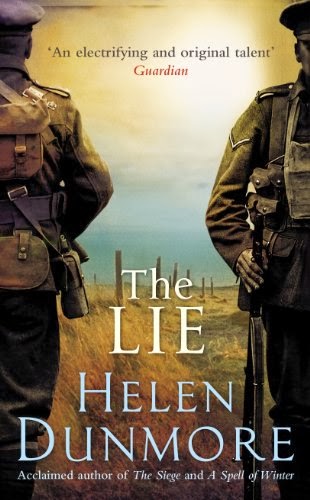
The Lie by Helen Dunmore (UK 2014) WWI, Novel, 304 pages

Set during and just after the First World War, The Lie is an enthralling, heart-wrenching novel of love, memory and devastating loss by one of the UK’s most acclaimed storytellers. Cornwall, 1920, early spring.

A young man stands on a headland, looking out to sea. He is back from the war, homeless and without family.

Behind him lie the mud, barbed-wire entanglements and terror of the trenches. Behind him is also the most intense relationship of his life.

Daniel has survived, but the horror and passion of the past seem more real than the quiet fields around him.

He is about to step into the unknown. But will he ever be able to escape the terrible, unforeseen consequences of a lie?

Undertones of War

August, Friday 29

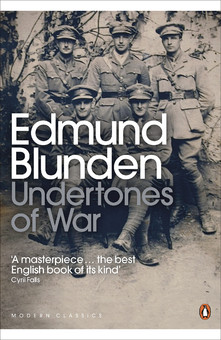
Undertones of War by Edmund Blunden (UK 1928) WWI, Memoir, 288 pages

In what is one of the finest autobiographies to come out of the First World War, the distinguished poet Edmund Blunden records his experiences as an infantry subaltern in France and Flanders. Blunden took part in the disastrous battles of the Somme, Ypres and Passchendaele, describing the latter as ‘murder, not only to the troops, but to their singing faiths and hopes’. In his compassionate yet unsentimental prose, he tells of the heroism and despair found among the officers. Blunden’s poems show how he found hope in the natural landscape; the only thing that survives the terrible betrayal enacted in the Flanders fields.

My Dear I Wanted To Tell You

September, Monday 29

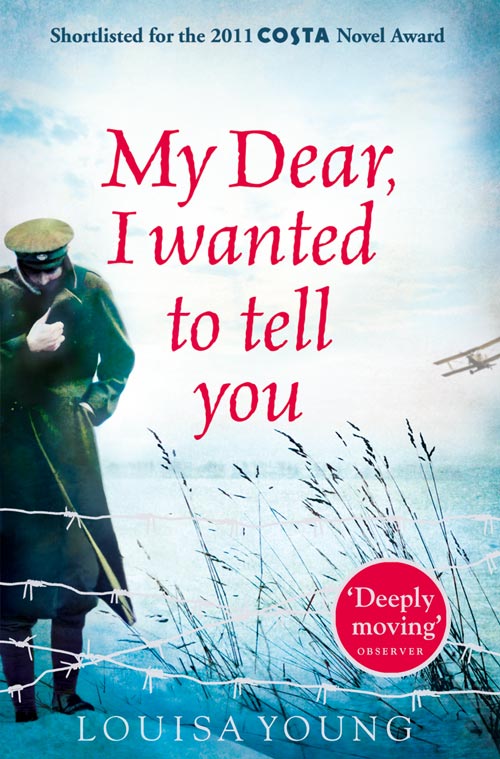
My Dear, I wanted to tell you by Louisa Young (UK 2011) WWI, Historical Fiction, 336 pages

A letter, two lovers, a terrible lie. In war, truth is only the first casualty. ‘Inspires the kind of devotion among its readers not seen since David Nicholls’ One Day’ The Times

While Riley Purefoy and Peter Locke fight for their country, their survival and their sanity in the trenches of Flanders, Nadine Waveney, Julia Locke and Rose Locke do what they can at home. Beautiful, obsessive Julia and gentle, eccentric Peter are married: each day Julia goes through rituals to prepare for her beloved husband’s return. Nadine and Riley, only eighteen when the war starts, and with problems of their own already, want above all to make promises – but how can they when the future is not in their hands? And Rose? Well, what did happen to the traditionally brought-up women who lost all hope of marriage, because all the young men were dead?

Moving between Ypres, London and Paris, My Dear I Wanted to Tell You is a deeply affecting, moving and brilliant novel of love and war, and how they affect those left behind as well as those who fight.

Phoenix and Ashes

October, Friday 31

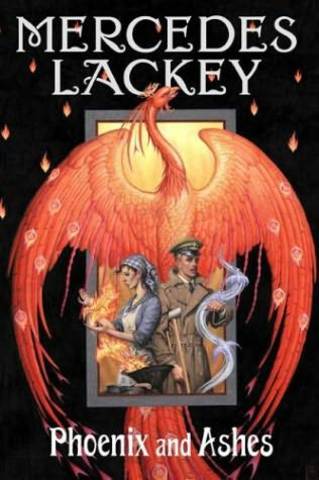
Phoenix and Ashes by Mercedes Lackey (US 2004) WWI, Fantasy, 468 pages

In this dark and atmospheric rendition of the Cinderella fairy tale, an intelligent young Englishwoman is made into a virtual slave by her evil stepmother. Her only hope of rescue comes in the shape of a scarred World War I pilot of noble blood, whose own powers over the elements are about to be needed more than ever.

“A dark tale full of the pain and devastation of war…and a couple of wounded protagonists worth routing for.”

Flight Without End

November, Friday 28

Flight Witout End – Die Flucht ohne Ende by Joseph Roth (Austria 1927) WWI, Classic,  144 pages

Flight Without End, written in Paris, in 1927, is perhaps the most personal of Joseph Roth’s novels. Introduced by the author as the true account of his friend Franz Tunda it tells the story of a young ex-office of the Austro-Hungarian Army in the 1914- 1918 war, who makes his way back from captivity in Siberia and service with the Bolshevik army, only to find out that the old order, which has shaped him has crumbled and that there is no place for him in the new “European” culture that has taken its place. Everywhere – in his dealings with society, family, women – he finds himself an outsider, both attracted and repelled by the values of the old world, yet unable to accept the new ideologies.

Letters From a Lost Generation

December, Monday 29

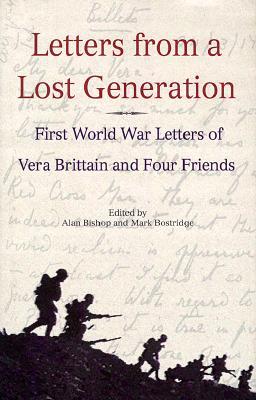
Letters from a Lost Generation by Vera Brittain and Four Friends (UK) WWI, Letters, 448 pages

Nothing in the papers, not the most vivid and heart-rending descriptions, have made me realise war like your letters’ Vera Brittain to Roland Leighton, 17 April 1915.

This selection of letters, written between 1913 & 1918, between Vera Brittain and four young men – her fiance Roland Leighton, her brother Edward and their close friends Victor Richardson & Geoffrey Thurlow present a remarkable and profoundly moving portrait of five young people caught up in the cataclysm of total war.

Roland, ‘Monseigneur’, is the ‘leader’ & his letters most clearly trace the path leading from idealism to disillusionment. Edward, ‘ Immaculate of the Trenches’, was orderly & controlled, down even to his attire. Geoffrey, the ‘non-militarist at heart’ had not rushed to enlist but put aside his objections to the war for patriotism’s sake. Victor on the other hand, possessed a very sweet character and was known as ‘Father Confessor’. An important historical testimony telling a powerful story of idealism, disillusionment and personal tragedy.

I think the list is very different from the last years. The one or the other title like Mercedes Lackey’s book is a bit of gamble but I tried to make the list as diverse as possible.

I hope that many of you will join.
Literature and War Readalong December 30 2013: The Sorrow of War aka Thân phận của tình yêu by Bao Ninh

The Sorrow of War

We’ve all seen movies or read books on the war in Vietnam from an American perspective. Bao Ninh’s The Sorrow of War aka Thân phận của tình yêu is told from the other side. The author was a North Vietnamese soldier and the book is based on his experiences.  The majority of the books we’ve read this year were set far away from the frontline. With this last novel of this year’s readalong, we return to the territory of the soldier.

Here’s the blurb

Kien’s job is to search the Jungle of Screaming Souls for corpses. He knows the area well – this was where, in the dry season of 1969, his battalion was obliterated by American napalm and helicopter gunfire. Kien was one of only ten survivors. This book is his attempt to understand the eleven years of his life he gave to a senseless war.

And the first sentences

On the banks of the Ya Crong Poco, on the northern flank of the 3B battlefield in the Central Highlands, the Missing In Action body-collecting team awaits the dry season of 1976.

The mountains an jungles ae water-soaked and dull. Wet trees. Quiet jungles. All day and all night the water steams. A sea of greenish vapour over the jungle’s carpet of rotting leaves.

*******

The discussion starts on Monday, 3o December 2013.

Further information on the Literature and War Readalong 2013, including all the book blurbs, can be found here.

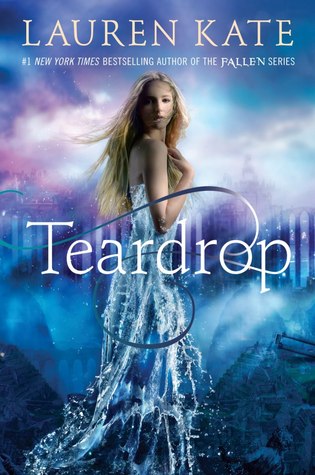
Lauren Kate: Teardrop (2013) Teardrop Trilogy I

Teardrop

Seventeen-year-old Eureka won’t let anyone close enough to feel her pain. After her mother was killed in a freak accident, the things she used to love hold no meaning. She wants to escape, but one thing holds her back: Ander, the boy who is everywhere she goes, whose turquoise eyes are like the ocean. And then Eureka uncovers an ancient tale of romance and heartbreak, about a girl who cried an entire continent into the sea. Suddenly her mother’s death and Ander’s appearance seem connected, and her life takes on dark undercurrents that don’t make sense.

I’ve been interested in Lauren Kate’s Fallen series ever since I first heard about it but somehow never managed to read it. That’s why I was so pleased when I was sent a review copy of Teardrop, the first in her new YA series.

Eureka has lost her mother in an accident. A rogue wave washed over a bridge and threw the car into the ocean. Eureka who was in the car with her was miraculously saved. We know from the beginning who saved her but we don’t know why her mother had to die.

Eureka has a hard time coping. She even tries to take her own life. That her father’s second wife bullies her into going to therapy doesn’t help. Slowly Eureka loses interest in in everything and she’s angry that nobody understand that you can not just forget an accident and a loss like that.

Nobody seems able to reach Eureka, not her family, nor her friend Cat, or her best friend Brooks who changes in odd ways. But there is Ander. A guy who appears seemingly out of nowhere at every moment.

Her mother has left Eureka a strange book and a mysterious stone. She finds an old woman who is capable of translating the book which seems to date back to Atlantis.

As if Eureka’s life wasn’t difficult enough, Brooks disappears and she is followed and threatened by a group of people Ander seems to know. Questions upon question arise, the most confusing one: Why is Eureka not allowed to cry?

There were a few things I really liked about Teardrop. First of all the setting. The story is set in Louisiana, somewhere near New Iberia. I loved the descriptions, loved how Eureaka runs in the rain, the evocation of humidity and lush vegetation. I think I even liked the setting and the atmosphere far better than the characters or the story. Eureka is a girl I felt for. She is isolated in her grief and surrounded by people who have not the tiniest bit of empathy. I think that was captured well. The love story was a bit too superficial for me but maybe there will be more depth to it in later books. The story which circles around the myth of Atlantis is unique, unfortuntaley the foreshadowing that Lauren Kate uses takes away some of the surprise. The end is a cliffhanger and if book two was already out,  I’d pick it up. I really loved the setting, the importance and symbolism of water and I’m interested to see where this is going.

Thanks to Random House for the review copy

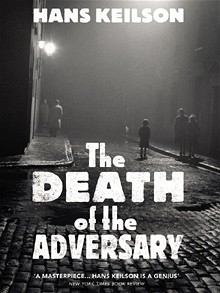
Hans Keilson: The Death of the Adversary – Der Tod des Widersachers (1959) Literature and War Readalong November 2013

Death of the Adversary

I wish it hadn’t happened but it did. I couldn’t finish Hans Keilson’s novel The Death of the AdversaryDer Tod des Widersachers. Not because I ran out of time but because – frankly – I hated it. I hate parables and books that whiff of Kafka (and are not Kafka) and  . . . If  you want to write about Nazism and the rise of Hitler, why don’t you mention it. Why does Hitler have to be referred to as “B”? Why is it never stated that the narrator is Jewish . . . It’s obvious, of course, but the way this is handled is just annoying.  Ilse Aichinger does a similar thing in her novel Herod’s ChildrenDie grössere Hoffnung, but it never feels like mannerism, it’s powerful, expressive and chilling.

I’ve read about 2/3 of The Death of the Adversary and there were passages I thought masterful but they had nothing to do with Nazism and/or oppression but were mainly taken from either childhood or young adult memories. There is a story in which the narrator tells how he forged stamps. This was psychologically subtle. There are other instances in which we see that Keilson’s observations are the result of his being a psychiatrist.

The book’s central story tells how a young Jewish boy first learns about his adversary “B”, a man who slowly rises to political power. His power can be felt in the growing number of followers and how they accept his theories and apply his laws and rules, which first lead to exclusion of the Jews, and then to their persecution. I don’t see what is gained in calling Hitler “B”. Did he want to show the universality of evil? He wanted to show the banality of it, which becomes obvious when he sees the man. And the way he treats the adversary as a recurring motif, showing that he is  s much on the inside as on the outside  . . .  Most of the time, I agree, things are not black or white but I don’t want this concept applied to Hitler and Nazism.

There is also a parable-in-the-parable – the story of the elks and the wolves, which I found particularly ambiguous. Elks were living under the best conditions, however they were not striving but dying. Why? Because there were no wolves. In order to live they would have needed adversaries.

I almost always finish books because some stories need every single passage to become a whole. Given that The Death of the Adversary is not only a parable but a disjointed book – I wouldn’t really call it a novel -,  I’m pretty sure, the end wouldn’t have made me think differently. From what I’ve seen so far, Keilson might be a good writer but he’s not a novelist.

I know that I’m one of a very few who didn’t like this book. But I really didn’t and although I’m sure that Comedy in a Minor Key is different – I’m not going anywhere near Keilson’s fictional work  for a while.

Other (favorable) reviews

Lizzy (Lizzy’s Literary Life)

Mel u (The Reading Life)

*******

The Death of the Adversary was the eleventh book in the Literature and War Readalong 2013. The next is the Vietnamese novel The Sorrow of War aka Thân phận của tình yêu by Bao Ninh. Discussion starts on Monday 30 December, 2013. Further information on the Literature and War Readalong, including the book blurbs can be found here.

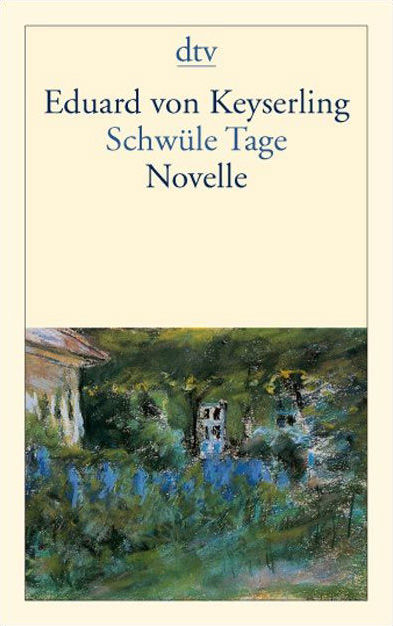
On Eduard von Keyserling’s – Schwüle Tage (Sultry Days) – (1916)

Schwüle Tage

Today we had the first snow. I woke to a fine layer of white in the morning. I don’t think it will stay, it’s already raining. Nonetheless it is strange to write about a book set during a sultry, sweltering summer.

Occasionally critics wonder why Eduard von Keyserling is not as widely read in Germany as Theodor Fontane. I often wonder why he isn’t translated into English. After having read the novella Schwüle Tage (Sultry Days) I think I can say with great certainty that being compared to Fontane may be the reason for both. Not because he isn’t as good and the comparison would be unfavorable, no, just because it’s wrong or, at least, not entirely correct. There is another important author whose work is far closer to Keyserling and that is Arthur Schnitzler. The subconscious plays a far greater role in Keyserling than in Fontane. Suppressed emotions and sensuality are more important than class and the rules of society. This particluar novella put me also in mind of an author I have discovered earlier this year: Hjalmar Söderberg.

None of his works illustrates this better than Schwüle Tage a short novella set during one hot summer. It is told from the point of view of an 18 year-old student who, failing his exams, can’t join his mother and siblings and spend his summer holiday  on the sea-side but has to stay with his patriarchical and domineering father on his estate. The young man is bored to death and quite afraid of his stern and pedantic father. Battling boredom and budding sexuality, he spends his days studying or yearning for fulfilment.

While the estate is busy during the day and servants and maids go about their tasks, mysterious things happen at night. Everyone seessm to lead a secret life during the night. One of the maids sings languorous songs in the park, his father goes for long walks, servants sneak around. Some of the servants tell the young man, that the night is the time during which everyone tries to satisfy their needs. The boy wants to participate and manages to seduce one of the maids.

Secretly the young man is in love with one of his cousins. The two girls are the only young people from the same social background he will see during this summer. He’s sad to know that the older and more seductive will get married and appalled when he finds out that she has a lover. Not only is he disappointed that she belongs to someone else but horrified to find out it is his father.

The end of the novella is unexpectedly tragic and will stay in my mind for a long time.

I loved how this tragic story was rendered, in impressionistic touches, and focussing on the hidden desires and yearnings of these people. They were all trapped in this rigid society and many a stern face was hiding great pain.

When I read this story I was reminded of many of Schnitzler’s tales and found it odd that a German writer, notably one from the Baltic sea, wrote like an Austrian. Only after finishing Schwüle Tage did I discover that von Keyserling studied and lived in Vienna for a long time and later moved to Münich where he stayed until his death. I felt that the influence was palpable. As much as I like Fontane, I love von Keyserling more because he adds a more interior, intimate layer to his writing.

I really hope that editors discover this amazing author and start to translate his work.

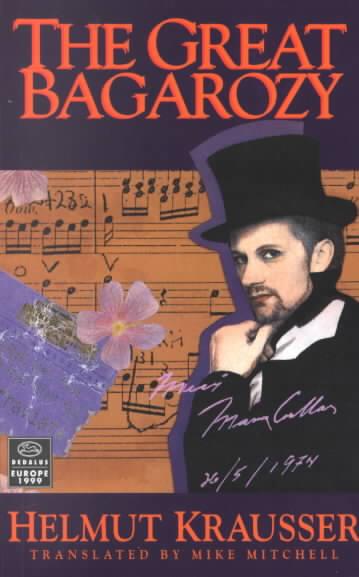
Helmut Krausser: The Great Bagarozy – Der grosse Bagarozy (1997)

the-great-bagarozy

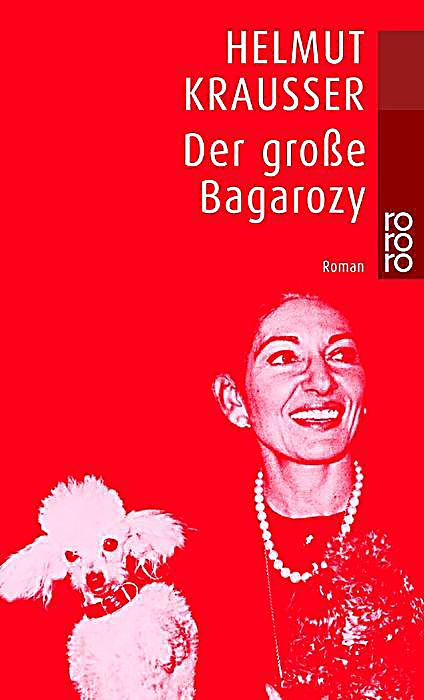
To enjoy this novel you don’t need to be a fan of Maria Callas but you should at least be interested in her life, as The Great Bagarozy – Der grosse Bagarozy is to a large extent an homage to the late Diva. (When you look at the German cover you’ll notice that they chose to make that fact obvious. Not so for the English cover.)

Cora Dulz is a psychiatrist. A very bored one and not exactly someone you’d call compassionate. She’s bored with her marriage to a cardiac tax consultant whose greatest interest is to collect morbid obituaries. There is nothing else in his life he’s this passionate about. Although some hints tell us that he likes to hire cleaning women who perform their tasks naked.

Cora is equally bored by her patients whose ailments make her either yawn or laugh. When two of them commit suicide, she fears for her practice. During this troubled time a new patient appears. Stanislaus Nagy, a man who is obsessed with Maria Callas and states to have known her very well. He pretends to be the devil himself and maintains that he has accompanied Maria during most of her life in the form of a black poodle.

Now this is a story that wakes up Cora. Not only is she interested in this new patient’s story, no, she also falls in love with him and fantasizes constantly about having sex with him. When he doesn’t turn up anymore she looks for him and ends up chasing him until she finds him on the stage of a music hall performing as The Great Bagarozy.

Kraussers novel deliberately blurs every line and confuses assumptions. Is Nagy ill? Or maybe Cora is far more obsessed than he is? Is he really the devil? Could that be?

Whether Nagy is just a devilish man playing tricks on a bored psychiatrist or whether he really is the devil is for you to find out. In any case, he pushes Cora to commit something quite horrible in the end.

I found this novel to be interesting, witty, funny, full of symbolism and extremely well-written. Krausser has a way with words, many of his sentences are worth quoting, and his descriptions are unusual like when he says the sky was the grey of poisoned doves. I’ve always been fascinated by Maria Callas. The woman and the legend and the fact that she’s actually not that good a singer but was considered, and still is considered, one of the greatest. Her life was tragic until the end. If you’re interested in her you’ll learn quite a lot about her life. I loved that Krausser chose to add the macabre obituaries Cora’s husband collects. It added a Six Feet Under feel to the story. He also chose to add many photos of Maria Callas, which add another layer. It’s interesting how her pictures seem to mirror her voice. She could be so beautiful on one photo, and look really rough on the next. When she was younger she managed to sing quite a pure soprano (especially in Tosca) but later on she was much more of a mezzo-soprano (as in Carmen), which, as far as I know, was her true voice type.

The Great Bagarozy is a funny, wicked, entertaining book and a great homage to Maria Callas.

The book has been made into a movie directed by Bernd Eichinger.

der-grosse-bagarozy-072101614

Elke Schmitter: Mrs Sartoris – Frau Sartoris (2000)

Mrs Sartoris

Part confessional, part thriller, Elke Schmitter’s explosive first novel is the story of Margaret. Jilted by a rich boyfriend when only eighteen, she finds herself many years later married, with a daughter, to Ernst, a war veteran with a penchant for routine and order. Living out her days in a small German village she is emotionally frozen, until one day she embarks on passionate affair with a married man. Planning to run away with him, she seems unaware that her plan is a fantasy that can never come true, and similarly unaware of the shocking repercussions that could result from chasing such a dream.

Why does someone commit a crime? Especially someone who isn’t really a criminal, but an ordinary person. Mrs Sartoris is an ordinary person, still, she kills someone. How that happened and who she killed is at the heart of this captivating and masterful novel.

Mrs Sartoris is a troubled woman. She drinks too much, is unhappy and once upon a time she spent a few months in a psychiatric hospital. She lives with her mother-in-law, her husband and her daughter in a small house. The only person in her life she’s truly attached to is her mother-in-law. She makes life bearable. There is no warmth between her and her husband and, as we will learn later, there are reasons for that.

The book opens with a cryptic short paragraph in which Mrs Sartoris, who tells the whole story, writes about an incident. What it is will be revealed very slowly. Small chapters on that incident change with chapters on her life. Her childhood and unhappy love story, her dreadfully boring and conventional married life, her affair with Michael.

Mrs Sartoris isn’t an entirely unreliable narrator but she’s highly deranged and depressed which clouds her judgement.

The story as such is interesting and suspenseful. And there is a twist at the end, which is very well done. But what makes this book truly masterful is the way it’s told. There are passages in the narration that I would call “litanies” in which Mrs Sartoris enumerates things. In one instance she talks about all the meaningless sentences she doesn’t want to say anymore. Reading them in rapid succession is eerie to say the least and makes the reader think how often one uses empty phrases just like that. How many meaningful conversations do we have day in and out? Another litany enumerates all the things Mrs Sartoris has never had in her life and this reveals so much bleak emptiness, it’s  chilling.

Mrs Sartoris has been compared to Mme Bovary. I don’t think I would have made the comparison if the blurb hadn’t told me to make it. Sure, there is an adultery, but other than that? Mrs Sartoris’ husband is as conventionally boring as Charles Bovary, Mrs Sartoris is lost in a dream world and her lover resembles Mme Bovary’s lover a tiny bit but that’s that. I would, if I had to, much rather compare it to Tim Parks’ Loving Roger.

Mrs Sartoris is the tightly woven story of a life, an analysis of a crime written in a chilling, and revealing style that will haunt readers for quite a while.

For another take on the novel here is Stu’s review.