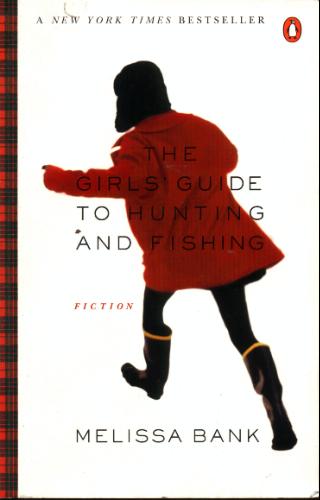
Melissa Banks: The Girl’s Guide to Hunting and Fishing (1999)

The Girls' Guide to Hunting and Fishing

I mistook The Girls’ Guide to Hunting and Fishing for superficial “chick lit”. At the time when it came out I wouldn’t have picked it up but a week ago I stumbled over a review which made me curious and when I saw that there were some dirt cheap used copies on amazon, I ordered one. I’m so glad I gave in. I thoroughly enjoyed reading this witty book. It’s funny and moving, sad and true, all at the same time. However, I would hesitate to call this a novel. It’s a series of short stories, mostly about the same character – Jane. Some of the stories, like the title story have been published by renowned magazines like Zoetrope. Two have been combined and made into a movie called Suburban Girl, starring Sarah Michelle Gellar and Alec Baldwin. While reading the book I remembered I’ve seen this film. It’s not a must-see. Luckily the stories are much better.

When it came out a few critics wrote harsh reviews, saying Jane was no real character and the book contained nothing but witty one liners. I agree that the book contains a lot of witty repartee and quotable lines but I thought it was anything but flat.

The story I liked best is the first in the collection. It’s called Advanced Beginners. Jane is a very young girl still and love and dating are confusing. Emotions are confusing and she understands how difficult it is to put certain feelings into words. They are too delicate; talking about them could destroy them. The following quote, which I found online, will give you a taste of Bank’s style.

My brother’s first serious girlfriend was eight years older—twenty-eight to his twenty. Her name was Julia Cathcart, and Henry introduced her to us in early June. They drove from Manhattan down to our cottage in Loveladies, on the New Jersey shore. When his little convertible, his pet, pulled into the driveway, she was behind the wheel. My mother and I were watching from the kitchen window. I said, “He lets her drive his car.”

My brother and his girlfriend were dressed alike, baggy white shirts tucked into jeans, except she had a black cashmere sweater over her shoulders.

She had dark eyes, high cheekbones, and beautiful skin, pale, with high coloring in her cheeks like a child with a fever. Her hair was back in a loose ponytail, tied with a piece of lace, and she wore tiny pearl earrings.

I thought maybe she’d look older than Henry, but it was Henry who looked older than Henry. Standing there, he looked like a man. He’d grown a beard, for starters, and had on new wire-rim sunglasses that made him appear more like a bon vivant than a philosophy major between colleges. His hair was longer, and, not yet lightened by the sun, it was the reddish-brown color of an Irish setter.

He gave me a kiss on the cheek, as though he always had.

Then he roughed around with our Airedale, Atlas, while his girlfriend and mother shook hands. They were clasping fingertips, ladylike, smiling as though they were already fond of each other and just waiting for details to fill in why.

Julia turned to me and said, “You must be Janie.”

“Most people call me Jane now,” I said, making myself sound even younger.

“Jane,” she said, possibly in the manner of an adult trying to take a child seriously.

Henry unpacked the car and loaded himself up with everything they’d brought, little bags and big ones, a string tote, and a knapsack.

As he started up the driveway, his girlfriend said, “Do you have the wine, Hank?”

Whoever Hank was, he had it.

I also enjoyed the two stories which were made into a movie, My Old Man and The Worst Thing a Suburban Girl Could Imagine. The narrator is a young editor who dates an older, very famous editor who tries to hide his alcohol problem. It’s just as witty as the first story, but more bitter-sweet.

The title story pokes fun at all those self-help books that promise women will find Mr. Right if they only stick to certain rules. The narrator follows such a rule book and at first the result is funny but then it becomes tragic and she turns into a parody of herself.

I can’t help it but I like a book with quotable lines. I enjoyed most of the stories and to me it even felt like a novel because we see Jane at various stages of her dating life. When it came out it was compared to Bridget Jones but that doesn’t do it any justice. It’s totally different, because tone and voice are so different. Jane sounds mostly laconic. I’d also say The Girl’s Guide … is more literary style wise but with less social/cultural commentary. One should really not compare them. It just goes to show that Bridget Jones was the 90s Gone Girl.

Susan Minot: Evening (1998)

Evening

With two novels and one short story collection published to overwhelming critical acclaim, Susan Minot has emerged as one of the most gifted writers in America, praised for her ability to strike at powerful emotional truths in language that is sensual and commanding, mesmerizing in its vitality and intelligence. Now, with Evening, she gives us her most ambitious novel, a work of surpassing beauty. During a summer weekend on the coast of Maine, at the wedding of her best friend, Ann Grant fell in love. She was twenty-five. Forty years later–after three marriages and five children–Ann Lord finds herself in the dim claustrophobia of illness, careening between lucidity and delirium and only vaguely conscious of the friends and family parading by her bedside, when the memory of that weekend returns to her with the clarity and intensity of a fever-dream. 

It’s not easy to capture the beauty of Susan Minot’s gorgeous and ambitious novel Evening. If Virginia Woolf or Proust had written page-turners, that’s what it could look like.

In beautiful prose which explores how memory and consciousness work Evening captures the story of Ann Grant’s life. It is 1994 and Ann is terminally ill; she’s lying in her bed, drifting in and out of consciousness. Scent transports her back in time. The morphine induces hallucinations, which are rendered in brilliant stream of consciousness paragraphs. These chapters and paragraphs, are very short, fragments only; the main story however simply moves back and forth between 1994 and 1954, the summer in which she met Harris Arden.

She smelled the cushion and smelled the balsam and what happened to her then was a kind of wild tumult. The air seemed to fracture into screens which all fell crashing in on one another in a sort of timed ballet with spears of light shooting through and something erupted in her chest with a gush and in her mind’s eye she saw her hands forty years younger and heard the clink of rocks on a beach and the sound of a motorboat and rising behind that came a black night and a band playing in the trees and the smell of water in the pipes of a summer cottage and she raised her hand to keep the cushion there and breathed in and heard an old suitcase snap open.

While Ann is remembering four days in 1954, when she met Harris, her grown-up children, her friends and nurses flutter like moths in the periphery of her bed. Ann is given morphine and more often than not, she’s not lucid but hallucinating. One moment she remembers something that happened in 1954 and the next moment a noise in her bedroom changes everything, makes her imagine something; another moment later, she’s back with her visitors.

Her children hear her talk to an invisible stranger, Harris, but when they ask her about him, Ann denies knowing a person with that name.

The story is divided into several recurring elements. There is the story of the four days in summer 1954, the stream of consciousness elements in which Ann sees her whole life pass, the passages in which we hear her children talk, and very short passages in which Ann seems to be talking to Harris who has come to visit her. His visits take place in her imagination but for her this seems more real than anything else.

Evening questions what is left of a life when it comes to its end. Memories, dreams, illusions, are all the same, when you look back. Ann has been married three times. Some marriages were good, others were bad, but now that she is dying, Harris, the unlived possibility, is the strongest memory she has.

Evening explores the way memory works

First she was Ann Grant, then Phil Katz’s wife then Mrs Ted Stackpole then Ann Lord. Bits of things swam up to her, but what made them come. Why for instance did she remember the terrace at Versailles where she’d visited only once, or a pair of green and checkered gloves,  photograph of city trees in the rain?It only demonstrated to her all she would forget. And if she did not remember these things who would? After she was gone there would be no one who knew the whole of her life. She did not even know the whole of it.

Although the narrative is fragmented and modernist in places, the book has the qualities of a page-turner. At the beginning we only know that Ann Grant met Harris in 1954 and that they both fell in love. It will take the whole book to reveal what has happened and why, after all these years, she still remembers him as if it had been yesterday but never told anybody about him.

Underlying this remembrance of things past, lies a very crucial topic: pain medication in palliative care. It’s briefly mentioned in the book that Ann Lord decided to be medicated although she knew she would probably spend her final weeks, days and hours not being lucid. Some cancer patients prefer lucidity and live their final moments with as much pain as they can possibly endure. Not Ann.

It’s a beautiful book and strangely uplifting. Possibly because it testifies how intense an interior life can be and that nothing is really lost. Everything we’ve ever experienced, imagined or dreamed is still somewhere. In its best moments Evening reminded me of Virgina Woolf’s The Voyage Out, in which we often see people or houses from outside. They are motionless or sleeping, but we catch a glimpse of their inner lives, which are rich and deep and passionate.

Evening has been made into a movie with Claire Danes, Vanessa Redgrave, Glen Close, Toni Colette, Natasha Richardson and Meryl Streep. It doesn’t capture what made the book so wonderful but it’s still a beautiful movie.

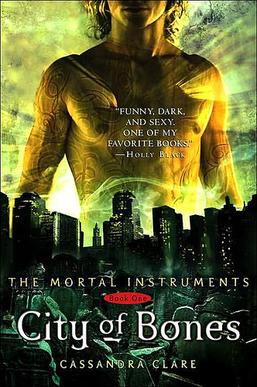
Cassandra Clare: City of Bones (2007) Mortal Instruments I Book and Movie

City of Bones

A couple of weeks ago I watched the movie City of Bones and liked the imagery and the story so much, I had to pick up the book. The movie got dreadful reviews; it seems I’m the only one who really liked it. The book was said to be much better. It’s tricky to read a book after having watched a film with such stunning visuals. For the first 200 pages I didn’t really see the descriptions of the book but the movie images. After that I got a better feel for the book because it contained some major plot elements which had been left out in the film.

The story might be familiar to you by now. Clary and her best friend Simon live in New York City. One night they go to the Pandemonium Club and Clary witnesses a murder. Funny enough Simon can’t see anything. Neither the murder, nor the people who commit it. When Clary’s mum is abducted a little while later, and Clary is attacked by a demon, it dawns on her that the life she has been living might have been a lie.

Together with her friend Simon, Jace, one of the guys who committed the murder, and his friends, she embarks on a big adventure. Clary like Jace is no real human. She is a shadow hunter. Shadow hunters kill demons, but they co-exist with downworlders like werewolves and vampires. I’m not going to write much more about the plot as it’s one of those that is easily spoilt.

I thought the movie did a good job at tightening the plot. Maybe if I had read the book first, I would have missed the scenes and episodes that were cut but I thought they were not that gripping. Clary’s interior monologue in the book is often silly, like when she wonders why there are only good-looking vampires. I’m going to spare you her reasoning. It’s NOT clever. Interestingly though, the greatest appeal of the book are the dialogue sections. Jace, Clary and Simon and not only witty but very sarcastic, which made me chuckle quite a few times.

Overall I would say, book and movie both have their strengths, but I prefered the movie because I absolutely loved the imagery and the interiors they created – the club, Clary’s house, the church in which the shadowhunters live.  I also liked that they made the plot so much tighter. And I thought the cast was perfect.

What I didn’t like so much in both lies in the nature of this specific type of story. There are numerous ways to tell (urban/dark) fantasy stories. I tend to prefer those in which magic/fantasy are part of the world the characters live in, and their existence are known by everyone, or when the main character is part of the paranormal world. Normal humans who are thrown into a paranormal situation or who discover at the beginning of a book that they aren’t entirely human are just not as appealing to me. I find that these stories stretch believability too much. At the beginning of City of Bones, for example, Clary is a normal teenager and after only one day, she’s immersed in a paranormal world she never knew existed, her mother’s abducted, she’s attacked by demons, werewolves and vampires, but she accepts this without questioning it too much. This premise can work sometimes. Neil Gaiman made it work in Neverwhere, but often it feels unrealistic.

Anyway, it’s an entertaining book and I might even read part two, if only for the dialogue. If there is another movie, I’ll certainly watch it.

This is my first contribution to Carl’s Once Upon a Time Challenge. Don’t miss the review site, which can be found here.

Literature and War Readalong April 28 2014: Toby’s Room by Pat Barker

Toby's Room

With Pat Barker’s novel Toby’s Room, we’re leaving the American Civil War behind and move on to WWI. All the books following Toby’s Room are dedicated to WWI.

Pat Barker is one of my favourite writers and her Regeneration Trilogy one of my favourite books. I read all three volumes (RegenerationThe Eye in the DoorThe Ghost Road) back to back and was genuinely sad when I turned the last page. It wasn’t only a story about WWI, but about shell shock, the development of two young disciplines (anthropology and psychiatry) and some of the famous poets who fought in the trenches. My love for her trilogy prevented me from picking up any of her other books, but now, some six years after I’ve read her masterpiece, I’m in the mood, to find out how I will like another of her novel. The scope of Toby’s Room is much smaller, the topics not as varied, but I still hope I won’t be disappointed. As far as I can judge from the blurb, Toby’s Room is a harrowing tale, touching on themes like disfigurement and facial reconstruction.

The first paragraph

Elinor arrived home at four o’ clock on Friday and went straight to her room. She hung the red dress on the wardrobe door, glancing at it from time to time as she brushed her hair. that neckline seemed to be getting lower by the minute. In the end her nerve failed her. She hunted out her pink dress, the one she used to wear for dancing classes at school, put it on and stood in front of the cheval mirror. She turned her head from side to side, her hands smoothing down the creases that had gathered round the waist. Oh dear. No, no, she couldn’t do it, not this time, not ever again.She wriggled out of it and throw it to the back of the wardrobe. Out of the window would have been more satisfying, but her father and brother-in-law were sitting on the terrace. She pulled the red dress over her head, tugged the neckline up as far as it would go, and went reluctantly downstairs.

And  some details and the blurb for those who want to join

Toby’s Room by Pat Barker (UK 2013), WWI, Novel, 272 pages

Pat Barker returns to the First World War in Toby’s Room, a dark, compelling novel of human desire, wartime horror and the power of friendship.

When Toby is reported ‘Missing, Believed Killed’, another secret casts a lengthening shadow over Elinor’s world: how exactly did Toby die – and why? Elinor determines to uncover the truth. Only then can she finally close the door to Toby’s room. Moving from the Slade School of Art to Queen Mary’s Hospital, where surgery and art intersect in the rebuilding of the shattered faces of the wounded, Toby’s Room is a riveting drama of identity, damage, intimacy and loss. Toby’s Room is Pat Barker’s most powerful novel yet.

*******

The discussion starts on Monday, 28 April 2014.

Further information on the Literature and War Readalong 2014, including all the book blurbs, can be found here.

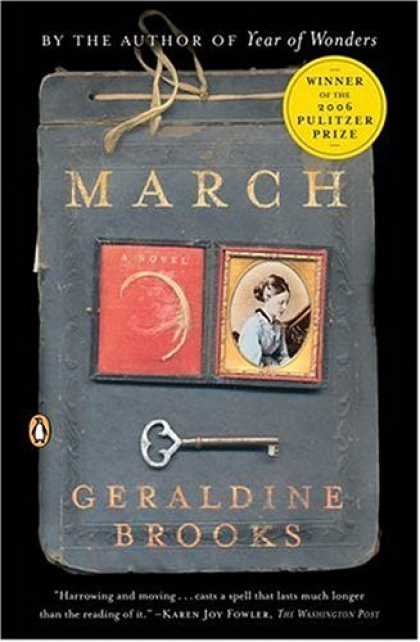
Geraldine Brooks: March (2005) Literature and War Readalong March 2014

March

It seems I have far less stamina than before, when it comes to finishing books I don’t like, even when they are my own readalong choices. While I did finish this novel, I must admit I read large portions of it diagonally, after having suffered through the first 15o pages. I’m not quite sure why I disliked March so much, I only know I did.

March tells the imagined story of the absent father in Louisa May Alcott’s Little Women. The father of the four girls has joined the Northern troops as a chaplain. The father is the narrator of the book – with the exception of a few chapters towards the end, which are told by his wife. Many of the chapters start with a letter to his wife, then they describe things that happen in the present and move back to the past, showing how March developed a sensibility for the cause or how he became an abolitionist.

As a young man, March toured the South as a peddler and that’s how he came into contact with Grace, a very cultivated and intelligent slave.  Together they wanted to teach a young girl to read and write, an undertaking that had fatal consequences. March falls in love with Grace and when he meets her again, later in the book, now a married man and father, it puts a lot of emotional pressure on him.

For the creation of the character March, Geraldine Brooks used the biography of Louisa May Alcott’s father Bronson Alcott. She introduces real characters like Emerson and Thoreau and the militant abolitionist John Brown. Introducing real characters, giving March the biography of a real person, could have made this book very authentic, but for me that’s what made it artificial and turned it into a pamphlet.

The many scenes leading to March’s awareness of the mistreatment of slaves and the stories that took place during the war, are harrowing and described in great detail, but they didn’t work for me either because of the voice. The biggest problem I had with this book was the voice. The tone was that of a goody-goody and often mawkish and preachy. At no time did I have the feeling of being transported to 19th Century America, but I never forgot that I read a book written by a 21st Century author with all the sensibilities of our time, with our thoughts, feelings and outrage about slavery. I’m sure that people who fought against slavery at the time, were outraged as well, still, it didn’t ring true. What diminished the message in this book was the combination of anti-slavery views and transcendentalist beliefs, which led to a peculiar mix that annoyed me.

Geraldine Brooks won the Pulitzer for this book, but, frankly, I don’t understand why. The style is heavy and preachy, the tone mawkish. The only passages that worked were the descriptions. Those were great.


Other reviews

*******

March is the third book in the Literature and War Readalong 2014. The next book is the WWI novel Toby’s Room by Pat Barker. Discussion starts on Monday 28 April, 2014. Further information on the Literature and War Readalong 2014, including the book blurbs can be found here.

Literature and War Readalong March 31 2014: March by Geraldine Brooks

March

Geraldine Brooks is an Australian-born writer whose second book, the Civil War novel March, received the Pulitzer Prize in 2006. The book is inspired by Louisa May Alcott’s famous novel Little Women. March tells the story of the absent father. Right from the beginning of Little Women we know that the father is fighting for the Northern forces in the Civil War.

Jo said sadly, “We haven’t got father, and shall not have him for a long time.” She didn’t say “perhaps never”, but each silently added it, thinking of father far away, where the fighting was.

I’ve always meant to read one of her novels and this seemed a good choice. It will be interesting to compare this to Killer Angels.

Here are the first sentences

October 21, 1861

This is what I write to her: The clouds tonight embossed the sky. A dipping sun gilded and brazed each raveling edge as if the firmament were threaded through with precious filaments. I pause there to mop my aching eye, which will not stop tearing. The line I have set down is, perhaps, on the florid side of fine, but no matter: she is a gentle critic.My hand, which I note is flecked with traces of dried phlegm, has the tremor of exhaustion.

And  some details and the blurb for those who want to join

March by Geraldine Brooks (Australia 2005) American Civil War, Novel, 304 pages

Brooks’s luminous second novel, after 2001′s acclaimed Year of Wonders, imagines the Civil War experiences of Mr. March, the absent father in Louisa May Alcott’s Little Women. An idealistic Concord cleric, March becomes a Union chaplain and later finds himself assigned to be a teacher on a cotton plantation that employs freed slaves, or “contraband.” His narrative begins with cheerful letters home, but March gradually reveals to the reader what he does not to his family: the cruelty and racism of Northern and Southern soldiers, the violence and suffering he is powerless to prevent and his reunion with Grace, a beautiful, educated slave whom he met years earlier as a Connecticut peddler to the plantations. In between, we learn of March’s earlier life: his whirlwind courtship of quick-tempered Marmee, his friendship with Emerson and Thoreau and the surprising cause of his family’s genteel poverty. When a Confederate attack on the contraband farm lands March in a Washington hospital, sick with fever and guilt, the first-person narrative switches to Marmee, who describes a different version of the years past and an agonized reaction to the truth she uncovers about her husband’s life. Brooks, who based the character of March on Alcott’s transcendentalist father, Bronson, relies heavily on primary sources for both the Concord and wartime scenes; her characters speak with a convincing 19th-century formality, yet the narrative is always accessible. Through the shattered dreamer March, the passion and rage of Marmee and a host of achingly human minor characters, Brooks’s affecting, beautifully written novel drives home the intimate horrors and ironies of the Civil War and the difficulty of living honestly with the knowledge of human suffering.

*******

The discussion starts on Monday, 31 March 2014.

Further information on the Literature and War Readalong 2014, including all the book blurbs, can be found here.

Michael Shaara: The Killer Angels (1974) Literature and War Readalong February 2014

The Killer Angels

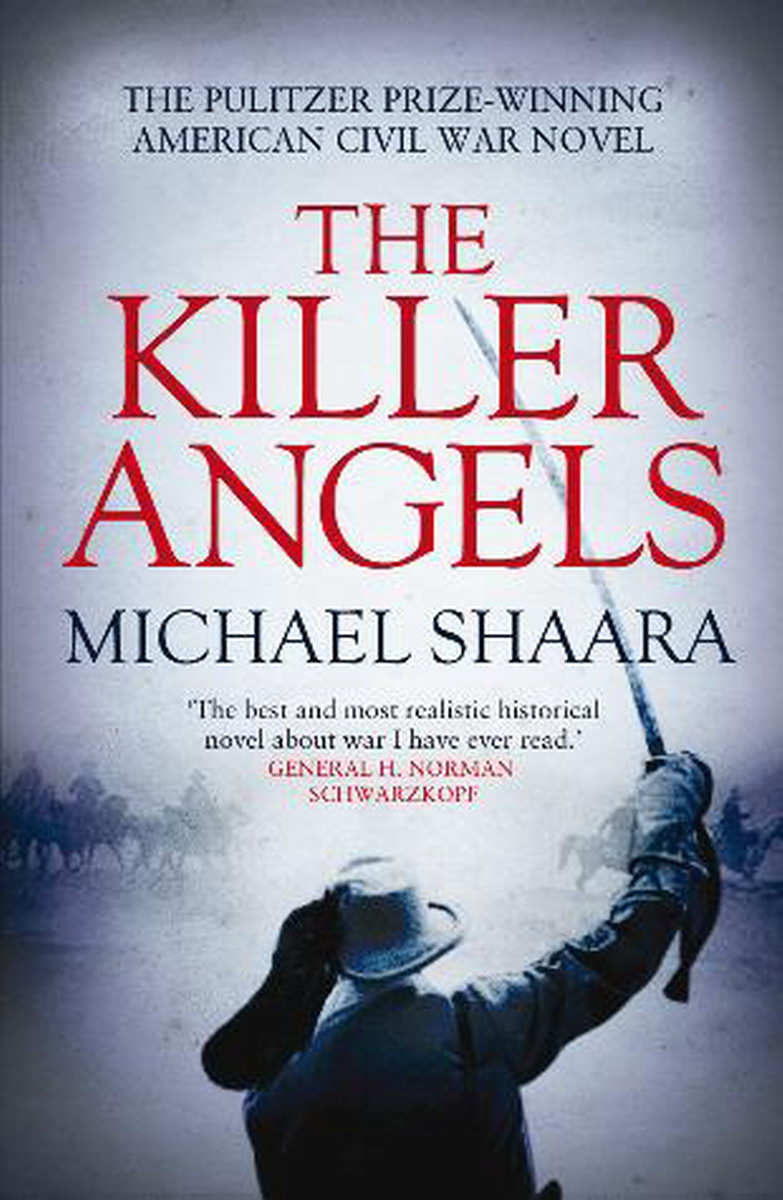
Books are not always the way we expect them to be. Still, I’ve only rarely been this wrong. I was afraid Michael Shaara’s Pulitzer Prize winner would be dry, heavy on tactics and military jargon. It wouldn’t have been too surprising if it had been like that, after all, Shaara tells the story of the three-day battle at Gettysburg. But The Killer Angels is anything but dry or heavy. It’s a beautiful, lyrical novel, which focusses much more on the moods and emotions of the main characters than on tactics.

I liked the way this was told. We have seven different POVs, each chapter told by another person. That way the narrative constantly  switches from the Confederate Army to the Union Army. On the Union side we have Chamberlain and Buford, on the Confederate side we have the POVs of Lee, Longstreet, Fremantle, Armistead and a spy.

Gettysburg is said to have been the decisive battle. It was lost by the Confederate Army who had been mostly victorious so far. The way Shaara tells this, I got the impression that the defeat was due to a large extent to General Lee’s unfortunate belief in assault warfare. His second in command, Longstreet, cautions against it, but to no avail. It seemed that while Lee was one of the most beloved Generals, he was very old-school in his tactics. Longstreet wanted to be defensive and was proven right in the end. The battle cost the lives of numerous soldiers, many officers and many, many horses.

The amazing thing in this novel is that Shaara writes so well about moods and emotions. We see the men mostly before or after the battle. The way they experience life in the army, the apprehension and exhilaration before the fight. How they experience the weather, the other men. Politics are present but in the background. Everyone on both sides thinks it’s about slavery but we come to realize that it’s not. Slavery is a symbol for a way of life. In a way it’s a battle of change versus tradition. I never really saw it that way. And the book made me understand why the South fought. They were scared to lose their way of life. If they had known how to stay the way they were – big plantations, old money, traditions – without slavery, maybe they wouldn’t have minded so much. And they certainly didn’t like being told how to live. Fremantle is an interesting character, because he’s a British journalist and the way he compares the South to Britain is interesting and sheds light on many aspects.

I’m certainly no expert on tactics but I was wondering whether the terrain wasn’t to some extent responsible for the defeat.

While I liked this book a geat deal, I have one reservation. I had to check up on Shaara because the way this was written, how it glorifies some aspects, made me think that, while familiar with life in the military, Shaara doesn’t sound like someone who has seen action. And I was right. He served before the war in Korea but not during the war.

I will leave you with three quotes, which capture the mood of this book.

Chamberlain on his own

Isn’t that amazing? Long marches and no rest, up very early in the morning and asleep late in the rain, and there’s a marvelous excitement to it, a joy to wake in the morning and feel the army all around you and see the campfires in the morning and smell the coffee . . .

Lee on his own

The night air was soft and warm. Across the road there were still many fires in the field but no more bands, no more singing. Men sat in quiet groups, talking the long slow talk of night in camp at war; many had gone to sleep: There were stars in the sky and a gorgeous white moon. The moon shone on the white cupola of the seminary across the road – lovely view, good place to see the fight.

Chamberlain again – in a crucial scene that explains the title of the book.

Once Chamberlain had a speech memorized from Shakespeare and gave it proudly, the old man listening but not looking, and Chamberlain remembered it still: “What a piece of work is man . . . in action how like an angel!” And the old man, grinning, had scratched his head and then said stiffly, “Well, boy, if he’s an angel, he’s sure a murderin’ angel.” And Chamberlain had gone on to school to make an oration on the subject: Man, the Killer Angel.

I don’t know what other books the year will bring, but I have a feeling this one could make it on the Best of List. I love books which are rich in atmosphere, capture quiet, introspective moods and manage to bring the most different characters to life. I certainly didn’t expect to find all that in a war novel. The Killer Angels is a gorgeous book on an awful subject, reading it felt like seeing all the major participants of the battle during their most intimate moments. I’m grateful to Kevin who said I would be missing out, if I didn’t read it. He was right.

Other reviews

*******

The Killer Angels is the second book in the Literature and War Readalong 2014. The next book is the American Civil War novel  March by Geraldine Brooks. Discussion starts on Monday 31 March, 2014. Further information on the Literature and War Readalong 2014, including the book blurbs can be found here.