Balzac: Le Colonel Chabert aka Colonel Chabert (1832/1844)

Balzac’s radiant story recounts the history of Colonel Chabert, a disenfranchised hero of the Napoleonic wars. Left for dead on the battlefield of Eylau, Chabert has spent years as an amnesiac in an asylum. The novel begins with his return to the life he left behind: only to discover that in his absence, his entire life – family, society, identity – has changed. With Napoleon deposed, France’s aristocracy has returned to power ‘as if the Revolution never occurred’. With Chabert supposedly dead, his wife is now married to a Count. Sickened by his wife’s pretence not to recognise him, and the titled society which spurns his former meritorious deeds, Chabert vows to recover his money, his reputation and his name.

A few years back I went through an intense Balzac phase reading one of his novels after the other. Still there are so many left I haven’t read and one of them was Le Colonel Chabert (or Colonel Chabert in English). I always thought it was much longer, probably because the edition I have contains other books as well. Or because of its notoriety. I think it is one of the most famous of his works.

Le Colonel Chabert is one of the books from the Scènes de la vie privée. Those who are familiar with Balzac know that the vast canvas of his work which he called La Comédie Humaine is organized in groups depending on the setting or themes.

Balzac has written an impressive amount of books. Some were serialized and written for the newspaper, like Splendeurs et misères des courtisanes, and the writing is not subtle at all. As wonderful as his plots, characters and topics usually are, his style is occasionally lacking. I was pleased to see that Le Colonel Chabert is, from a purely literary point of view, one of his best. It was published twice, first in 1832 under the name La transaction and then again in 1844.

Colonel Chabert is one of Balzac’s most tragic figures, a man who had everything and lost it all. To a certain extent the figure of Colonel Chabert whose fate is tied to that of Napoléon, also mirrors the emperor’s fate. Like Napoléon himself, he knew fame and glory and lost it all.

The novel opens on a scene of lively banter among several clerks who work for a young and promising lawyer. This scene is Balzac at his very best. With a few words he captures mediocrity. Into this setting enters a man who looks like a ghost. An old and broken man, poorly dressed, weak and ailing. When he asks to see Derville, the young lawyer, they make fun of him. And even more so when he tells them that he is the Colonel Chabert. Everybody knows that this cannot be as the Colonel has died in the battle of Eylau. His much deplored death has even been confirmed by Napoléon himself. His wife has remarried and born two children to a new husband. His fortune has been divided. The man standing in front of them cannot be the dashing looking colonel. This is an old man who seems to have seen nothing but poverty and misery.

The clerks who do not believe the old man send him away and tell him to return at one in the morning, the only hour during which the lawyer receives his clients.

When Chabert returns Derville is gruff at first but he is not only an ambitious young man, he is also very intelligent and kind-hearted. He pities the poor man and allows him to tell his story.

The Colonel who has shown Derville the deep scar on his skull, tells him how he was mortally wounded by a sabre, who almost split his skull in two. Buried under his horse who had been killed, he wasn’t trampled by the fleeing army but left unconscious. When they finally discovered him, they declared him dead and buried him. He regained consciousness later in the grave and managed to dig himself out from underneath corpses, earth and snow. This is a truly creepy scene that reminded me of an Edgar Allan Poe story.

Illustration de Le Colonel Chabert

(La bataille d’Eylau by Antoine-Jean Gros)

Ten years have passed since that episode. Ten years of suffering and erring during which the Colonel wrote to his wife a few times. Hoping to make a better marriage she pretends not to believe that he is alive. Chabert finally decides to ask for help and wants the young lawyer’s assistance in claiming back his wife and his considerable fortune.

His former wife, now the Countess Ferraud, is one of the ugliest characters of Balzac whose novels are full of greedy, vile people.

I will stop my summary here and just tell you that the outcome isn’t exactly what we expect.

I am not sure if it would be ideal to start reading Balzac with Le Colonel Chabert. I usually recommend Le père Goriot or La cousine Bette. Once you are more familiar with Balzac’s themes and characters you will realize how unique this book is. It is very short but extremely complex and a lot of allusions to French history are almost crammed into it. To fully comprehend the story it is good to know something about French history.

I’m looking forward to watch the movie one of these days as it seems to be very good as Guy Savage writes in his review of the book.

My favourite Balzac is Les illusions perdues aka Lost illusions, followed by La cousine Bette aka Cousin Bette. Which one do you like?

Colonel Chabert (Hesperus Classics)

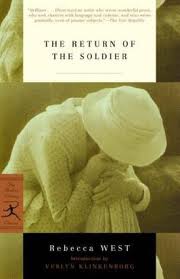
Literature and War Readalong March 25 2011: The Return of the Soldier by Rebecca West

There is still plenty of time for anyone who wants to join the Literature and War Redalong this month to get a copy of Rebecca West’s The Return of the Soldier. It is only 90 pages long which makes it all the more feasible. If all those of you who expressed an interest in this book will read along we might be quite a crowd. We will see. There are at least two different paperback editions available. I got the one from The Modern Library with an introduction by Verly Klinkenborg. The other one is a Virago edition with an afterword by Sadie Jones.

Rebecca West’s book is unique as it was published in 1918, before the war had ended. She tells the story of a returning soldier who suffers from shell-shock. I am particularly interested in this topic and curious to compare her handling of it with Pat Barker’s Regeneration trilogy which is for me still one of the greatest books on WWI, shell-shock and the development of the new medical discipline, psychiatry.

I was very surprised to find out that The Return of the Soldier that seems so well-known in the English-speaking world has not been translated into German. The only two of her books that made it into German are Black Lamb and Grey Falcon and The Fountain Overflows.

Rebecca West was only 24 when she wrote this novel but already an acclaimed journalist and women’s rights activist. This isn’t an account of the front line but purely a story that takes place on the home front.

Shell-shock is extremely typical for most WWI accounts. It seems as if there had never been so many cases of shell-shock in any war as in WWI. Psychologists state that one of the reasons for this lies in the trench warfare. Being in the trenches for such a long time infused the soldiers with a deep feeling of helplessness that makes shell-shock much more probable than any othe type of warfare. The moment the soldiers were allowed to leave the trenches and move about shell-shock was far less frequent.

Here is the link to the Rebecca West Society if you want to find out more about the author, upcoming conferences and events.

The Return of the Soldier has also been made into a movie.

Joseph Roth: Hotel Savoy (1924)

Hotel Savoy

Written in 1924, Hotel Savoy is a dark, witty parable of Europe on the verge of fascism and war.

I read Joseph Roth’s The Radetzky March years ago in school and had sworn at the time that I will re-read it and read as much as I can of this incredible author. A while back I stumbled upon a really nice discovery in a local bookshop, a little slipcase containing seven of Joseph Roth’s novels. It consists of Hotel Savoy (Hotel Savoy) (1924) Hiob (Job) (1930) Radetzkymarsch (The Radetzky March) (1932) Beichte eines Mörders (Confession of a Murderer) (1936) Das falsche Gewicht (Weights and Measures) (1937) Die Kapuzinergruft (The Emperor’s Tomb) (1938) and Die Geschichte von der 1002. Nacht (The String of Pearls) (1939).

Roth is one of three Austrian authors (the other two being Robert Musil and Heimito von Doderer) who wrote about the end of the Danube Monarchy. The end of an era, the changing of the times, is often central in his books.

I decided to read Roth’s books chronologically and started with Hotel Savoy.

What an absolutely wonderful novel this is. Beautifully written, astonishingly varied in style, themes and characters. How can you capture so much in under 120 pages? The style is very different from Radetzkymarsch but not less enchanting. His sentences are very special, often composed of a list of nouns which might have been a challenge for a translator.

I am happy, once more, to shed an old live, like I did so often these past years. I see the soldier, the murderer, the man who was almost murdered, the resurrected man, the captive, the wanderer.

Or this powerful sentence:

I enjoy the floating feeling, calculate how many wearisome steps I would have had to climb if I wasn’t sitting in this luxurious lift, and I throw down bitterness, poverty, homelessness, migration, hunger,  the past of the beggar, throw them deep into the shaft, from where they cannot reach me, the hovering one, ever again.

Hotel Savoy is a “Heimkehrer Roman”, the story of the former soldier Gabriel Dan who after WWI and several years of having been a prisoner of war in a Siberian camp returns to Poland. He is a descendant of Russian Jews and one of his uncles lives in the city in which he stops. He wants to travel westwards to Paris or any of the other big Western cities. As far away as he can get from Russia and a painful past full of deprivations, it seems.

He moves into a room on one of the upper floors of the grand and glamorous looking Hotel Savoy. As pompous as it may seem from the outside, the interior is rundown.

The first three lower floors are reserved to rich people, bankers, aristocrats, factory owners and patrons. The upper floors belong to the poor who cannot pay their rent. After a few weeks their suitcases and luggage is confiscated and they are left completely destitute.

What a colorful group of people they are in those upper floors. Dancers and clowns and people who return from the war or people who have lost everything in one foolhardy transaction. They are eccentrics and lunatics and more than one of them is terminally ill. There is singing and dancing and cheerfulness and a lot of dying going on.

Gabriel hopes to be able to extract some money of his rich uncle, Phöbus Böhlaug, but to no avail. His uncle’s avarice is frightening.

There is nothing else to do for Gabriel than stand at the train station daily and hoping for work. Every other week the train station is flooded by prisoners returning from the camps. One day he meets one of his old comrades the peasant Zwonimir.

What a character, this Zwonimir. Full of life, exuberant, funny and droll. He makes friends easily has a funny sense of humour and detects everything phony in the rich and pompous people around him.

They work hard and enjoy themselves in the evening, drinking copiously, going to cabarets and the vaudeville, walking through the city, exploring the quarters where only Jews live.

I always enjoy novels set in hotels. They are full of interesting characters from the most diverse social backgrounds. In this inter-war period hotels were often the only place where people could stay. It took those who returned from the war an awfully long time to get back to their homes and they had to stay somewhere on the way. Others had lost their houses or just fled the countryside.

It is a fascinating microcosm this Hotel Savoy. The very poor and the very rich rub shoulders.

One of the central episodes is the arrival of Henry Bloomfield an incredibly rich banker who left Europe for America but returns once a year to his hometown. No one really knows why he chooses to come back to this little town when he could stay in Berlin.

While he resides at the Savoy, people cue up to talk to him and present their business ideas hoping he might finance them. Gabriel is lucky and is chosen by Bloomfield as temporary assistant. He will listen to all the stories and sort the valuable ideas out.

This novel has really everything. It is funny, sad, picturesque, touching and bitter-sweet and the ending is perfection. Roth describes people, the hotel and the little town with great detail. And every second sentence bears an explosive in the form of a word that shatters any illusion of an idyllic life. Roth served in WWI and never for once allows us to forget that the horror of one war and subsequent imprisonment have only just been left behind  while the next one is announcing itself already.

I was reminded of other novels set in hotels, pensions or clubs like Muriel Spark’s The Girls of Slender Means, Vicki Baum’s Menschen im Hotel (Grand Hôtel), Elizabeth Taylor’s Mrs Palfrey at the Claremont, Assouline’s Lutetia, Thomas Mann’s Felix Krull and Anita Brookner’s Hotel du Lac.

I am sure there are many more. Do you know any others?

I translated the quotes from the original German. Any mistakes are entirely my own.

Haruki Murakami: Sputnik Sweetheart (2001) aka Sputoniku no koibito (1999)

The narrator, a teacher, is in love with the beguiling, odd Sumire. As his best friend, she is not adverse to phoning at three or four in the morning to ask a pointless question or share a strange thought. Sumire, though, is in love with a beautiful, older woman, Miu, who does not, can not, return her affections. Longing for Sumire, K (that is all we are told by way of a name) finds some comfort in a purely sexual relationship with the mother of one of his pupils. But the consolation is slight. K is unhappy. Miu and Sumire, now working together, take a business trip to a Greek Island. Something happens, he is not told what, and so K travels to Greece to see what help he can offer.

Sputnik Sweetheart was my second Haruki Murakami. The first one I read was South of the Border, West of the Sun which I liked a lot but I was told many times that it wasn’t a typical Murakami.

It was a strange experience to read Sputnik Sweetheart but not because of the book, I didn’t think it was all that weird but my reactions to it were weird as it reminded me of a lot of other books I have read before. Instead of enjoying it my mind started to rush around like a hungry little monkey looking for food and trying to solve the riddles of the 1001 allusions. If I hadn’t been so busy doing this, I would have enjoyed it much more while reading it but looking back on it I think it is a marvelous book. Unusual, original and fascinating. And furthermore, having finished it, I saw that what happened to me, this mad chasing of “clues”, is probably not completely unintentional. I think the author is well aware of our European triggers and pulls them one by one.

I read quite a few reviews who stated that it wasn’t easy to describe what the book is all about. I don’t think that’s true. It’s a pretty straightforward story and you can summarize it in a few sentences. The problem is that wouldn’t do the book any justice as plot line is not Murakami’s main concern.

K, an elementary school teacher, is madly in love with Sumire, a strange, intelligent, loner type girl who wants to become an author. Sumire however falls for Miu, a married woman and 18 years her senior. They meet at a wedding reception and due to a misunderstanding related to the writer Jack Kerouac, Sumire’s favourite author of the month, Sumire calls Miu Sputnik Sweetheart.

Ever since that day Sumire’s private name for Miu was Sputnik Sweetheart. She loved the sound of it. It made her think of Laika, the dog. The man-made satellite streaking soundlessly across the blackness of outer space. The dark, lustrous eyes of the dog gazing out of the tiny window. In the infinite loneliness of space, what could Laika possibly be looking at?

Sensing that a change is needed in Sumire’s life, Miu offers her a job. Part of this job is a trip to Europe. The two women travel from France to Italy and from there to Greece and there Sumire disappears. Miu asks K to come to Greece and help her look for Sumire. He travels to Greece but the whole adventure proves to be futile.That is the story in a nutshell.

The central theme of this novel is loss. In many different forms. And getting lost and being lost, and losing as well as never reaching what we want. The people in this little universe that is Sputnik Sweetheart all chase something. Most of them love someone who loves someone else. They feel trapped and isolated like little satellites circling aimlessly through space.

So that’s how we live our lives. No matter how deep and fatal the loss, no matter how important the thing that is stolen from us – that is snatched right out of our hands – even if we are left completely changed people with only the outer layer of skin from before, we continue to play out our lives this way, in silence. We draw ever nearer to our allotted span of time, bidding it farewell as it trails off behind. Leaving behind a feeling of immeasurable emptiness.

They also chase dreams that seem unreachable. Sumire who wants to become a writer, can’t write a real novel, Miu who wanted to become a pianist had to give up the piano.

And there are the side stories of lost animals. Sumire had  a little tortoise-shell cat that climbs a tree and is never seen again. K had a little dog, his only childhood friend, whom he loses too. And there are the black cats. Since I am an owner of black cats I could relate to this very well. Many of Murakami’s novels are populated by black felines.

K’s and Sumire’s love and friendship is a very beautiful one. They are both loners and bookish people who talk endlessly on the phone. It is sad that Sumire does absolutely not feel attracted to K. Despite the attraction Sumire’s feels for Miu, K is her true love.

I have read a few newspaper articles that came out at the time of the publication of Sputnik Sweetheart in Germany and quite a lot of them stated that Murakami wasn’t really a Japanese author because there are endless references to European culture. It is true, that this is surprising. In this novel, he enumerates many European composers like Mozart and Brahms, and also European performers. Apart from one book, Soseki’s novel Sanshiro, every book, movie or city that is mentioned is European.

Does the fact that a Japanese author cites so many European things make him less of a Japanese writer? I absolutely don’t think so and believe that on the very contrary,  this is a typically Japanese novel. The excellent evocation of futility of beauty for one thing, but then also the mix of genres (adventure story, ghost story, detective and love story) and the quoting of books. And quoting is only one thing, there is also a subtle intertextuality. Does K not remind us of the K in Kafka’s book? And the Doppelgänger motif is reminiscent of a lot of German literature.

Maybe we have to study modern Japanese paintings to be able to get Murakami.

Be it as it may, I’m extremely glad I read this book and am looking forward to the next one.

As a little visual impression of Murakami’s books I attached another Murakami’s work.

Both paintings are by Takashi Murakami.

This was my first Murakami for the Haruki Murakami Reading Challenge. Other reviews of this and other Murakami novels can be found there.

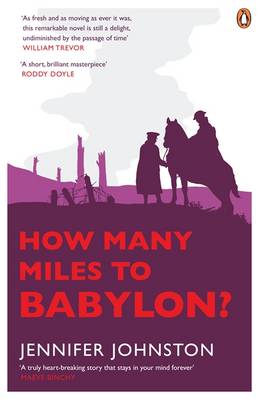
Jennifer Johnston: How Many Miles to Babylon? (1974) Literature and War Readalong February

Alec and Jerry shouldn’t have been friends: Alec’s life was one of privilege, while Jerry’s was one of toil. But this hardly mattered to two young men whose shared love of horses brought them together and whose whole lives lay ahead of them. When war breaks out in 1914, both Jerry and Alec sign up – yet for quite different reasons. On the fields of Flanders they find themselves standing together, but once again divided: as officer and enlisted man. And it is there, surrounded by mud and chaos and death, that one of them makes a fateful decision whose consequences will test their friendship and loyalty to breaking point.

We know from the beginning of this novel that it is not going to end well. Alec is held in detention and knows that he will die. Because he is an officer and a gentleman, as he states, they have given him his notebooks, pen and ink and he writes down the story of his life. The story spans from his lonely isolated childhood in rural Ireland to the war-torn trenches in France. The tone of the novel is melancholic, full of nostalgia for a world that has been lost and is at the same time infused with the profound love of a country.

By now the attack must be on. A hundred yards of mournful earth, a hill topped with a circle of trees, that at home would have belonged exclusively to the fairies, a farm, some roofless cottages, quiet unimportant places, now the centre of the world for tens of thousands of men. The end of the world for many, the heroes and the cowards, the masters and the slaves.

Alec’s childhood was a lonely one. Caught between two parents who hated each other and who kept a polite and icy distance, he was the pawn with which his mother played. He didn’t like his mother, a haughty, cruel but beautiful woman whose strict rules and relentless following of etiquette ruined every childhood joy. What his parents do not know for a long time is that Alec has a secret friend. Alec and Jerry have a lot in common. Their love of horses, their sense of humour, they share so much, unfortunately not the social class. Alec is an only child of a wealthy Anglo-Irish couple whereas Jerry is part of the Catholic underclass. When their friendship is found out, Alec’s mother freaks out and decides to go on a 4 month trip to Europe with Alec.

When Alec comes back he doesn’t see Jerry anymore. Jerry is working while Alec is still studying. And then the war breaks out. At first there seems to be only a rumour of war. Jerry knows it long before Alec hears it and most people think it isn’t really true.

We paid very little attention to the war when it happened first. Belgium and Flanders seemed so far away from us. Our fields were gold and firm under our feet. Autumn began to stroke the evening air with frost. Smoke from bonfires was the only smoke to sting our eyes. Cubbing began in the early morning, the earth temporarily white with mist and dew. A few familiar faces disappeared. War was on the front pages of the newspapers daily brought from Dublin on the train.

Many do not feel that this is their war or that they should assist the British. Tensions inside of Ireland start to be palpable, tensions that bear the foreboding of the things that will come, the striving towards independence. However people who feel loyal towards Britain send their sons. Alec’s father considers it to be foolish to go to a war when you are not forced to go but his mother, out of spite and vengeance against his father, drives Alec away.

Meanwhile Jerry had already enlisted and the two young men meet in the training camp near Belfast in which they stay for six weeks until they get shipped to France. Their superiors do not like to see an officer talk to an enlisted man. Alec, due to his social class, has become an officer immediately.

When they finally arrive in France they stay separated. Alec shares quarters with a British officer, Bennett, a guy with a lot of humour, while Jerry sleeps with the other enlisted men. Still the three of them meet occasionally and ride about the country together.

They hardly see any action for a long time and stay far off the trenches for a while. When they are finally sent to the front line they will spend a lot of their time cleaning and reconstructing the badly damaged trenches.

We spent three more days in the front trenches, mainly shoveling and making props. It rained a considerable amount of the time. Sometimes sleet cut into the men’s bare hands, and at night there was sharp frost that covered the bottom of the trenches with a thin film of ice. We extended the line to our left. It was hard work moving the earth, heavy with water, always crouching till ones back and shoulders ached pitifully. The men hated it and worked slowly, grumbling most of the time. For most of the day there was concentrated shelling of the German lines by our artillery. The shells screeched over our heads sometimes for hours at a time. After a while I became so used to the noise that I felt strangely unprotected when it stopped, then slowly the process of thinking had to begin again.

The cold is unbearable and Alec suffers a lot from it. They constantly drink rum as it is the only way to warm up. Here again Alec and Jerry are caught talking together and the superior officer forbids it. But that is not the only trouble they are in. The Irish are not appreciated at all. On top of that there are rumors of a movement that wants to fight for the independence of Ireland. Jerry is suspected to be part of that movement and one day he confides in Alec.

“I don’t know how you can contemplate ever fighting again.”

“It won’t be like this. There’ll be no trenches, no front lines. No waiting. Every town, every village will be the front line. Hill, rock, tree. They won’t know which way to look. Even the children, for God’s sake, will fight them. It won’t be like this, I promise you that. Oh, Alec, it’s some thought.”

When Jerry receives a letter from his mother in which she informs him that his father has gone missing, he runs off to look for him and the tragedy unfolds.

I loved How Many Miles to Babylon? I think it is a beautiful book. It doesn’t teach you as much about WWI as Strange Meeting (see post 1) but it says a lot about Irish history. I found this look at the first World War from an Irish perspective extremely fascinating.

As Jennifer Johnston said, she wanted to write about the Troubles but didn’t feel ready yet. This is the prehistory of the Troubles. The Irish War of Independence started right after WWI in 1919 and was closely followed by the Irish Civil War. This succession of wars was the reason why Ireland stayed neutral during WWII. They simply couldn’t afford to be in another war in such short time.

How Many Miles to Babylon? hints at all this. But it is not only a very Irish novel because of the historical elements but also for its imagery, the symbolism and the many references to Irish mythology and culture.

The motif of the swans is a recurring element. There are swans on the lake on the property of Alec’s parents, they see swans in France, some soldiers shoot a swan which does upset Alec terribly. Since Alec reads W.B. Yates at the beginning of the book I think the swans are an allusion to Yates’ famous poem The Wild Swans at Coole which seems to mourn a time long gone.

In contrast to the gratuitous killing of the swans stand the mercy killings. Wounded horses are killed, a wounded man is killed…

I really liked this enchanting novel. I loved the poetical prose, the melancholic tone and the feeling of nostalgia that pervaded it.

What did you think of the novel in general and its treatment of WWI?

Other reviews:

Anna (Diary of an Eccentric)

Danielle (A Work in Progress) and here as well

Fence (Susan Hated Literature)

*****

How Many Miles to Babylon? was the second book in the Literature and War Readalong. The next one will be Rebecca West’s The Return of the Soldier. Discussion starts on Friday March 25, 2011 .

Daniel Glattauer: Every Seventh Wave (2011) aka Alle sieben Wellen (2009) The Sequel of Love Virtually

Every Seventh Wave

A while back I wrote about Daniel Glattauer’s Love Virtually which has been released meanwhile. I just saw that the sequel, Every Seventh Wave,  will be published this year as well. Usually I include the amazon blurb at the beginning of my posts but this one  contains too many spoilers of the first book.

Like its predecessor, I have read Alle sieben Wellen when it came out in Germany. For all those who like Love Virtually, they can look forward to a sequel that is very close to the first book. The story of Leo and Emmi, their e-mail exchange goes on. More passionate and more intense than before. And still they ask the same questions. Should they meet or should they not? To the somewhat playful tone of the first book Glattauer adds a bit of a darker undertone. I cannot say too much or it would be a spoiler.

Even though I didn’t like the idea of a sequel at all and if I had had something to say, it wouldn’t have been written but since it was and I liked the tone of the first book, I had to read this one as well. And it isn’t disappointing. It is as witty, charming, thought-provoking and enjoyable as the first.

All those who thought that Emmi and Leo’s story shouldn’t finish like it did in Love Virtually will enjoy this book. All those who loved the style of Glattauer the first time, will enjoy this as well. Although Love Virtually can be read on its own, this one can not. If you want to read Glattauer, you should start with the first one.

I have no problem with the translation of the title this time, it is pretty literal but I still like the German cover better.

The Austrian author Daniel Glattauer has written quite a few books that have been successful in Germany and other German speaking countries. Like so very often none of them has been translated. Should you read German you can find more information on his website.

Matthias Politycki: Next World Novella (2011) aka Jenseitsnovelle (2009)

Hinrich takes his existence at face value. His wife, on the other hand, has always been more interested in the after-life. Or so it seemed. When she dies of a stroke, Hinrich goes through her papers, only to discover a totally different perspective on their marriage. Thus commences, a dazzling intellectual game of shifting realities.

How do you picture the afterlife? Like a cold dark lake you have to cross? Do you picture how you will be surrounded by loneliness and obscurity and that you will know before you even start to dip into those icy waters that you will never make it across and that you will die a second time while attempting to reach the other shore?

Probably this is not your idea of the next world but it is Doro’s. The thought of it terrifies her and when she confides in Hinrich, telling him of her terrors, they form a bond and eventually become a couple. Before she reveals herself, Hinrich, a professor of sinology, secretly pines after Doro the young specialist of the I Ging who occupies a room on the same floor of the department of sinology. While he is very much in love and provides her with a pot of green tea every afternoon, she doesn’t seem to care for him at all. But suddenly one afternoon, to show Hinrich what her idea of the after world looks like, she takes him to an art museum and shows him a painting. The painting isn’t named but from the detailed description it seems they stand in front of Böcklin’s Toteninsel. Of course Hinrich doesn’t take her fears seriously. This is as much mystical rubbish to him as the I Ging. Still he promises her that he will wait for her on the other shore.

However these days are long gone and the memory of the beginning of their story provides only one part of the things Hinrich will remember on a beautiful autumn morning on which, like every day, he gets up late only to find Doro already sitting at a table and correcting what he has written the day before. The moment he enters the room he realizes something is wrong. The room is filled by an overpowering smell and the fact that Doro sits here correcting something is a little strange as well as he hasn’t written anything in a long time.

What we finally discover through Hinrich’s eyes is the fact that Doro has died inexplicably and that the text she not only corrected and annotated but tried to finish as well is an old fragment of a novel that Hinrich has written some thirty years ago. It is the story of Marek the drunkard who gets involved and hurt by a beautiful waitress. Marek is as opposed to Hinrich as can be imagined.

From the moment of the discovery of her body until the very end of the novel the book takes a few very surprising twists and turns.

Hinrich and Doro’s story alternates with the parts of the fragments of the novel that Hinrich rereads. The tone of the interwoven texts is very different. The novel uses outdated slang, the other parts are written in a very polished and literary German.

Hinrich, a man who had extremely bad eyesight and could hardly see a thing, decided late in life to have a laser operation. To be able to see clearly has transformed him into a completely different person. Before his opperation he was dedicated to Doro, content with a life filled with books that took place either at the university or at home. Since he can see he goes out in the evenings with his students, chats up waitresses and discovers a completely new side to himself.

What he didn’t know and discovers now through reading the annotations and the letter that Doro has left for him is not only that she knew about his affairs but also that she hated and despised him and that she has taken revenge.

I did absolutely not like this novel at first as I found Hinrich Schepp to be such a boring and narrow-minded character. But I should have known better when embarking on reading a book whose main character has such a name.  Surely no one would choose a name like that for his protagonist if he wasn’t poking fun at him. All the infuriating and annoying bits about Hinrich’s charcter and his actions fall into place at the end and their meaning changes one’s view of Hinrich. One could even say that Hinrich becomes endearing.


As said before, the book has a few extremely surprising twists and turns to offer and from page to page we see things and people in a new light until, at the end, everything changes again.

There are a few painful moments in which Hinrich’s mask is ripped off and he finds himself exposed and ridiculed. Shame is one of the strong feelings that pervades the whole novella.


Next World Novella is a quirky book that touches on a lot of different things. It explores the fear of dying and death as well as marriage, love and self-deception. The most interesting aspect for me was the exploring of the ideas of an after life and the dimension added by the references to the I Ging, a text that I find highly fascinating. But also the discovery of how much “unlived” life there is hidden in an ordinary life is interesting. Every human being has a potential that would allow him or her to live many lives that would maybe look very different from the one chosen.

I have read the German book and insofar I cannot say much about the translation. I thought for a long time about the title and if Next World Novella is really how I would have translated Jenseitsnovelle. For different reasons I don’t think so. The sense is the same but I had a feeling “Jenseits” sounds more poetical than “Next Life”. The word “next” contains a very hard consonant whereas “Jenseits” has a soft and flowing sound. That is why I would have tended towards a title containing hereafter or after life. I’m sure Anthea Bell who is a renowned translator had her reasons. As for the rest of the text, I got the impression the German is more old-fashioned and mannered than the English translation.

All in all I can only recommend this book. It’s very different, surprising and intelligent.