Angela Carter Week June 2014 – Wrap-up

ACW badge 2-2

This was such an exciting week. When Delia and I decided to host an Angela Carter Week we couldn’t foresee such a great success. So many fascinating posts and discussions. So many people who have either discovered a new favourite author or rediscovered her writing. What I liked best was the enthusiasm and the lively discussions and how all of our posts together are like one big tapestry, which mirrors and illustrates Angela Carter’s themes, the symbolism in her work, the topics.

It was great to see that some picked up a second book after finishing the first and certainly will go on reading her.

There were some critical comments as well. There should be, actually, after all, she’s a provocative writer and some of her topics are disturbing and can make a reader feel uncomfortable. I don’t think she ever wanted to please and that’s illustrated in some of our posts as well.

We’ve had 34 contributions, one of which from Russia. I had to use google translate to read it and wouldn’t have seen it if the writer of the post hadn’t linked to my post. Unfortunately I couldn’t leave a comment.


Thanks to everyone who joined us, to those who read Angela Carter’s books, wrote about them, discussed them and to those who read our thoughts on her work.

A very big thank you goes to Delia, my co-host.


Here are the links to all the participants’ posts.

1. Brona 14. Danielle @ A Work in Progress – Angela Carter’s Fairy Tales Part 1 27. Caroline @ Beauty is a Sleeping Cat – American Ghosts and Old World Wonders
2. Melinda Jane Harrison 15. TJ @ MyBook Strings (Love) 28. Yasmine Rose – Love
3. Bluebeard (Dolce Bellezza) 16. Priya @ Tabula Rasa (American Ghosts and Old World Wonders) 29. Vishy (The Magic Toyshop)
4. TJ @ MyBook Strings (Love) 17. Helen @ She Reads Novels (The Bloody Chamber) 30. The Reading Life Angela Carter on Tales Versus Traditional Short Stories
5. Violet @ Still Life With Books // Love 18. Brona (The Bloody Chamber – the cat stories) 31. Brona (The Fall River Axe Murders)
6. The Reading Life (The Man Who Loved a Double Bass) 19. Jane @ Fleur in her World (The Magic Toyshop) 32. Book Notes – Кровавая &#
7. Candiss @ Read the Gamut (The Fall River Axe Murders) 20. Violet @ Still Life With Books // Heroes and Villains 33. Delia @ Postcards from Asia – Nights at the Circus
8. The Reading Life “ Black Venus” plus Rushdie picks 21. Helen @ a gallimaufry (Several Perceptions) 34. Danielle @ A Work in Progress – Angela Carter’s Fairy Tales Part 2
9. Delia @ Postcards from Asia – The Bloody Chamber 22. The Reading Life “ The Company of Wolves” 35. Yasmine Rose – Fireworks
10. Caroline @ Beauty is a Sleeping Cat – The Magic Toyshop 23. Yasmine Rose – Bluebeard 36. Lit Nerd – Nights at the Circus
11. Violet @ Still Life With Books // The Magic Toyshop 24. Cathy 746 Books 37. TJ @ MyBookStrings – A Card From Angela Carter by Susannah Clapp
12. Brona (The Bloody Chamber) 25. Lindy Lit – Black Venus
13. The Reading Life “ Wolf Alice” 26. Brona (The Bloody Chamber – the rest!)
Angela Carter Week

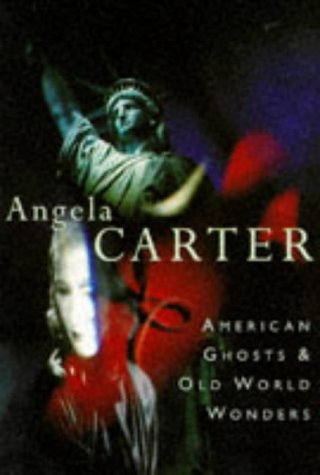
Angela Carter: American Ghosts and Old World Wonders (1993)

American Ghosts

I’m sure we all read because we like a good story but aren’t we equally keen on writing which ignites our imagination? Writing that connects us with our subconscious, our emotions and dreams? Angela Carter knows how to tell a story but more than that, she inspires. She makes us think, explore, dream, fantasize, question. Sometimes it’s not even important to understand every aspect of her short fiction but just to read one of her wonderful sentences, discover one of her splendid images is enough.

The short story collection American Ghosts and Old World Wonders is such a treasure trunk. It’s full of retellings, deconstruction, parodies, reimagining of old myths, fables and fairy tales. It wasn’t always a breezy read. I had to hunt for a few academic papers in order to fully understand the one or the other of the pieces in this book. Like in all of her collections, there were a few stories that stood out and I’ve even found a new favourite.

In this collection Angela Carter mixes myths and elements of the American Dream and/or of America as the land of dreams, the country of  one of the biggest movie industries, the country of serial killers and westerns, of endless possibilities, and juxtaposes these elements with stories from the old world – fairy tales and history. The result is stunning.

The book is divided in two parts. I’d call the first the “American” part and the second the “Old World” part.

Part I

Lizzie’s Tiger is the second Lizzie Borden story she wrote. It shows us a young fearless Lizzie who discovers the magical world of a circus and a tiger who’s living in it. It’s as much an allusion to Blake’s famous poem as it is an imagination of a time when Lizzie was still small and had options to become someone else.

John Ford’s ‘Tis Pity She’s a Whore is a pretty tongue-in-cheek and cheeky piece. What if the film director John Ford made British playwright John Ford’s drama ‘Tis Pity She’s a Whore into a movie? Well – read her story and you’ll find out what that would be like.

Gun for the Devil is another Western type story set near the Mexican border. Johnny get’s a gun and frees a girl. Sort of. The story contains an allusion to the movie Johnny Got His Gun.

The Merchant of Shadows is my favourite story in the book and has become one of my all-time favourites. A story of decay, exuberance, mystery, set in a decadent Hollywood setting, reminiscent of Sunset Boulevard (one of my favourite movies btw). A young academic comes to interview the widow of the famous film director von Mannheim (he seems inspired by von Sternheim). His widow was once a femme fatale but now she’s in a wheelchair, living with her sister who looks like a cowboy.

Here are is a sample of this deliciously lush and weird story, which contains a lot of Angela Carter’s magic, including metafiction, allusions, cultural references and a lot more:

A flight of rough-cut stone steps led up to a pool surrounded by clumps of sweet-smelling weeds; I recognised lavender. A tree or two dropped late summer leaves on scummy water and, when I saw that pool, I couldn’t help it, I started to shiver; I’ll tell you why in a minute. That untended pool, in which a pair of dark glasses with one cracked lense rested on an emerald carpet of algae, along with an empty gin bottle.

On the terrace a couple of rusty, white-enamelled chairs, a lopsided table. Then, fringed  by a clump of cryptomeria, the house von Mannheim caused to be erected for his bride.

That house made the Bauhaus look baroque. An austere cube of pure glass, it exhibited the geometry of transparency at its most severe. Yet, just at that moment, it took all the red light of the setting sun into itself and flashed like a ruby slipper. I knew the wall of the vast glittering lounge gaped open to admit me, and only me, but I thought, well, if nobody has any objections, I’ll just stick around on the terrace for a while, keep well away from that glass box that looks like nothing so much as the coffin for a classical modernist Snow White; let the lady come out to me.

No sound but the deep, distant bass of the sea; a gull or two; pines, hushing one another.

So I waited. And waited. And I found myself wondering just what it was the scent of jasmine reminded me of, in order to take my mind off what I knew damn well the swimming pool reminded me off – Sunset Boulevard, of course. And I knew damn well, of course I knew, that this was indeed the very pool in which my man Hank Mann succumbed back in 1940, so very long ago, when not even I nor my blessed mother, yet, was around to so much as piss upon the floor.

I waited until I found myself growing impatient. How does one invoke the Spirit of Cinema? Burn a little offering of popcorn and old fan magazines? Offer a libation of Jeyes’ Fluid mixed with Kia Ora orange?

This passage shows something else that strikes me every time when I read Angela Carter – how she is at the same time irreverent and full of admiration for her themes.

I liked the stories in part II a little less.

The Ghost Ships – A Chritsmas Story, I didn’t really get it but it had a few great moments. This opening for example:

‘Twas the night before Christmas. Silent night, holy night. The snow lay deep and crisp and even. Etc. etc. etc.; let these familiar words conjure up the traditional anticipatory magic of Christmas Eve, and then – forget it.

Then In Pantoland – a parody of the way fairy tales have become a pure commodity, robbed of their deeper meaning and sometimes violent aspects due to the way Disney has used them.

Ashputtle or The Mother’s Ghost contains three ways to deconstruct Ashputtle. Very different from Disnye’s Cinderalla.

Alice in Prague or The Curious Room is an homage to a Czech filmmaker. It combines Dr Dee and Alice in Wonderland. Edward Kelly is called Ned Kelly. I didn’t really understand what this figure of Australian history got to do in this text. I really love this passage:

Night was. Widow Night, an old woman in mourning, with big, black wings, came beating against the window; they kept her out with lamps and candles.

Impressions: The Wrightmans Magdalene is the reimagining of the story of Mary Magdalene. It references two artists’ representation: Georges de La Tour’s Mary Magdalene and Donatello’s Mary Magdalene. One a painting, the other a sculpture.

This collection was a wild ride, at times challenging, but mostly really captivating and enchanting.

This is the second review for Angela Carter week, co-hosted with Delia (Postcards from Asia).

PLEASE ADD YOUR OWN REVIEWS TO THE MR LINKY HERE
ACW badge 2-2


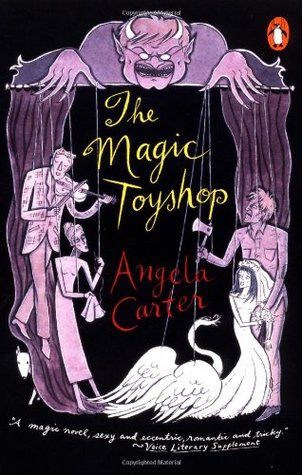
Angela Carter: The Magic Toyshop (1967)

The Magic Toyshop

I’m often tempted to skip the summary when reviewing a book, because, most of the time, the story as such doesn’t tell you a lot about a book. This is especially true in the case of Angela Carter. Her second novel The Magic Toyshop is no exception. It tells the story of a young girl, 15 year-old Melanie, who loses her parents the day after exploring the nightly parental garden in her mother’s wedding dress. She and her two siblings are then sent to her maternal Uncle Philip, a toy maker. At her uncle’s house she meets her Aunt Margaret and her aunt’s two brothers Finn and Francie. One is a painter, the other one a fiddler. It’s a very strange household. Creepy, joyless and fearful when her uncle is around; excentric and exuberant when he’s out. There’s a strange attraction between Finn and Melanie and one night, in the ruin of a magical garden, he kisses her. Melanie is confused by this because she doesn’t really fancy Finn. Additionally they have to hide their attraction because their uncle hates affection and emotions; he only lives for and through his toys and puppets. The grand finale is set in motion when Melanie has to play Leda in a cruel version of Leda and the Swan. Finn not only refuses to play along, but he takes revenge. Will the inhabitants of the sinister uncle’s house be able to free themselves or will they continue to be puppets in his hands?

A summary like this doesn’t tell you anything about the lush richness of the writing or what it feels like to enter an Angela Carter novel. Reading The Magic Toyshop is like entering an antiques shop or a shop with vintage clothes. You move from one beautiful garment to the next, from one arresting object to the following, only instead of objects and clothes you find sentences and images, allusions to fairy tales and myths, all woven into a shimmering tapestry. I felt like walking around in a stuffy room; in one corner I saw Bluebeard, in the next Red Riding Hood, and, over there, in a corridor, I spotted Dickens. Uncle Philip is like Bluebeard but he’s also a counter piece to the many bad stepmothers in fairy tales. He decidedly plays the role of a very bad step-father.  He’s an illustration of Carter’s play with gender clichés and tropes. Why does it always have to be the step mother who is vicious and vitriolic? In The Magic Toyshop the older women are positive, maternal figures. The older man is wicked and the younger are dreamy and wild.

The amazing thing in Carter’s writing is, that in spite of its complexity, it is very accessible and even entertaining. You can read The Magic Toyshop without being aware of the subtext, the allusions and references and still enjoy it. But, of course, she’s an author who makes you want to pick up books on her writing. It makes it so much richer, when you know what she is referring to or what she deconstructs.

Before I end this somewhat disjointed review (we have a heat wave currently and it’s hard to concentrate) I’d like to mention two more elements and maybe someone else can tell me how to interpret them:

Dirt – Dirt plays an important role in this novel. Melanie comes from a rich, elegant environment and everyone is clean at all times. Not so in Uncle Philip’s household where it’s hard to find warm water or soap and the people and their clothes are filthy. I remember from other stories that dirt is important but I’m not sure what meaning it has.

Incest – There’s open incest and incestuous moments in the novel. This is also a recurring theme.

The Magic Toyshop has been made into a movie which you can watch on YouTube. Angela Carter was fascinated by cinema and has twice contributed to the scripts of her own stories. This may be one of the reasons why anyone can enjoy her work – it’s always very visual.

This is my first review for Angela Carter week, co-hosted with Delia (Postcards from Asia).

PLEASE ADD YOUR OWN REVIEWS TO THE MR LINKY HERE

ACW badge 2-2

Welcome to Angela Carter Week

ACW badge 2-2

Today marks the beginning of Angela Carter Week.  We have over twenty people who would like to participate. I saw quite a few intro posts, links and announcements. Thanks everyone for that. I’m really thrilled to see so much enthusiasm.

Delia has made a list of the participants and I’ve added everyone to my bloglovin account – still, it’s possible we might not see every contribution, therefore we’d be glad if you could use the Linky below.

It’s not as sophisticated as a blogspot Linky but it does work. You just have to click on the widget to see all the entries.

I’ll be visiting and posting all through the week. Next Sunday we’ll wrap up and hopefully we’ll be able to share a list with all the links.

I wish all the participants a great Angela Carter Week!

Some Plans: Spanish Literature – Japanese Literature and Mary Hocking

Japanese Literature Challenge

I’m not good at sticking to plans and projects these days. Especially not when I add reading lists to my intro posts. That jinxes it every time. Therefore, I’m not going to make the same mistake again and just let you know that I will take part in three events. Maybe these announcements will inspire the one or the other to join as well.

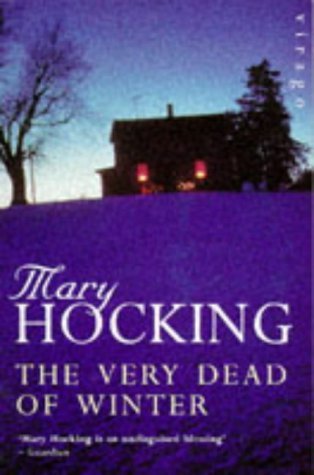
First up is Heavenali’s Mary Hocking Reading Month. I’d never heard of the author, nor was I familiar withHeavenali’s blog before I saw an announcement on Kaggy’s Bookish Ramblings. Browsing told me that Mary Hocking is right up my street and I decided, if I can get one of her many novels (many are out of print), I’ll join. So this is the only plan I’m sharing. I’ll be reading Mary Hocking’s The Very Dead of Winter.

The Very Dead of Winter

Here’s the blurb

This is a portrait of a family forced to confront the grievances of their shared past. In the very dead of winter they assemble at a remote country cottage enveloped in snow. Mary Hocking has also written “Good Daughters, Indifferent Heroes”, “Welcome Strangers” and “An Irrelevant Women”.

Should you want to join, there are quite a lot of used copies available. She’s written a lot of books, many of which have been published by Virago and are still in print. You can find a list on Heavenali’s blog.

spanish_speaking_countries_flags

July is Spanish Literature Month hosted by Richard (Caravana de Recuerdos) and Stu (Winstonsdad’s Blog). Two years ago, when they hosted the first Spanish Literature Month I had some wonderful plans and failed miserably. This year it should be different. I’ve been collecting books for the event, the general direction might be crime, but I’ll decide what I’ll read spontaneously.

Japanese Literature Challenge

Bellezza’s Japanese Literature Month 8 has started on the first of June and runs until the end of January 2015. On Bellezza’s blog you’ll find reading suggestions and links to the review site. This year I will read whatever I like, without taking into consideration whether or not the book has been translated into English. Hopefully I’ll be in the mood for something that has been widely transalated.

Will you participate in any of these events?

Literature and War Readalong June 27 2014: Fear aka La Peur by Gabriel Chevallier

Fear

Every year there is at least one book in the readalong I’m dreading. This year Gabriel Chevallier’s Fear –La Peur is one of them. Cheavllier called it explicitly an anti-war novel and at the same time his wish was to be as truthful as possible, to tell things as they were and to make those, who were not there understand what the war was like. His own experience as an infantryman made him especially qualified to write about the war.

In the French edition of the book is a foreword from 1951 and reading it, one could almost think thar Chevallier himself thought that he went too far. Probably it’s not surprising that the book went out of print when WWII broke out as it was considered bad for morale.

In any case, it’s one of the great French WWI classics. Another one of Chevallier’s novels, Clochemerle, was quite successful.

Here are the first sentences

The fire was already smouldering somewhere in the depths of Europe, but carefree France donned its summer costumes, straw hats and flannel trousers, and packed its bags for the holidays. There wasn’t a cloud in the sky – such an optimistic, bright blue sky. It was terribly hot and drought was the only possible worry. It would be so lovely out in the country side, or down by the sea. The scent of iced absinthe hung over the café terraces and gypsy orchestras played popular tunes from The Merry Widow which was then all the rage.

Some details and the blurb for those who want to join

Fear – La Peur by Gabriel Chevallier (France 1930)  WWI, Classic, Novel, 320 pages

It is 1915. Jean Dartemont is just a young man. He is not a rebel, but neither is he awed by authority and when he’s called up and given only the most rudimentary training, he refuses to follow his platoon. Instead, he is sent to Artois, where he experiences the relentless death and violence of the trenches. His reprieve finally comes when he is wounded, evacuated and hospitalised.

The nurses consider it their duty to stimulate the soldiers’ fighting spirit, and so ask Jean what he did at the front.

His reply?

‘I was afraid.’

First published in France in 1930, Fear is both graphic and clear-eyed in its depiction of the terrible experiences of soldiers during the First World War.

*******

The discussion starts on Friday, 27 June 2014.

Further information on the Literature and War Readalong 2014, including all the book blurbs, can be found here.

Michael Morpurgo: Private Peaceful (2003) Literature and War Readalong May 2014

Private Peaceful

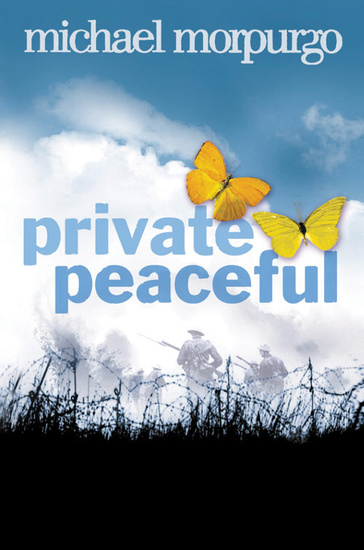
British author Michael Morpurgo is one of the most appreciated writers for Children. He was the UK Children’s Laureate from 2003 to 2005 and Writer in Residence at the Savoy Hotel in 2007. He won many prizes for his fiction.

Tommo Peaceful is the narrator of Private Peaceful. He begins his story at five past ten in the evening, after everyone else has left him. He awaits the next day with anxiety but he doesn’t want any company or distraction. He wants to spend the night thinking about his life. The chapters are all given a specific time and each intro to the chapter describes briefly Tommo’s surroundings and his state of mind. After the intro Tommo tells us in flashbacks his story, from the idyllic childhood in the English countryside to the trenches of WWI.

Tommo is one of three boys. At the age of nine his father dies in an accident and Tommo feels responsible for his death. Although he and his older brother Charlie are very close, he never mentions what happened in the woods, the day their father dies. They have an older brother Big Joe who had Meningitis as a child. He can’t go to school and is easily agitated but they are still very fond of him.

Their father’s death marks a transition from a carefree life to a life of some hardship. They are at the mercy of the Colonel in whose cottage they live. The cottage is tied to a function and after the death of the father, who was the forester, they would have to leave. The Colonel’s estate is big and many people and families work for him and so Tommo’s mother is offered a position at the big house, and they can stay in the cottage.

The years go by and there is happiness and heartache in equal measures. When WWI breaks out, they don’t think they are affected. Tommo is only 16 and Charlie, who is two years older, doesn’t think of volunteering but in the end they are forced. Although Tommo is too young, he doesn’t want to abandon Charlie and pretends he’s older. Finally they are shipped to France together. From there they move on to Belgium and stay near Ypres for the following months.

They don’t see any action at first but eventually they come under heavy fire. From then on we get an impression of everything that was typical or important during WWI: trench warfare, mustard gas, rats, rain, mud, high numbers of casualties among men and horses, arbitrariness of orders, sadism of the high command, absurdity of it all . . . While it’s usually key to show but not tell, Morpurgo often tells but doesn’t show. He stays away from graphic descriptions or anything that you could call gruesome. We still get the horror because we see how it affects Tommo. Most of the time, we just don’t get to see what he sees. I think that’s a great way to go in a Children’s book.

What works particularly well in the book is the contrast between the childhood and teenage years and the war scenes. Morpurgo takes a lot of time to introduce us to his characters and to make us care for them. While some of the secondary characters are a bit stereotypical, the main characters Charlie and Tommo are well-developed. Their relationship is very close and they would give everything for each other.

As I wrote in the introduction to this month, I was particularly interested to see how a Children’s author would handle a WWI book from the point of view of a soldier. I think Michael Morpurgo did an admirable job. I’m sure, children will get a good impression for the particularities of WWI. And they will care for the characters and feel deeply about the end. For an adult reader who has read some very similar books for adults – Strange Meeting and How Many Miles to Babylon come to mind – it was not exactly a huge revelation, but in spite of that, I found the twist at the end harrowing.

Other reviews

Danielle (A Work in Progress)

 Judith (Reader in the Wilderness)

*******

Private Peaceful is the fifth book in the Literature and War Readalong 2014. The next book is the WWI novel Fear – La Peur by Gabriel Chevallier. Discussion starts on Friday 27 June, 2014. Further information on the Literature and War Readalong 2014, including the book blurbs can be found here.