Bernice L. McFadden: Glorious (2010)

Glorious is set against the backdrops of the Jim Crow South, the Harlem Renaissance, and the Civil Rights era. Blending fact and fiction, Glorious is the story of Easter Venetta Bartlett, a fictional Harlem Renaissance writer whose tumultuous path to success, ruin, and ultimately revival offers a candid and true portrait of the American experience in all its beauty and cruelty.

What an entertaining and well written book! I always say that I don’t like historical novels but I really liked this one a great deal. I had a feeling I had only just started when it was already finished.

Glorious tells the story of the fictitious Harlem Renaissance writer E.V. Gibbs whose maiden name was Easter Venetta Bartlett.

Easter’s story is a blend of fact and fiction and from what I can judge McFadden put a lot of effort into the research of her topic and manages to weave it artfully into the story.

I was drawn into the book from the first pages on. In the prologue we read about the tragic beginning of Easter’s story. I liked the way McFadden did this in adding a long list of sentences  and paragraphs all starting with “If….” It exemplifies something that is on my mind a lot, namely the one single instance or occurrence in which a fatal or happy series of events is triggered, the one crucial point that determines the course a life will take.

If her father hadn’t won a boxing match, Easter’s sister wouldn’t have been raped. If that hadn’t happened her father wouldn’t have had an affair and her mother wouldn’t have died. If her mother hadn’t died, Easter wouldn’t have left her hometown and if….

But it did happen and Easter leaves. First she stays with relatives in the Jim Crow South until she witnesses a lynching.  She escapes and joins a travelling circus where she meets the charismatic, lesbian Rain. Easter will not stay very long with the circus and moves on. After some more trials and tribulations she arrives in New York.

She settles down in New York, finds a job that pays he bills, meets a man from the Caribbean and gets married.

Since her early days Easter has always written stories. In New York, after having met Rain again and been introduced to Meredith Tomas, the rich wife of a Cuban plantation owner, she is discovered as the great hidden talent she is. All the prominent people of the Harlem  Renaissance like her writing and she is very influential.

Chance however is not on her side. Her husband who attempts to murder Marcus Garvey, dies soon after her talent has been discovered and Meredith, consumed by envy of her talent, steals Easter’s novel.

The last chapters fast forward some 4o years and we see what has become of  Easter who is now an elderly woman working as a maid in her hometown.

As I said, this book is based on a lot of facts and I’m pretty sure, that it is to a large extent inspired by Nella Larsen’s biography whose career did also end with an accusation of plagiarism.

The beginning in the Jim Crow South is maybe the best part of the novel. The descriptions are very powerful and almost cinematographic. What a monstrosity the South of those days was. It made me think of the song Strange Fruit. I have been collecting versions of it for years now.

Glorious will not be my last Bernice McFadden novel. She really is a very talented writer and it was a highly entertaining read. I already got her first novel Sugar here.

I’m amazed that she hasn’t been translated into German. If there is one market for which her novel would be perfect, it is the German one.

I wouldn’t have read this book if it hadn’t been for a comment by Anna (Diary of an Eccentric) who mentioned it on my first Nella Larsen post.

Here is the link to Anna’s review and to my first Nella Larsen post on Quicksand and to the second on Passing.

Last but not least here is the link to Bernice McFadden’s Blog.

I couldn’t resist and have attached one of my favourite Strange Fruit versions sung by Nina Simone. The video is worth watching as well. It’s very shocking.
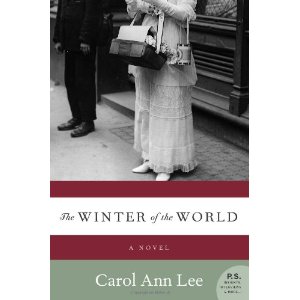
Carol Ann Lee: The Winter of the World (2007) Literature and War Readalong April

Journalist Alex Dyer made his name covering the bloody horrors of the European trenches. Yet even after the Great War is over, he cannot shake the guilt he feels for not serving on the front lines like his dearest childhood friend, Ted Eden. Worse still, Alex cannot put to rest the emotions that gnaw at him from the inside: his feelings for Clare, Ted’s wife—a woman they both have loved more than life itself. 

Carol Ann Lee’s The Winter of the World is the last novel on WWI in this read along. For the next one we will be moving on to WWII.

This wasn’t the easiest review to write as I am in two minds about this novel. There are parts in it that are so haunting and powerful but then again there were others were I was just rolling my eyes thinking “get on with it”.  Still it would be unfair to write a totally negative review because the good parts are among the best on WWI I’ve ever read.

Alex and Ted are childhood friends. They are close and attached to each other until the day Ted introduces Alex to his soon-to-be wife Clare. Very unfortunately this is a love at first sight moment for Alex and Clare. They try to fight it but, as we will see soon enough, the more the story advances, the less likely it is that they will succeed.

The marriage takes place just when the war breaks out. Ted will enlist, Alex will participate as a war correspondent and Clare will be one of the nurses in France.

The novel moves back and forth between Alex’s and Clare’s point of view. Alex sees a lot of atrocities and the descriptions are very graphic and extremely impressive without falling into the trap of being too clichéd. But since Alex isn’t fighting, it stays an outsider’s perspective. Clare’s point of view was captivating for totally different reasons. As a war nurse she has to deal with indescribable wounds and suffering. The abundance of facial wounds seems to be a trait of WWI and these parts reminded me of one of the best WWI movies I have ever seen, La chambre des officiers aka The officer’s chamber based on the eponymous novel by Marc Dugain. We seem to get an insider’s view of this truly harrowing aspect of the “Great war”. I can hardly imagine what it must have been like to have been the victim of this kind of facial mutilation and to be rejected by those you loved and who once loved you. The reactions of the relatives and fiancées were often brutal. Through Clare’s eyes we also get an equally close look at what mustard gas did to those who became its victims and how they suffocated or drowned slowly.

The only men more popular than I was were the ones in wheelchairs, or those with empty sleeves pinned against their chest. Everyone wanted to talk to them, to do something for them. Children presented them with flags and in the railway stations they got free tea or coffee. It was different for the ones whose faces had been destroyed. People averted their eyes quickly, the blood flooding their skin. No one wanted to make eye contact with a disfigured soldier; they were modern-day lepers.

While the war moves on – not stopping at Christmas, as was expected – the love affair develops as well. Clare and Alex meet secretly but are finally driven apart by conflicting emotions and wishes. Alex feels he needs to tell Ted everything, while Clare wants to protect him and keep the affair secret.

Through Alex’ voice we hear what it must have been like to cover this war as a correspondent. The journalists were not allowed to tell the truth. The numbers of casualties were not mentioned nor were the biggest defeats spoken of. While Clare’s parts rather focus on individuals, Alex’ parts illustrate the enormity of the losses. He evokes the incredible amount of wounded, disfigured and killed soldiers. At moments I had the feeling of seeing all these dead men standing in one huge row before my inner eye. When we visit those cemeteries we get a feeling for those massive losses.

He imagined a thin line linking the cemeteries along the old Western Front, from the smallest graveyards hidden away within woods to those huge, silent cities on the plains where the most ferocious battles had been fought. Some bore the names given to them by the soldiers themselves – Owl Trench, Caterpillar Valley, Crucifix Corner – while others were named after the battalion who had buried their own men there. He imagined how tha line would look from the air; so thick in parts that it resembled a child’s scribble, for they were everywhere these Gardens of Stone.

The novel slowly moves towards the culminating point which is the burial of the “unknown warrior”. The name is chose deliberately as “warrior” sounded more inclusive than “soldier”. The grave which is really located in Westminster Abbey was meant to commemorate all the dead fighters of this war, not only the infantry men. The burial is one of the best and most powerful parts in this novel.

Despite all these impressive elements, I had my problems, as I said. The biggest part of the story is told by Alex. He tells Lombardi, a guy he meets in Flanders after the war, why he is so tormented, why he cannot get over the war. I didn’t get this narrative device at all.  I would have preferred a more straightforward story, not this artificial telling of what happened to someone who has nothing to do with it. This was a common technique in 19th century novels but I think it doesn’t add anything to a modern novel at all. The next biggest negative aspect was the coincidence. I found it highly unlikely that Alex would meet Ted at the end. The third thing that I didn’t think well-done is the love-triangle. I think it was unnecessary that Alex and Clare had an affair. The descriptions of Alex’ feelings worked very well for me but not those of Clare. And the guilt-theme was just an element too much. Last but not least I missed Ted’s point of view.

I have a lot of questions at the end of this novel and would be curious to know what others thought.

Was this really the tone of a WWI novel? Especially the love-affair seemed very WWII to me but maybe that impression stems from the similarity to Pearl Harbor.

What about the facial wounds, does anyone know whether this was a consequence of the trenches? In The officer’s chambers, the young officer loses half of his face on the battle field, but I have really never heard so much about this type of injury from any other war.

Why do you think Carol Ann Lee left out Ted’s point of view? I think she might have risked to fall into the trap of cliché but I am not sure that’s why she chose to leave it out.

I’m really curious to read your thoughts.

Here are other reviews

Anna (Diary of an Eccentric)

Danielle (A Work in Progress)

*******

The Winter of the World was the fourth book in the Literature and War Readalong. The next one will be Shusaku Endo’s The Sea and Poison aka Umi to dokuyaku. Discussion starts on Friday May 27, 2011 .

Sarah Blake: The Postmistress (2010)

The wireless crackles with news of blitzed-out London and of the war that courses through Europe, leaving destruction in its wake. Listening intently on the other side of the Atlantic, newly-wed Emma considers the fragility of her peaceful married life as America edges closer to the brink of war. As the reporter’s distant voice fills the room, she sits convincing herself that the sleepy town of Franklin must be far beyond the war’s reach. But the life of American journalist Frankie, whose voice seems so remote, will soon be deeply entangled with her own. With the delivery of a letter into the hands of postmistress Iris, the fates of these three women become irrevocably linked. But while it remains unopened, can Iris keep its truth at bay?

I wanted to like The Postmistress and for 200 pages I really did. It has a cinematic quality to it, the descriptions are so perfect, you think you are watching a movie. A movie like Pearl Harbor, not The Draughtsman’s Contract, that’s for sure, but still, it’s an achievement. Also the story is really interesting for far more than two thirds of the book and then it sadly collapses. What starts out as an entertaining and very well-researched read becomes slightly insipid.

The Postmistress interweaves the lives of three very different American women. Frankie Bard, a war reporter, Emma Fitch, the young wife of a doctor and Iris James, the postmaster (she insists on calling herself “postmaster” and I never really got the title).

The story that is told in the book takes place in 1941. During the first two thirds of the book, Frankie is in war-torn Europe, reporting live on the radio, during the Blitz and later from different cities in France. Emma and Iris live both, in the fictional small town Franklin in Massachusetts and hear Frankie’s broadcasts that brings the war into their living rooms. They feel Frankie’s engagement, they live the tragedy with her. They are so far away if it wasn’t for Frankie the war would seem almost unreal.  Apart from Harry Vale, Iris’ fiancé, no one in Franklin, Massachusetts thinks that America will ever go to war, even though the draft has started.

The plot starts to get silly when Emma’s husband decides to go and help in London. He seeks atonement for a “medical accident” for which he feels responsible.

The second third of the book shows Frankie travelling with various trains from Germany to Portugal to interview refugees on the trains. She collects the stories on disks and those voices will later be listened to – thanks to a huge story-twist – in Franklin.

The central story is the one part of the book that I didn’t like and this is unlucky because it ties the three parts together. The idea was to tell the story of a letter that is not delivered because the postmistress decides to hold it back.

Something else that didn’t quite work for me is due to the handling of the characters. Although all three women get their equal share at the beginning, it becomes ultimately Frankie’s story. The other two seem to be mere vehicles to make the plot work.

Sarah Blake writes in her after-word that Frankie couldn’t have had access to a portable disk recorder at that time. What she uses came into usage in 1944 and enabled live-recording from the battlefields.

I took liberty with the date because World War II was the first war that was brought into people’s living rooms by radio, and I wanted to highlight the power of the voice to convey the untellable, the refugees speaking into an air into which they will vanish.

Sarah Blake studied a lot of books on female war reporters, Martha Gellhorn and many other books on WWII. The themes are decidedly interesting and it is no wonder the book has A Reader’s Guide and Discussion Questions. An ideal choice for a book club I presume. Occasionally I wonder if these Reader Guides are not meant to justify the book and ultimately to sell it. It strikes me that I see this more in more in books, even in so-called American literary fiction.

The history of female war reporters and the evolution of reporting is interesting. I think the book also captures very well how far away the war seemed to the Americans. It looks at the way people go on about their lives while in another part of the world people go through terrible things. This seemed very timely and I was reminded of the situation in Japan. We are here and safe while people in another country fight for their survival. How do we go on living as if nothing was happening?

If you are still curious, here is The book’s homepage where you can read the first chapter.

Historical Novels

100 Must-Read Historical Novels (Bloomsbury Good Reading Guides)

I always thought that I didn’t like historical novels or that it was at least a genre that I hardly ever read. Still, when I came upon this little book (it’s a very small size) on amazon I was curious and as it was one that you can open and browse (as you can when clicking on the picture) I had a look and was astonished how many of them I had read or knew. I found Pat Barker’s Regeneration in it as well as Kate Grenville’s The Secret River and Penelope Fitzgerald’s The Blue Flower. Willa Cather is mentioned alongside with Umberto Eco’s The Name of the Rose and Giuseppe Tomasi di Lampedusa’s The Leopard. I was so curious that I finally had to order it and I am glad I did. It’s a great little book.

100 Must-read Historical Novels describes 100 books in detail, with a brief introduction to the author and  a summary of the book. Other books of the author are mentioned as well as books that are similar and movies based on the book.

In between the entries on the authors are book lists with themes. You can find a list of books on World War I and its aftermath, a list with books on the American West, a list with historical novels on Asia, a list with historical fiction for children, novels on ancient Greece and Egypt, The Renaissance, The Middle Ages and so on and so forth.

I picked two lists as examples and reproduced them for you:

Black History Fiction

David Dabydeen, A Harlot’s Progress

Barbara Hambly, A Free Man of Colour

Lawrence Hill, The Book of Negroes

Toni Morrison, A Mercy

Walter Mosley, Devil in a Blue Dress

Caryl Philipps, Cambridge

William Styron, The Confession of Nat Turner

Margaret Walker, Jubilee

Writers’ Lives

Andrew Taylor, The American Boy (Edgar Alan Poe)

Julian Barnes, Arthur & George (Sir Arthur Conan Doyle)

Anthony Burgess, Nothing Like the Sun (William Shakespeare)

Frederick Busch, The Night Inspector (Herman Melville)

Tracy Chevalier, Burning Bright (William Blake)

J.M. Coetze, The Master of Petersburg (Fyodor Dostojevsky)

Michael Didbin, A Rich Full Death (Robert Browning)

Helen Dunmore, Counting the Stars (Catullus)

Carlos Fuentes, The Old Gringo (Ambrose Bierce)

Tom Holand, The Vampyre (Lord Byron as one uf the undead)

Michèle Roberts, Fair Exchange (William Wordsworth)

Steven Saylor, A Twist at the End (O.Henry)

C.K. Stead, Mansfield (Katherine Mansfield)

Colm Toibin, The Master (Henry James)

Of those mentioned here I have Colm Toibin’s The Master and A Mercy on my TBR pile. I did start The American Boy but never really got into it but Devil in a Blue Dress is a favourite.

I realize that my understanding of historical novels was slightly narrower than what is shown in this book and maybe that was based on a misconception. A historical novel had to be set before the 20th century. That’s why I wouldn’t have considered Pat Barker to be a writer of historical novels. According to Nick Rennison, the author of the book guide, he applied the same rule that Sir Walter Scott once applied. In order for a novel to be called historical, the events that are described must have taken place at least 60 years prior to the year in which the writer lives.

My favourite three historical novels (in a narrow sense) are: Françoise Chandernagors L’allée du roi aka The King’s Way, Margaret Mitchell’s Gone with the Wind and Tracy Chevalier’s Girl with a Pearl Earring.

I know that many of you love historical novels. Which would be your top three?