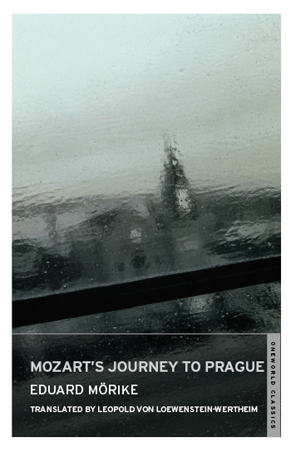
Eduard Mörike: Mozart’s Journey to Prague – Mozart auf der Reise nach Prag (1855)

This is one of those books that I had meant to read since years. Now that I have read it, just after reading Kleist, I must say, I couldn’t imagine another classic as far from Kleist as Mörike. Mozart’s Journey to Prague is a truly lovely piece of writing. Sunny, cheerful but still profound, thoughtful and with a melancholic undertone. All in all one could say the sunniness is deceptive.

It’s the year 1787 and Mozart and his wife Konstanze are on a journey to Prague for the opening of Don Giovanni. They are cheerful but not without worries. Money is a big issue in Mozart’s life. Money and his health. He never rests, never stops running from one invitation to the next, working till the early morning, hardly sleeping.

His needs were various, above all his passion for all the pleasures of society were extraordinarily strong. Honoured and sought out as an incomparable talent by Vienna’s noblest families, he seldom or never declined invitations to dinners, parties and soirées. In addition he would entertain his own circle of friends with befitting hospitality. The Sunday musical evening, a long-established tradition in his house, or the informal luncheon at his well-furnished table with a few friends and acquaintances two or three times a week, were pleasures he refused to forgo. Sometimes, to his wife’s dismay, he would bring unannounced guests straight in off the streets, a very varied assortment of people, dilettanti, artistic colleagues, singers and poets. The idle parasite whose sole merit lay in an untiring vivacity, ready wit and the coarser sort of humour was made as welcome as the learned connoisseur or the virtuoso musician.

They talk about a few of these things but they are enjoying themselves as well. Mozart steps out of the carriage in a forest and gets all enthusiastic about the trees, the beauty of nature of which he hardly sees anything in Vienna.

A little later they stop at a village and Konstanze rests in a guest house while Mozart goes for a walk in someone’s garden. Lost in his thoughts he carelessly snaps an orange from a little tree and halves it with his knife. He immediately gets arrested by the gardener and brought in front of the noble man whose park he has entered. Lucky for him they recognize him and are delighted to have him there.

The little tree is very dear to the daughter of the noble man. It has once been a gift from Mme de Sévigné herself. The little tree was about to die but thanks to a skillful gardener has recovered. His oranges were counted and the tree was meant as a gift for the daughters engagement.

Mozart and his wife are invited to spend the day and the evening of the engagement with the family. He plays the piano, sings, introduces them to Don Giovanni.

There is a lot of cheering, drinking and laughing but towards the end the daughter of the family feels a chill. She is convinced that Mozart is burning from an inner fire, that he consumes himself too fast and will not live much longer. The novella finishes with a sad poem by Mörike that ends the book on a melancholy note.

Mörike wrote this novella as an homage to Mozart whose music he adored. He tried to capture the beauty and the cheerfulness of his music and the man himself but did not omit the fact that Mozart wasn’t able to refrain himself. He couldn’t live in a moderate way, was excessive in everything, burned the candle on both sides and did, as we all know, not live very long.

Reading this novella felt at times like watching a painter paint a very colorful painting, drawing flowers and trees, a sunny blue sky but in the upper left corner of the painting we can see a dark cloud slowly starting to spread.

Mozart was without any doubt a genius and there is always a mystery surrounding them. One could wonder whether he was living and working so excessively, as the novella wants us to believe, because he knew deep inside he was going to die young or whether his excesses led to his untimely death.

It’s a very visual novella, lovely and enchanting but profound as well.

The review is part of German Literature Month – Week IV Kleist and the Classics
Wednesdays are wunderbar – Pick and Mix Classics

Since it’s classics week the giveaway will be a classic. Classics is something many people already own. In order to make sure that you can win books you do not already own One World Classics offers to two people to pick and mix any two classics from their catalogue.

Interested? Then hop over to Lizzy’s blog for details .

The giveaway is part of German Literature Month.

Heinrich von Kleist: The Duel – Der Zweikampf (1811)

Today is the bicentennial of Kleist’s death. I had a few different ideas for this post but finally, after having read The Duel – Der Zweikampf, one of the very few of his novellas I hadn’t read before, I decided on focusing on that. The initial idea was to write about his death. Since his death and the novella The Duel have elements in common, it’s only fair, to at least mention it.

Kleist shot himself on November 21 1811, near the Kleiner Wannsee, after having shot his friend Henriette Vogel. This suicide was premeditated and even announced. He wrote letters to different people mentioning it and so did Henriette. It has been argued that one of the reasons why his grave is hard to find and almost hidden isn’t that he was a suicide but that he was also a murderer. I don’t think we can call him that, what he did was assisted suicide. Henriette wanted to die with him and, as was found out later, had reasons. The autopsy showed that she suffered from terminal cancer. In any case, what is striking, is the violence of their deaths which leads me back to The Duel. One of the most striking features of Kleist’s prose, apart from being very unique, and at times challenging to read, is the omnipresence of violence. Rape, abuse, murder, fights, duels, you name, it’s there. The novella The Duel is no exception. The story that is set in the 14th century starts with a murder. From the beginning there is a suspect only he seems to have an alibi. He indicates to have spent the night with a noble woman, a widow. In order to save himself, he reveals her name which has severe consequences. Upon hearing what their sister has done, her brothers beat her up and chase her from their home. She seeks refuge at the castle of another noble man, one who had asked her to marry him before. Convinced of her innocence he wants to duel with the man who has brought shame upon her and in doing so prove that she is not guilty. Since he is convinced she is innoncent, he is convinced the other one will die.

For those who will still read this novella I’m not going to reveal the outcome of the fight. What struck me is that it is believed that a duel equals a judgment of God and that the outcome isn’t only a means to get satisfaction but will show the irrevocable truth. The duel should help clarify who is lying. It’s aim is not a payback for an inflicted injustice or a libel but it will, through God, reveal the truth.

The story felt very archaic, and as I already said, I was, as always with Kleist, amazed how violent the story is. I’m far less familiar with his plays. I think some of them are even comedies. Kleist is a fascinating writer because there is something mysterious in what he writes. His characters react in a very intense way and one of the predominant themes is always sexuality which is linked to violence. The aggression between men is intense but it’s far more intense between men and women.

The Duel is one of Kleist’s shorter novellas and not a bad starting point if you have never read him. My favourite is The Marquise of O. An incredible story of a woman who doesn’t know how she got pregnant and is looking for the father of her child.

The Duel is part of The Art of the Novella series by Melvillehouse Publishing and in this series part of The Duel set of five novellas with the same title from different authors.

Have you read any of them and which one did you like? How do you think Kleist’s book compares to other duel stories?

For those who read German, I attached this link where you can find his letters. Alle Briefe

The review is part of German Literature Month – Week 4 Kleist and other Classics

German Literature Month Week III Wrap-up and The Winners of the Friedrich Glauser Giveaway

When I did the wrap up for the first week I was amazed about the contributions and thought that the enthusiasm might die down further into the month. I’m glad I was wrong with this assumption. The number of reviews and the variety of authors and books that have been chosen is as great as during week I and II. I would really like to thank all of you who contributed and help making this event a huge success.

The complete links and participants list can be found HERE.

Lizzy contributed two posts, one in which Publisher’s and Authors recommend their favourite German books and the other is a review of Julya Rabinowich’s Splithead which sounds like a most unusual book.

The Magic Mountain of German Literature 3 (Publisher and Author Recommendations)

Splithead by Julya Rabinowich

I reviewed a short story collection by Peter Stamm that I liked a lot and also reviewed Vicki Baum’s classic bestseller Grand Hôtel. While it isn’t as refined as Joseph Roth’s Hotel Savoy it is still a surprisingly interesting and character driven book.

In Strange Gardens and Other Stories by Peter Stamm

Grand Hôtel – Menschen im Hotel by Vicki Baum

Danielle (A Work in Progress) reviewed The Murder Farm by Andrea Maria Schenkel which she found a fascinating and unusual crime story in the vein of Capote’s In Cold Blood.

Emma (Book Around the Corner) read Short Stories by Stefan Zweig. The stories had all a historical theme. She did enjoy it but maybe not as much as his non-historical stories.

Ted (BookeyWookey) read The Artificial Silk Girl by Irmgard Keun and liked it a lot. The review captures the frothy playful tone that covers a dark undercurrent very well. The many quotes included in the review give a good impression of the novel (a favourite of mine).

Grace (Books Without Any Pictures)  re-read The Trial by Kafka which she thinks a most unusual and absolute must-read book. She likes it better than most of his short stories.

Richard (Caravana de Recuerdos) read Doctor Faustus by Thomas Mann after having been urged by a few people. He appreciated it a lot but liked it more for its ideas than its style. His review gives an excellent impression of the many interwoven themes of this complex book.

Jackie (Farm Lane Books) came to the conclusion that neither Jelinek’s Piano Teacher nor Grass’ The Tin Drum are to her liking. On Jelinek’s the Piano Teacher and Grass’ The Tin Drum. Judging from the comments, she is far from alone.

Guy (His Futile Preoccupations) read and reviewed Where Do We Go From Here? by Doris Dörrie which seems to have been a very good read, in typical Dörrie style “With piercing wit and a generous view of human nature.” Guy also read and reviewed  The Snowman by Jörg Fauser. A cult classic of gritty German crime which – to quote Guy – “is strongest in its depiction of the seedy underbelly of life –the cheap hotels, the filthy toilets (…).  There’s an intense authenticity to these scenes, and a sour truth to Fred’s realization that he’s small-time for a reason.”

Rise (in lieu of a field guide ) underlined in his review of Rock Crystal by Adalbert Stifter how crystal clear Stifter’s prose is. A captivating story written in a flawless style, concrete and precise like poetry, as he writes.

Fay (Read, Ramble) read Poems by Rilke which impressed her or in her own words “One reading of selected poems gives a sense of striking imagery and intense artistic purpose but not enough mastery of Rilke’s art to make further commentary worthwhile. Rilke is a poet who deserves several careful readings. All I know is that the more I came to know Rilke’s voice, the better I liked him, after a hesitant start. It is a voice to listen to again.”

Rikki (Rikki’s Teleidoscope) read Maybe This Time by Alois Hotschnig in German. She writes “I read this is German and I don’t think I have ever come across a writer who writes in such a precise way and who conjured such a clear picture of what is going on.”

Scott W. (seraillon) reviewed  Beautiful Days – Schöne Tage by Franz Innerhofer. In his in-depth review he writes about the unusual combination of a seemingly cheerful title with the topic of child abuse. The book seems to be well worth reading, complex and arresting.

Priya (Tabula Rasa) liked Hotel Savoy by Joseph Roth a lot and recommends it highly.

Alex (The Children’s War) rediscovered and reviewed an old children’s classic Emil and the Detectives by Erich Kästner and reviewed A Song For Summer by Eva Ibbotson. Ibbotson’s book offers a wide variety of unusual, typical Ibbotoson characters and despite a WWII topic stays light and hopeful.

Parrish (The Parrish Lantern)  introduced a great book on German poetry, including authors like Else Lasker-Schüler as well as Jan Wagner. The Faber Book of 20th Century German Poems. He included the whole list of poets, a poem by Elke Erb and a lot of other information.

Anthony (Time’s Flow Stemmed) calls Old Masters by Thomas Bernhard a flawless book. It seems also a very interesting book and one that was echoed by two other reviews (in lieu of a filed guide and seraillon). Bernard’s character criticizes Austrian art and artists, among them Stifter. The book could be called a rant but Anthony chooses to call it a tirade.

Tony (Tony’s Reading List) What happens when someone reads Kafka’s The Castle and participates in German Literature Month? Given he is an imaginative person it might look a little bit like this Das Schloss – The Play Act One  – Das Schloss – The Play Act Two  – Das Schloss – The Play Act Three Das Schloss – The Play (Director’s Cut). Tony writes his own “Castle Play ” and adds a review of Kafka’s book.

Liz (Tortoisebook) liked the sad but beautiful  The Sorrows of Young Werther by Goethe. She says “This book is a lovely read, beautifully told and achingly heartbreaking.”

Vishy (Vishy’s Blog) reviewed the original sheep crime novel Three Bags Full by Leonie Swann which read as if “Agatha Christie had rewritten The Wind in the Willows“.

Poor Daryl (Who Killed Lemmy Caution?) was ill but is recovering. Soon we will read her review of Klausen by Andreas Meier. Review on Its Way

Week three gives us a slightly puzzled Tom (Wuthering Expectations ) who after having read Wedekind’s Spring Awakening during week II thought he had seen the height of Austrian treatment of  sexuality in plays but no – he hadn’t read the La Ronde/Der Reigen by Arthur Schnitzler yet. He was quite amused by the use of … to cover up the ongoing activities and wonders how they handled this during the play.

Effi Briest Readalong

Week III

Andrew

Caroline

Danielle

Eibhlin

Fay 

Iris

Lizzy

Tony

**************

And here are the winners of the Friedrich Glauser giveaway courtesy of Bitter Lemon Press.

One copy each of In Matto’s Realm goes to

Neer from A Hot Cup of Pleasure and

Richard from Caravana de Recuerdos

Happy reading Neer and Richard!

Please send me your address via beautyisasleepingcat at gmail dot com.

The giveaway is part of German Literature Month.

The next giveaway will take place on Wednesday 23 November 2011.

German Literature Month – Effi Briest Group Read Week III

The picture is taken from the latest film version Effi Briest (2009) starring Julia Jentsch and Sebastian Koch as Effi and Instetten. Here is more about the movie including trailers and pictures.

This is the final week of our Effi Briest Group Read. The questions have been provided by Lizzy. Please, if you haven’t read the book, don’t read the answers. They are not spoiler free.

Why do you think Effi kept Crampas’s letters?

I was wondering exactly this the whole time. Why did she keep those letters? On the other hand it is understandable. They were probably full of flatteries and compliments that she enjoyed re-reading. Knowing Instetten it was very unlikely he would search her things. It was a pure accident that he found them. I think it clearly shows that she thought he really wasn’t too interested in her or she wouldn’t have been so careless. If she’d been married to a man who seemed to have been in love with her and very jealous, I doubt, she would have kept them.

Did Innstetten have a choice?

Yes, I really think he did have a choice. The man he called, who would be his second, advised against it as well. Hee could just have pretended he never found those letters. In the end, I believe, he doubts his own choice. If he had found out while it happened, I think one could debate, whether or not, he had a choice, but six years later…

Are there any events in this final section that make you feel outraged?  Is that how Fontane wants you to feel?

I was not outraged, it made me very sad. My feeling for Effi was stronger than a feeling of outrage. I thought it was utterly pointless. Wasted lives, for nothing else but pride.

Is there a villain in this piece?

The mother is the worst character, closely followed by Instetten. I could imagine that her decision to be so hard on Effi was because she wondered how Effi could have cheated on a husband she would have loved to have. But precisely this history between her and Instetten might have been part of the source why Instetten never really opened up to Effi. I think that a lot of social injustice could have been stopped earlier if the members of a given society didn’t tacitly endure the rules – or even reinforce them – and I find it especially horrible when mothers think their daughters or sons should go through the same experiences they had to go through, no matter how bad they were. It’s as if the mother was thinking “If I was able to endure it, you should be able too.”     

The lot of the real-life Effi, Elizabeth von Plotho, was a much happier one. Why do you think Fontane made the outcome for Effi much harder?

To prove a point, I guess. He clearly condemns the ways of Prussian society, the regulations and rules. To make it crystal clear the ending had to be more drastic.

Were you surprised by the ending?

The first time I read it I was shocked. I don’t know how I thought it would end but not the way it did. Not after such a long time. I’m outraged to think what consequences adultery had for women in these days.

Where would you place Effi in the pantheon of C19th fictional adulteresses?

I found Mme Bovary very annoying and never really had any feeling for her. In the case of Anna Karenina I thought the book was so much more about Vronsky and Lewin than about her but to a certain degree she is more tragic as she loves Vronsky. Effi doesn’t love Crampas. The tragedy in Effi is very different. I think what makes it so harrowing is that it seems so pointless. More than 6 years have passed since the affair and if Instetten hadn’t found the letters accidentally, nothing would have happened.

Do you think you would ever reread Effi Briest?

Yes, I think so. In a few years, I can see myself re-read it.

German Literature Month – Effi Briest Group Read Week II

This is the second week of our Effi Briest Group Read. This week the questions have been sent out by me.

What strikes you most in this novel,  what do you like or dislike the most?

What strikes me personally most is that I don’t dislike anything. I find no superfluous words, no false tones in this novel. I think it’s an incredibly accomplished book that is as moving the second time as it was the first time I read it.

I really love everything about the book but I do have pretty strong reactions towards some of the characters. Instetten is for me, this time, a pompous insufferable git. I truly hate people who think they are superior. He patronizes Effi wherever he can. He is very rigid and follows rules and orders.

Do you think Fontane likes Effi? Whose side is he on?

I was wondering very often and think, he must like her a great deal or I wouldn’t feel for her. As a person she is quite opposite to myself or people I’m usually interested in, now as well as when I was 17. She isn’t introspective but fun-seeking. I think if Fontane didn’t like her, I wouldn’t feel the way I feel about her. She is a bit like a little animal that needs protection.

What do you make of the story of the Chinese and the haunted house. How would you interpret it? And what about Crampas’ interpretation?

I’m surprised how important this story is as this is something I had completely forgotten although I love a good ghost story. I think Effi is extremely isolated and all sorts of things play tricks on her mind. I also think it’s foreshadowing things to come but for fear of spoilers I’m not going to elaborate on this.

Crampas interpretation strikes me as spot on and it does enforce my negative feelings for Instetten. Wanting to educate or drilling Effi is so like him.

Descriptions are an important part in Effi Briest. How do you like them and how important do you think they are for the novel?

This question is tied to the next one. I had a feeling that the novel moves back and forth from outdoor to indoor scenes and in the outdoor scenes the descriptions are very important.

The region in which Kessin is located bears a lot of dangers for humans. There are the marshes that can swallow you, the snow can cut you off from the outside, the storms make ships sink. This seems very symbolic and full of foreboding.

The contrast between the loveliness of Effi’s family’s garden compared to the bleak landscape around Kessin emphasizes her loneliness. She would need a welcoming home but the house she lives in scares her as well.

The descriptions of the outside world also seem to point to things to come and the night in which Effi and Crampas sit together in the carriage and almost sink into the “Schloon” (that’s the German expression and I have no clue what the corresponding English word is, I guess marsh) seems full of foreboding.

It struck me while I was reading this novel how Fontane pairs descriptions of cozy and scary. Did you notice this as well and if so, what did you make of this?

For a tormented soul like Effi’s the idea that feet are running over her head and that she is all alone in the dark unwelcoming house in Kessin is very scary. I found the whole novel much more “gothic” this time around than when I first read it. The contrast to her family home, in which everything was cozy is very striking.

Another scene where I saw this pairing was when she walks in the wood with Crampas and it begins to snow. It might be a scary idea usually to be snowed in but Effi mentions a poem set druing the war, in which an old woman was snowed in and the snow-covered her up so the soldiers couldn’t find her. The idea warms Effi, she feels that being snowed in means being sheltered from the outside world.

What do you think of Crampas?

I didn’t think Crampas was such an unlikable character but he is a very irresponsible man. He should have thought of Effi and not start something with her. Of course he is trapped in a loveless marriage as well but he doesn’t seem to love Effi either. He is clearly a player. He likes to break rules and says so early on. I think it’s maybe as much about having an affair for him as about doing something forbidden. Still in the scenes in which we see them together he is far nicer to Effi than her husband and she seems a more mature person in his presence, not a little child that fears to be criticized at any moment.

Fontane chose to describe more than one Christmas in this novel, what do you think Christmas signifies?

Christmas is traditionally a family holiday. There is more than one Christmas in the novel and they are all slightly different. They do mark the passing of time but also show what it means for Effi to have left Hohen-Cremmen. Her first Christmas is a very lonely one. The second is slightly better but she misses her family. What struck me is that there was no attempt at spending Christmas together. I found that unrealistic. I can’t imagine a reason why they didn’t visit Effi’s parents. It felt like a punishment when I read it, as if she was an outcast.

What kind of mother is Effi?

I think she is quite a devoted mother. The child turns her into a grown up but, as it was usual then, someone else, in this case Roswitha, spends much more time with the child.

Where will the novel go from here? What do you think will happen next?

As I have read it before I’ll skip the question of course.

Please leave a link to your post in the comments section or in the Mr. Linky. (To see the participants, you have to click on Mr Linky).

2 German Crime Ladies: Charlotte Link and Petra Hammesfahr

There are two German crime writers who are more famous than most others in Germany and these are Charlotte Link and Petra Hammesfahr. While Charlotte Link is probably by far the most read German author she has so far not been translated into English. That’s why I was so pleased when I saw that finally it’s going to happen. Her novel The Other Child – Das andere Kind will be published at the beginning of 2012. Here is the blurb:

A suspenseful and atmospheric new psychological crime novel from ‘Germany’s most successful living female author’

An old farm, a deserted landscape, a dark secret from times past with fatal consequences for the present. In the tranquil northern seaside town of Scarborough, a student is found cruelly murdered. For months, the investigators are in the dark, until they are faced with a copy-cat crime.

Charlotte Link is such a good example for another type of genre that German writers excel at and that is historical fiction. The amount of books and authors is amazing.

Link is famous for her psychological novels in the vein of Mary Higgins Clark and for her long family sagas and historical novels. The Other Child which I have not read yet – I wanted to but 700 pages were not feasible for German Literature Month – combines both. The story is set in 1970 – 2008 and during WWII in England. Young women are being killed, the crimes resemble each other and the trace to the killer seems to go back to WWII. One of the themes is the children that were sent to the country during the war.

Link has an easy but very gripping way of writing. I’ve read many of her psychological thrillers of women who are being stalked by ex-lovers. Her world is often one in which men are predators, but her descriptions are great and atmospherical and the pace is appealing. If this is really, as it seems, her first novel in English, I’m not sure how good a choice it is. It’s cunning to test the waters with a genre blend, I suppose, because if this book is loved, chances are high that her psychological thrillers and her historical novels will be equally liked.

For German Literature Month I picked up a slim volume of short stories by Petra Hammesfahr. While these stories have not been translated, Hammesfahr’s novels are slowly available in English and seem as succesful as they are in her native Germany. While Link is strong on plot and pace, Hammesfahr is even stronger on psychology. Whenever I start one of her novels, I don’t want to stop. I had the same experience when reading her short stories. Accurate descriptions, psychological insights and a surprising ending. Good people turn into criminals because the monotony and madness of daily life becomes too much to bear or highly dysfunctional people become delinquent because there was just this one moment that made them snap.

Hammesfahr, unlike Link, combines the very ordinary with the uncanny, the sick, the revolting. The outcast who may not be guilty, the housewife who may be.

The novels available in English so far are The Sinner – Die Sünderin and The Lie – Die Lüge. I would hope that others will be translated. Most of all Der stille Herr Genardy.

Of the three German crime novelists I reviewed, Noll is the most literary, Link, the most mainstream, and Hammesfahr is somewhere in between. For you to choose what you prefer. I like them all, depending on my mood.

The review is part of German Literature Month Week II – Crime