Georges Simenon: Maigret’s Christmas or The Girl who believed in Santa Claus aka Un Noël de Maigret (1951)

Nine stories present Simenon’s dauntless detective in a series of cases in which Maigret’s paternal side is activated and his detection efforts considerably aided by some observant and resourceful children.

I haven’t read any Simenon for a long time and when I was browsing amazon. fr. and discovered Un Noël de Maigret I thought it might be fun to read it at this time of the year. I thought it would be a longer book or a collection of short stories but the book contained only a 100 page long novella. It has been taken out of a collection with the same title and reissued on its own. Maybe it was the best and longest story in the original book. The English version Maigret’s Christmas contains still all nine stories, one of which is The Girl who believed in Santa Claus, the story that I have read. So, if you are in the mood for a lot of Christmas themed Maigret, you will have to get the English version.

The story has very melancholic undertones. It is easily summarized in a few sentences. On Christmas day two neighbours of Maigret come to visit to tell him that the little step-daughter of one of the two women pretends that Santa Claus has visited her in her bedroom at night. He offered her a big doll and tried to remove some floorboards in order to access the apartment below. The step-mother, a cold and distant woman, says she doesn’t believe the little girl, she says, she thinks she made everything up. The second woman, a spinster with a crush on Maigret, has a keen interest in the little girl and forced the step-mother to come along and tell Maigret all about the odd story the child is telling.

The story behind the Santa Claus and the solving of the mystery is not that gripping. The charm of this book lies in the person of Maigret and his psychological analysis. Maigret treats people with amazing respect, he is truly non-judgemental. The book is also infused with his and his wifes sadness about their childlessness. Christmas, being the family holiday it is, reminds them of their fate in a painful way.

Simenon excels in descriptions and psychological analysis. I could compare him to some other crime authors but that wouldn’t do him any justice. He wrote before Rendell, Mankell and all the others. He is very subtle, very poignant. This is not one of his great works but it is well done and his craftmanship can be perceived in every sentence. There is no superfluous word in this book, it’s soothingly unadorned.

I have read a few non Maigret books that I enjoyed a lot (Three Bedrooms in Manhattan aka Trois chambres à Manhattan is wonderful)  but I am not too familiar with his Maigret books.

Who has read any? Which did you like? Or do you prefer those without the inspector?

Arnaldur Indriðason: Silence of the Grave (Reykjavík Murder Mysteries 2) aka Grafarþögn (2001) An Icelandic Mystery

Silence Of The Grave (Reykjavik Murder Mysteries 2)

Building work in an expanding Reykjavík uncovers a shallow grave. Years before, this part of the city was all open hills, and Erlendur and his team hope this is a typical Icelandic missing person scenario; perhaps someone once lost in the snow, who has lain peacefully buried for decades. Things are never that simple. Whilst Erlendur struggles to hold together the crumbling fragments of his own family, his case unearths many other tales of family pain. The hills have more than one tragic story to tell: tales of failed relationships and heartbreak; of anger, domestic violence and fear; of family loyalty and family shame. Few people are still alive who can tell the story, but even secrets taken to the grave cannot remain hidden forever.

Silence of the Grave is the second of Indriðason’s successful mysteries. When reviewing Sjón the other day I had forgotten that I had the German edition (Todeshauch) of this book somewhere. Very much in the mood to read more Icelandic literature I picked it up and was hooked right away. I wouldn’t compare it to Mankell though (as it is usually done in Germany), they don’t have a lot in common apart from two disillusioned inspectors and being disillusioned is all the two inspectors have in common. Mankell’s books are much more psychological. Indriðason is bleaker, drearier. You’d better put a coat on should you read this as it is chilly, very chilly. Picture one of the Absolute Vodka adds. Right, that’s how cold it is. In every sense. We tend to forget that Iceland is not only about beautiful landscapes but there is the city of Reykjavík in which the people have pretty much the same problems as anywhere else. Delinquency, drugs, child abuse, domestic violence. And all this in a climatically challenged setting of excessively long winter nights and never ending summer days.

The novel starts in April and already it is getting dark after 9 p.m. and the days start in the wee hours of the morning.

Inspector Erlendur is divorced. He has two children he rarely sees. One is a junky, lying in a coma all through the novel,  the other is completely estranged from him. His ex-wife hates him. This is important as his personal story gets as much attention as the crime that is to be solved. Both stories are interwoven with a third story line that takes place during WWII. This third story is one of the worst stories of domestic violence I have ever read.  We know that this is somehow tied to the crime that has to be solved. It is also interesting to read about Iceland during WWII.

In the beginning of the novel it is not a 100% clear if there really has been a crime. Children find some human bones on a construction site. Archeologists have to dig them out with painstaking slowness. It takes the whole book until we know who is buried. What is discovered is very surprising. There are as many differnet possibilities with regard to the victims as with regard to the murderers.

I am not always happy when authors jump back and forth in time and mix many story lines but Indriðason did a good job. He also did a good job at describing Iceland and its harsh winters. The moment you leave Reykjavík you are at the mercy of nature. Many people get lost in winter during storms and die a white death. A handy cover-up for many a crime, as we are told.

Silence of the Grave was very different from any other crime novel I have read so far. No comparing it to Mankell (more psychlogical), Larsson (more elaborate) or Nesbø (bad!), please. I liked reading it, kept on guessing and wondering who, where, why, when but I am not sure I am sufficiently interested in Erlendur and his life to read another one in this series soon.

I am always fascinated how different covers look in other countries. The one I have is the blue hardback one. I think it does the book more justice than the English and the German paperbacks.

Teresa Rodriguez: The Daughters of Juárez (2007) Roberto Bolaño, Bordertown and The Story That Wants to be Told

For more than twelve years, the city of Juárez, Mexico — just across the Rio Grande from El Paso, Texas — has been the center of a horrific crime wave against women and girls. Consisting of kidnappings, rape, mutilation, and murder, most of the atrocities have involved young, slender, and poor victims — fueling the premise that the murders are not random. As for who is behind the crimes themselves, the answer remains unknown — though many have speculated that the killers are American citizens, and others have argued that the killings have become a sort of blood sport due to the lawlessness of the city itself. And despite numerous arrests over the last ten years, the murders continue to occur, with the killers growing bolder, dumping bodies in the city itself rather than on the outskirts of town, as was initially the case, indicating a possible growing and most alarming alliance of silence and cover-up by Mexican politicians.

The subtitle of this book reads A True Story of Serial Murder South of the Border. Ciudad de Juárez must be one of the most dangerous cities on Earth. For women and men alike. I heard about the serial murders on poor maquiladora (assembly factories) workers while reading a blog post on MAC’s tasteless new cosmetics series, dedicated to the dead women of Juárez. I started to investigate and found numerous films online. I read that there has been a movie starring Jennifer Lopez, Bordertown (don’t think it is very good), which is dedicated to the Juárez murders and that even Bolaño’s novel 2666 was in large parts dedicated to those crimes. I had decided to tell their stories long before I read about Bolaño and since I haven’t read him yet, there is no actual influence here. My story is progressing slowly. Too many points of view. But I can’t stop. The story wants to be told. It feels odd. While writing I am stiil researching as well. This is the first nonfiction book on those dead women I picked up. It is probably what is called a true crime book. Something I never read but the story has a hold on me.

Ciudad the Juárez is a Mexican border town that has grown from 200’000 to 2’000’000 in 40 years. Factories from across the border have opened up their doors and hire cheap workers by the thousands. Preferably young women and girls. They make 3 – 5 dollars a day in 9-14 hour shifts. Many are as young as 12 and work with forged passports. Girls are preferred as they are cheaper and said to be more accurate on the assembly lines. In the factories they have air conditioning, clean toilets, showers, and light. I mention this because when they come home, they don’t have that. Many of them live in shacks. No lighting, no electricity, no warm water and a hole in the floor instead of a toilet. These are the poorest of the poor. Many of these girls and women work double shifts or go to school as well. They disappear on their way home from work or school. One after the other. Their families are so poor, they have no telephone, no mobile phone. When the girls go missing  a manifold ordeal begins. How do you get to the police to tell them someone is missing without a car? Once you are there, they tell you to wait 72 hours and come back. And they laugh and say your daughter is a loose girl and that she will come back eventually.

This happened to thousands of families. Many of the girls were never found. The others were found dead. I spare you too many details, just let me say that they were raped, tortured and mutilated and either left dying in the desert or disposed openly near the city.  And almost none of the killers has been found. Who kills the girls of Juárez? The police? Serial murders from the US? People who do snuff movies? Frustrated Mexican men? Drug dealers? Brujos? Satanists? The dead girls look all similar. They are between 17 and 25, slender, petite, with long dark hair and very pretty faces.

I am haunted by these stories. I cannot help much but I can raise awareness. And I can tell their stories. Below you see the remembrance crosses of some of the victims and an Amnesty International clip. Women’s organizations try to help now. Tereza Rodriguez is a reporter with Univision. Her book is full of stories and full of loose ends about the possible killers. It’s interesting and horrible to read. If you would like to know more, just go to youtube and type Ciudad the Juárez. There are movies from Women’s groups and mothers who mourn their daughters. Be prepared, this might be one of the darkest stories you will ever hear. No wonder some of the families think it’s the devil commiting these crimes. It is hard to believe that one human being does this to another one.

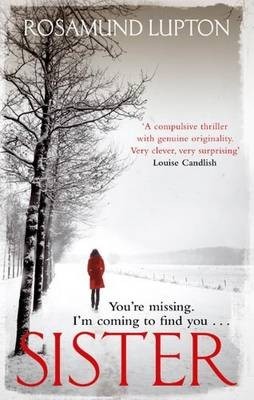
Rosamund Lupton: Sister (2010) A Great New British Thriller Writer

Nothing can break the bond between sisters …When Beatrice gets a frantic call in the middle of Sunday lunch to say that her younger sister, Tess, is missing, she boards the first flight home to London. But as she learns about the circumstances surrounding her sister’s disappearance, she is stunned to discover how little she actually knows of her sister’s life – and unprepared for the terrifying truths she must now face. The police, Beatrice’s fiance and even their mother accept they have lost Tess but Beatrice refuses to give up on her. So she embarks on a dangerous journey to discover the truth, no matter the cost.

That was a fast read. Even though this was a busy week and the novel had some 370 pages I read it in a few days. That certainly says something. I liked it a lot. The writing reminded me of Maggie O’Farrell. Should she ever choose to write a thriller, that’s what it could look like.

Sister is the story of  Tess and Beatrice, two sisters who are extremely close, even though the older one, Beatrice, lives in New York, while the younger, Tess, is still in London where she goes to an art school. When Beatrice gets the phone call from her mother saying her sister is missing she is highly alarmed and flies back to London immediately. When the sister is found dead and declared to be a suicide Bee – as her sister used to call her – is the only one who does not believe it was suicide. She is certain it was murder. And she won’t change her mind. No matter what the police, her mother or Tess’ psychiatrist say.

The story is told in part as if Beatrice was writing  a letter to her dead sister, telling her the whole story after the murderer has been found and arrested. In part she writes the letter, in part she tells the whole story to a lawyer. Consecutive flash backs. The story is also interspersed with dialogue between the sisters.  There are many red herrings as so many men who were in Tess’ life seem suspicious. The ending is quite a twist. That’s the only flaw I could find in this book. It seems a little bit artificial but then again it is not an improbable ending.

There are  many colorful characters in this novel. Art students, immigrants, doctors, scientists, policemen. The bond between those sisters is certainly the most important relationship in the book and it is very deep and moving. The story of their childhood is not an easy one which is another reason why they were so close. All through the novel Beatrice finds other people to relate to and some relationships like the one with her mother are completely transformed. Bee herself is also changed considerably. When the novel starts she is afraid of life, at the end she is ready to embrace and enjoy it.

Sister is Rosamund Lupton’s first book. The next should come out in 2011. I am already looking forward to reading it.

Ruth Rendell: A Judgement in Stone (1977)

Four members of the Coverdale family – George, Jacqueline, Melinda and Giles – died in the space of fifteen minutes on the 14th February, St Valentine’s Day. Eunice Parchman, the housekeeper, shot them down on a Sunday evening while they were watching opera on television. Two weeks later she was arrested for the crime. But the tragedy neither began nor ended there.

I discovered this novel  thanks to a suggestion from Danielle from A Work in Progress. I have read a few books of Ruth Rendell before and liked them and  I also read one she wrote under the pen name Barbara Vine but didn’t know which to read next. It is always good with prolific writers if someone can make a suggestion. I really liked A Judgement in Stone and can see why it is considered to be one of her best. It takes a very good writer to be able to captivate a reader even though the victims and the murderer are known from the very beginning. The psychological insights are absolutely convincing. Each character is so different from the other and they are all quite fascinating. Rendell adds a lot about the British class system and her description of two completely deranged women is amazing.

Because we know from the start that the main characters will be killed the book has an eery quality. It reminded me of a Greek tragedy. There is nothing to stop the course of the action.

Eunice Parchman, a middle-aged, illiterate and not very intelligent woman starts her employment with the Coverdales in summer. On Valentine’s Day she kills them. The changing of the seasons that Rendell describes with great detail adds to the feeling of the inevitable. The narrator is very present in this story, he misses no occasion to remind us, that the people he describes will meet a certain death. This reminded me of Gabriel Garcia Marquez’ Chronicle of a Death Foretold.

Eunice is not only illiterate she also lacks feelings for others. There is not the tiniest bit of empathy in this woman. Since she can’t read and sees this as a great flaw she abhors the written word and those who like to read. The Coverdales, a typical British upper class family, love to read. There are books all over their house. Eunice tries to cover up her disability as best she can and gets herself in a lot of impossible situations. One day, when running errands, she meets Joan Smith, a former prostitute who has joined some obscure Christian sect. One woman is as deranged as the other. Eunice is a cold-hearted selfish sociopath and the other a fanatic psychopath. Their alliance can only bring misfortunes.

Rendell’s  book is gripping, psychologically convincing and utterly fascinating. I’m really in the mood to read more of her books.

A Judgement in Stone has twice been made into a movie. One of them is by Claude Chabrol, La Cérémonie, starring Sandrine Bonnaire as Eunice and Isabelle Huppert as Joan.


Boileau-Narcejac: The Fiends/The Woman Who Was No More aka Celle qui n’était plus/Les diaboliques (1952)

Boileau-Narcejac, the French writer duo, are for France what Simenon is for Belgium or Agatha Christie for the UK. They are not traditional crime writers though. Solving the mystery is not the main interest when reading them. What they are famous for is the twist in the stories. The combination of the spooky with the suspense. The density of the melancholic atmosphere. Their writing is a cinematographic one. Once you open one of Boileau-Narcejac’s psychological thrillers you feel as if you were in the middle of a movie. No wonder their books were made into movies. The most famous one is certainly Hitchcock’s Vertigo that was based on their D’entre les mort/Sueurs froides aka The living and the dead.  The second most famous one is Cluzot’s Les diaboliques that was later remade starring Sharon Stone and Isabelle Adjani. It will not be easy to find English translations of their work. They are out of print, I guess. This book is no exception but it is worth trying and libraries should have them, I am sure.

Sit back, open the book and let yourself be enchanted by this atmospheric, haunting tale in which there is a lot of dense fog along dark, sparely lit piers. The lanterns illuminate the quay only barely and inside the house you see a couple, Ravinel and his lover Lucienne, planning the murder of Ravinels’s wife. They are after her life insurance. Lucienne who is a doctor has planned it carefully. They will give Murielle an anesthetic and drown her in the bath. Ravinel is a salesman. He works in Nantes but lives near Paris.  They trick Murielle into coming to Nantes, kill her and drive with her body back to Paris where  they dump her in a river. But this is only the very beginning of the story. If Murielle is dead, how come she is writing letters to Ravinel? Ravinel knows the answer. She is a ghost. Isn’t she? The second part of the story takes place in  Paris which gives the writers the opportunity for detailed descriptions of little smoky bars and cafés, old, dark houses. The way they describe a Sunday morning in a house, with all the different noises, children screaming, radios blaring and the smells of coffee and breakfast is wonderfully evocative.

There will be much more confusion in this book and the end is quite astonishing.

Boileau-Narcejac are masters of their art. If you have ever seen one of those French movies, maybe Le quai des brumes with  Jean Gabin, then you know the feel. There is a certain visual simplicity that is highly atmospherical. A solitary lamppost on an empty street, its yellow halo penetrating the fog. A lonely person in a room smoking and thinking. The pictures are simple but the feelings are complex. Their writing is economical and highly efficient at the same time.

I would really like to encourage you to discover these great writers.

Since I am not sure if I finish my German book/books for R.I.P. I count this as Peril The Third.

Celle qui n’était plus amazon.fr