Neil Gaiman – The Graveyard Book (2008) Readalong Part I

There was a hand in the darkness, and it held a knife.

The knife had a handle of polished black bone, and a blade finer and sharper than any razor. If it sliced you, you might not even know you had been cut, not immediately.

From the very first lines we are drawn into the story of the little boy Nobody Owens and the man Jack who kills his whole family at the beginning of Gaiman’s novel The Graveyard Book.  We don’t know why the man Jack kills the little boy’s family, all we know is that he isn’t happy he didn’t get the little boy as well. While he was killing Nobody’s parents and brother, the baby escapes through the door, down a hill and into the graveyard.

Mrs and Mr Owens see the little boy and Mrs Owens, although she is a ghost, feels an intense, until now unfulfilled longing  and wants to keep the baby for herself. At first there is debate. The other ghosts are not sure it is a good idea. How will she feed him? How will she take care of him? But when the man Jack arrives at the graveyard door and they become aware the baby is in great danger, they agree to protect him and keep him in the graveyard. Luckily Silas, who isn’t really a ghost but no real human either, can move between their and our world and is capable to provide food for the little boy.

In the subsequent chapters the boy who the ghosts have baptised Nobody Owens is introduced to the ways of the living and the dead. He learns to read and write, is taught history and other things, makes friends with a little girl, is abducted by ghouls.

The story as such, which is inspired by Kipling’s The Jungle Book, is not that special but the way it is told is fantastic. More than a writer Gaiman is a story-teller. He is a very musical writer with an ear for language and it’s not surprising his books work well as audio books. The sentences have a hypnotic quality, they draw you in, captivate you by their sound and their meaning alike.

What I thought was particularly great is that we know the man Jack will turn up again. We know his story isn’t over. And we don’t want it to be over. We want to find out why he killed Nobody’s family and what he will do to access the graveyard. The inhabitants of the cemetery may not be corporeal but they still have power. They were able to protect Nobody once, will they be capable to do it again?

I can’t tell you how much I like this novel. It’s wonderful, it feels as if Gaiman when he writes is connected to the very source of story telling itself. In an introduction to a short story collection Gaiman wrote that he thinks the only proof a story is well written is when the readers ask the question “What happened next?”. Gaiman certainly achieved this and much more.

I’ve bought The Graveyard Book a couple of years ago but never read it. I’m so glad it is part of this year’s R.I.P. hosted by Carl. 38 people have signed up to read along. If you want to read what other’s thought of the first 3 chapters, don’t miss visiting Carl’s blog for the other reviews.

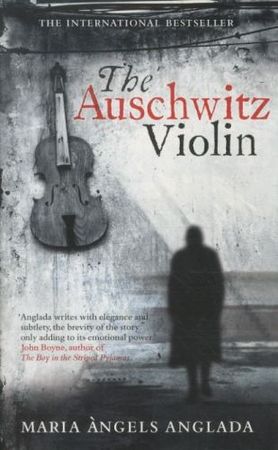
Literature and War Readalong October 2012: The Auschwitz Violin – El Violi` d`Auschwitz by Maria Àngels Anglada

Maria Àngels Anglada who died in 1999 was considered to be one of the most important Catalan writers of the 20th Century. She won many prizes and was widely read. The Auschwitz Violin – El Violi`d`Auschwitz was translated a year ago and when I saw it in a book shop I thought it’s a perfect choice. It’s slim, seems well written and tells the story of a musician and his struggle to stay human during his imprisonment in Auschwitz.

Here are the first sentences

December 1991

I always have trouble falling asleep after I perform at a concert. It keeps playing in my mind, like a tape going round and round. I was more keyed up than usual because this concert had been special: it marked the two hundredth anniversary of Mozart’s death. The recital was held in Krakow, a city of wonderful musicians, in a makeshift auditorium in the bellissima Casa Veneciana.

*******

The discussion starts on Monday, 29 October 2012.

Further information on the Literature and War Readalong 2012, including all the book blurbs, can be found here.

Wednesdays Are Wunderbar – German Literature Month Giveaway II

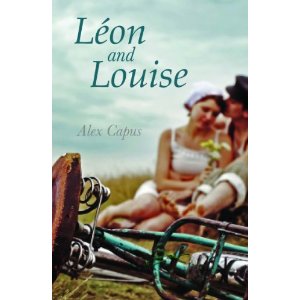
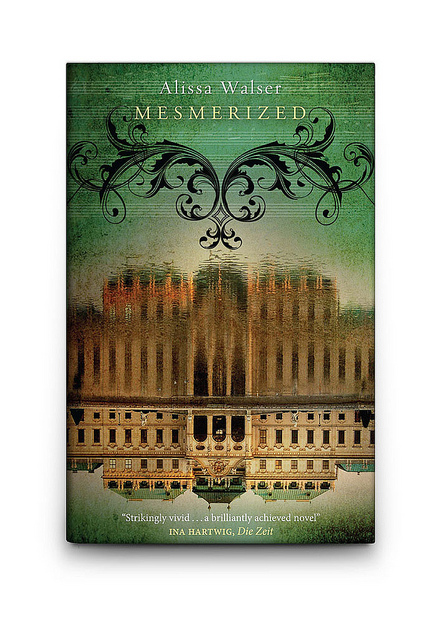
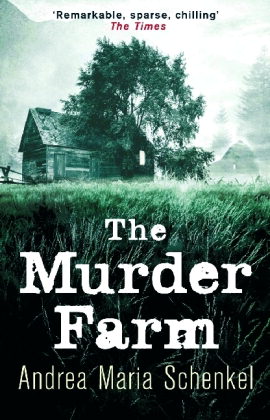
As promised here is the second giveaway of German Literature Month. While the first one was focussing on novellas and literary books, this one combines literary books and genre. Alissa Walser’s novel is clearly historical, it still is a literary novel, the same goes for Léon and Louise and Love Virtually, both are love stories but not pure genre. Things are different when it comes to Andrea Maria Schenkel. Hers is a crime novel, no doubt. One of the most interesting new German genre writers is Zoran Drvenkar who writes a lot of different genres. Thriller, YA, children’s books and many more. The book I’ve chosen is a genre blend which is extremely successful in Germany among adults and young adults alike.

I’d like to thank Haus Publishing for offering Léon and Louise and MacLehose Press for Alissa Walser’s novel Mesmerized. Lizzy is offering Love Virtually and Grimm’s Fairy Tales and I’m contributing The Murder Farm and Tell Me What You See.

I hope the blurbs will help you decide which of the books you would like to win.

Love Story

Alex Capus – Léon and Louise

Summer 1918. The First World War is drawing to a close when Léon Le Gall, a French teenager from Cherbourg who has dropped out of school and left home, first meets and falls in love with Louise Janvier. Severely wounded by a German artillery attack they are separated, both mistakenly believing each other to be dead. Ten years later, while travelling on the Paris Métro, Léon – now married – briefly catches sight of a girl who bears a strong resemblance to Louise, the first love he has never forgotten. He goes in search of her at the insistence of his wife Yvonne. The couple are briefly reunited, but part again with a heavy heart as Louise refuses to destroy Léon’s marriage. And then another war tears them apart. Paris is occupied by the Germans, for whom Léon indirectly works at the headquarters of the Paris CID. Louise, an employee of the Banque de France, is shipped off to French West Africa with the bank’s gold reserves. Narrated by Léon’s grandson, Léon and Louise is the story of an enduring passion that survives the vicissitudes of world history and the passage of time, spanning more than forty years. But it is far more than this. The long-separated lovers are flesh and blood characters vividly captured in complex human relationships and real-life situations: in German-occupied Paris, where Léon wages a lone battle against the abhorrent tasks imposed on him by the SS and his wife fights stubbornly for her family’s survival; and in the wilds of Africa, where Louise confronts the hardships of her primitive environment with courage and humour.

Daniel Glattauer – Love Virtually

It begins by chance: Leo receives emails in error from an unknown woman called Emmi. Being polite he replies, and Emmi writes back. A few brief exchanges are all it takes to spark a mutual interest in each other, and soon Emmi and Leo are sharing their innermost secrets and longings. The erotic tension simmers, and it seems only a matter of time before they will meet in person. But they keep putting off the moment – the prospect both unsettles and excites them. And, after all, Emmi is happily married. Will their feelings for each other survive the test of a real-life encounter?

Historical

Alissa Walser – Mesmerized

Mozart’s Vienna. A crucible for scientific experimentation and courtly intrigue, as Europe’s finest minds vie for imperial favour. In a colourful, chaotic private hospital that echoes with the shrieks of hysterical patients, Franz Anton Mesmer is developing a series of controversial cure-alls for body and mind. When he is asked to help restore the sight of a blind musical prodigy favoured by the Empress herself, he senses that fame, and even immortality, is within his grasp. Mesmer knows that he will have to gain her trust if he is to open her eyes. But at what cost to her fragile talent? And will their intimacy result in scandal?

Crime

Andrea Maria Schenkel – The Murder Farm

A whole family has been murdered with a pickaxe. They were old Danner the farmer, an overbearing patriarch, his put-upon devoutly religious wife, and their daughter Barbara Spangler, whose husband Vincenz left her after fathering her daughter, Marianne. Also murdered was the Danners’ new maidservant, Marie, who was regarded as slightly simple. Despite the brutal nature of the killings and the small village where it has taken place, the police have no leads. Officially the crime is unsolved. And then a former resident returns home… The Murder Farm is an unconventional detective story. The author interweaves testament from the villagers, an oblique view of the murderer, occasional third-person narrative pieces and passages of pious devotion. The narrator leaves the village unaware of the truth, only the reader is able to reach the shattering conclusion.
 

Fairy Tales

The Brothers Grimm – Fairy Tales

Is a collection of well-loved fairytales by the brothers Grimm. Stories include Hansel and Gretel, Tom Thumb, Little Red Riding Hood, Sleeping Beauty, Rumpelstiltskin, Snow White, the Frog Prince, Rapunzel, The Elves and The Show Maker and many more.
 

YA/Horror/Ghost story

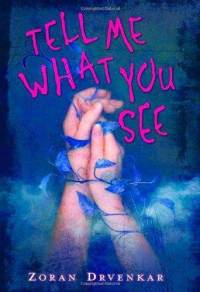
Zoran Drvenkar – Tell Me What You See

Berlin. The dead of night. Sixteen-year-old Alissa and her best friend Evelin make their secret Christmas pilgrimage to Alissa’s father’s grave. In the graveyard, Alissa falls through thick snow into an underground crypt. Searching for a way out, she discovers something else: out of the lid of a small coffin coils a strange black plant. Drawn closer, Alissa sees its roots embedded in a young child’s heart. This chance encounter sets off a chain of nightmarish events that throw her life into turmoil. Haunted by angels, stalked by her ex-boyfriend, only with Evelin’s help can Alissa reclaim her sanity and discover the truth about her frightening new gift.
 
*******
If you are interested in any of the books, just leave a comment indicating which one(s) you would like to read.

The competition is open internationally. The winners will be announced on Wednesday October 10 2012.


Patricia A. McKillip: Solstice Wood (2006)

No stranger to the realms of myth and magic, World Fantasy Award-winning author Patricia A. McKillip presents her first contemporary fantasy in many years-a tale of the tangled lives mere mortals lead, when they turn their eyes from the beauty and mystery that lie just outside of the everyday…

Patricia A. McKillip is one of the most renowned fantasy writers and rightly so as she combines great stories with refined writing. Last year I’ve read her Winter Rose and was quite enchanted by its mysteriously poetic qualities. Winter Rose is a typical fantasy novel regarding the setting. It depicts a time long gone and a pre-industrialized society. When I found out that she had not only written a sequel but that she had set it  in modern times, something she normally doesn’t, I was very curious to read it. Solstice Wood takes place many decades, even centuries after Winter Rose and apart from the setting and some elements, I’d say the two books do not have a lot in common. The style is very different and you could say, they really are stand-alones with a few common traits.

Sylvia grows up with her grandmother. Her mother has died when she was still little and she doesn’t know who her father is. When she finds out that she is half fey, she flees from Lynn Hall and settles in a big city where she becomes a book shop owner. She never wants to return as there is one thing her grandmother hates and tries to keep at bay and that are fairies. When she gets a call informing her of the death of her grandfather she is very reluctant but eventually gives in and flies back home for the funeral. Her aunt and her cousin Tyler are there, as are her grandmothers’ brother and her grandmother Iris.

She feels like a stranger but at the same time she is happy she gets to see her friends again. She would never have left them if it hadn’t been for her secret an only now she becomes aware how much she missed them. Still Sylvia is really anxious and wants to fly back right after the funeral but strange things happen. It seems that the dark wood forces, guided by the queen of the fairies, are about to break loose. Her grandmother, together with a dozen other women, is part of a fiber guild. The magical quilt they are crocheting has the power to keep the two worlds well separated. When Tyler is suddenly replaced by a changeling and the women find out the web of their quilt is about to unravel and the worlds are merging, it’s about time, everyone gets active. For some of them that means entering the Otherworld. The big question is whether they will all survive and if they will, whether they will admit that some of them, not only Sylvia, are not just humans.

I liked Solstice Wood, it’s well written and the way McKillip describes how the worlds merge is interesting. I enjoyed the idea of the fiber guild. What worked very well too is that you can interpret the world of the fairies as anything which feels strange and unfamiliar. The book offers an interesting variation on the themes of prejudice and bias. The more the worlds touch, the more the people get to know the other side, the less it’s frightening. In the end it’s all a matter of being open.

I liked to read a contemporary fantasy novel by McKillip. It’s a lovely and quick read, no big suspense or anything, much more a family story with a fantasy touch.

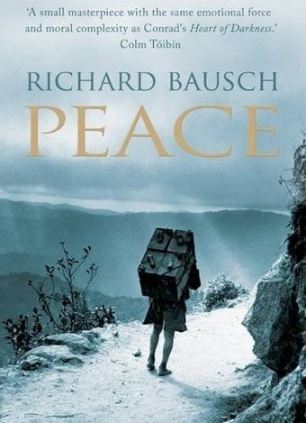
Richard Bausch: Peace (2008) Literature and War Readalong September 2012

Richard Bausch’s Peace (2008) is set in Italy during WWII. An American  recon squad comes upon a group of people and a cart. A German officer and a German prostitute are hiding on the wagon. When they turn it around, the German officer opens fire and kills two of the young American soldiers. Corporal Marson shoots him, while Sergeant Glick shoots the woman in the head.

It’s the end of WWII and German troops are retreating but not without trying to take down anyone they can with them. The mountains are hostile territory, it’s cold and it rains constantly. The little troop of men is demoralized. The life of a recon squad is usually very dangerous, they have to find out where the German line is and might accidentally already be behind the lines. After the shooting of the officer and the whore, three of the men are sent on recon again. Sgt Marson, Ash and Joyner. On their way they meet Angelo, a frail and very old Italian man and force him to guide them.

Marson, Ash and Joyner are as different as three people can be. Marson is the oldest, he’s 26, married and has a child. Joyner and Ash are 20. Ash seems to be deeply traumatized by something he experienced in Africa and which wakes him every night. He seems to be a good sort but starts to annoy Marson because he wants to denounce Glick. The murder of the prostitute has shocked him and he thinks Glick should be brought to justice. While Marson agrees with him, he feels it’s not the right time and he has problems of his own. They are on a very dangerous recon mission, it’s very cold and raining. They don’t know where they are and have to rely on a man he doesn’t completely trust. Many of the Italians have surrendered, many never really participated but there are still a lot of fascists who would gladly kill them. Plus he fights a battle with his conscience. Before shooting the German officer he had never killed anyone up close and the memory of it makes him sick. Tensions between the four people would be high anyway but Joyner is an aggressive bigot, anti-Jews, anti-Communists, anti-drinking. But swearing and abusing people constantly which is a huge contradiction.

Matters get even worse when it starts snowing and they hear shots. They find a dead German and later hear more shots coming from a village where, as the old man explains, Jews are being executed.

The three men are really tested and have to go to their limits. They fight the cold, are in enemy territory, traumatized by what they have seen so far and by their conscience.

I must honestly say I was not too impressed with this book. It’s told in chapters alternating between the past of the three men, what they had experienced in Palermo and their actual recon mission. The central conflict or theme, drawing the line between justified killing and murder, is shown but it didn’t move me. The book exemplifies how much it meant for soldiers to kill, it underlines that in WWII shooting someone from up close was in no way common and could cause a huge problem, triggering moral conflicts. Unfortunetly I never felt that conflict.

It’s hard to say why this book did so not work from me. I felt Bausch wanted to tell a story that wasn’t his and I suspect he watched a few movies in order to get a feel for what it was like but ultimately I felt he couldn’t make this story his and tell it in a moving way. In this it reminded me of Coventry but looking back I’d say, I liked that much more.

I’m aware this is a bit of an uninspired review but I’m really unfazed by this book.

I hope others did read along. I’m very interested to hear their thoughts.

Other reviews

Danielle (A Work in Progress)

Victoria (creativeshadows)

*******

Peace was the ninth book in the Literature and War Readalong 2012. The next one will be Maria Angels Anglada The Auschwitz Violin – El violí d’Auschwitz. Discussion starts on Monday 29 October, 2012.

Wednesdays Are Wunderbar – German Literature Month Giveaway I

Those who followed German Literature Month last year know that Wednesdays are wunderbar because they are giveaway days!

This year we are splitting the giveaways into two batches. The first, this one, is a goody bag designed to complement the first half of the month during which we’ll be reading novellas and literary novels. It’s hosted by Lizzy, so if you are interested in winning one of the following books, make sure to visit her blog soon.

The first two novellas are courtesy of Pushkin Press, the next two are offered by Haus Publishing. The only novel among the titles,  The Bridge of the Golden Horn, is my contribution.

Burning Secret – Stefan Zweig (1913)
Set in an Austrian spa where a lonely twelve-year-old is befriended by a charming and enigmatic baron. As the boy gradually becomes infatuated with him, the older man heartlessly brushes him aside to turn his seductive attention to the boy’s mother.

Fear – Stefan Zweig (1913)
Irene Wagner has been married for eight years and is tired of her bourgeois and predictable existence as wife and mother. She starts an affair with an up-and-coming young pianist but finds herself being blackmailed by her lover’s former mistress. Irene is soon in the grip of an astonishing fear.

A Minute’s Silence – Siegfried Lenz (2009)
The delicately paced structure of Lenz’s novella begins with the memorial ceremony for a popular young English mistress, Stella Petersen, seamlessly alternating between this scene and eighteen-year-old Christian’s memory of a summer love affair with his tutor. They keep their mutual attraction concealed at school and as the season goes on the lovers continue to meet discreetly. Tragedy strikes when Stella goes on holiday with friends, sailing around the Danish islands. As the yacht returns to Hirtshafen at the end of the trip, a storm breaks. Before Christian’s eyes his beloved is flung overboard and fatally wounded. Lenz was twenty or thirty pages into writing A Minute’s Silence when his wife of fifty-six years died. Grief-stricken, he suffered from a serious bout of writer’s block and it seemed he would never finish the novel. With the passage of time, Lenz found that he could write again and complete this tender love story. Despite the obvious distance and difference of Lenz’s own long marriage and the brief, youthful passion of Christian for Stella, Lenz has wrought a well-aimed response to Auden’s famous request: ‘Tell me the truth about love.’

On the Edge – Markus Werner (2004)
When the cynical divorce lawyer Thomas Clarin finds himself at a table on the terrace of the Bellavista Hotel beside Thomas Loos, an eccentric, ageing philologist, hey strike up an unlikely conversation. Soon Clarin’s questions tease out stories from Loos’ past, and as both men slowly reveal more of themselves they are forced to question their opinions on love and life. The men are opposites; they intrigue and repel each other. But as the mystery of Loos’ past deepens, we begin it wonder if all as it seems.

The Bridge of the Golden Horn – Emine Sevqi Ozdamar (2002)
The Bridge of the Golden Horn is a coming-of-age novel, a sentimental education that is also a political, cultural and intellectual one. In 1966, at the age of 16, the unnamed heroine lies about her age and signs up as a migrant worker in Germany. She leaves Istanbul, works on an assembly line in West Berlin making radios, and lives in a women’s factory hostel. But this novel is not about the problems of assembly line work – it’s a witty, picaresque account of a precocious teenager refusing to become wise, of a hectic four years lived between Berlin and Istanbul, of a young woman who is obsessed by theatre, film, poetry and left-wing politics. These are sometimes grim years, particularly in Turkey, but they also have a hope and optimism that seem almost unimaginable today.

*******

Now all you have to do is visit Lizzy’s blog.

The competition is open internationally.

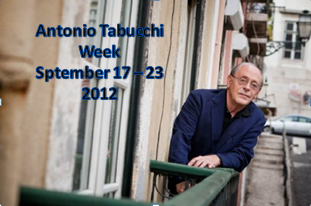
Antonio Tabucchi Week – Wrap Up

Tabucchi Week is already over and I wanted to thank all of you who joined, read along, wrote reviews, commented and read other’s posts. I’m really happy that it was quite interactive and people visited each other’s blogs. There were quite a few very interesting discussions. I’m also happy that those who joined who didn’t know Tabucchi found an author whose work they want to continue exploring and those who knew him felt like returning to an old friend. I enjoyed the two books I chose a great deal and I’m also glad that I have discovered a few new blogs.

What I also loved was that many of the posts showed how wide Tabucchi’s range is and that everyone can find something else in his books. Quite a few people have read Pereira Maintains but every single post was completely different and highlighted other things, something I’ve rarely noticed when many people read the same novel.

Once more – Thank you so much for participating.

Below are all the participant reviews again (they are also in the intro post). In a few days I’ll set up a page which will allow to find the posts more easily. I’m pretty sure this isn’t the last author week I’ve hosted and knowing that I like a bit of a theme the next week will most probably also be dedicated to an Italian writer. No worries, though, not before next year.

It’s Getting Later All the Time – Brian (Babbling Books)

On Dreams of Dreams – Tom (Wuthering Expectations)

Pereira Declares – Judith (Reader in the Wilderness)

Pereira Maintains – TBM (50 Year Project)

Pereira Maintains – Vishy (Vishy’s Blog)

Pereira Maintains – Bettina (Liburuak)

Pereira Maintains – Andrew Blackman

Piazza d’Italia – Scott (seraillon)

Requiem – Caroline (Beauty is a Sleeping Cat)

The Edge of the Horizon – Caroline (Beauty is a Sleeping Cat)

The Flying Creatures of Fra Angelico – Stu (Winstons Dad’s Blog)

The Last Three Days of Fernando Pessoa with Bonus Lobster Recipe – Tom (Wuthering Expectations)

The Missing Head of Damasceno Monteiro – Richard (Caravana de Recuerdos)

Vanishing Point -1streading

Pereira Maintains (Book and Movie) and Requiem – Scribacchina (Parole/Words)